Daniel 3 — Faith Under Fire
Source: Christian Virtual Fellowship — Book of Daniel series (taught by Dustin Smith)
1. A Story About Daniel’s Friends, Not Daniel
Despite sitting inside the book that bears his name, Daniel 3 is not actually about Daniel — Daniel never appears in it. The spotlight falls entirely on his three friends, Shadrach, Meshach, and Abednego, and their commitment to faithfulness even while facing punishment and death, with no guarantee that God would step in to save them. It’s a pattern that repeats through every chapter of Daniel so far: those who remain faithful to God in a foreign, hostile empire — even without knowing whether they’ll be vindicated — end up rewarded and exalted.
The title of this teaching, “Faith Under Fire,” is a deliberate pun: these three men were quite literally saved from fire because of their faithfulness.
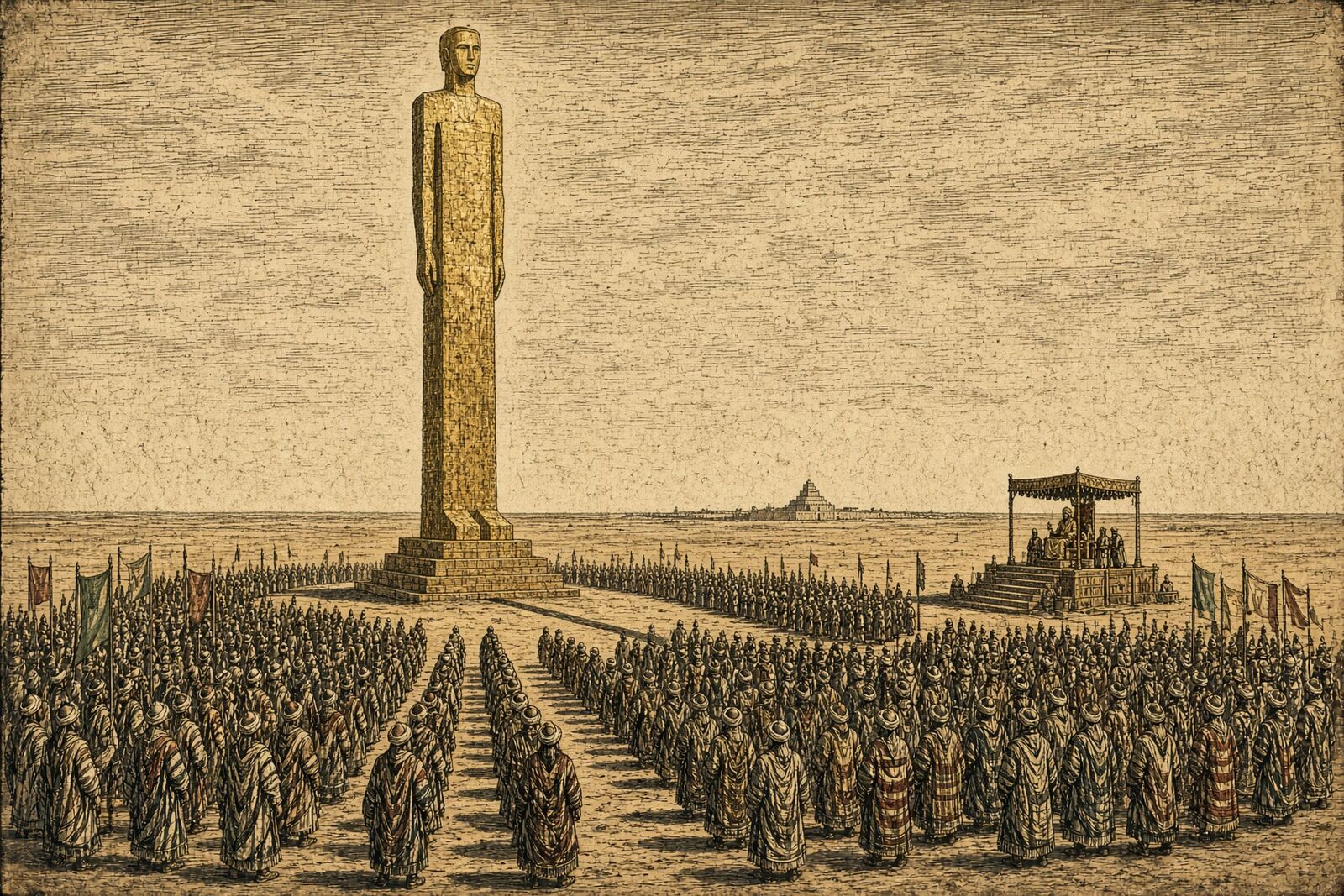
Nebuchadnezzar erects a golden image and commands that everyone — at the sound of an entire orchestra of instruments — fall down and worship it or be thrown into a blazing furnace. Everyone complies except three Jewish officials, who are denounced by Chaldean rivals, hauled before the king, and given one more chance to comply before execution. They refuse. Nebuchadnezzar has the furnace heated seven times hotter than normal and has them bound and thrown in — so hot that the soldiers who carry them in are killed by the flame. Yet the three walk unbound and unharmed inside the fire, joined by a fourth figure. Nebuchadnezzar calls them out, inspects them (not even the smell of smoke is on them), blesses their God, decrees protection for anyone who speaks against that God, and promotes all three within the province of Babylon.
The text is not subtle about Nebuchadnezzar’s arrogance. Not content with merely being “the head of gold” in the statue he saw in his dream in chapter 2, he now builds an entire statue made of gold — 60 cubits tall by 6 cubits wide. Since a cubit is roughly a foot and a half, that’s a 90-foot-tall, 9-foot-wide statue — a 10-to-1 height-to-width ratio. Most artistic depictions render the statue with normal human proportions, but a true 10:1 ratio would look bizarre and exaggerated — which is exactly the rhetorical point: it’s meant to look absurdly, ostentatiously grand.
The list of officials summoned (satraps, prefects, governors, counselors, treasurers, judges, magistrates, and rulers of the provinces) works out to seven categories of officials — a detail worth noting alongside the furnace being heated seven times hotter than normal, echoing the kind of numerical patterning (“seven” as a number of completeness) that shows up again later in apocalyptic literature like Revelation.
3. A Linguistic Clue to the Story’s Date
Although Daniel 3 is written in Aramaic, many of the titles for Nebuchadnezzar’s officials are borrowed from Persian, and several of the instrument names in the royal orchestra (horn, flute, lyre, trigon, psaltery, bagpipe) are Greek loanwords transliterated into Aramaic. This orchestra also sounds nothing like what we know of temple worship music in Jerusalem. To many scholars, this vocabulary suggests the chapter’s final written form dates later than the sixth century BC, since these particular Persian and Greek terms wouldn’t have existed yet in Nebuchadnezzar’s own era. This is a side observation, not a major point of the lesson — but it doesn’t diminish the story’s power to inspire faithfulness regardless of when it was ultimately written down.
4. Where Was Daniel?
Only Shadrach, Meshach, and Abednego are named as refusing to worship the image — raising the obvious questions: did the rest of the Jewish exiles comply? And where is Daniel in all of this?
There’s no indication in the text that Daniel or other Jews compromised. Daniel 3 reads as a self-contained story — it could stand alone as its own short book and lose nothing of its impact. It’s simply a story about these three men specifically. It would be uncharitable to assume Daniel’s absence means he disobeyed; even faithful people of God sometimes falter under pressure (Peter denied Jesus three times), but the text gives no basis to conclude that’s what happened here. The narrative simply chooses to honor these three by name.
5. “Even If He Does Not” — Their Answer to the King
When Nebuchadnezzar demands to know “what god is there who can deliver you out of my hands,” it’s a doubly arrogant question — he not only assumes no god rivals Babylon’s gods (since, in his thinking, the Babylonian gods had already defeated Israel’s God by allowing the exile and the destruction of the Jerusalem temple), he has also apparently forgotten that just one chapter earlier he personally confessed that Daniel’s God revealed the meaning of his dream to him.
The three friends answer together, and their reply carries a careful, two-part theology:
“Our God whom we serve is able to deliver us from the furnace of blazing fire, and He will deliver us out of your hand, O king. But even if He does not, let it be known to you, O king, that we are not going to serve your gods or worship the golden image that you have set up.”
Their commitment to obedience does not hinge on a guaranteed rescue. First, they affirm that God is able to deliver them, and — in this case — He does. But their obedience was never contingent on that outcome; they were prepared to disobey the king and die rather than compromise, even if deliverance never came. Sometimes God intervenes and rescues His people in the moment; sometimes that vindication is delayed until the day of judgment and the resurrection — some people genuinely are martyred. Either way, their commitment to faithfulness remains the same.
6. The Fourth Man in the Fire
When the fire fails to harm them, Nebuchadnezzar sees a fourth figure inside the furnace and describes his appearance as “like a son of the gods.” Older translations (notably the King James Version) render this with a definite article — “the Son of God” — implying the pre-incarnate Jesus. But modern translations correctly drop the article: this is a son of the gods, not the Son of God. Jesus was not yet born at this point in the story, and Jesus is not an angel.
The phrase parallels the Hebrew bene elohim (“sons of God”), used in Genesis 6 and in the opening chapters of Job to refer to heavenly messengers — angels, God’s envoys, not deities in their own right. Nebuchadnezzar himself clarifies the identity a moment later, calling the figure “his angel” sent by God to deliver His servants. This fits a pattern that continues through the rest of Daniel: God repeatedly sends angels to intervene on behalf of His faithful people.
7. Vindication
When the three emerge from the furnace unbound, unsinged, and without even the smell of smoke on them, Nebuchadnezzar blesses “the God of Shadrach, Meshach, and Abednego,” decrees that anyone who speaks against that God will be torn limb from limb, and promotes all three within the province of Babylon. It’s the same pattern seen throughout Daniel: those who remain faithful under threat are, in the end, rewarded — even though nothing in the story guaranteed that outcome in advance. This is also the last appearance of these three men in the Book of Daniel; they didn’t need to reappear in every chapter for their faithfulness to be permanently recorded.
8. Daniel 3 and the Maccabean Crisis
The original readers of Daniel were most likely Jewish believers in the second century BC, wrestling with how to respond to the tyrannical reign of Antiochus IV Epiphanes and the events leading to the Maccabean Revolt (roughly 171–164 BC): compromise with the overwhelming power of the Greek regime, take up arms in violent revolt, or find a faithful middle path that neither compromises nor resorts to violence.
1 Maccabees 1:54–63 records what that period actually looked like:
An abomination of desolation was erected on the altar of burnt offering; the book of the law was torn up and burned; anyone found possessing a copy of the covenant, or who adhered to the law, was condemned to death by royal decree; women who had their infants circumcised were executed along with their families, the infants hung around their mothers’ necks; and many in Israel chose to die rather than eat unclean food or profane the holy covenant.
The parallels to Daniel 3 are unmistakable: a pagan image erected, a royal decree demanding compliance, and a faithful remnant willing to die rather than disobey God. What stands out is that Shadrach, Meshach, and Abednego do not pick up weapons or start a revolt against Nebuchadnezzar — they simply refuse and trust God with the outcome. Readers living through the Maccabean crisis would have drawn courage and resolve from this story to choose death over profaning the covenant, just as 1 Maccabees describes. Not all of them were vindicated within their own lifetimes — many were martyred — which is part of why the Book of Daniel ultimately ends, in chapter 12, with the promise of resurrection as God’s final means of vindicating the faithful.
9. Four Applications for Today
| # |
Principle |
Description |
| 1 |
Faith requires faithfulness |
If we claim faith in Jesus and his gospel of the kingdom, it must result in faithfulness to his teachings — even with consequences. This calls for a resolute commitment to understand God’s will and courage in the face of opposition. |
| 2 |
Teach it as basic, not advanced |
Doing what is right even when everyone else is doing wrong is a core part of the Great Commission’s call to “teach them to observe all that Jesus commanded.” It should be passed on from parents to children, from leaders to followers, and among believers as foundational — not advanced or “super-spiritual” — teaching. |
| 3 |
Support those who suffer for faithfulness |
When someone in the Christian community suffers for taking a faithful stand, we should offer them comfort, love, and support — since the point of persecution is to break a person’s resolve, and community support helps sustain it. |
| 4 |
Vindication may be delayed |
Sometimes God intervenes to rescue the faithful in the moment; sometimes that intervention is delayed until the resurrection on the day of judgment. Our faith must not collapse if God chooses to wait to vindicate us — just as Jesus’s faith did not collapse when God did not rescue him from the cross, but vindicated him instead through resurrection. |
Summary
| Is |
Is Not |
| A story about Daniel’s three friends, not Daniel himself |
Evidence that Daniel or other Jews compromised |
| A model of obedience not contingent on a guaranteed rescue |
A promise that faithfulness always produces immediate deliverance |
| A vision of a heavenly angel (“a son of the gods”) sent to deliver the faithful |
An appearance of the pre-incarnate Jesus |
| A story that shaped faithful, non-violent resistance during the Maccabean crisis |
A call to armed revolt against unjust rulers |
| A pattern of vindication — sometimes now, sometimes at the resurrection |
A guarantee that vindication always comes within this lifetime |
“Our God whom we serve is able to deliver us from the furnace of blazing fire… but even if He does not, let it be known to you, O king, that we are not going to serve your gods or worship the golden image that you have set up.”