Daniel 1 — Faithful Amidst Tragedy
Source: Christian Virtual Fellowship — Book of Daniel series (taught by Dustin Smith)
1. A Story Built on Every Excuse to Quit
Daniel and his three Jewish friends had every reason to walk away from God. By the time this chapter opens, it could appear that God himself had been unfaithful: a foreign nation has conquered Israel, the Davidic kingship — the line from which the promised Messiah was to come — has been suspended, the Jerusalem temple (where God was believed to dwell) has been plundered, and God’s people have been ripped from the land promised to Abraham, Isaac, and Jacob and dragged into a pagan empire.
And yet these four young men chose loyalty, obedience, and faithfulness anyway — and God rewarded them for it.
“God has not abandoned them, even though there has been a terrible religious and cultural tragedy that has taken place. God continues to be with his people even when it seems that all hope is lost.”
That is why this chapter earns the title Faithful Amidst Tragedy — and why it has spoken to generations of readers who found themselves in similarly desperate circumstances.
2. The Story at a Glance (Daniel 1:1–21)
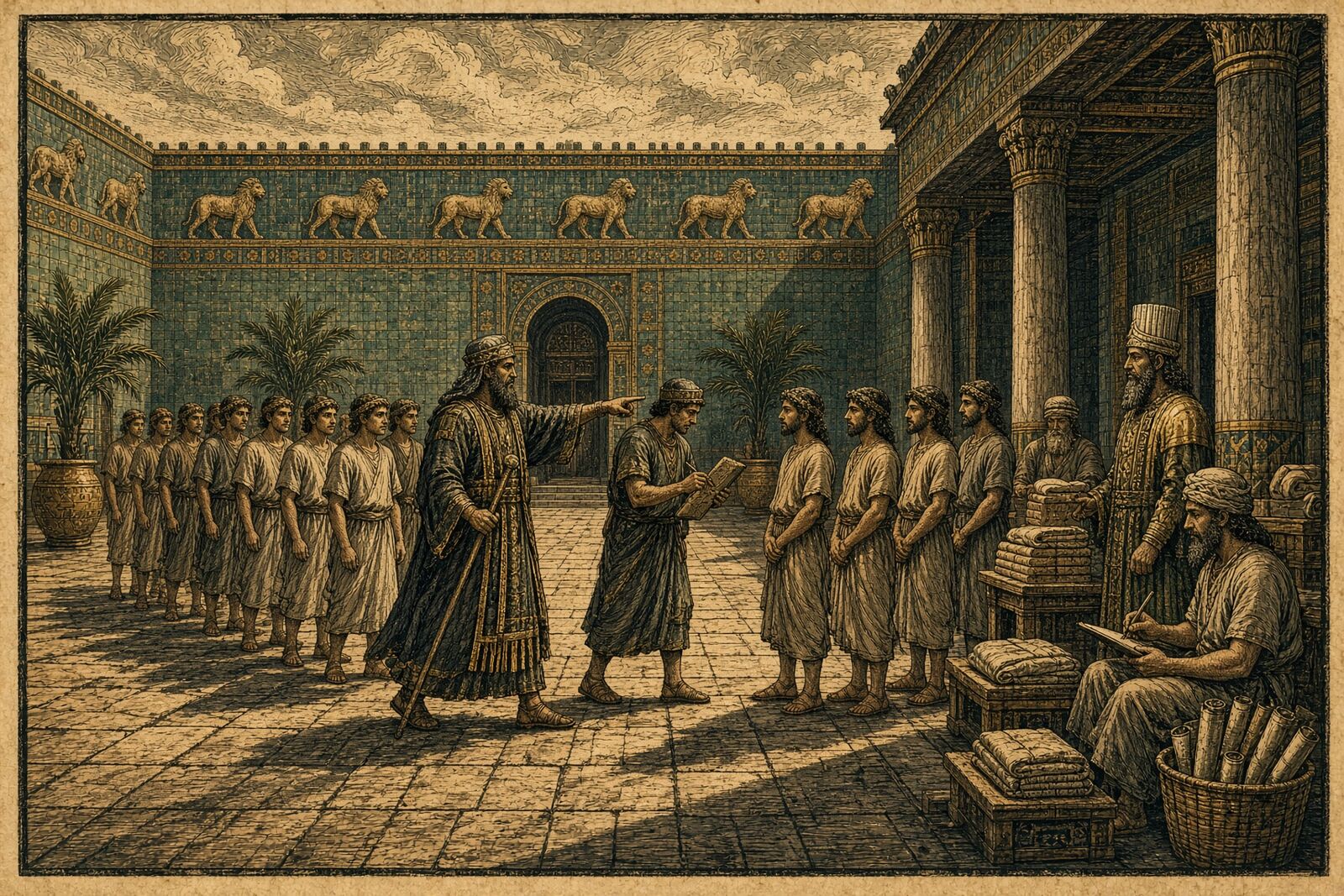
- Nebuchadnezzar besieges Jerusalem, carries off temple vessels, and selects promising young men of Judah’s royal family and nobility — including Daniel, Hananiah, Mishael, and Azariah — for a three-year Babylonian re-education program.
- The four are renamed with Babylonian names and assigned the king’s own food and wine.
- Daniel resolves not to defile himself with the royal food and requests a ten-day trial of vegetables and water instead.
- After ten days, the four appear healthier than the youths eating the king’s food, so the steward lets them continue on the simple diet.
- God gives all four wisdom and understanding; Daniel is additionally given insight into visions and dreams.
- At the end of their training, Nebuchadnezzar finds them ten times better than all the magicians and enchanters in his kingdom.
- Daniel remains in royal service all the way until the first year of King Cyrus — outliving the entire Babylonian empire.
What begins as a religious, cultural, political, and theological catastrophe ends in dramatic reversal: the exiles are exalted, and the “invincible” empire that defied the God of Israel does not even outlast one of its own captives.
3. Setting the Historical Stage — From Nebuchadnezzar to the Maccabees
Understanding Daniel 1 requires understanding the centuries of history it sits inside — both the sixth-century exile it narrates and the second-century crisis its final form was written to encourage.
| Date (BC) |
Event |
| 606 |
Daniel 1:1’s stated setting — “the third year of Jehoiakim” (see Section 4 for the difficulty this creates) |
| 605 |
Nebuchadnezzar II becomes king of Babylon; Jeremiah instead dates this to Jehoiakim’s fourth year |
| 597 |
Nebuchadnezzar II captures Jerusalem; Judah’s kings become Babylonian vassals |
| 587 |
After Judah allies with Egypt and revolts, Babylon destroys Jerusalem and the temple — the exile proper begins |
| 539 |
Cyrus of Persia conquers Babylon; Daniel lives to see this transition |
| 333 |
Alexander the Great defeats Persia; control of Judea passes to the Greeks |
| ~323 |
Alexander dies without an heir; his empire is divided among four generals — Seleucus takes the north, Ptolemy takes Egypt and Palestine |
| 320 |
Ptolemy secures control of Israel and Egypt, founding the Ptolemaic dynasty (still Greek) |
| 200 |
Antiochus III of the Seleucid (Syrian Greek) dynasty defeats Egypt and takes control of Israel |
| 171 |
A faction of Jews enters a covenant asking Antiochus IV to Hellenize Judaism — the Jews’ own initiative |
| ~167 |
Antiochus IV desecrates the temple, erecting an altar to Zeus Olympios — this ignites the Maccabean Revolt |
| ~164 |
Jews regain national independence for the first time since 597 BC — roughly 400 years — and hold it for about a century, until Rome arrives |
The final form of Daniel was being read by a community living through that Antiochus IV crisis in the 160s BC — a detail that shapes how the whole book, and especially its calls to faithful, non-compliant resistance, would have been heard.
4. A Puzzling Opening Verse — Literary Purpose, Not Precise History
Daniel 1:1 dates Nebuchadnezzar’s siege to “the third year of the reign of Jehoiakim,” which lands on 606 BC. But Nebuchadnezzar was not actually made king until 605 BC, and Jeremiah dates his conquest to Jehoiakim’s fourth year — a year later than Daniel’s own opening verse suggests.
Rather than force the numbers to align, the honest reading is that verse 1 is doing literary work rather than precise chronological work: it establishes that Nebuchadnezzar besieged Jerusalem, plundered the temple, and brought the exiles to Babylon — setting the stage for the story about to unfold — without functioning as an exact historical marker.
5. Indoctrination on Every Front — Names, Language, and Food
Babylon’s assimilation program targeted every layer of Jewish identity at once. The four young men were to be:
- Taught Babylonian literature and language (“the Chaldeans”) for three years
- Fed the king’s own food and wine, breaking Jewish food laws that marked out the Jewish people (no pork, no shellfish)
- Given new theophoric names — names with a god’s identity embedded in them — replacing names that honored the God of Israel with names honoring Babylonian gods
Even the setting is loaded: the exiles are brought to “the land of Shinar,” a Jewish derogatory term for Babylon, not a neutral geographic label.
| Hebrew Name |
Meaning |
Babylonian Name |
Meaning (some uncertainty) |
| Daniel |
“God (El) is my judge” |
Belteshazzar |
Possibly “protect the life of the prince”; contains Bel, Babylon’s most prominent god |
| Hananiah |
“Yahweh has been gracious” |
Shadrach |
Possibly “the command/word of Aku”; contains the god Aku |
| Mishael |
“Who is what God (El) is” |
Meshach |
“Who is what Aku is”; contains the god Aku |
| Azariah |
“Yahweh has helped” |
Abednego |
“Servant of Nebo” (also Nabu); Nego is an alternate form of Nebo, Abed is a Semitic word for “servant” |
The renaming is deliberate: strip out the God of Israel from a person’s identity and replace him, name by name, with the gods of the empire.
6. “Daniel Made Up His Mind” — Faithfulness as a Choice
Against this full-court assimilation effort, Daniel 1:8 says simply: Daniel made up his mind that he would not defile himself.
This is emphasized as Daniel’s own deliberate choice, not something predetermined for him — he decides, in the middle of the loss of land, kingship, and temple, that he will remain loyal to the God of Israel and trust God to work it out.
“Even though I’m no longer in my land, even though I have no idea when this Messianic King is going to come, even though these people have destroyed God’s dwelling place… I’m making up my mind that I’m going to be loyal, faithful, and obedient to the God of Israel, because I trust that he’s going to take care of me in the end. I don’t know how it’s going to happen, but I trust him.”
Two features of Daniel’s resistance stand out:
- It is entirely non-violent. Daniel doesn’t take up arms or organize a revolt against Babylon — he simply requests permission for an alternative.
- It works through negotiation, not confrontation: a ten-day trial of vegetables and water — a “trial by diet” (a forerunner of the later “trial by fire” elsewhere in the book).
After Daniel resolves not to defile himself, “God granted Daniel favor and compassion” — in Hebrew, terms (chesed among them) that describe God’s covenant faithfulness toward his obedient people, not mere personal fondness. The pattern: Daniel commits to faithfulness first, and God responds with covenant loyalty in return.
7. The Theme of Reversal
The chapter’s structure is built on reversal. Exiles with no earthly hope choose faithfulness and are promoted into the highest ranks of Nebuchadnezzar’s own royal court — found “ten times better” than every magician and enchanter in the realm, not merely a notch above them.
The reversal extends to the empire itself: Nebuchadnezzar, the king who plundered God’s temple and defied the God of Israel, does not last. Daniel outlives him — and outlives Babylon altogether, remaining in service into the reign of Cyrus of Persia, the empire that conquers Babylon. The nation that looked invincible and unstoppable simply doesn’t endure; the exiled man of God does.
This is also placed in tension with how vindication doesn’t always arrive on the same timetable. In Daniel’s story, the reversal happens within his own lifetime — but that isn’t always how it goes for God’s faithful people. Jesus himself had to die as a martyr before being vindicated, exalted, and rewarded. Sometimes God intervenes within a lifetime, as with Daniel; sometimes his people must trust that vindication will come at the resurrection.
8. Reading Daniel Through Maccabean Eyes
Daniel’s final form was addressed to Jews living through the Hellenistic crisis of the 160s BC, and 1 Maccabees 1 supplies the historical backdrop those original readers would have recognized immediately:
- A faction of “renegade” Jews initiated a covenant to adopt Gentile customs, building a gymnasium in Jerusalem, removing the marks of circumcision, and abandoning the covenant.
- Antiochus IV “arrogantly entered the sanctuary,” stripping the temple of its gold altar, lampstand, table, cups, bowls, censers, and decoration — a direct echo of Nebuchadnezzar’s plunder of the temple vessels in Daniel 1:2.
- A decree ordered death for mothers who had their children circumcised, with infants hung from their mothers’ necks.
- In response, “many in Israel stood firm and were resolved in their hearts not to eat the unclean food… they chose to die rather than be defiled by food or profane the holy covenant” — a direct parallel to Daniel’s resolve not to defile himself with the king’s food, except this generation paid for it with their lives.
Against that backdrop, the examples of Daniel, Shadrach, Meshach, and Abednego were written to encourage the Maccabean-era readers toward faithfulness and loyalty without cultural compromise. But notably, Daniel does not endorse the violent revolt that followed (the Maccabean Revolt itself). Instead, the book models a third option: refuse to assimilate, but do so without taking up the sword.
9. Four Ways to Apply Daniel 1 Today
| # |
Application |
Description |
| 1 |
Make up your mind |
Cultural shifts away from God’s ways will likely keep intensifying. Like Daniel, believers must deliberately resolve to obey Jesus and his kingdom principles rather than simply drift with the culture. |
| 2 |
Reject violence as a strategy |
Though their entire religious way of life was threatened with extinction, the heroes of the story never resorted to violence to preserve it. Faithfulness to God includes obedience to Jesus’ call to be peacemakers, not participants in violent revolt. |
| 3 |
Trust God as judge |
Seemingly invincible, totalitarian nations and rulers never last. Part of faithfulness is trusting that God — who will judge the world through Jesus — will deal with the wicked in his own time, so his people don’t have to take justice into their own hands. |
| 4 |
Stay in community |
Rather than isolating themselves, the four friends functioned together as a community of faithful exiles, encouraging and holding one another accountable. Their example points to the necessity of fellowship — not the isolated, “Lone Ranger” Christianity that tries to go it alone. |
Summary
| Daniel 1 Is |
Daniel 1 Is Not |
| A story of faithfulness chosen freely, in the face of every excuse to quit |
A story about people compelled by fate to be righteous |
| A model of non-violent, non-compliant resistance |
An endorsement of the violent Maccabean revolt that followed |
| Evidence that God had not abandoned his exiled people |
Proof that faithfulness exempts God’s people from real hardship |
| Written with one eye on the sixth-century exile and one eye on the second-century Maccabean crisis |
A precise historical timeline or numerology puzzle |
| A picture of reversal — the powerless exalted, the “invincible” empire outlived |
A guarantee that vindication always arrives within one’s own lifetime |
“I don’t know how it’s going to happen, but I trust him. I’m making up my mind that I’m not going to compromise, I’m not going to be indoctrinated, and I’m not going to backslide.”