Daniel 4 — The King’s Pride
Source: Christian Virtual Fellowship — Book of Daniel series (taught by Dustin Smith)
1. The Shape of the Chapter — A King’s Letter, Framed and Corrected
Daniel 4 opens strangely because it is strange: the chapter is written as a public letter from King Nebuchadnezzar himself — “Nebuchadnezzar the king, to all the peoples, nations, and men of every language that live in all the earth… may your peace abound.” Nebuchadnezzar is the writer, and “all the earth” is his audience.
The chapter is structured as a sandwich, and noticing the structure is essential to reading it correctly:
| Section |
Verses |
Voice |
| The king’s account of the dream |
1–18 |
Nebuchadnezzar (his own version of events) |
| The interpretation of the dream |
19–27 |
Daniel |
| The fulfillment of the judgment |
(narrated) |
The narrator (omniscient) |
| The king’s account of his restoration |
final 4 verses |
Nebuchadnezzar (his own version again) |
Because the dream is effectively told twice — once by Nebuchadnezzar in his letter, once through Daniel’s interpretation — the reader is given a rare opportunity: to compare the king’s version against the Spirit-inspired version and see exactly where the king has shaded the truth. As the teacher put it, the careful reader will notice “the version of the story offered by Nebuchadnezzar is misleading, requiring the correcting efforts of Daniel.”
2. The Dream of the Great Tree
Nebuchadnezzar, at ease and flourishing in his palace, is terrified by a dream. None of his conjurers, magicians, Chaldeans, or diviners can interpret it — the same court that failed him in chapter 2. Finally Daniel (called Belteshazzar after the king’s own god) is brought in.
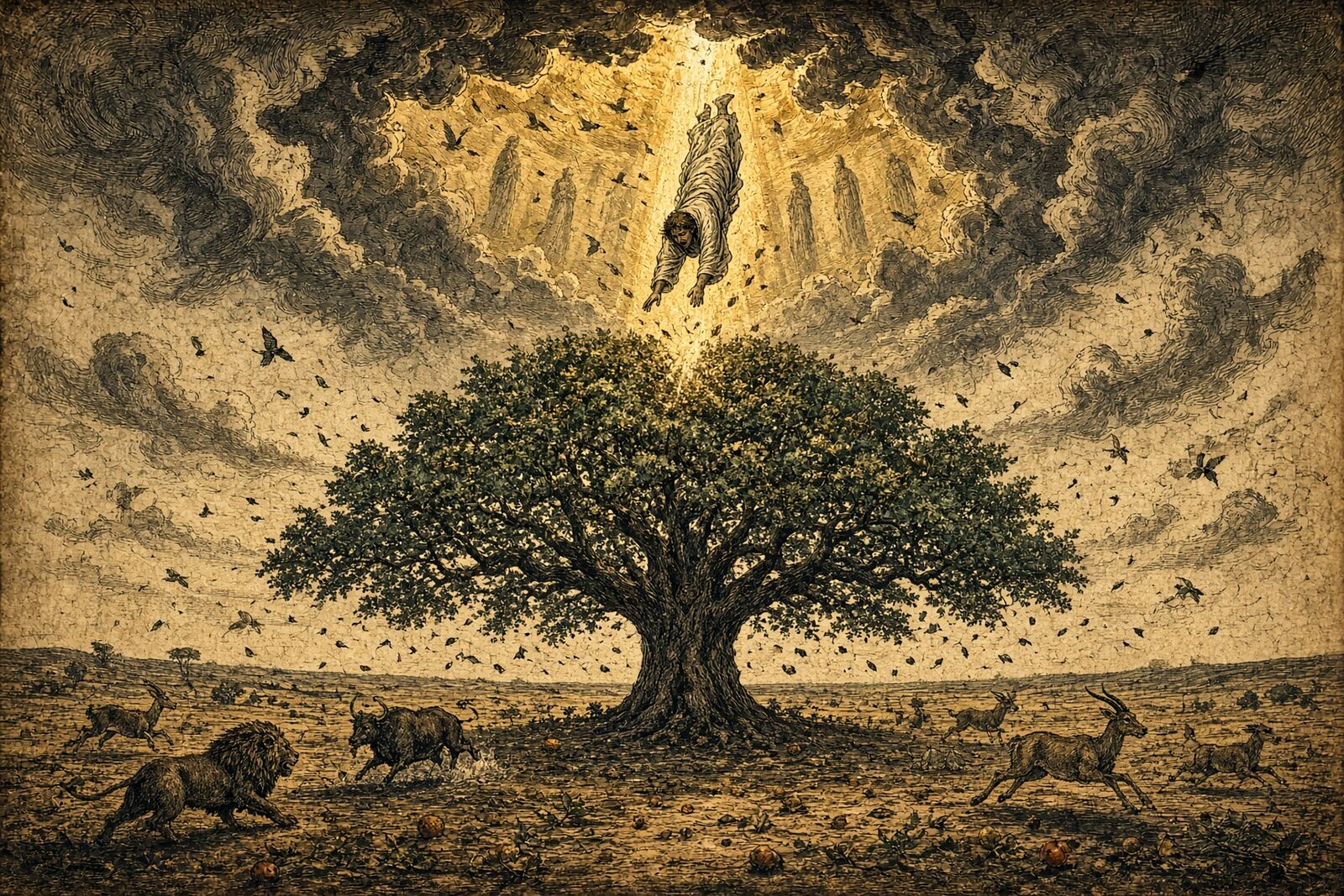
The dream: a massive tree stands, visible to the whole earth, offering shade and fruit to every beast and bird. A Watcher, a Holy One, descends from heaven and issues a decree — chop down the tree, strip its branches and fruit, but leave the stump bound with a band of iron and bronze in the grass of the field. Let the tree’s “mind be changed from that of a man” to “a beast’s mind,” and let seven periods of time pass over it, “in order that the living may know that the Most High is ruler over the realm of mankind and bestows it on whomever He wishes.”
3. Comparing the Two Tellings — Where Nebuchadnezzar Exaggerates
The Aramaic contains a detail easy to miss in English translation. When Nebuchadnezzar says the tree was “in the midst of the earth,” the preposition doesn’t just mean the tree happened to be centrally located — it implies the whole earth revolves around it. That’s the king’s own spin, and it’s one of several details he adds that Daniel’s version deliberately omits.
| Detail in Nebuchadnezzar’s telling (vv. 10–12) |
Present in Daniel’s retelling (vv. 20–21)? |
| The tree was “in the midst of the earth” |
Omitted |
| “Its height was great” |
Omitted |
| “The beasts of the field found shade under it” |
Omitted |
| “All the living creatures fed themselves from it” |
Omitted — because it is not the tree (or the king) who feeds creation; it is God |
“He’s exaggerating a little bit… he might sound like he’s honoring God, but in reality he’s being pretty arrogant.”
Even the letter’s opening line, where Nebuchadnezzar says it “seemed good to me to declare the signs and wonders which the Most High God had done for me,” carries an emphatic construction in the Aramaic underscoring that this happened to him personally. He is not simply praising God — he is still centering himself.
4. Who Are the “Watchers” and the “Holy Ones”?
Daniel 4 is the first place in Scripture where angels are given the title Watchers — a term that doesn’t reappear elsewhere in the Bible but shows up frequently in other Jewish literature contemporary with Daniel, describing the “angelic sons of God” language found back in Genesis 6.
The same angels are also called holy ones, a phrase that can refer either to heavenly angels or to God’s holy people — the meaning depends entirely on context. As an example, the teacher pointed to Psalm 89:
“The heavens will praise Your wonders, O Yahweh… For who in the skies is comparable to Yahweh? Who among the sons of the mighty is like Yahweh, a God greatly feared in the council of the holy ones?” (Psalm 89:5–7)
Here the “holy ones” are clearly in the skies, around Yahweh, called the “council of the holy ones” and the “sons of the mighty” — unambiguously angels. This matters for reading other passages (such as 1 Thessalonians 3, where Jesus returns “with His holy ones”) correctly — it need not mean resurrected saints are already in heaven; it may simply mean angels. It also incidentally demonstrates that Jesus is not himself one of these angelic “holy ones,” since the psalm’s whole point is that none among the holy ones compares to Yahweh.
5. Twelve Months of Grace — The Warning Ignored
Daniel, though “appalled” and alarmed at what the dream meant, tells the king plainly: “the tree… it is you, O King.” He follows the interpretation with an appeal: “let my advice be pleasing to you: break away now from your sins by doing righteousness, and from your iniquities by showing mercy to the poor, in case there may be a prolonging of your prosperity.”
Then comes the detail that damns the king: twelve months later. That gap of time isn’t incidental — it shows Nebuchadnezzar had ample opportunity to repent, with specific fruits of repentance named for him (justice, mercy to the poor), and did nothing.
Instead, walking on his palace roof, “the king reflected and said, ‘Is this not Babylon the great, which I myself have built as a royal residence by the might of my power and for the glory of my majesty?’” And “while the word was still in the king’s mouth,” judgment fell — not on some distant future day, but in the very moment of his boast.
6. From King to Beast — The Theology of Dehumanization
The punishment is a dehumanizing transformation: driven from human society, eating grass like cattle, drenched with the dew of heaven, his mind changed from a man’s to a beast’s, until “his hair had grown like eagles’ feathers and his nails like birds’ claws.”
This is not arbitrary. It draws directly on Genesis 1:28, where God commissions newly created humanity to “be fruitful and multiply, fill the earth and subdue it, and rule over the fish of the sea, over the birds of the sky, and over every living thing that moves on the earth.” Human beings were made to be God’s vice-regents — co-rulers under heaven, stewarding creation and reflecting God’s own just rule to the world. When a ruler forgets that vocation and rules for his own glory instead, he is demoted from ruling over the animals to becoming like them.
This theology of humanity as God’s vice-regent over creation will resurface directly in Daniel 6 and 7, and even echoes at the trial of Jesus, where the Son of Man — the one who truly embodies humanity’s calling — is surrounded by hostile accusers evoking the beast imagery of Daniel.
7. Restoration — The King Who Finally Says “the King of Heaven”
At the end of the appointed time, Nebuchadnezzar raises his eyes to heaven, his reason returns, and he blesses “the Most High… him who lives forever, for His dominion is an everlasting dominion.” His sovereignty, majesty, and splendor are restored.
One detail closes the chapter with real weight: throughout his letter Nebuchadnezzar had repeatedly styled himself “King Nebuchadnezzar.” In his final words, he no longer claims that title for himself:
“Now I, Nebuchadnezzar, praise, exalt, and honor the King of Heaven, for all His works are true and His ways are just, and He is able to humble those who walk in pride.”
That is the last we hear of Nebuchadnezzar in the book of Daniel — a once-arrogant king who now ascribes kingship not to himself but to God, and who, though still speaking as a polytheistic pagan (he earlier calls Daniel’s inspiration “the spirit of the Holy Gods”), acknowledges the God of Israel as a single sovereign person.
8. Reading Daniel 4 Through the Eyes of the Maccabean Audience
The original readers of Daniel were Jews suffering under the Greek king Antiochus IV Epiphanes during the Maccabean revolt. When they read about an arrogant pagan king who desecrated what was holy and was ultimately humbled by God, they would have recognized their own tyrant immediately. The historical accounts of the revolt describe Antiochus in strikingly similar terms:
“He arrogantly entered the sanctuary and took the golden altar… He took all the hidden treasures that he found… He shed much blood and spoke with great arrogance.” (1 Maccabees 1)
Antiochus, “elated in his spirit,” carried off 1,800 talents from the temple, “thinking in his arrogance that he could sail on the land and walk on the sea, because his mind was elated.” (2 Maccabees)
For readers living under that kind of arrogance, Daniel 4 was a promise: God humbles the proud, even pagan kings who plunder the temple — and He would do it again.
9. Four Applications for Today
| # |
Application |
What It Means |
| 1 |
Empty yourself like a servant |
As Christ-followers we must take the posture of a servant (Philippians 2), rather than thinking too highly of ourselves — even when our talents and accomplishments are real, they were given to us by God. |
| 2 |
Live now as a kingdom citizen |
Humanity was created to rule as God’s image-bearers. Forgetting that vocation leads to dehumanization — acting “like animals.” Living now as citizens of the coming kingdom gives others a reason to ask about the hope we carry. |
| 3 |
Have Daniel’s courage |
Daniel modeled the courage to name pride in someone else — privately, gently, aiming at restoration, not embarrassment. Pride and exaggeration are often invisible to the person caught in them; they need a loving voice from outside. |
| 4 |
Trust God, not violence, with unjust rulers |
Daniel was written to people tempted to think the only answer to unjust rulers was the sword. Daniel’s example — faithful, non-violent, uncompromising — shows that our calling is faithfulness and trust that God will intervene in His own time, not violent revolt. |
Summary
| Daniel 4 Is |
Daniel 4 Is Not |
| A letter in which the king’s own pride shows through his exaggerations |
A straightforward, unbiased eyewitness report |
| A warning that unaddressed pride leads to dehumanization |
A random or arbitrary punishment |
| Built on Genesis 1:28 — humanity as God’s vice-regents over creation |
A story about magic, dreams, or superstition for their own sake |
| A call to courageous, loving confrontation of pride in others |
Permission to publicly shame or embarrass a struggling believer |
| An encouragement to the persecuted under Antiochus IV that God humbles tyrants |
A guarantee that judgment always comes visibly or immediately |
| A model of trusting God rather than the sword |
A justification for violent resistance to unjust rulers |
“Our response hasn’t changed — our response is to be faithful, to be obedient, to be loyal, to do what we’re supposed to do, and trust that God is going to take care of it in His own time.”