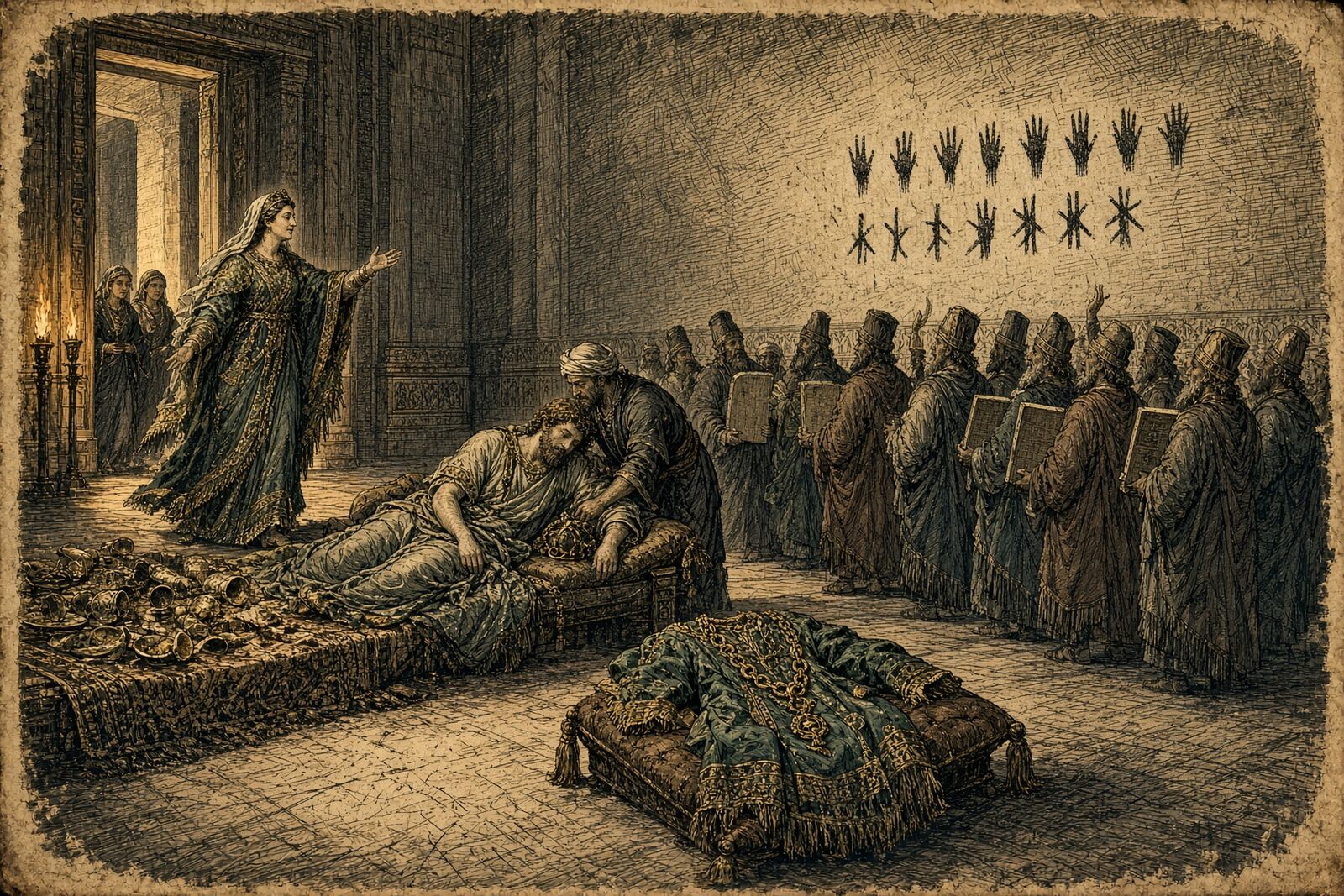
Daniel 5 — The Writing on the Wall
Source: Christian Virtual Fellowship — Book of Daniel series (taught by Dustin Smith)
1. The Pattern of the Story
Daniel 5 follows a pattern already familiar from Daniel 2 and 4: a king acts defiantly toward the true God, behaves with pride, and God removes him from his position and gives it to someone else. In the middle of it, Daniel steps in as a faithful prophetic figure who speaks truth to the king — even though doing so could have cost him his life.
The chapter gives readers two examples: one of how not to behave, and one of how a person of God should behave. The story is only 31 verses, but it packs in idolatry, terror, a word study, and a kingdom-changing judgment — all inside a single night.
2. Belshazzar — Sinking Lower Than His Father
The king of this story is Belshazzar, not to be confused with Daniel’s Babylonian name, Belteshazzar. Belshazzar is a genuine historical figure: Babylonian records are unusually complete about this dynasty. He acted as regent while his actual father, King Nabonidus, was away on business — which is why Daniel is later offered the position of “third ruler” of the kingdom rather than a share of “a third” of it. Belshazzar himself was never technically king; he was occupying the throne on his father’s behalf.
The narrator introduces him as hedonistic and arrogant. While tasting wine at a feast for a thousand nobles, he orders that the gold and silver vessels taken from the Jerusalem temple be brought out so that he, his nobles, his wives, and his concubines can drink from them — and then toast the gods of gold, silver, bronze, iron, wood, and stone with them.
Notably, the text gives no indication that Nebuchadnezzar himself had ever done this. Nebuchadnezzar sank low — reduced to eating grass like an animal — but even he never defiled the sacred vessels of the temple this way. Belshazzar reaches a new low his own father never touched.
“It’s not just that he’s drunk. It’s not just that he’s holding this feast and praising a bunch of other gods. It’s the fact that he’s defiling the temple and the instruments of the temple — that’s going to be very, very important.”
The hand appears at the exact moment Belshazzar is engaged in this behavior, signaling that God is intervening specifically because of the profaning of the temple vessels — the true catalyst for judgment in this story.
The moment the hand appears, Belshazzar’s swagger collapses. His “face grew pale” (5:6). This is where a small but striking word study comes in.
The earliest Greek translation of Daniel is the Septuagint, but a second-century AD Jewish translator named Theodotion rendered “his face grew pale” as “the form of the king changed” — using the Greek noun morphē. That is the same word Paul uses in Philippians 2, where Jesus was “in the form of God” but emptied himself and took “the form of a servant.”
The point is not that Belshazzar stopped being human and turned into something else — he stayed who he was, but his posture, attitude, and disposition changed completely, from arrogance to terror. Seeing that same word, morphē, used elsewhere to describe Jesus emptying himself of his kingly status and taking on the posture of a servant, sharpens the sense of what Philippians 2 is describing: a change of attitude and posture, not a change of essence.
4. “His Loin Belts Were Loosened” — A Humiliating Detail
The NASB’s “his hip joints went slack” is a softened translation. The more literal Aramaic reads that his loin belts were “loosened” — and the word for belts is plural. Since a person typically wears only one belt, some scholars suggest this is a deliberately humiliating way of saying that something more than his belt came loose — that Belshazzar may have lost control of his bowels in terror.
Whatever the precise sense, the detail sharply contrasts the king who, moments earlier, was the picture of arrogance and command, with the man who instantly collapses in fear once he recognizes what God has done.
5. The Wise Men Fail — and an Unlikely Hero Steps Forward
As in chapters 2 and 4, the king’s professional wise men, conjurers, and Chaldeans are called in — and once again, they are completely unable to read or interpret the inscription. By this point in the book, the reader has come to expect this outcome: it is never the court’s own experts who can explain what God is doing, but Daniel, empowered specifically by God’s Spirit rather than by native intelligence.
Into this vacuum steps the queen, a minor character who nonetheless plays an important role. She enters uninvited and reminds Belshazzar of Daniel and everything he had already done for Nebuchadnezzar — information the king should already have known. That Belshazzar needs reminding further exposes his incompetence.
Nothing negative is said about the queen anywhere in the text. While the king, his nobles, wives, and concubines are all swept up in the drunken, irreverent feast, she alone stands apart — the one positive Chaldean in the entire story.
6. Daniel’s Refusal and His Rebuke
Daniel is summoned and offered purple robes, a gold necklace, and the rank of third ruler if he can interpret the writing. He refuses all of it immediately — though the king gives him the rewards anyway, rewards Daniel surely knew would not last long.
Before interpreting the inscription, Daniel delivers a pointed rebuke built on three claims about Nebuchadnezzar’s own history:
| # |
Claim |
Significance |
| 1 |
The Most High God gave Nebuchadnezzar sovereignty, grandeur, and majesty |
Kingship is a gift from God, not a product of military or personal strength |
| 2 |
Nebuchadnezzar then did as he wished, and his heart became proud |
Empowerment was followed by arrogance |
| 3 |
Because of his pride, God removed his throne and reduced him to animalistic, sub-human living |
Judgment specifically targets pride |
This recalls Genesis 1 theology: human beings were created to rule over the animals. When a human ruler like Nebuchadnezzar is reduced to acting like a beast, something in God’s creation is inverted, and God must intervene to restore the proper order. The same human-versus-animal contrast will reappear in Daniel 6 (Daniel among the lions) and Daniel 7 (the son of man versus four beasts).
Daniel then turns the knife directly on Belshazzar: “You his son Belshazzar have not humbled your heart even though you knew all this.” Belshazzar already knew Nebuchadnezzar’s whole story and repeated it anyway — he is held accountable specifically for failing to learn from his predecessor’s mistakes.
Daniel also notes that Belshazzar exalted himself above the Lord of Heaven (a more literal reading of the Aramaic than the NASB’s “against”), praising gods that “cannot see, hear, or understand” while refusing to glorify the God who actually gives him breath and life.
“The rebuke from Daniel indicates something really important for the story: the readers should have also learned from the mistakes of those who came before. Belshazzar should have learned from the mistakes of Nebuchadnezzar.”
7. The Writing on the Wall — A Chain of Puns
Only after the rebuke does Daniel explain the inscription itself: Mene, Mene, Tekel, Upharsin. In Aramaic, these words function as nouns (units of weight and money) that are also puns on Aramaic verbs of judgment — a wordplay that is essentially impossible to preserve in English translation.
| Word |
Literal Meaning |
Pun Verb |
Judgment |
| Mene |
A mina (1/16 of a talent) |
to number |
“God has numbered your kingdom and put an end to it” |
| Tekel |
A shekel (1/16 of a mina) |
to weigh |
“You have been weighed on the scales and found deficient” |
| Upharsin / Peres |
A half-mina (“u-“ is simply the conjunction “and”) |
to divide into two |
“Your kingdom has been divided and given to the Medes and Persians” |
The amounts named — mina, shekel, half-mina — grow progressively smaller, mirroring the diminishing of Belshazzar’s own kingdom. The verb behind Peres specifically means to divide into exactly two parts, which matters: the kingdom is handed to two separate recipients — first to the Medes (at the end of this chapter) and then to the Persians (in the next).
8. That Same Night
Daniel is rewarded exactly as promised — purple robe, gold necklace, third ruler — but the reward lasts less than 24 hours. That very night, Belshazzar is killed and Babylon falls to Darius the Mede, who receives the kingdom “at about the age of 62.” The text never says who kills Belshazzar, only that Babylon fell during a night of feasting — a detail independently preserved by at least two ancient historians, not just Herodotus.
This transfer of power from Babylon to a Mede first, and then (in the next chapter) to Persia, is significant for reading Daniel as a whole: it confirms the four-kingdom sequence — Babylon, Media, Persia, Greece — from the statue vision in Daniel 2, since kingship passes through Media before it passes to Persia.
9. How the Maccabees Read This Chapter
To understand how the original audience — Jews living through the Maccabean Revolt, under a king who desecrated the Jerusalem temple and set up an altar to Zeus — might have applied this story, the lecture turns to 1 Maccabees. When Judas Maccabeus and his forces reclaimed and cleansed the desecrated sanctuary, they did not attempt to purify and reuse the defiled altar or vessels. They tore down the profaned altar and stored its stones “until a prophet should come,” and they made entirely new holy vessels rather than reusing anything that had been defiled.
That instinct — that a defiled sacred vessel cannot simply be cleaned and reused but must be replaced — reflects exactly the lesson of Daniel 5, where it was the profaning of the temple’s own vessels, more than the drunkenness or idolatry, that appears to be the true catalyst for God’s judgment on Belshazzar.
10. Historical Difficulties — An Honest Look
The lecture pauses to address problems that show up in study-Bible notes: historians struggle to harmonize Daniel 5 with the historical record, which has led most specialists to read the chapter as a theological story rather than a strictly historical one.
| Difficulty |
Historical Detail |
| Belshazzar’s father |
Nebuchadnezzar’s actual son and successor was Evil-Merodach (per 2 Kings 25:27), not Belshazzar. Several unrelated kings — Neriglissar, Labashi-Marduk, then Nabonidus — reigned between them |
| Belshazzar’s title |
He was never formally king; his father Nabonidus was alive and reigning while away on business, leaving Belshazzar as acting regent |
| “Darius the Mede” |
No surviving Babylonian or Median records mention a ruler by this name, despite otherwise extensive records for the period |
The speaker’s conclusion: he does not have answers to reconcile all of these difficulties, but is committed to being honest about them rather than hiding them. Importantly, none of this affects how the story’s applications work — the lessons of the chapter stand regardless of these historical questions.
11. Applying Daniel 5
Four applications close out the lecture:
- Our positions are gifts, not achievements. The rise and fall of rulers throughout Daniel reminds us that we hold our current roles only because the Creator has graciously given them to us. The proper response is thanksgiving, praise, and humility — precisely what Belshazzar failed to offer.
- Learn from others’ mistakes, as a community. Belshazzar is held accountable for failing to learn from Nebuchadnezzar’s fall. In the same way, believers must understand the sinful behavior God dislikes and strive together, through obedience, prayer, and the Spirit, not to repeat it.
- Have the courage to speak truth to power. Daniel’s willingness to confront the king, even at personal risk, models what it means to be “kingdom people” now — training in the present for the reign to come, praying for the courage, wisdom, and words to promote God’s reign today.
- Be the one who does right even when everyone else is doing wrong. The queen alone speaks up while everyone else in the room participates in the king’s sin. Her example — echoed later by John the Baptist and by Jesus rebuking authorities — is a call to say and do the right thing even when it is costly and even when no one else in the room will.
Summary
| Belshazzar Is |
Belshazzar Is Not |
| Hedonistic, arrogant, and defiant toward God |
A neutral or sympathetic figure |
| Guilty of defiling the temple’s holy vessels — worse than Nebuchadnezzar ever was |
Guilty of merely being drunk or throwing a lavish party |
| Judged specifically for failing to learn from Nebuchadnezzar’s fall |
Judged arbitrarily or without warning |
| Terrified and transformed in posture the instant he sees the hand |
Repentant — no remorse is recorded |
| Stripped of his kingdom that very night |
Given any second chance |
| Daniel and the Queen Are |
Daniel and the Queen Are Not |
| Faithful, courageous, and willing to speak truth at personal risk |
Motivated by the rewards offered to them |
| Empowered by God’s Spirit, not their own intelligence |
The source of their own wisdom or insight |
| Examples of how God’s people are meant to act among the powerful |
Passive bystanders to evil |
“We only have wherever we are — our jobs, our positions, our households, our communities, our marriages, whatever they may be — because God gave them to us. Our covenant response is to respond faithfully: by showing thanksgiving, by the offering of praise, and by demonstrating humility.”