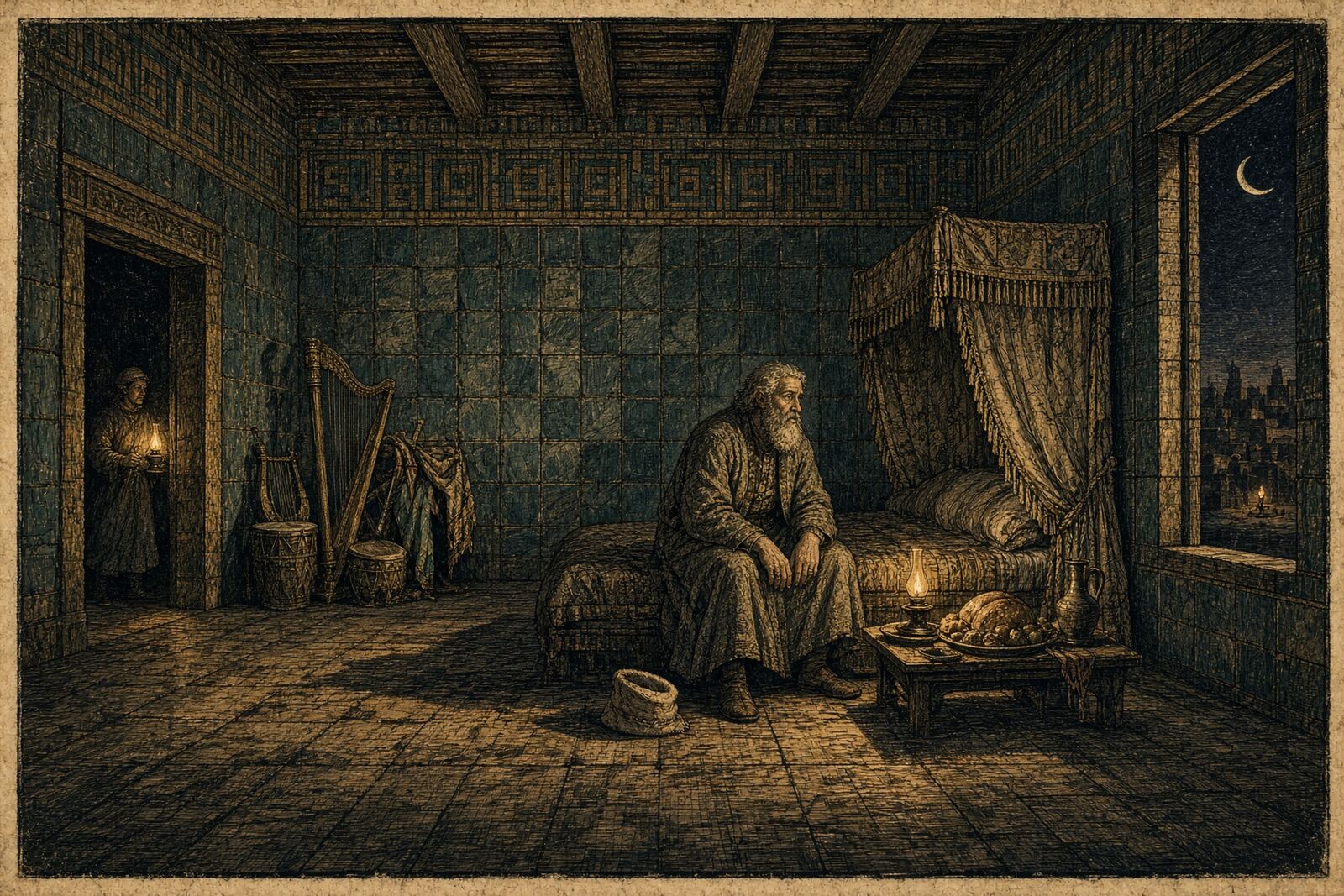
Daniel 6 — Daniel and the Lion’s Den
Source: Christian Virtual Fellowship — Book of Daniel series (taught by Dustin Smith)
1. Three Characters to Watch
The chapter is framed around three figures the narrator carefully develops: Daniel, the new king Darius the Mede, and the conspiring bureaucrats (120 satraps and their superiors). Watching how the narrator characterizes each of the three — why Daniel is righteous, innocent, and courageous; what kind of king Darius turns out to be; how the bureaucrats relate to their king — is what makes the chapter land with unexpected force for readers today.
The version told to children usually stops at “Daniel was rescued.” Left out: the men who maliciously accused Daniel — along with their wives and children — were thrown into the den themselves and killed by the lions. Daniel is vindicated; his accusers are not.
2. The Pit, Not a “Den”
The Aramaic word usually translated “den” is actually the ordinary word for a pit. A stone was rolled over its mouth — not a caged enclosure — which the speaker’s own Bible footnotes confirm. This detail matters later, when the story explores the relationship between a faithful human being and the animals meant to be under human rule.
3. Kings in Contrast: Nebuchadnezzar, Belshazzar, and Darius
Every time a new king appears in Daniel, the question is the same: will he repeat the mistakes of the kings before him?
| King |
Behavior |
| Nebuchadnezzar |
Arrogant; God humbled him until he was reduced to an animal-like state and finally acknowledged the God of heaven |
| Belshazzar |
Never learned from Nebuchadnezzar’s example; rebuked by Daniel for his failure to humble himself |
| Darius the Mede |
Not arrogant like his predecessors, but weak — pressured by his own subordinates into an irrevocable law he never questions, and unwilling to reverse course even when he regrets it |
The speaker draws a modern parallel: the anxiety people feel today over whether a new ruler will be “good” or “harsh” toward people of faith is the same anxiety the exiled Jews carried under a succession of foreign kings who controlled their land, their temple, and their fate.
4. Daniel Distinguishes Himself
Daniel stands out among the commissioners and satraps because he “possessed an extraordinary spirit,” and Darius planned to promote him over the entire kingdom. The other officials — wicked, conspiring bureaucrats — searched for grounds of accusation against him but found none.
The Aramaic verb “find” repeats emphatically in this section: they could not find any ground of accusation, because no corruption was to be found in him. The narrator gives the reason directly:
“The reason why the narrator indicates that no corruption was to be found in Daniel is that he was faithful. He was loyal, he was obedient — and again, this is something we’ve seen in the previous stories.”
Daniel is described here as blameless — above reproach — which the teacher contrasts pointedly with how commonplace corruption is among people seeking power today.
5. The Conspiracy Targets Daniel’s Monotheism
Unable to find any wrongdoing in Daniel’s conduct, the bureaucrats deliberately engineer a law they know only a strict monotheist would break: a thirty-day ban on petitioning any god or man except the king. Any pagan official would have found this easy to comply with — praying to the king or to one of the empire’s many gods cost them nothing. They “zeroed in” on the one thing that made Daniel’s faith different: he would not pray to a king, and he would not pray to any god but Yahweh.
Had Daniel been willing to compromise — offer a token petition to the king and later ask God’s forgiveness — nothing would have happened to him. He would simply no longer have been describable as faithful.
6. Darius — A Weak King
The teacher reads Darius as strikingly passive: he offers no objection when the law is proposed, no questions, no resistance. He does not push back even after he realizes he has been maneuvered into destroying a man he respects.
“Darius appears to be a weak king that allows the people under him to pressure him and force him into doing something that he doesn’t want to do, and he doesn’t have the boldness and the bravery to stand up against those people — or even the foresight to see what these people are doing.”
At sentencing, Darius petitions Daniel’s God to deliver him but does nothing himself to intervene — good intentions with no backing action. He spends the night fasting, sleepless, and rushes to the den at dawn, but the initiative throughout belongs to God, not to the king.
7. Prayer as Habit, Not Crisis Response
Daniel knows the document has been signed and continues his practice of praying three times a day, in view of anyone who cares to look, with his windows open toward Jerusalem. Praying three times daily is not a requirement of the Law of Moses — it appears to be Daniel’s own established discipline, one that later shaped Jewish and Christian devotional practice (early second-century Christian writings recommend praying the Lord’s Prayer three times a day; some rabbinic sources likewise point back to Daniel’s example).
“It suggests that his ongoing practice of praying three times a day was preparing him for this difficult time… he was already in the habit of doing it during times of peace, so that when times became difficult, he was able to easily transition into doing what was right.”
Daniel’s courage under threat is not a sudden act of heroism; it is the natural continuation of habits formed long before the crisis arrived.
8. Innocence, Righteousness, and Trust — A Word Study
The narrator explains Daniel’s rescue as owing to his “innocence” — but the underlying Aramaic word is rare and semantically tied to righteousness in its covenantal sense. As in the earlier study of Romans, righteousness here is not primarily a moral category (being personally upright) but a relational and judicial one: doing what is right within the covenant relationship with God, and being declared right when a judge intervenes on one’s behalf. Daniel is the wrongly accused party; God, as judge, intervenes and rules in his favor — and Daniel is described as righteous in that judicial sense.
Daniel also insists he has committed no crime against the king, even though the law technically forbade his prayer. From the narrator’s perspective, a law designed to remove worship from the God of Israel simply does not bind Daniel’s conscience — though the teacher cautions against stretching this into a general license to disregard civil law.
Finally: Daniel was not injured “because he had trusted in his God” — not mere belief that God exists, but confidence built on precedent, since God had already delivered Shadrach, Meshach, and Abednego from the fire.
9. The Reversal — Accusers Thrown to the Lions
After Daniel’s vindication, it is the king — not Daniel — who orders the accusers, along with their wives and children, thrown into the pit, where the lions kill them before they even reach the bottom. Daniel never expresses a wish for this outcome; the narrator gives him no words of vindictive satisfaction. The chapter closes with Darius writing to “all the peoples, nations, and languages” of his kingdom, commanding that all fear the God of Daniel — a positive shift the teacher attributes directly to the faithful behavior of one person.
10. Genesis 1 and the Theology of Image-Bearing Rule
Daniel 6 recalls the creation theology of Genesis 1: human beings are made to rule over the animals as faithful image-bearers (Genesis 1:27–28). Nebuchadnezzar failed to live up to that role and was reduced to an animal’s existence. Daniel, by contrast, acted faithfully as a ruler, was wrongfully thrown among animals, and was vindicated by God — raised back above them.
This is also, the teacher argues, why Daniel 7 is placed next to Daniel 6 even though it is chronologically out of order (Daniel 7 is dated to Belshazzar’s reign, which belongs earlier in the narrative, in the Babylonian period):
“It is outside of God’s purpose for the world for animals to be controlling and attacking human beings — that’s not the way it’s supposed to work. When a human being is faithful, he’s going to be vindicated from the animals.”
Daniel 6 pictures a faithful human wrongly attacked by literal animals and vindicated above them; Daniel 7 will picture a faithful “son of man” figure attacked by animalistic beasts and likewise vindicated. The two chapters are a matched pair — thematically and theologically, even if not chronologically.
11. Echoes in 2 Maccabees — Resurrection Hope
The teacher situates the original audience of Daniel among Jews living during and after the Maccabean revolt, and reads a passage from 2 Maccabees describing a mother and her seven sons tortured for refusing to eat forbidden food. As each son dies rather than transgress the law of his ancestors, the last one declares:
“You cursed wretch, you dismiss us from this present life, but the king of the universe will raise us up to an everlasting renewal of life, because we have died for his laws.”
This passage — written under the direct influence of Daniel — shows how later readers drew on Daniel’s example: faithfulness even to the point of death, sustained by the hope that God is “the king of the universe” who raises the dead. The same hope, the teacher notes, later sustained Jesus, who told His disciples the Son of Man would be handed over, persecuted, killed — and raised on the third day.
12. Four Applications for Today
Application 1 — Three ways to respond to persecution. Daniel’s response is one of three options available to a persecuted person:
| # |
Response |
Description |
| 1 |
Compromise |
Cave in and abandon the faith rather than stand firm |
| 2 |
Violent resistance |
Fight back with weapons or force |
| 3 |
Faithful, non-violent endurance |
Remain obedient and loyal even at the cost of one’s own life — the pattern of Daniel, John the Baptist, and Jesus |
The teacher notes that the author of Daniel would have disagreed with the Jews who chose violent revolt during the Maccabean period — the book’s own theology calls readers to wait for God to intervene, not to take up the sword.
Application 2 — Blamelessness as preparation to reign. Daniel’s character is highlighted as one “in whom no corruption could be found.” Kingdom citizens who look forward to reigning with Christ in the new creation are likewise called to be blameless and honest now.
Application 3 — Vigilance under weak rulers. Darius represents a second pattern of ungodly rule: not tyranny, but weakness that caves to pressure. As culture increasingly produces weak-willed rulers, believers are called to stay awake, sober, and vigilant (echoing Paul’s language in 1 Thessalonians 5) — paying attention to how such rulers will treat the faithful.
Application 4 — Trusting God when targeted unjustly. Sometimes wicked people target the blameless for no legitimate reason — as happened to Daniel and to Jesus. Jesus taught His followers not to return insult for insult, not to curse their persecutors, but to trust the God who delivers the righteous, whether in this life or at the resurrection.
Summary
| Daniel 6 Is |
Daniel 6 Is Not |
| A story of faithful, non-violent endurance under unjust persecution |
A tame children’s story with the ending quietly left out |
| A picture of Genesis 1’s image-bearing rule — a faithful human vindicated above the animals |
A morality tale with no deeper theological structure |
| A pattern later Jews (2 Maccabees) and ultimately Jesus drew on to face death with hope |
An isolated incident disconnected from the rest of Scripture |
| Righteousness as covenant right-standing, vindicated by God the Judge |
Righteousness as mere personal moral perfection |
| A rebuke of both compromise and violent revolt as false responses to persecution |
An endorsement of armed resistance against unjust rulers |
“Sometimes God vindicates people in this life, and sometimes He doesn’t — but the hope of resurrection, and the hope of a God who vindicates and rescues the faithful, is what motivated them to do what was right and not compromise their faith.”