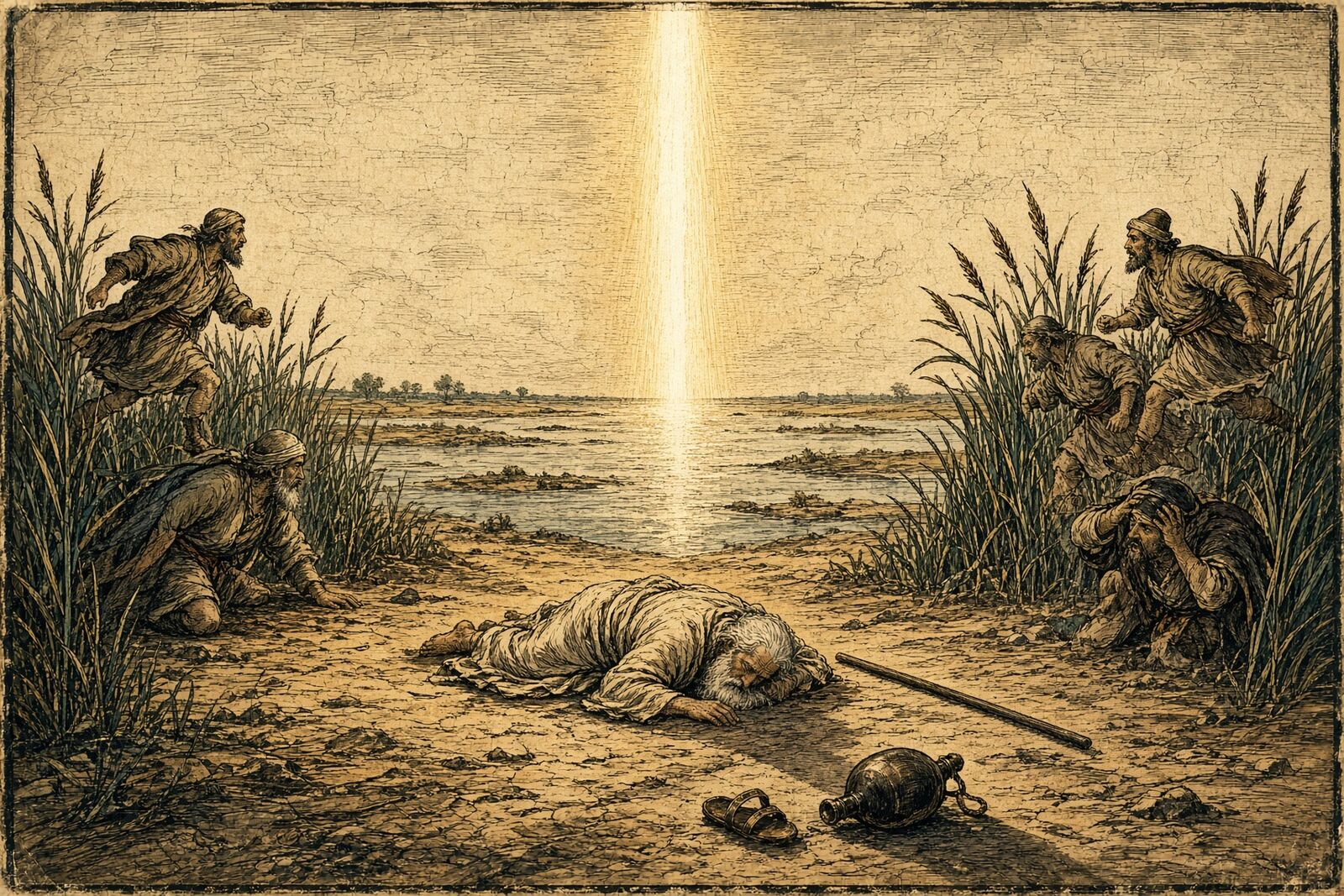
Daniel 10 — Angelic Warfare
Source: Christian Virtual Fellowship — Book of Daniel series (taught by Dustin Smith)
1. Chapter 10 Opens the Book’s Final Section
Daniel 1–9 are individual, self-contained stories that can be read out of order — they aren’t even arranged chronologically. Daniel 10–12 is different: it is one continuous, self-sustained narrative, the longest section in the book, and it functions as the climactic conclusion to Daniel as a whole. Chapter 10 is not a standalone story; it is the introduction to what unfolds in chapters 11 and 12.
The chapter itself is short and, unlike earlier chapters, involves no meaningful translation disputes. But it contains a detail the teacher considers genuinely underappreciated — one that, in his words, could “revolutionize the way that you understand the world and understand conflict and understand the relationship between good and evil.” He titles the chapter Angelic Warfare.
2. The Setting — Daniel Stays Behind
The chapter opens “in the third year of Cyrus King of Persia,” roughly 537 BC — two years after Cyrus’s decree (539 BC) permitted the Jewish exiles to return home. Daniel receives his vision while standing at the bank of the Tigris River, which is nowhere near Jerusalem, Judea, or Israel.
This detail carries weight: Daniel had the freedom to return to the homeland — to help rebuild the temple, restore the Davidic kingship, and await the Messiah — yet he apparently chose to remain in the Persian Empire rather than go back with the rest of the exiles. The text doesn’t explain why; it simply establishes, geographically, that Daniel is still far from home.
3. A Message of “Great Conflict”
The narrator tells us two things about what Daniel received: it is called true — Hebrew emet, a word carrying the sense of faithful more than merely factual — and it involves great conflict. Unlike the visions of chapters 7 and 8, Daniel does not need an interpreting angel to explain the meaning to him; he already “understood the message and had an understanding of the vision.” Yet an angel appears anyway, not to interpret but to strengthen and inform him.
Notably, the actual content of the message is withheld from the reader until chapter 11.
4. Twenty-One Days of Mourning — Overlapping Passover
Daniel responds to the message with a voluntary act of mourning: three full weeks with no tasty food (Hebrew lechem, which also means bread), no meat, and no wine. People in Scripture typically mourn over death or over sin — but nothing suggests either here. The logic of the text points instead to Daniel mourning the content of the message itself.
The detail most readers miss: this 21-day fast, beginning in the first month, necessarily overlapped Passover (day 14 of the first month) and the following Days of Unleavened Bread (days 15–21). A Jewish reader would immediately recognize the significance — Daniel was so disturbed by what he had learned that he was willing to forgo even the celebratory meal of Passover. For the original audience, likely reading during the Maccabean crisis and the desecration of the temple under Antiochus IV, this kind of grief would have made immediate sense.
5. The Angelic Visitor
On the 24th day, an angel appears whose form Daniel struggles to describe: a body like beryl, a face like lightning, eyes like flaming torches, arms and feet like polished bronze, a voice like the sound of a tumult. This is a recognizable convention of apocalyptic literature — Ezekiel does something similar in chapter 1 when he cannot fully describe the appearance of God, and the Book of Revelation later reuses this exact kind of imagery (and even the detail of a strengthening touch) in its description of the risen Jesus.
“Obviously this Angel does not have fire torches for eyeballs… obviously his words are not tumultuous water — that’s just the sound of them.”
6. Why the Delay? The Hebrew Word Sar
The angel explains that he was dispatched the moment Daniel humbled himself — on day one — but was delayed because “the prince of the kingdom of Persia was withstanding me for 21 days… then behold Michael, one of the chief princes, came to help me.”
The key to this chapter is the Hebrew noun sar (the root behind the modern word czar, by way of Caesar). It generally means a leader, ruler, or person of rank — sometimes a human commander, but the teacher argues it clearly refers to angelic beings every time it appears in Daniel 10.
| Reference |
“Sar” figure |
Role |
| Daniel 10:13 |
Prince of the kingdom of Persia |
An evil angel who withstood/blocked the messenger angel for 21 days |
| Daniel 10:13 |
Michael, “one of the chief princes” |
A good archangel who came to help the messenger angel |
| Daniel 10:20 |
Prince of Persia / Prince of Greece |
The messenger angel returns to fight Persia’s angel; Greece’s angel is coming next |
| Daniel 10:21 |
Michael, “your prince” |
Identified as Daniel’s own angelic prince |
| Daniel 12:1 |
Michael, “the great prince who stands guard over the sons of your people” |
Israel’s guardian angel |
Since Michael is explicitly an archangel — one of several “chief princes” (extra-biblical Jewish tradition names seven, though only Michael and Gabriel appear in Scripture) — and is clearly not human, the parallel term “prince of Persia” must likewise refer to an angelic being, not a human ruler. The logic extends: nations and cities each appear to have a representative angel, and these angels can fight one another, sometimes overpowering the “good” side for a time.
This usage isn’t unique to Daniel. In Joshua 5:14–15, centuries earlier, an angel identifies himself as “the prince (sar) of the host of Yahweh” — the same word, the same angelic sense, applied even earlier in the biblical text.
7. Michael as Israel’s Angelic Patron
Putting the pieces together: Persia has an angelic prince, Greece has an angelic prince, and Michael appears to function as Israel’s angelic prince — not merely Daniel’s personal guardian, but the angelic patron who “stands guard over the sons of your people” (12:1).
This framework, the teacher argues, illuminates a passage much later in the canon: Revelation’s letters “to the angel of the church of Ephesus” (and the other six churches). If Daniel already establishes that Persia, Greece, and Israel each have a representative angel, it is a short step to see the seven churches of Revelation as having angelic representatives in the same sense — especially since Daniel is the first apocalyptic book and Revelation draws heavily on it.
8. A Window into 2 Maccabees — Armies in the Sky
Second Maccabees, an early historical source dependent on and influenced by the language of Daniel, records a vivid parallel: during Antiochus’s second invasion of Egypt (which required marching his army through Israel), the people of Jerusalem reportedly saw for nearly 40 days a vision in the sky of golden-clad cavalry, charging armies, drawn swords, and clashing spears — and everyone prayed the apparition would prove to be a good omen. It is a strikingly literal picture of exactly what Daniel 10 describes conceptually: heavenly battles corresponding to and explaining earthly conflicts.
9. Theodicy — Why Do the Righteous Suffer?
Daniel 10 offers one biblical answer — not the only one — to the question of why the people of God suffer under pagan powers.
“There are battles going on in the Heavenly Realms that we can’t see, and there are good Angels who fight on behalf of Israel — but there are also evil angels representing Pagan Nations and cities who, by the way, can actually overpower the good Angels… The battles in heaven affect the outcome of the battles that are currently taking place on Earth.”
The answer is deliberately not “God has abandoned you.” It’s that the visible conflict between Israel and pagan empires has an invisible counterpart — a war among representative angels — and the outcome on earth is bound up with that unseen contest, even when it means the “good” side is temporarily delayed or overpowered.
10. Modern Applications
| # |
Application |
Basis in the Text |
| 1 |
Humility invites God’s response |
The angel tells Daniel his prayer was heard the very first day he humbled himself and set his heart on understanding — not after 21 days. God’s faithfulness was immediate even though the answer’s arrival was delayed. |
| 2 |
Patience and long-suffering during delay |
Daniel did not quit after day one when nothing happened. He waited faithfully through the full 21 days, even though he could not have known an angelic conflict was the reason for the silence. Not every delay has this explanation, but Daniel’s endurance models the right response when an answer is slow in coming. |
| 3 |
We participate in the same spiritual conflict |
Drawing on Revelation 12:7–8 (Michael and his angels defeating the dragon and his angels) and Revelation 12:11, believers today “conquer the dragon” not with weapons but “because of the blood of the Lamb and because of the word of their testimony,” and by refusing to love their own lives “even when faced with death.” |
“Because of the death of Jesus and the blood of the Lamb… because of the word of their testimony, which is the gospel message… you defeat with the speaking of the message — and there’s the sense of a faithfulness that is willing to endure even in the midst of conflict.”
Summary
| Daniel 10 Establishes |
Daniel 10 Does Not Say |
| Daniel received a true, faithful message involving “great conflict” |
The content of that message (withheld until ch. 11) |
| Daniel mourned and fasted 21 days, overlapping Passover |
That Daniel was mourning his own sin or a death |
| An angel was dispatched the instant Daniel humbled himself |
That the delay meant God wasn’t listening |
| The angel was withstood 21 days by “the prince of Persia” |
That “prince” (sar) refers to a human ruler |
| Michael, an archangel, is Israel’s angelic prince/patron |
That Michael is merely Daniel’s personal guardian |
| Nations/cities have representative angels who can fight one another |
That earthly outcomes are unrelated to this heavenly conflict |
“While nations are fighting on Earth, when the curtain is pulled away and the images are revealed — like heaven showing what’s really going on — you can actually see: the reason why these nations are fighting, and why one might be stronger than the other, is because there are representative angels fighting in the heavenly realm. And sometimes the forces for good can actually be thwarted and slowed down.”