Daniel 2 — The King’s Dream
Source: Christian Virtual Fellowship — Book of Daniel series (taught by Dustin Smith)
1. A King Tests His Wise Men
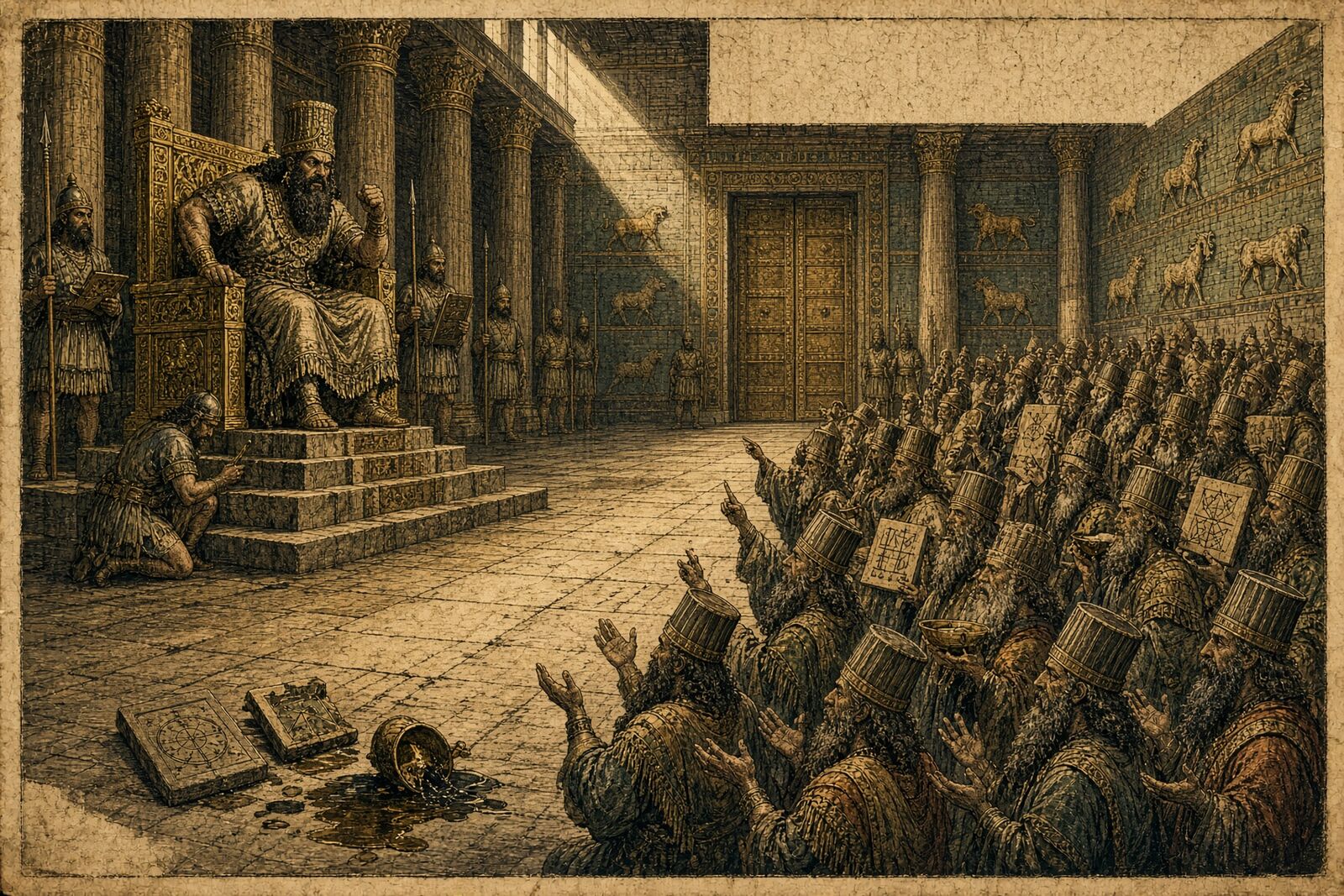
Nebuchadnezzar has a troubling dream, but instead of simply telling his court officials what he saw and asking for an interpretation, he demands something much harder: they must first tell him what he dreamed, and only then its meaning. This is a deliberate test of legitimacy — if they can’t describe the dream itself, they have no business claiming to interpret it.
“He wanted to see if they were legitimate. He said, ‘I want you to tell me what I actually dreamed, and tell me the interpretation of the dream.’ Well, the people that try to fake that sort of prophetic stuff — they’re not able to do that.”
The magicians, conjurers, sorcerers, and Chaldeans cannot meet the demand. They stall, Nebuchadnezzar accuses them of buying time, and they finally admit the truth: “There is not a man on earth who could declare the matter to the king… except gods whose dwelling place is not with mortal flesh.” Furious, the king orders all the wise men of Babylon executed — a decree that puts Daniel and his three friends in the path of death through no fault of their own.
2. A Language Shift Signals a New Section
At Daniel 2:4, the text switches from Hebrew into Aramaic, and it stays in Aramaic all the way through the end of chapter 7. In English translation this shift is invisible, but for an original reader moving from Hebrew straight into Aramaic mid-sentence would have been jarring — a clear signal that something structurally different is beginning at this point in the book.
3. The Wise Men’s Failure and Daniel’s Prayer
Daniel, informed of the death decree, asks the king for time and then goes home to tell his friends Hananiah, Mishael, and Azariah, so they can seek mercy from “the God of heaven concerning this mystery.” That night the mystery is revealed to Daniel in a vision, and he responds not with pride but with worship — blessing the God who “changes the times and the epochs,” “removes kings and establishes kings,” and “reveals the profound and hidden things.”
Where the pagan court could offer Nebuchadnezzar nothing, Daniel comes bearing both the dream and its interpretation, insisting the credit belongs to God alone: “Not for any wisdom residing in me more than any other living man, but for the purpose of making the interpretation known to the king.”
Nebuchadnezzar saw a single enormous statue of “extraordinary splendor,” built out of four different metals from top to bottom, struck and destroyed by a stone “cut out without hands.”
| Part of Statue |
Material |
| Head |
Gold |
| Breast and arms |
Silver |
| Belly and thighs |
Bronze |
| Legs |
Iron |
| Feet |
Partly iron, partly clay |
“You continued looking until a stone was cut out without hands, and it struck the statue at the feet of iron and clay and crushed them… The iron, the clay, the bronze, the silver, and the gold were crushed all at the same time and became like chaff from the summer threshing floors… But the stone that struck the statue became a great mountain and filled the whole earth.”
5. Counting the Kingdoms — Where the Text Puts Its Weight
The interpretation names four successive kingdoms, marked off by transition phrases: “after you there will arise another kingdom,” “then a third kingdom,” “then there will be a fourth kingdom.” After that fourth kingdom is introduced, the text never adds a fifth — it simply keeps expanding on the fourth one, describing its divided, part-strong/part-brittle nature, until the kingdom of God finally appears to end it.
Dustin points out that the amount of attention given to each kingdom is wildly uneven. Counting the actual Aramaic words devoted to each kingdom, the first kingdom (Babylon) receives about 22 percent of the text, while the fourth kingdom alone receives roughly 62 percent — more space than all the other kingdoms combined.
“It’s not just telling you four empires — it’s really telling you about the importance of the fourth empire, and it’s only telling you about empires one, two, and three just to kind of transition you over until you get to that.”
6. Two Rival Interpretations of the Four Kingdoms
Before offering his own reading, Dustin warns against eisegesis — bringing an outside interpretive framework (a “lens”) to the text and reading it back into Daniel, rather than building an interpretation out of the text’s own historical and literary details. With that caution in place, he lays out the two most common identifications of the four kingdoms and tests each one against the specific details Daniel actually gives: inferiority, ruling “over all the earth,” strength like iron, a divided strong/brittle kingdom, and intermarriage that fails to hold.
| Kingdom |
Popular Internet Interpretation |
Scholarly Consensus Interpretation |
| 1 — Gold |
Babylon |
Babylon |
| 2 — Silver |
Media-Persia (combined into one) |
Media alone |
| 3 — Bronze |
Greece |
Persia |
| 4 — Iron/Clay |
Rome |
Greece (divided among Alexander’s four generals) |
Problems with the popular view:
- Oddly must combine two separate nations (Media and Persia) into a single “second kingdom.”
- The Medo-Persian Empire lasted longer and held more territory than Babylon — which contradicts the text’s description of the second kingdom as “inferior” to the first.
- It is not clear how Rome was ever “partly strong and partly brittle” in a way that matches the statue’s feet.
- Rome’s succession of Caesars was hereditary, not divided into intermarrying factions — there is no historical intermarriage between “strong” and “weak” halves of Rome to match the text.
Strengths of the scholarly view:
- Media alone (not combined with Persia) fits “inferior” — it was the least relevant and least powerful of the four kingdoms, largely unknown to most Jews.
- Persia conquered both Media and Babylon and held far more territory, matching “ruled over all the earth.”
- Greece under Alexander was strong enough to conquer all of Persia and push toward India — “strong as iron.”
- After Alexander’s death, his empire was literally divided among four generals, with the Seleucid dynasty ruling Syria in the north and the Ptolemaic dynasty ruling Egypt in the south — a divided kingdom, still recognizably one (Greek) kingdom.
“Gold stars all the way, 100, A-plus — that’s why I find this argument much more convincing than the other argument, point by point, detail by detail.”
7. The Intermarriage Clue — Daniel 11 Solves the Puzzle
The detail interpreters most often skip is the statue’s feet: iron and clay that “combine with one another in the seed of men” but “will not adhere to one another” — a description of intermarriage attempted between the strong and brittle halves of the fourth kingdom that ultimately fails to produce lasting unity. Daniel himself supplies the historical answer to this riddle later in the book, in chapter 11.
| Daniel 11 Passage |
Historical Event |
| 11:6 — “the daughter of the king of the South will come to the king of the North to carry out a peaceful arrangement… but she will not retain her position of power” |
Circa 250 BC, Antiochus II (Seleucid “King of the North,” grandson of Seleucus I) married Berenice, daughter of Ptolemy II (“King of the South”), to secure peace. Antiochus was later poisoned by his ex-wife Laodice; Berenice and her infant child were also murdered. |
| 11:17 — “he will also give him the daughter of women to ruin it… she will not take a stand for him or be on his side” |
Circa 194–193 BC, Cleopatra I, daughter of Antiochus III, was betrothed to Ptolemy V as part of a peace treaty. Antiochus intended her to undermine the Ptolemaic kingdom from within, but she instead embraced her husband’s cause. |
Both marriages were arranged within the Greek kingdom — between the Seleucid north and Ptolemaic south — not between Rome and anyone else. That, Dustin argues, is decisive: Daniel’s own later chapters confirm that the fourth kingdom of the statue is Greece, not Rome.
8. A History of Misreading — Every Generation’s “Fourth Kingdom”
Dustin traces how, across church history, interpreters have repeatedly reinterpreted the fourth kingdom to match whatever empire was dominant in their own lifetime — rather than reading it in its original historical context.
| Era / Source |
Reinterpretation of the Fourth Kingdom |
| 4 Ezra (1st century, post-Temple destruction) |
Reinterprets the eagle/fourth kingdom as Rome, while explicitly admitting: “It was not explained to him as I now explain it to you.” |
| Eusebius (Constantine’s court theologian) |
Preached that Rome, having converted under Constantine, had now transitioned into the kingdom of God itself. |
| Later Christians after Rome’s fall |
Reassigned the fourth kingdom to the Byzantine Empire. |
| A French theologian, 12th century |
Argued the fourth kingdom was France. |
| Bishop Richard of Bury, 14th century |
Taught the fourth kingdom was Britain. |
| Martin Luther, 1520s |
Argued the kingdom had transferred from the Latins (Rome) to the Germans. |
| Hugo Grotius, 17th century |
Returned to the Seleucid/Greek reading — recovering the original historical context. |
“Is there one dominant interpretation throughout church history? The answer is no. What seems to have happened is that whatever kingdom seems to be really, really powerful right now — that now becomes the fourth kingdom… That’s ripping the text out of its context and interpreting it in light of your own situation. That’s not how you interpret ancient text.”
9. The Stone That Became a Mountain — Kingdom of God and the Stone/Son Wordplay
Daniel 2:44 says, “In the days of those kings the God of heaven will set up a kingdom which will never be destroyed.” This is the origin point of the New Testament phrase “kingdom of heaven” — it is called that precisely because it is the God of heaven who sets it up (Aramaic: malkut shemayin, “the kingdom of the heavens”).
There is also a wordplay embedded in the original languages: the Hebrew/Aramaic word for stone (eben) sounds like the word for son (ben). Jewish and later Messianic interpreters read the stone that crushes the statue as a pun for the Son — the Messianic King who establishes God’s kingdom.
Jesus appears to draw on exactly this pun. In Luke 20:17–18, quoting Psalm 118, he says: “The stone which the builders rejected, this became the chief cornerstone… everyone who falls on that stone will be broken to pieces, and on whomever it falls, it will scatter them like dust.” The chief priests and scribes, Luke notes, “understood that he had spoken this parable against them” — they recognized Jesus was identifying himself as the stone/son of Daniel’s vision.
“Jesus interprets that as if the stone has already come down. Jesus [is] not looking at the stone as something that’s coming in the future — he’s saying it’s already been inaugurated, it’s already begun, it’s already started.”
10. Vindication — Daniel’s Example for the Faithful
The chapter closes with Nebuchadnezzar falling on his face before Daniel, ordering an offering and incense presented to him, promoting him to rule over the whole province of Babylon, and making him chief prefect over all the wise men — with Shadrach, Meshach, and Abednego installed under him.
“We actually have a Jew who formerly was imprisoned as an exile — the overlords were Gentiles — and now we’ve got this Jew who’s now promoted, and now he is ruling over the Gentiles. The level of vindication there should not go unnoticed.”
Daniel and his friends had been marked for death alongside the rest of Babylon’s wise men, purely by association. Their faithfulness and reliance on God — not cleverness or self-promotion — is what leads to their deliverance and exaltation.
11. Applying the Vision Today
Dustin draws out three lines of application, arguing that most “prophecy teachers” stop at identifying the kingdoms and never take this last step:
- Already and not yet. Since Jesus interpreted his own ministry as the stone that brings the kingdom, his hearers must reckon with the fact that the reign of God was genuinely inaugurated in his ministry — through the new covenant, forgiveness, the ethics of the kingdom, and exorcisms (“if I cast out a demon, then the kingdom of God has come upon you”). At the same time, the kingdom is not yet fully consummated: believers must live in anticipation of Jesus’s future physical return, resurrection, judgment, and the new heavens and new earth. Neither half can be dropped in favor of the other.
- Daniel as an example of faithfulness under injustice. Just as in chapter 1, Daniel and his three friends face unjust threats and unfair treatment, yet remain faithful and loyal rather than compromising — and God vindicates them. Believers facing unfair treatment, threats, or injustice from rulers today are meant to follow the same pattern.
- The original readers’ situation (their Sitz im Leben). The story encouraged its first audience to wait faithfully for God’s kingdom rather than trusting the pagan Seleucid rulers who were hellenizing Judea, and rather than trusting the violent, revolutionary Maccabean armies who responded to that pressure with the sword. Daniel endorses neither compromise nor violent revolt — only faithful waiting.
“No matter how bad the kingdoms of the world act, the God of heaven is still in charge and is still active — so by placing our allegiance in Jesus and in his kingdom, we can rest easy knowing that God will never abandon nor forsake his faithful people.”
Summary
| Daniel 2 Is |
Daniel 2 Is Not |
| A test of legitimacy God’s wisdom passes and pagan wisdom fails |
A vague promise of “the kingdom” with no historical anchor |
| A vision of four real, identifiable, successive kingdoms (Babylon, Media, Persia, Greece) |
A code that can be reassigned to whatever empire is currently in power |
| Confirmed and cross-referenced by Daniel’s own later chapter (Daniel 11’s intermarriages) |
A puzzle to be solved by imposing an outside interpretive framework onto the text |
| The historical root of “kingdom of heaven” and the stone/son wordplay Jesus applies to himself |
Merely a future event Jesus never connected to his own ministry |
| An example of vindication for faithful, non-compromising, non-violent endurance |
A call to political revolt or assimilation with pagan power |
“Since Jesus interpreted his ministry in terms of the rock that brings the kingdom, then we need to deeply consider the ramifications… we must choose to participate in the present reign, and we have to live in anticipation of the coming consummation.”