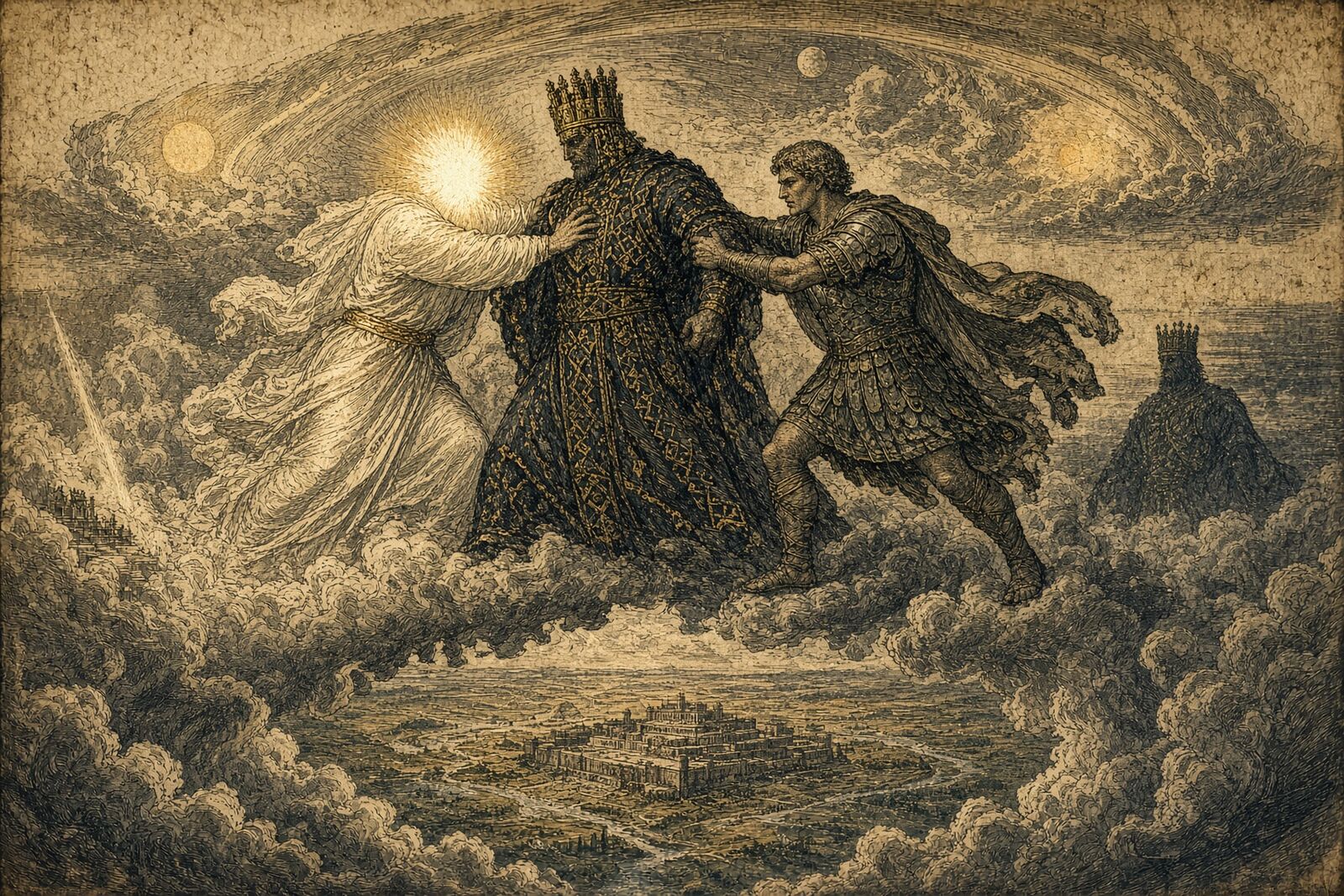
Daniel 11 — Kings of the North and South
Source: Christian Virtual Fellowship — Book of Daniel series (taught by Dustin Smith)
1. A Vision Still Being Explained
Daniel 11 is not a standalone chapter. The unnamed angelic revealer introduced in Daniel 10 — who came to comfort and instruct Daniel after a disturbing vision — remains the speaker for all of chapter 11 and most of chapter 12. The chapter break at the end of 11 is misleading; it exists only because the vision is 45 verses long and had to be split somewhere. The narrative itself continues straight into chapter 12.
This chapter traces history from the sixth century BC down to 164 BC — a stretch of biblical history most Christians know far less well than the Samuel–Kings–Chronicles narratives, because 1–2 Kings and 1–2 Chronicles end at the exile, and Daniel 11 picks up centuries later. Unlike the heavily layered symbolism of a book like Revelation, this vision is historically transparent: ancient historians — the writers of 1 and 2 Maccabees, the Greek historians Polybius and Diodorus Siculus, the Latin historian Livy, and the Jewish historian Josephus (author of the twenty-volume Antiquities) — corroborate nearly every event described, allowing readers to cross-reference names, dates, and places with confidence.
2. Not an Equal History — Media, Persia, and the Weight of Greece
The chapter moves through history at a wildly uneven pace. As in Daniel 2, 7, 8, and 9, the narrator rushes past the earlier empires to dwell almost entirely on the fourth and final one — Greece.
| Empire |
Verses Given |
Share of Chapter |
| Media |
1 verse (11:1) |
— |
| Persia |
1 verse (11:2) |
— |
| Greece |
43 verses (11:3–45) |
~95% of the chapter |
| — of which, Antiochus IV alone |
25 verses (11:21–45) |
~55% of the chapter |
The question the reader is meant to ask is: why does the author rush through Media and Persia only to fix his gaze on one particular Greek king? The rest of the chapter answers that question.
3. Two Thrones, Many Kings
The chapter follows two thrones geographically related to Israel: the King of the North (the Greek-controlled region of Syria) and the King of the South (Greek-controlled Egypt). Both are part of a divided Greek empire — this is not a shift to non-Greek powers.
“This is not a king of the north and a king of the south — these are multiple kings of the north and multiple kings of the south… You’re going to see the King of the North did this, and then you’re going to see, well, that person came to his end, and then the King of the North did that — it’s not the same individual. It’s different individuals throughout history that are occupying that throne.”
Different men occupy each throne throughout the chapter; the text never bothers naming most of them by their proper names, only by their office. Israel — geographically wedged between the two — is repeatedly caught in the crossfire.
4. The Death of Alexander and the Rise of Four Kingdoms (11:1–4)
Verses 1–2 sprint through roughly two hundred years of history — from Darius the Mede through four named Persian kings — until Persia collides with “the realm of Greece.” The book of Ezra (4:5–7) likewise names four Persian kings, and these appear to be the only four Persian kings named explicitly anywhere in the Hebrew Bible, which explains why the narrator singles out these four rather than the many others who actually reigned.
Verses 3–4 then introduce “a mighty king” who “will do as he pleases.”
“Whenever you read in the Bible that a king is going to do as he pleases, that’s never a good sign. That always means the king is going to be prideful and arrogant, and he’s going to be humbled by the God of Heaven.”
This is Alexander the Great — arguably the most historically influential ruler in history, who spread Greek language and culture (Hellenization) across the known world through conquest. He died young in 323 BC without an acknowledged living heir, and his kingdom was broken up — not to his descendants, but among his four generals, known as the Diadochi (“the Successors”).
| Successor |
Territory Received |
| Cassander |
Greece and Macedonia |
| Lysimachus |
Thrace |
| Antigonus (quickly replaced by Seleucus I) |
Northern Syria and Babylonia |
| Ptolemy I “Soter” (“Savior”) |
Egypt, Israel, and southern Syria |
At this point Israel belonged to the southern, Egyptian-based Greek kingdom. The rest of Daniel 11 narrows its focus to the last two of these four kingdoms — the Seleucid north and the Ptolemaic south.
5. The Ptolemies and Seleucids at War (11:5–16)
The King of the South here is Ptolemy I Soter, who reigned an unusually long 323–285 BC. One of his princes, Seleucus I, eventually gains ascendancy and takes over the northern kingdom, exactly as verse 5 describes.
Around 250 BC (“after some years”), the two dynasties attempt a peace alliance through marriage: Berenice, daughter of Ptolemy II, marries Antiochus II (grandson of Seleucus I). The alliance collapses — both are murdered — and Berenice’s brother, Ptolemy III, rises to the southern throne (246–221 BC). Ptolemy III wages a successful campaign against Seleucus II, plundering Syria’s gods, images, and treasures back to Egypt (“their gods with their metal images… he will take into captivity to Egypt”). Seleucus II’s counterattack fails.
Seleucus II’s sons — Seleucus III and, ultimately, Antiochus III — muster large armies and secure Samaria and Galilee, moving the narrative into the early second century BC.
Verses 10–12 describe a see-saw of battles between the two thrones, culminating in Ptolemy IV’s victory at the famous Battle of Raphia on June 22, 217 BC. That victory did not stop Antiochus III, who went on to further conquests in Persia and Asia Minor. Raphia produced a peace treaty binding both kings not to attack one another as long as the other lived — but when Ptolemy IV died in 203 BC, Antiochus III concluded the treaty no longer applied and resumed fighting.
In this window, the angel tells Daniel that “the violent ones among your people will also lift themselves up in order to fulfill the vision, but they will fall down” — a reference to pro-Egyptian Jews who rebelled against the advancing Seleucid king and were crushed. That rebellion allowed Antiochus III to capture Caesarea Philippi and Sidon (guarded by Aetolian mercenaries) in 199 BC, transferring Israel — “the beautiful land” — from Ptolemaic to Seleucid control for the first time.
6. Cleopatra’s Betrayal, Rome, and the Plundered Temples (11:17–20)
Fearing Roman involvement, Antiochus III tried to pacify the south by marrying off his daughter — Cleopatra I (not the later, more famous Cleopatra) — to Ptolemy V. The plan backfired: “she will not take a stand for him,” and Cleopatra sided with Egypt against her own father.
Rebuffed, Antiochus III turned toward the coastlands of Asia Minor, but Rome — strong enough at this stage to act as referee among the Hellenistic kingdoms without directly conquering them — defeated him in 191 BC and forced him to pay tribute. To raise the money, Antiochus III plundered the Temple of Bel (Elymais); the resulting outrage led to his murder.
His son, Seleucus IV (187–175 BC), still owed the debt to Rome, and sent his chief financial officer, Heliodorus, to raid the Jerusalem Temple treasury for funds. According to 2 Maccabees, Heliodorus was thwarted before he could complete the raid — an episode famous enough that Raphael spent two years (1511–1512) painting The Expulsion of Heliodorus from the Temple, still on display in the Vatican.
Heliodorus later conspired to murder Seleucus IV in order to seize the throne himself. The plot failed to secure him the crown — Seleucus IV’s younger son was too young to rule, and the throne instead passed to Antiochus IV Epiphanes, whose accession, tellingly, “was really kind of marred” from the start.
7. A Despicable Person Seizes the Throne — Antiochus IV Epiphanes (11:21–28)
Verses 21–45 — the last 55% of the chapter — describe a single king: Antiochus IV Epiphanes.
“A despicable person will arise on whom the honor of kingship has not been conferred.”
The description is precise: Antiochus IV was not the rightful heir. He secured Onias III, the sitting high priest and a conservative Jew opposed to Hellenization, replaced — Onias III (the “prince of the Covenant,” a title given to the high priest) was murdered in 171 BC. Onias’s brother Jason offered Antiochus IV his allegiance in exchange for the high priesthood, since with no king of their own, the high priest was the highest religious authority left to Israel.
Verses 23–28 describe an alliance “with a small force” — Antiochus IV’s military alliance with Eumenes II of Pergamum. Antiochus IV was known for lavish spending; one ancient source records that he paid his entire army’s annual salary a full year in advance. This spending fueled the Sixth Syrian War (170–168 BC) against Ptolemy VI. Though Ptolemy commanded the larger army, he was betrayed by members of his own royal court, exactly as the text describes (“those who eat his choice food will destroy him”).
In 169 BC the two kings met at Memphis under the pretense of peace — “they will speak lies to each other at the same table” — but the meeting was a sham on both sides. Returning north from Memphis, Antiochus IV passed through Jerusalem and plundered the Temple treasury to refill his depleted coffers.
8. The Abomination of Desolation and Three Ways to Respond (11:29–35)
In 168 BC Antiochus IV attempted a second invasion of Alexandria, but Roman ships — called “ships of Kittim,” a cipher for Rome — arrived to support Egypt, and Rome forced him to withdraw. Furious and humiliated, he retreated north, stopping again in Jerusalem.
There he found Jason (the ousted former high priest) and Menelaus (who had outbid Jason for the office) fighting each other for control of the priesthood, apparently believing Antiochus had died in Egypt. Antiochus IV would not tolerate revolt in his own realm. In the summer of 167 BC he sent troops to halt the temple sacrifices and set up an altar to Zeus Olympios on top of the sacrificial altar.
“It’s very important that when it says in Daniel that they will set up the abomination of desolation… it’s important — the abomination of desolation is not a person. The abomination of desolation is a thing that is set up in the temple.”
This crisis split the Jewish population into three responses:
| Response |
Description |
| Compromise |
Accept Hellenization — give up circumcision, kosher law, and Jewish distinctives to accommodate Greek rule |
| Faithful non-violence |
Refuse to accommodate, but do not resort to violent revolt; remain loyal and wait on God to vindicate them |
| Violent resistance |
Refuse to accommodate and take up arms — the Maccabees |
The text calls the second group “those who have insight” — a phrase that recurs twice in chapter 11 and twice more in chapter 12, and appears to be the response the author of Daniel commends. Many of these faithful non-violent Jews were martyred “by the sword, by flame, by captivity, and by plunder,” in order, the text says, “to refine, purge, and make them pure until the end time.” When they are finally given “a little help,” it is a reference to the Maccabean forces — but the text notes that many who join this help do so “in hypocrisy.” The author of Daniel does not endorse taking up the sword; he commends refusing to compromise without resorting to violence.
9. “He Will Exalt and Magnify Himself” — The Self-Deified King (11:36–39)
Antiochus IV, the text says, will “exalt and magnify himself above every god” and “speak monstrous things against the God of gods” — Yahweh himself. As far as historians can tell, he was the first king in history to mint coins bearing his own image alongside a divine title. One surviving coin reads (in the speaker’s translation): “King Antiochus, God Manifest, Bearer of Victory” — the word for “victory-bearer” shares its root with Nike.
He habitually plundered pagan temples for funds, favored Zeus over Apollo (the Seleucid dynasty’s ancestral god), and rejected Tammuz — the god the text describes obliquely as “the desire of women.” In place of his ancestral gods he honored “a god of fortresses… whom his fathers did not know,” lavishing gold, silver, and precious stones on this new cult — Zeus, whose image his forces had installed in the Jerusalem Temple, which Antiochus renamed the Temple of Zeus Olympios. He rewarded Jewish compromisers who sided with him by “parceling out land” to them.
“You already know what God does to these sorts of kings. You already know what God did to Nebuchadnezzar… when they get too prideful, God knocks them down.”
10. The Difficult Ending (11:40–45)
Everything up to verse 39 can be corroborated in detail — names, dates, locations, all verifiable against ancient historians. Verses 40–45 cannot. This final section describes a climactic clash “at the time of the end”: the King of the South collides with Antiochus IV; he storms with chariots, horsemen, and ships; conquers many countries and enters “the beautiful land”; Edom, Moab, and Ammon escape him; he plunders Egypt’s treasures; Libyans and Ethiopians follow him; rumors from the east and north disturb him; and he pitches his royal tents “between the seas and the beautiful holy mountain” (Mount Zion) — where “he will come to his end, and no one will help him.”
Historically, Antiochus IV Epiphanes died of illness in Babylon — not between the seas and Jerusalem. The mismatch has led interpreters to three different resolutions:
| Option |
Approach |
| A — Cut the passage |
Treat 11:1–39 as literal 6th–2nd century BC history, then insert an unmarked ~2,200-year gap before 11:40–45, which is read as events just before the Second Coming |
| B — Trust the text over the historians |
Assume the text is historically precise and that all the ancient historians are mistaken |
| C — Accept the text as it stands |
Interpret the passage on its own terms without forcing it to harmonize with either option A or B |
None of the three is without difficulty, and the speaker offers no definitive resolution — only the observation that, regardless of which option is right, the outcome is the same good news for the original readers: this tyrant does not last. “He comes to his end.”
11. How the First Readers Responded — Mattathias and the Maccabean Revolt
First Maccabees 2:17–26 preserves how the earliest readers of this history responded to it in real time. A royal officer offers Mattathias, a respected Jewish leader, wealth and status if he will comply with the king’s decree, as “all the Gentiles… and those left in Jerusalem” had already done. Mattathias refuses:
“Even if all the nations that live under the rule of the king obey him… my sons and my brothers will continue to live by the covenant of our ancestors. Far be it from us to desert the law and the ordinances. We will not obey the king’s words by turning aside from our religion to the right hand or to the left.”
When a Jew steps forward to sacrifice on the altar at Modein as commanded, Mattathias kills him and the king’s officer, then tears down the altar — an act the text compares to the zeal of Phinehas in Numbers 25. This is the beginning of the Maccabean revolt, portrayed by its own author as heroic, and it eventually won the Jewish people their independence. It represents the third response identified above — refusal to accommodate combined with armed violence — distinct from the non-violent “insight” the author of Daniel commends.
12. Three Applications for Today
- Remain faithful without compromising. Just as many Jews found it easier to compromise their identity under Antiochus IV, believers today face constant temptation to soften Christian truth and ethics for comfort or acceptance. The call is to have the courage to remain faithful — and to encourage others who are wavering.
- God will not let the guilty go unpunished. Arrogant, corrupt rulers will keep arising throughout history, but the Everlasting God is on his throne. Believers can trust him for justice rather than take matters into their own hands.
- Don’t forget the quiet, faithful heroes. History and its retellings tend to fixate on the violent — the Maccabees, the tyrants — and forget “those who have insight,” who resisted not with the sword but with loyal endurance, even to the point of martyrdom. Jesus Christ himself is the ultimate example of this pattern: faithful, loyal, and obedient to the point of death.
Summary
| Daniel 11 Is |
Daniel 11 Is Not |
| Verifiable history — cross-referenced by Polybius, Diodorus Siculus, Livy, Josephus, and 1–2 Maccabees |
Deeply symbolic imagery requiring special decoding |
| An uneven history that rushes to Greece, then to one king: Antiochus IV Epiphanes |
A balanced, equal survey of Media, Persia, and Greece |
| A record of many kings occupying two thrones — North and South |
The story of a single “King of the North” and “King of the South” |
| A warning that arrogant self-exalting rulers will meet their end |
A prediction glorifying any human ruler’s power |
| A commendation of “those who have insight” — faithful, non-violent endurance |
An endorsement of the Maccabees’ violent revolt |
| Continuous with Daniel 10 and 12 — one long angelic vision |
A standalone, self-contained chapter |
“In the midst of a detailed retelling of history… let’s not get bogged down in all the details and forget the fact that the text is even emphasizing that there are faithful Jewish people that stood up in the midst of all this — and they’re honored in the text, in a way that’s meant for you the reader to say, this is the example that I’m supposed to follow as well.”