Daniel 12 — The End of Daniel
Source: Christian Virtual Fellowship — Book of Daniel series (taught by Dustin Smith)
1. Setting the Scene — Concluding the Vision of Chapters 10–12
This is the final teaching session on the book of Daniel itself. (A separate future session will look at how Jesus uses the book of Daniel, particularly in the Olivet Discourse of Mark 13, Matthew 24, and Luke 21 — but that is a teaching for another day.)
Chapter 12 is not a stand-alone unit. It concludes the single long vision that began in chapter 10 (the introduction of the vision), continued through chapter 11 (roughly forty-five verses spanning the Persian and Greek periods, with heavy focus on the career and downfall of Antiochus IV Epiphanes), and now wraps up in chapter 12 with the vision’s climax and the book’s ending.
The title plays on a double meaning: this is both the end of the book of Daniel and the end of Daniel’s own life — the chapter closes with Daniel being told to go rest and rise again at his allotted portion.
The chapter’s basic movement: a general statement of coming distress → a promise of resurrection → a question about timing (“how long?”) → a time period given → Daniel asks for further clarification → two more time periods are given → Daniel is told to go his way, rest, and rise again at the end of the age.
2. Michael Arises, and a Time of Unprecedented Distress
“At that time Michael, the great prince who stands guard over the sons of your people, will arise, and there will be a time of distress such as never occurred since there was a nation until that time.” (Daniel 12:1)
Michael functions as Israel’s guardian angel — just as, earlier in Daniel, angelic princes are assigned to Persia and Greece, Michael is described as “your prince,” the angel who represents Daniel’s people. His “arising” indicates that God is going to send angelic help when it looks like all hope is lost, though the text does not specify exactly what that action involves.
Michael is not a minor angelic figure. He is one of the archangels (Jewish tradition names seven archangels), and Revelation 12 depicts Michael and his angels as strong enough to make war against the devil and his angels and overpower them — without Jesus needing to intervene. Daniel’s portrayal of Michael clearly shaped how he is later depicted in Revelation.
The “time of distress” corresponds to the historical persecution of the Jewish people under Antiochus IV, roughly 167–164 BC — the very persecution that Jews commemorate today at Hanukkah, which celebrates the temple’s rededication in 164 BC after Antiochus had halted the daily sacrifices, sacrificed an unclean pig on the altar, and erected an altar to a pagan god on top of it.
The promised “rescue” of God’s people does not mean their lives will be spared from the persecution — some Jews, including those who joined the Maccabean revolt, were killed. Instead, rescue is defined in its fullest sense by the very next verse: resurrection from the dead.
3. The Promise of Resurrection (Daniel 12:2)
“Many of those who sleep in the dust of the ground will awake, these to everlasting life, but the others to disgrace and everlasting contempt.” (Daniel 12:2)
This is described as the fullest and most unambiguous passage in the Old Testament on the promise of bodily resurrection — the one verse in the chapter worth committing to memory. It specifies exactly what people are doing, where they are doing it, and what will happen to them:
| Element |
Meaning |
| “Sleeping” |
A metaphor for death (used this way over 60 times in the Bible) |
| “In the dust of the ground” |
Not purgatory, hell, heaven, or Abraham’s bosom — simply the grave |
| “Awake” |
A metaphor for resurrection |
| Destiny 1 |
“Everlasting life” — for the righteous |
| Destiny 2 |
“Disgrace and everlasting contempt” — for the wicked |
This appears to describe a single resurrection event with two possible destinies, not two separate resurrections. “Everlasting” here describes the age being entered, not an unending process of torment — it is the life of the age to come, or the disgrace and contempt of the age to come.
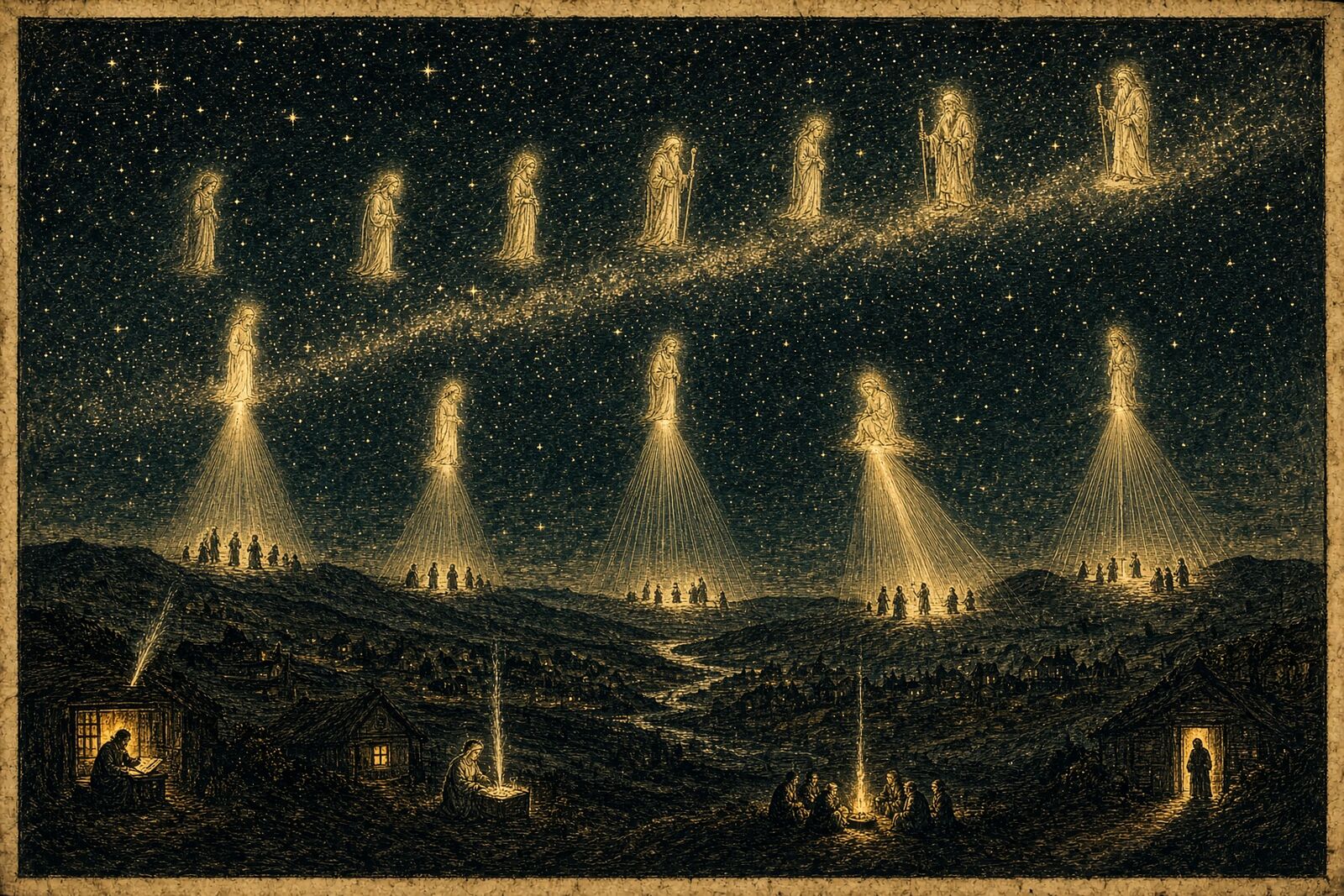
4. The Righteous Shine Like Stars (Daniel 12:3)
“Those who have insight will shine brightly like the brightness of the expanse of heaven, and those who lead the many to righteousness, like the stars forever and ever.” (Daniel 12:3)
This is almost certainly describing one group in two descriptions, not two separate groups. The righteous are people who:
- Possess correct insight — right theology and understanding, gained through the visions and dreams given to Daniel.
- Lead others by example — right, practical living.
Correct belief and correct lifestyle together define the righteous in Daniel’s vision.
Jesus alludes to this verse in the parable of the tares and the wheat (Matthew 13:43), where at the judgment the angels cast out the wicked and the righteous “shine forth” like the sun. It is a loose quotation, but clearly draws on Daniel 12:3 — the resurrected, glorified righteous will shine.
5. “The Time of the End,” Not “The End of Time”
Verse 4 tells Daniel to seal up the scroll (“book” — the Hebrew sefer means scroll; books didn’t exist yet) until, as many translations render it, “the end of time.” This is a mistranslation.
“In Hebrew, the literal translation is ‘the time of the end,’ not ‘the end of time.’ There is a very, very big difference… it’s not that time is going to come to a complete stop.”
“The time of the end” refers to the end of the specific persecution under discussion — not a cosmic termination of time itself. Some interpreters use the “end of time” mistranslation to try to pinpoint the return of the Messiah, but neither the Messiah’s return nor the Son of Man appears anywhere in this passage. The passage should be understood on its own terms first, before theology is drawn from it.
6. Eternal Life — From Hebrew to Greek to the New Testament
Daniel 12:2 is the theological root of the New Testament phrase “eternal life,” and understanding it correctly here is described as absolutely foundational to New Testament Christianity.
In Hebrew, Daniel 12:2 literally reads that the righteous will be resurrected to “the life of the age” (not “eternal life” as a free-floating abstraction). Since:
- the resurrection is a resurrection to immortality, this life is necessarily eternal life, and
- the resurrection marks the transition from the present evil age to the age to come,
“the life of the age” is understood as the life of the age to come — the life that belongs to and characterizes the new era inaugurated by the day of judgment.
In Greek, the translators of Daniel rendered this Hebrew phrase as Zoe aionios — literally “life of the age” (zoe = life; aionios = an adjective meaning “of the age,” not simply “everlasting”). This exact Greek phrase is used by New Testament authors more than thirty times, always assuming the reader already knows its primary meaning: resurrection life from the grave.
“Have any of us right now attained to eternal life in the literal sense of the word? … No, we haven’t — because we have not been raised out of the grave to immortality. That has not yet taken place.”
| Usage in the New Testament |
What it describes |
| Eternal life spoken of in the future |
The literal, future, bodily resurrection to immortality — Daniel 12:2’s primary meaning |
| Eternal life spoken of in the present (as in John’s Gospel — 15 of its 17 occurrences are present-tense) |
A metaphorical application: the “coming to life” of conversion — being dead in trespasses and sins (Ephesians 2) and being raised to new life through repentance, baptism, and union with Jesus |
By default, “eternal life” in Daniel 12:2 — and behind most New Testament usage — is a future reality we do not yet possess, not merely “going to heaven when you die.”
7. “How Long?” — the Question, the Answer, and Three Responses to Persecution
In verses 5–6, two other figures appear by the river, and one asks the man dressed in linen, “How long will it be until the end of these wonders?” This “how long, O Lord” cry is a familiar prayer of the suffering and persecuted, appearing often in prophetic literature and most frequently in the Psalms — a prayer prayed hoping God will intervene to judge evil and vindicate the righteous.
The key to understanding the angel’s answer is understanding what “wonders” means. This rare root word appears only three times in Daniel, and every occurrence describes the destructive activity of Antiochus IV:
| Reference |
What “wonders” describes |
| Daniel 8:24 |
Antiochus will “destroy with an extraordinary degree” — his destructive power |
| Daniel 11:36 |
Antiochus will “speak extraordinary things against the God of gods” (Yahweh) |
| Daniel 12:6 |
“How long until the end of these wonders” — the question being asked |
The question is therefore not “how long until the resurrection,” but “how long until Antiochus’s persecution ends.” Some interpreters wrongly assume the prayer must cover everything in the passage, including the resurrection, and use that assumption to throw the whole chapter into a still-future timeline — but the text itself defines “wonders” narrowly, as Antiochus’s own destructive activity.
Daniel also identifies three ways Jews responded to Antiochus’s persecution, with the third being the response the book of Daniel commends:
| Response |
Description |
| Accommodation |
Assimilating with Greek rule and culture — abandoning marks of Jewish identity and supporting the Hellenization of Judaism |
| Armed revolt |
Taking up weapons and fighting (the Maccabean revolt) |
| Patient, non-violent waiting |
Neither compromising nor resorting to violence — waiting on God, which Daniel appears to encourage |
Those “who have insight” (v. 10) are those responding in this third way.
8. Time, Times, and Half a Time — and the Puzzling Extra 45 Days
The angel’s answer to “how long” is “a time, times, and a half a time” — the same phrase already used in Daniel 7:25 to describe the period during which God’s people would be given into Antiochus’s hand. The logic: one “time,” plus a doubled “times,” plus a “half time” = three and a half. Since seven is the number of completion/perfection in apocalyptic literature, three and a half is exactly half of seven — a deliberately incomplete, unfinished number, signaling that this terrible period is not permanent.
The text clarifies its own imagery a few verses later: “time, times, and a half a time” = 1,290 days, roughly three and a half years — measured from the abolition of the daily sacrifice and the setting up of the abomination of desolation (167 BC) to Antiochus’s own downfall and death (164 BC), matching known history exactly.
Daniel then asks for further clarification (vv. 8–9), and the angel repeats: “these words are concealed and sealed up until the time of the end” (again, not “end time” — the end of this specific persecution). He also clarifies that the abomination of desolation is a thing, not a person — an object (an altar to a pagan god, per the writers of Maccabees, who describe it with a neuter pronoun) that was physically set up in the temple. This point is stressed against readings that turn it into a future individual.
Then comes a genuine puzzle: verse 12 promises blessing to whoever “keeps waiting and attains to 1,335 days” — forty-five days beyond the 1,290. Neither 1st nor 2nd Maccabees records anything historically significant happening at that additional 45-day mark, and the text gives no explanation. Commentators have no consensus, and — predictably — where the text is unclear, wild speculation tends to fill the gap.
One plausible explanation offered: the book of Daniel continued to grow after its Hebrew/Aramaic form (twelve chapters) reached its final shape around 164 BC. The earliest Greek version of Daniel, translated in the same century, includes substantial additional material:
| Addition (Greek Daniel only) |
Location |
Length |
| The Prayer of Azariah and the Song of the Three Jews |
Inserted between Daniel 3:23 and 3:24 |
68 verses |
| The story of Susanna |
A new chapter (ch. 13, or moved to the front in Theodotion’s version) |
63 verses |
| Bel and the Dragon |
A new chapter (ch. 14) |
42 verses |
Combined, these additions total roughly 48% more material than the twelve-chapter Hebrew/Aramaic Daniel. Given that the book demonstrably kept growing and being added to, it is a reasonable (though not certain) guess that the extra 45-day reference in verse 12 may be part of this same ongoing process of addition to the text.
9. Daniel’s Own Rest and Resurrection
“As for you, go your way to the end; then you will enter into rest and rise again for your allotted portion at the end of the age.” (Daniel 12:13)
While readers are told to possess insight, lead others to righteousness, and wait patiently, Daniel himself is given a personal, final word. “Go to your end” means the end of his life. “Rest,” in a chapter that has just spoken of sleeping in the dust of the ground and awakening, means dying — not taking a nap, but falling asleep in death and awaiting resurrection.
There is also a wordplay worth noting: the Hebrew word translated “lot” (as in “allotted portion”) carries the same double meaning it carries in English — it can mean a “lot” as in something cast/chosen, or a “lot” as in a plot or parcel of land. So “your allotted portion” means Daniel will rise to his land of inheritance. Daniel 12:13 is described as an underappreciated but rich verse for theology: Daniel will die, rest, be raised in the resurrection just described in verse 2, and receive his inheritance — and so will anyone who follows his example of faithfulness.
10. Second Maccabees 7 — Living Out Daniel 12
To show how the original readers actually responded to this chapter, the teaching turns to the account of the martyrdom of seven brothers and their mother in 2 Maccabees 7, who were tortured for refusing to eat unclean swine’s flesh rather than transgress the law of their ancestors. As one brother is being tortured to death, he declares:
“You dismiss us from this present life, but the King of the universe will raise us up to an everlasting renewal of life, because we have died for his laws.”
These martyrs did not respond with violence against their persecutors. Their hope — drawn directly from passages like Daniel 12 — was that faithfulness unto death would be met with resurrection, and that God would ultimately vindicate the innocent and the faithful. This same hope, it is suggested, is very likely the kind of hope Jesus himself drew on as the most prominent suffering righteous figure in Jewish history, trusting that God would vindicate him and raise him from the dead.
11. Modern Applications
Four applications are drawn directly from the chapter:
| # |
Application |
| 1 |
Daniel’s petition — “how long will it be until the end?” — is a familiar prayer for God’s suffering people, past and present. God’s response assures us he hears and values these prayers and promises to defeat oppressive evil, even if not within our lifetime, certainly by the day of judgment. |
| 2 |
The righteous are defined as those who possess both insight (biblical truth/theology) and lead others to righteousness (practical, righteous living). Neither alone is sufficient — both must be valued, even if one comes more naturally than the other. |
| 3 |
The future resurrection involves both rising from the grave and facing judgment for how faithfully one lived. Though the wicked often appear to get away with evil in this life, all will stand before the Judge — facing either vindication or public shame and eventual annihilation. |
| 4 |
The book’s final line points to the faithful inheriting “their plot of land” — an echo of humanity’s original vocation. Obedient, faithful human beings will again be placed in charge of God’s world, just as Adam was created to be, a calling forfeited through disobedience, redeemed in Jesus, and brought to its ultimate consummation at the resurrection. |
Summary
| Daniel 12 Is |
Daniel 12 Is Not |
| The clearest, most unambiguous Old Testament promise of bodily resurrection |
A vague or merely spiritual hope of an afterlife |
| A single resurrection event with two destinies — everlasting life or everlasting disgrace |
Two separate resurrections |
| Rescue defined as vindication through resurrection and judgment |
A guarantee of physical safety from persecution |
| “The time of the end” — the end of Antiochus’s specific persecution |
“The end of time” — a cosmic stopping point |
| “Wonders” (12:6) — Antiochus’s destructive acts, as defined by 8:24 and 11:36 |
An open-ended reference covering the whole vision, including the resurrection |
| The abomination of desolation — a thing (an idolatrous altar) set up in the temple |
A future individual person |
| Eternal life — future, bodily resurrection life of the age to come (with a present metaphorical use for conversion) |
Simply “going to heaven when you die” |
| The root of thirty-plus New Testament uses of Zoe aionios |
A phrase New Testament writers had to explain from scratch |
| A word to persecuted communities to remain faithful, non-violent, and hopeful |
A timetable for calculating the date of Christ’s return |
“Let us rejoice in the hope of the kingdom of God — where obedient, faithful, loyal human beings will again be placed in charge of God’s world, in the same way that Adam was created and put in charge, before human disobedience caused us to fall from that vocation. It’s been redeemed in Jesus, and it’s going to come to its ultimate consummation on the day of judgment, when the righteous are raised from the dead, given immortality, and placed in charge of God’s world again. That’s the hope — let’s rejoice in it, hold on to it, and share it with others.”