Revelation Compendium
The complete session notes · 54 sessions · ordered by chapter

Revelation Compendium

Every session summary from the series, reorganised so the material sits under the chapter of Revelation it treats rather than the week it was taught.

What this is

The full text of all 54 session notes — roughly 79,367 words — not a summary of them. Nothing has been shortened, merged or rewritten.

What changed

Only the order. Sessions are grouped under the chapter they cover, so everything on Revelation 13 sits together instead of across three weeks.

Finding your way back

Each card keeps its original session number and links to the recording, so any passage can be traced to the week it was taught.

Before the text

Two introductions

The devotional purpose of the book, and the rules of the apocalyptic genre — taught before the verse-by-verse study began.

Session 1

Intro to the Book of Revelation & Its Devotional Message

Why the book exists Recording ↗

Source: A2K Online Church Archive
Format: Wednesday night Bible study — lecture + Q&A


1. What Kind of Book Is Revelation?

“Apocalypse” does not mean “end of the world.” The Greek word simply means an unveiling or revealing.

Revelation belongs to a distinct genre called apocalyptic literature, which differs from ordinary prophetic literature in two key ways:

  • How the message is received: Classical prophets (Isaiah, Jeremiah, Ezekiel) received the “word of the Lord” directly. In Daniel and Revelation, a heavenly figure appears to a human and explains visions.
  • It is visionary literature: Revelation is full of symbolic visions, not straightforward speech.

Revelation is actually a combination of three genres:

Genre What It Means
Apocalypse Symbolic, visionary, revelatory — communicated through signs
Epistle (Letter) Written to real first-century churches with real situations
Prophecy Not primarily prediction, but calling people to repentance and faithfulness

2. Read It as a Letter to Real People

Because Revelation is a letter, the right interpretive question is:

How would the original recipients have understood this?

The seven churches were real communities in Asia Minor, struggling with real problems — persecution, compromise, lukewarmness, and martyrdom. Misreading Revelation almost always results from ignoring this and treating the book as a cryptic end-times code.

Practical implication: Read the whole letter from start to finish, just as you would any of Paul’s epistles.


3. Symbolism Is the Language of Revelation

The repeated phrases “like” and “as” throughout Revelation signal that it communicates through symbols, not literal descriptions.

“I heard a loud voice like the sound of a trumpet” — it wasn’t literally a trumpet.

Just as an American flag carries more communicative power than the words “United States of America,” apocalyptic symbols carried immediate, powerful meaning to their original audience. The goal is to understand what those symbols communicated in their cultural and historical moment.


4. The Three Prophetic Functions (Correcting a Misconception)

Prophecy is not primarily about predicting end-times events. The primary function of a biblical prophet — think Samuel, Nathan, Elisha — was to:

  1. Stand between God and the people as an intermediary
  2. Call people to repentance: “If you don’t repent, judgment comes; if you do, blessing follows”

Prediction of distant events is a secondary element, not the core. John functions as a prophet in this primary sense — preaching the gospel and calling communities to faithfulness.


5. The Central Thesis — Conquering as Jesus Conquered

This is the speaker’s doctoral research argument and the heart of the lecture.

Every letter to the seven churches ends with a promise “to the one who conquers” (Greek: nikaō — the root of Nike, the goddess of victory). The word appears more in Revelation than in any other book of the Bible.

The Problem

The Roman world had a clear definition of conquering: defeat your enemies with a sword, bloodshed, and force. So when Jesus tells every church “you must conquer,” the original readers would naturally wonder: Am I supposed to take up arms?

The Paradox

Revelation 3:21 says believers are to conquer “just as I [Jesus] conquered.” But Jesus:

  • Was crucified
  • Had his own blood spilled, not his enemies’
  • Appeared to lose from any Roman perspective
  • Never took up arms or promoted Rome’s empire

Yet Revelation 5:5 calls Jesus the triumphant Lion of Judah who has conquered — because he was also the slaughtered Lamb.

This is an upside-down, paradoxical conquering.

The Three Ways Christians Conquer
# Method Description
1 Faithful gospel proclamation Announcing the kingdom of God as a counter-empire to Rome — not colluding with or promoting the kingdoms of this world
2 Non-violent perseverance Enduring suffering without retaliation, even to the point of death — “they did not love their life even when faced with death” (Rev. 12:11)
3 Faithfulness unto martyrdom Not compromising with Rome or the surrounding culture; being willing to die rather than defect

These are exactly the three things Jesus himself did.


6. The Word “Martyr” — A Linguistic Shift

The Greek word martys originally meant simply “witness” — someone who testifies in a legal setting or about the resurrection (Luke 24). It was used of John in his role as an evangelist.

The Book of Revelation is the historical turning point where martys began to shift in meaning toward “one who dies for what they testify.”

This linguistic development reflects the theological reality Revelation is portraying: faithful witness can and sometimes does lead to death — just as it did for Jesus, the “faithful martyr” (Rev. 1:5).


7. Revelation Is Not a Timeline — It’s Ethical Instruction

The speaker’s thesis, stated plainly:

“The book of Revelation is not a timeline of events that are going to happen at the end of the world.”

It is primarily a book of encouragement and ethical direction for persecuted believers. Its purpose is to tell embattled communities:

  • You are already a kingdom and priests (Rev. 1:6)
  • Do not be assimilated into the culture of Rome
  • Do not respond to persecution with violence
  • Identify with the Lamb, not the beast
Key Interpretive Points
  • Babylon (Rev. 17) is identified as sitting on “seven hills” — an unmistakable first-century reference to Rome. But “Babylon” can reappear in any age and culture.
  • The “Antichrist” — that word never appears in Revelation. Reading it into the text is an assumption.
  • The beasts most likely referred to Roman emperors in the original context.
  • The “son of perdition” (2 Thess. 2) is a different figure from Revelation’s beast — the manner of death described differs between the two passages.
  • The lake of fire is a symbol unique to Revelation. Revelation itself interprets it: “the second death” (Rev. 20:14). It is a metaphor for final judgment, not a literal geographic description.
  • “The Lord’s Day” (Rev. 1:10) refers to Sunday — the first day of the week, the day of resurrection, confirmed by second-century usage and broader NT evidence (1 Cor. 16).

8. Multi-Generational Application

While the book is firmly grounded in its first-century context, its message is transferable across generations — just as we apply Paul’s letters today. The “seven” churches likely represent completeness (a symbolic number), meaning the message is addressed to the whole church throughout history.

The call to:

  • Conquer as Jesus conquered
  • Not be assimilated into whatever culture’s dominant “empire”
  • Preach the gospel faithfully
  • Endure non-violently

…is perennially relevant. Evil “Babylons” keep reappearing. The response of God’s people is always the same.


Summary

What Revelation Is What Revelation Is Not
A letter to real first-century churches A secret code for predicting end-times events
Apocalyptic, visionary, symbolic literature A straightforward prophetic timeline
A call to conquer as Jesus conquered A military or political battle plan
Devotional encouragement for persecuted believers Relevant only to a future generation
A portrait of faithful, non-violent witness A justification for violence or self-defense

“I truly believe this is a book that speaks to you devotionally. I’ve found a lot of comfort in reading this — which is really shocking, because if you only think that this refers to the end of the age, you’re missing out.”

Session 2

Introduction to the Apocalyptic Genre

The apocalyptic genre Recording ↗

Source: A2K Online Church Archive
Format: Wednesday night Bible study — lecture + Q&A
Context: Second session in a series working through the Book of Revelation. This session focuses entirely on the literary genre before touching a single verse.


Why Genre Matters

Before reading any book of the Bible, it helps to identify what kind of literature it is. Just as you’d read the funny pages differently than the classifieds, apocalyptic literature has its own rules, conventions, and expectations. Most misreading of Revelation stems from applying the wrong genre assumptions.

The two primary apocalyptic books in the Bible are:

  • Daniel (chapters 7–12)
  • Revelation

What “Apocalypse” Actually Means

The word apocalypse does not mean “the end of the world.” It comes from the Greek and simply means an unveiling or revealing — as if God is pulling back a curtain so human beings can see reality from his perspective.


John Collins’ Scholarly Definition

In 1979, scholar John Collins — still regarded as the world’s leading expert on apocalyptic literature — proposed a definition that remains the scholarly standard today:

“An apocalypse is a genre of revelatory literature with a narrative framework in which a revelation is mediated by an otherworldly being to a human recipient, disclosing a transcendent reality which is both temporal (insofar as it envisages eschatological salvation) and spatial (insofar as it involves another supernatural world).”

This definition has four major components worth unpacking.


Unpacking the Definition

1. Revelatory

Apocalyptic literature unveils truths from God’s perspective that human beings wouldn’t naturally perceive on their own. There is a veil between how humans perceive reality and how God sees it. The apocalypse lifts that veil.

For example: a community might think compromising with sin is no big deal because God is gracious. Revelation reveals that from God’s perspective, that compromise is serious. Five of the seven churches Jesus addresses are rebuked — even though they likely thought they were doing fine.


2. Narrative Framework

Daniel and Revelation are not just lists of visions — they are stories with characters, plot, suspense, and drama.

  • In Daniel, the narrative follows Israelite boys (Daniel, Shadrach, Meshach, Abednego) navigating faithfulness inside a pagan empire. Six chapters of resistance and divine rescue before the visions begin.
  • In Revelation, John on Patmos receives a vision from Jesus involving God, angels, seven churches, nations, dragons, beasts, and more.

Implication: The book should be read like a story — from beginning to end, allowing the narrative to unfold. Jumping to the last chapters to “get the ending” misses how the story builds.


3. Mediated by an Otherworldly Being

This is one of the clearest distinctions between apocalyptic and prophetic literature:

Type How the Message Comes
Prophetic (Isaiah, Jeremiah, Ezekiel) “The word of the Lord came to…” — direct, unmediated
Apocalyptic (Daniel, Revelation) A heavenly being (angel or Jesus) appears and explains the visions

In Daniel 7–12, angels mediate the visions. In Revelation, it is Jesus and angels together.


4. Two Axes of Reality

Collins identifies that apocalyptic literature reveals reality on two different axes simultaneously:

Axis of Temporality (Time)

Two time periods are set in contrast:

  • Now: A time of crisis — persecution, compromise, pressure, suffering
  • Then: A time of peaceful resolution — God’s justice, the kingdom, restoration

The apocalypse doesn’t just announce these two times. It shows the audience how to endure from the crisis period into the resolution. This maps roughly onto the Jewish concept of “the present evil age” and “the age to come,” though not always exactly.

Axis of Space (Heaven and Earth)
  • Heaven above: God’s realm, where everything operates according to God’s will
  • Earth below: A realm in need of redemption, full of corruption and suffering

Believers in the seven churches are caught between these two realities — they belong to heaven (identified with God and the Lamb) but they live on earth in the midst of God’s enemies. The resolution: heaven will ultimately invade and transform earth (“your will be done on earth as in heaven”).

Axis of Morality (The Righteous and the Wicked)
  • Apocalyptic literature identifies the righteous and shows them how to behave
  • It also exposes the character and practices of the wicked — specifically to warn the righteous not to slide into that category
  • Examples from Daniel: resisting Nebuchadnezzar’s food, refusing to bow to the golden statue, enduring the lions’ den
  • Examples from Revelation: not compromising with Rome, not worshiping the emperor, not tolerating false teachers

The outcome is clearly displayed: the faithful are rewarded; the wicked are judged.


13 Characteristics of Apocalyptic Literature

John Collins studied over 30 early Jewish and Christian apocalypses and identified 13 common traits. Those shared specifically by Daniel (chapters 7–12) and Revelation include:

  1. Visions, epiphanies, discourses, and dialogues — the primary mode of communication
  2. Writing — the angel instructs Daniel to write; Jesus instructs John to write
  3. An otherworldly mediator — angels in Daniel; Jesus and angels in Revelation
  4. The recipient’s reaction — Daniel fasts and is terrified; John falls at Jesus’ feet as if dead
  5. Persecution and upheaval — the backdrop of crisis, pressure to assimilate, and resistance
  6. Judgment and destruction of the wicked — the fate of those who oppose God
  7. Judgment of otherworldly beings — angels, the dragon, and the beasts are also judged
  8. Otherworldly regions and beings — Daniel sees nations and visions; John is taken to heaven, a wilderness, a high mountain
  9. Instructions to the recipient — both John and Daniel are told how to live and what to do with what they’ve received
  10. Cosmic transformation and resurrection — earthquakes, lightning, the dead rising
  11. Promises to the faithful — those who conquer receive rewards in the kingdom
  12. Urgency of behavioral response — these books are deeply concerned with how you live, not just what you believe
  13. God’s ultimate sovereignty — behind all the chaos and persecution, God remains on the throne

Signs, Symbols, and Images

One of the most important practical takeaways of this lecture: Revelation communicates through symbols, not straightforward description.

John received a visionary experience — a picture, a trance — and was then tasked with writing it down. Since “a picture is worth a thousand words,” he uses every tool available:


“Like” and “As” — The Language of Comparison

The words like and as appear a combined ~100 times in Revelation — more than any other New Testament book. Nearly one in four sentences uses these comparative words.

“I heard a voice like the sound of a trumpet” — it wasn’t literally a trumpet

This is the book’s way of saying: I’m showing you the best approximation I can of what I saw. These are images, not exact descriptions.


Colors as Symbols

Colors in Revelation carry consistent symbolic meaning rooted in first-century culture:

Color Symbolic Meaning
White Victory, resurrection, purity, heaven, the godly
Red / Fiery Violent power, blood
Purple & Scarlet Imperial decadence, evil empire
Black Death, disaster, mourning
Pale Green Death (the color of unembalmed skin)
Gold Wealth, royalty (true or false)

Animals and Beasts as Political Symbols

Nations and political powers are depicted as animals in both Daniel and Revelation — just as the United States uses an eagle, Russia uses a bear, and so on.

Example: Daniel 7 describes three separate beasts — a lion, a bear, and a leopard — representing three different empires. Revelation 13 then introduces one new beast that combines the characteristics of all three:

“The beast I saw was like a leopard, its feet were like a bear’s, and its mouth like a lion’s.” (Rev. 13:2)

John is not repeating Daniel. He is drawing on Daniel’s imagery to describe something new and worse — a single beast that combines all the ferocity of the previous empires. This is how John uses the Old Testament: creatively and with a new purpose, not as a direct quotation.


Symbols in Culture — Why This Matters

The lecture uses several examples to show that symbols are already part of daily life:

  • A green traffic light means “go” — not just in words, but as a symbol we respond to automatically
  • A police badge means “help” if you’re a victim, “danger” if you’re a criminal — context and perspective shape what a symbol means
  • The American flag carries enormous emotional weight for Americans, but may mean nothing to someone from Uzbekistan — if you don’t know the symbol, you miss the message

This is exactly the challenge with Revelation: its symbols were immediately understood by first-century Jewish Christians. For modern readers unfamiliar with that world, they require study.


Revelation’s Use of the Old Testament

Revelation draws constantly on Old Testament imagery — but with two important caveats:

  1. Over 99% of Old Testament allusions are without direct quotation. John doesn’t say “as it was written in Isaiah.” He just uses the image. Either you recognize it or you don’t.
  2. John regularly disregards the original context of Old Testament passages. He treats Scripture as inspired and therefore adaptable — freely reapplying images and symbols to his own situation and audience. The Old Testament is his source material, not a constraint.

Common mistake: Assuming that understanding the Old Testament passage first gives you the “key” to Revelation. In reality, John may be using it in an entirely new direction.


Numbers as Images

Numbers in Revelation carry symbolic meaning, just as they do in any culture. Examples from everyday life:

  • “We’re number one!” = first place
  • “I waited forever” = a long time, not literally infinity
  • “They’re nickel-and-diming me” = being cheap, nothing to do with actual coins

Numbers in Revelation work the same way. Key symbolic values:

Number Symbolic Meaning
1/3 or 1/2 Limited in scope or time — things are bad, but not total
3 A distinct, identifiable group (e.g., the dragon and two beasts; the threefold description of God)
3½ A limited period of persecution — half of seven, so incomplete and temporary
4 Creation or universality (four corners, four winds, four creatures surrounding the throne)
6 Imperfection — one short of seven’s fullness (hence 666 = three layers of imperfection)
7 Fullness, completion, perfection (seven days of creation, seven churches = the whole church)
12 and multiples The fullness of God’s people (twelve tribes, twelve apostles, 144,000 = 12 × 12 × 1,000)
1,000 A large symbolic number, not a literal count

On 3½ years: This number would have triggered immediate historical memory for Jewish readers — the Maccabean revolt (temple desecrated and restored over 3½ years, commemorated by Hanukkah), the Jewish-Roman War of 66–70 AD (3½ years from outbreak to temple destruction), and Elijah’s drought under Ahab and Jezebel (3½ years of persecution). For a Jewish Christian, “three and a half years” didn’t demand a calendar — it meant a defined, terrible, but survivable time of trial.

On 666: It is simply imperfection stacked three times. The beast may look like it has the power of seven — but Revelation reveals it’s really at six, then drops further. It is a symbol of something that appears complete and powerful but is fundamentally flawed.


The Real Danger: Misusing Revelation

The session closes with an honest conversation about the harm done by irresponsible interpretation. Revelation has been used to:

  • Divide families, churches, and denominations
  • Lead people into fear, conspiracy theories, and unstable behavior
  • Convince vulnerable people that God is engineering their suffering as preparation for the end
  • Cause real psychological and spiritual harm

The teacher’s response: read the text carefully, take the symbols seriously on their own terms, and never claim more than the text actually says. The book itself warns that anyone who adds to or takes away from it will face judgment — a warning the teacher takes personally.


Summary

Concept Key Takeaway
Genre Apocalyptic literature — a distinct type shared only by Daniel and Revelation in the Bible
“Apocalypse” Unveiling or revealing — not “end of the world”
How it works A heavenly being mediates visionary revelations to a human, disclosing God’s perspective
Two axes Time (crisis → resolution) and Space (heaven → earth) and Morality (righteous vs. wicked)
Symbolic language “Like” and “as,” colors, animals, numbers — all carry specific meaning
Old Testament Constantly drawn upon, but freely and creatively — without direct quotes or original context
Numbers Symbolic, not literal — seven means fullness, three and a half means limited persecution, 666 means imperfection
Purpose Ethical instruction and encouragement for persecuted communities — not an end-times prediction chart

“The more carefully I read the text, the more I see. It’s been there for 2,000 years — and it explains 20 other questions I’ve had.”

↑ Chapters

Revelation 1

The Son of Man Among the Lampstands

From session 3, session 4, session 5, session 6.

Session 3

Revelation 1:1–5 — Verse-by-Verse Introduction

1:1–5 Recording ↗

Source: A2K Online Church Archive Format: Wednesday night Bible study — lecture + Q&A Context: Third session in the series. Opens with a brief recap of the three axes, then begins the verse-by-verse study of Revelation, covering 1:1–5.


Quick Recap: The Three Axes

Before moving into the text, the teacher briefly reviewed the interpretive framework from the previous session. Apocalyptic literature operates on three axes simultaneously:

Axis Two Poles Purpose
Temporality (Time) Time of crisis → Time of peaceful resolution Comfort the afflicted; warn the comfortable
Space Heaven (God’s realm) ↔︎ Earth (realm in need of redemption) Reveal God’s perspective to those below
Morality The righteous ↔︎ The wicked Show the righteous how to live; warn them not to backslide

A key pastoral insight: good preaching is supposed to afflict those who are comfortable and comfort those who are afflicted. Revelation does both — it encourages the persecuted faithful and warns those living comfortably in sin that a time of judgment is coming.:


The Problem with Modern Interpretation

Popular culture has reduced Revelation to a coded calendar of end-times events — a puzzle to decode so you can know what’s happening just before Jesus returns. This misses:

  • The original recipients — real people in real crisis who needed practical guidance
  • The function of persecution — the book is written to people under pressure to abandon their faith
  • The practical application — the book is meant to change how you live now, not just inform you about the future

Revelation 1:1a — About and From Jesus

“The revelation of Jesus Christ…”

The phrase “revelation of Jesus Christ” can mean two things — and it means both:

  1. A revelation about Jesus — we will learn who Jesus is throughout the book. Notably, the most common image of Jesus in Revelation is not “King” or “Lord” but the Lamb — a weak, slaughtered animal. This image of Jesus as a Passover lamb is woven through the entire book.
  2. A revelation from Jesus — Jesus is the one communicating this message to John, having received it from God.

“Jesus Christ” is not his first and last name. Christ means “the Anointed King.” Yet the most common image Revelation gives us of this King is a weak, slain animal — that paradox is intentional.

The Hierarchy of Revelation

The chain of communication follows a clear order:

God → Jesus → Angel → John → Bond-servants (churches)

This is consistent with the definition of apocalyptic literature: truth revealed from heaven through otherworldly figures to human recipients.


Revelation 1:1b — The Meaning of Tachos (“Soon”)

”…to show his bond-servants the things which must soon take place.”

The Greek word tachos (from which we get “tachometer,” and related to “taxi” — a vehicle that gets you there quickly) can mean two things:

  1. Soon in time — events that will happen quickly
  2. Close in proximity — something right in front of you, like a pin dropped on your head approaching you rapidly

Neither meaning limits the book only to the first century, nor does it reduce it to a distant future event irrelevant to the original readers. The word creates a sense of urgency — whether temporal or spatial, the decisive moment is close.

A related concept: Kairos (the word for “time” in verse 3) means a decisive, opportune moment — not just any moment on a clock. The decisive time is always near. For a believer, it could be the moment to preach the gospel, to forgive, to speak a word of witness — right in front of you.


Revelation 1:1c — Communicated by Signs (Sēmainō)

”…he communicated it by his angel to his bond-servant John.”

The Greek word translated “communicated” is sēmainō — which means to signify, to give a sign. This is not ordinary verbal communication. From the very first sentence, Revelation is telling the reader how it works:

This book communicates through signs and symbols — not through plain speech.

Reading anything in Revelation as woodenly literal is already against the grain of the text itself. The proper question is always: What does this sign or symbol mean? How would it have functioned for the original audience?


Revelation 1:2 — The Testimony of Jesus and the Word Martyria

“John, who testified to the word of God and to the testimony of Jesus Christ, even to all that he saw.”

Two important observations:

1. The Word of God = The Gospel

“The word of God” here is not a reference to the Bible. It refers to the gospel message — the proclamation about Jesus, specifically Jesus’ own testimony.

2. The Linguistic Shift of Martyr

The Greek word martyria (testimony/witness) is the root of our English word “martyr.”

  • Before Revelation: martys simply meant a witness — someone who gives testimony, like a legal witness. It carried no connotation of death.
  • After Revelation: The word gradually came to mean someone who dies for their testimony.

Scholars have identified the Book of Revelation as the historical turning point that caused this semantic shift. The book so closely ties faithful testimony to the risk of death that the word itself changed meaning over time.

John as evangelist is introduced from verse 2 as a model witness. Jesus will shortly be called the faithful witness — the one whose testimony led directly to his death. The book is laying the groundwork for its central ethical call: witness faithfully, even to the point of death.

Running notes so far:

  • John is a faithful evangelist
  • Jesus’ testimony = the gospel

Revelation 1:3a — Blessed Readers and Hearers

“Blessed is he who reads and those who hear the words of the prophecy and heed the things written in it.”

How the Book Was Experienced

One person reads aloud; the congregation listens. This was the normal experience of Scripture in the first century — literacy rates were extremely low. Even in the most educated cities like Athens, literacy at its peak was around 10%. The vast majority of church members would have experienced Revelation as an oral performance, hearing it read aloud.

This has implications for how the book was designed — it was meant to sound powerful, not just to be decoded quietly in private study.

“Prophecy” Doesn’t Mean “End-Times Prediction”

Revelation is called a prophecy — but prophets in the Bible primarily functioned as:

  • Spokespersons between God and the people
  • Preachers calling for repentance and faithfulness
  • Warning agents: “If you don’t repent, judgment comes; if you do, blessing follows”

Prediction of distant future events was secondary. Think of Samuel, Nathan, Elijah, Elisha — they preached to the people in front of them. Even predictions like those in Isaiah and Jeremiah were conditional: if people repent, the judgment doesn’t come (see Jonah and Nineveh as proof that prophetic judgment is conditional by nature).

The Verb Tēreō — “To Heed/Keep”

The verb translated “heed” (tēreō) means to keep, maintain, and obey. This verb appears in 10% of all its biblical occurrences inside the Book of Revelation — a striking concentration. The book is fundamentally a book of practical commands to be obeyed.

Every occurrence points to concrete behavior:

Reference What Is to Be Kept
Rev. 1:3 The words of this prophecy
Rev. 2:26 Jesus’ deeds, until the end
Rev. 3:3 What you have received and heard (the gospel)
Rev. 3:8 Jesus’ word; not denying his name
Rev. 3:10 The word of Jesus’ perseverance
Rev. 12:17 The commandments of God + testimony of Jesus
Rev. 14:12 The commandments of God + faith/faithfulness of Jesus
Rev. 16:15 Staying awake and keeping your clothes (moral alertness, identity)
Rev. 22:7 The words of the prophecy of this book

Every single “keep” in Revelation refers to things you could have learned from reading Paul’s letters or the Gospels — faithfulness to the gospel, obedience to God’s commands, perseverance in witness. Nothing is novel or hidden. The book reinforces what disciples are already called to.


Revelation 1:3b — The Time Is Near and Jesus Is Present

”…for the time is near.”

Kairos = a decisive, critical moment — not a random tick on a clock.

The teacher makes a provocative point: nearness does not only mean time. Jesus said “where two or three are gathered in my name, I am there in their midst.” Revelation 1:20 reveals that the seven lampstands are the seven churches — and Jesus is described as walking in the middle of them (1:12–13). Jesus is near now. He is present in the churches.

This means:

  • He can see what they’re doing (“I know your deeds” — said to every church)
  • He can rebuke and judge immediately, without waiting for a final second coming
  • The church in Ephesus that didn’t repent lost its lampstand — it no longer exists. Jesus judged it in real time.
  • Ananias and Sapphira (Acts 5) and the Corinthians abusing the Lord’s Supper (1 Cor. 11) are New Testament examples of present-tense judgment, not deferred judgment

“The time is near” doesn’t mean the end of history is imminent. It means the decisive moment — for obedience, for witness, for repentance — is always right in front of you.


Revelation 1:4a — The Epistolary Greeting

“John to the seven churches that are in Asia: Grace to you and peace from him who is and who was and who is to come…”

This is a standard Greek letter opening — identical in form to Paul’s epistles (“Paul to the church in Corinth, grace and peace from God our Father and Jesus Christ”). This confirms the book’s genre as an epistle written to real, specific communities in the first century.

The seven churches were real historical congregations in Asia Minor (modern Turkey). Archaeological evidence confirms their existence. These were not symbolic future churches — they were communities Paul and others knew and cared for.

“Him Who Is and Who Was and Who Is to Come”

Instead of writing “God the Father,” John uses this word-picture. Its meaning:

  • Eternal: God always has been, is, and always will be
  • Contrasted with false gods: Several Greco-Roman gods were described in similar terms in the first century:
    • Isis: “All that has been and is and shall be”
    • Zeus: “Zeus is, Zeus was, Zeus shall be”
    • Aion (god of time): “The one who is, was, and will be”

John’s formula is a polemical counter-claim: the God who revealed himself to Israel — not Isis, not Zeus, not Aion — is the true eternal God who controls history and reveals himself through Jesus.

Notably, later in Revelation at the moment of judgment, God is described only as “he who is and who was” — no longer “who is to come” — because he has already arrived.


Revelation 1:4b–5a — The Seven Spirits and Jesus’ Three Titles

The Seven Spirits

”…and from the seven spirits who are before his throne…”

Some read “seven spirits” as a reference to the Holy Spirit. This is unlikely for two reasons:

  1. The number: The Holy Spirit is never described as seven of anything. Seven is the number of fullness — but “seven spirits” in the plural points to distinct beings.
  2. Epistolary convention: In every Pauline letter, greetings come from God and Jesus — never from the Holy Spirit. The Holy Spirit does not send greetings in letters.

Later in Revelation (chs. 3–4), these seven spirits are identified as seven angels. Angels are described as “ministering spirits” elsewhere in the New Testament (Heb. 1:13–14). These are the authorized angels — the heavenly intermediaries consistent with apocalyptic literature — sending greetings alongside the Father.

Jesus: Three Descriptions (Rev. 1:5)

Jesus is introduced with three titles that form a deliberate progression:

Title Meaning
Faithful Witness (martys) Jesus preached the gospel faithfully and died for it — he is the original martyr in the fullest sense
Firstborn of the Dead He is the first to be resurrected; his resurrection is the guarantee and preview of ours
Ruler of the Kings of the Earth Jesus already reigns — not just at his future return, but now, seated at God’s right hand

On “Ruler of the Kings of the Earth”: This doesn’t look true when you turn on the news. Wars, corruption, injustice. But this is precisely what Revelation is revealing — from God’s perspective, Jesus already rules. His rule will be fully consummated at the second coming, but it has already begun. If he’s already ruling, believers must already be obedient and subservient to him — not to the empires of this world.


The Number Seven in Revelation

The book is saturated with sevens — not accidentally, but as a deliberate literary and theological structure:

Item Count
Blessings (“blessed”) 7
Occurrences of “testimony of Jesus” 7
Occurrences of the name “Jesus” 14 (2 × 7)
Occurrences of “Christ” 7
Occurrences of “Lamb” (referring to Jesus) 28 (4 × 7)
Occurrences of “God and the Lamb” 7
Occurrences of the universal phrase “peoples, tribes, nations, tongues” 7

Seven signals completeness and fullness. The seven churches don’t represent only those seven communities — they represent the fullness of the church in all times and places.


Summary: What Revelation 1:1–5 Establishes

Element What It Tells Us
“Revelation of Jesus Christ” Both about and from Jesus; the primary image of Jesus = the Lamb
Hierarchy God → Jesus → Angel → John → Churches
“Communicated by signs” (sēmainō) The entire book works through signs and symbols, not literal description
“Soon” (tachos) Close in time and/or in proximity — creates urgency without limiting audience to one era
“Testimony” (martyria) Revelation is where the word “martyr” began its shift to mean “one who dies for their witness”
“Blessed… if you heed” (tēreō) The book is fundamentally practical — its words are commands to obey
“The time is near” (kairos) The decisive moment is always in front of you; Jesus is already present in his churches
Epistolary greeting A real letter to real first-century communities — not a coded future prophecy
“Him who is and who was and who is to come” A polemical claim against Greco-Roman gods — the God of Israel is the true eternal ruler of history
Three titles of Jesus Faithful witness → firstborn of the dead → ruler of the kings of the earth (already, not only future)

“What I want you to walk away with today is that Revelation is intentionally and deliberately practical for your life. It was practical for them 2,000 years ago and it’s still practical for us today. How can I use this book to make me a better disciple? How can I use this book to help me be more allegiant to God and obedient to the Lamb?”

Session 4

Revelation 1:5-8 — Jesus the Faithful Witness, Priests, and Alpha & Omega

1:5–8 Recording ↗

Session 4 | Continuing the verse-by-verse study of Revelation 1, covering verses 5–8. Source: A2K Online Church Archive — Revelation 1:5-8


The Twofold Purpose of Apocalyptic Literature

Before continuing in the text, the teacher restates the core purpose of this genre and the entire study:

  1. To give hope to believers suffering persecution, tribulation, or hardship — pointing them toward resurrection, vindication, and the coming kingdom
  2. To rebuke and prod Christians who have grown comfortable, apathetic, or compromised with the surrounding fallen world.

The practical question that should drive every reading: How can this book encourage me in whatever I’m going through — and how can it shake me out of apathy?


Three Descriptions of Jesus (Rev 1:5)

Jesus is introduced with three progressive titles that form a theological argument:

1. The Faithful Witness (martys)

The very first description of Jesus in Revelation is not “King” or “Lord” — it is the faithful witness, which is literally the faithful martyr. Jesus is held up first and foremost as someone who:

  • Preached the gospel faithfully
  • Died because of that preaching
  • Is the model for Christian discipleship

The teacher makes a critical application: if Jesus is the faithful evangelist who died for his witness, then we who follow him are also called to preach the kingdom — even in the midst of a culture that glorifies another kingdom (Rome in the first century; whatever fallen Babylon looks like in ours).

2. The Firstborn of the Dead

After martyrdom comes resurrection. As the firstborn of the dead:

  • Jesus is the first of many who will be raised — his resurrection is a preview and guarantee of ours
  • “Firstborn” implies privilege and priority; Jesus has been exalted to the highest position of any creature
3. The Ruler of the Kings of the Earth

Jesus is already the ruler of the kings of the earth — not just at the second coming, but now. This is one of the central claims Revelation wants its readers to believe despite appearances to the contrary. The New Testament consistently teaches this “already/not yet” tension:

  • 1 Corinthians 15: “He must reign until he puts all enemies under his feet” — he is reigning now
  • Psalm 110:1: “Sit at my right hand until I make your enemies your footstool” — he is currently seated, not idle

The overlap of the ages: The age to come has already broken into the present. Jesus’s exaltation is real, even if the consummation of his kingdom is still future.

Implication for Christians: Because Jesus is already ruler of the kings of the earth, we belong to his empire — not Rome’s, not any nation’s. Our allegiance is to a different kingdom.


Love That Reproves and Disciplines (Rev 3:19 cross-reference)

Revelation says Jesus “loves us” (1:5), but the book immediately defines what that love looks like in practice. Turning to Revelation 3:19:

“Those whom I love I reprove and discipline.”

This is crucial: Jesus’s love in Revelation is expressed through correction and rebuke, not just comfort and reassurance. Of the seven churches, five receive rebuke. The practical application:

  • When we read Revelation and feel convicted, that is the love of Christ at work
  • Being freed from sin means Jesus, not sin, now governs our behavior
  • Christians should welcome reproof rather than resist it

Made a Kingdom and Priests (Rev 1:6)

Jesus has already made the body of believers:

  1. A kingdom — We are already citizens of God’s kingdom, not merely waiting for a future one. This parallels Philippians 3:20 (“your citizenship is in heaven”) and the Lord’s Prayer (“your kingdom come… on earth as in heaven”).
  2. Priests — Drawing on Exodus 19:6 (“you will be a kingdom of priests and a holy nation”), Jesus has now fulfilled this calling through the church. This is picked up again in 1 Peter 2:9 (“a royal priesthood”).
What Does Being a Priest Mean?

The teacher leads a discussion and identifies key priestly responsibilities for Christians today:

  • Intercession — standing between God and the people, praying for others and pointing them to right relationship with God
  • Holy behavior — being set apart for God’s purposes, distinct from the fallen culture
  • Living sacrifices — Paul’s Romans 12:1 teaching that God never wanted animal sacrifices as an end in themselves; what he wanted was the complete giving of oneself to God
  • Temple workers — if we are priests, we serve in a temple; that temple is the body of Christ (1 Cor. 6:19)
The Body of Christ as the New Temple

The church is described throughout the New Testament as God’s new temple:

  • Paul: “You are the temple of God” (1 Cor. 3:16)
  • Revelation: The churches are called lampstands — the lampstand (menorah) was a fixture of the Jerusalem temple
  • This means the church’s identity is that of a holy, priestly, temple community — affecting both behavior (holiness, distinctness from the world) and mission (being a light to the world through gospel proclamation)

The Lamb as the Most Common Image of Jesus

The most common title for Jesus in Revelation is not “King” or “Lord” but the Lamb — specifically, a slaughtered Passover lamb. This is theologically deliberate:

  • It identifies Jesus with weakness, sacrifice, and death
  • To be identified with Jesus means to be identified with this slain lamb
  • Christians as “followers of the Lamb” carry the same image: sacrifice, not domination

“Behold, He Is Coming With the Clouds” (Rev 1:7)

This is a double citation from two Old Testament texts:

  • Daniel 7:13 — the Son of Man coming in the clouds
  • Zechariah 12 — “those who pierced him” mourning

John uses Zechariah here in a completely reinterpreted way. In Zechariah, the people who “pierced” God were Israelites who spurned him. John takes this and applies it to the rejection and crucifixion of Jesus — not because the original context demands it, but because he is freely reappropriating Old Testament scripture for a new purpose.

The key point of verse 7: When Jesus returns, every eye will see him, and all the tribes of the earth will mourn over him. This mourning is not the mourning of defiance — it is the godly mourning of repentance.

“Blessed are those who mourn, for they will be comforted.” (Matthew 5:4) — mourning one’s sin leads to change, repentance, and comfort.

Revelation here is not just announcing Jesus’s return as an event of destruction. It is calling the nations to mourn their sin, to repent, and to follow the Lamb. The heart of God in this book is for repentance and conversion, not merely punishment.


“The Amen” and Its Function

The word Amen in verse 6 is not a casual sign-off. When the original readers said “Amen” to the descriptions of Jesus — faithful witness, firstborn of the dead, ruler of the kings of the earth, lover of our souls, freer from sin, maker of priests — they were verbally committing themselves to these truths. It is an act of allegiance, not just agreement.


God as Alpha and Omega, the Almighty (Rev 1:8)

God the Father is introduced with two important titles:

Alpha and Omega

The first and last letters of the Greek alphabet — a way of saying God is the beginning and the end, the one who initiates and consummates all things. This is not primarily about omniscience; it is about total sovereignty over history.

Importantly, later in Revelation (11:17) God is described as “the one who is and who was” — with the phrase “who is to come” dropped — because at that point in the narrative God has already arrived in judgment.

Pantocrator — The Almighty

The Greek word for “Almighty” (Pantocrator) means ruler of all things (pan = all; krateo = to rule). Archaeologists have found inscriptions in four of the seven cities (Ephesus, Smyrna, Sardis, Laodicea) calling the Roman Emperor the Autocrator — the self-ruler. Revelation counters: God is the true Pantocrator, the ruler of all things. Caesar is nothing by comparison.


Summary Table

Element Meaning
Faithful Witness Jesus preached the gospel and died for it — he is the model for Christian evangelism
Firstborn of the Dead His resurrection guarantees ours; his exaltation is the highest ever given to a creature
Ruler of the Kings of the Earth Already true — not just future; we belong to his kingdom now
Love that reproves Jesus’s love includes discipline and correction, not just comfort
Kingdom and Priests Christians are already both — affecting identity, behavior, and mission
New Temple The church is where God’s presence now dwells; lampstand = temple imagery
He is coming The nations will mourn — a call to repentance, not just a threat of judgment
Amen An act of public commitment and allegiance to these truths
Pantocrator God is the true Almighty Ruler — not Caesar, not any human empire

“This book is so incredibly practical. It doesn’t matter if it was written 2,000 years ago or written today — it is so practical, and we could use this in our lives.”

Session 5

Revelation 1:9-13 — John on Patmos, the Lord’s Day, and Jesus Among the Lampstands

1:9–13 Recording ↗

Session 5 | Covers Revelation 1:9–13, the introduction of John, his situation on Patmos, the Lord’s Day, the trumpet-like voice, and the vision of the lampstands. Source: A2K Online Church Archive — Revelation 1:9-13


Authorship: Why It Matters to the Churches

John introduces himself not as an apostle but as a fellow brother who shares in three things with the seven churches. His authority doesn’t come from apostolic status — it comes from his prophetic experience of receiving this vision from the risen Jesus.

The practical reason authorship matters: if someone outside your community writes a letter claiming divine authority, you need a reason to listen to them. John’s credentials are:

  • He is a fellow sufferer — a partaker in the same tribulation
  • He received a direct vision from the risen Christ
  • He is a faithful gospel preacher (the “Word of God and testimony of Jesus”)

Three Things Shared with the Churches (Rev 1:9)

John says he is a fellow partaker (koinōnia) in three realities, all of which are “in Jesus”:

1. The Tribulation (thlipsis)

This is the tribulation — with a definite article. John and the seven churches are already experiencing it. It is not a future event. They suffer because of their identification with Jesus, not because they are law-breakers.

Note on “The Tribulation”: Some Christian theologies reserve this phrase for a future period. This text clearly says the Christians of the first century are already in it. Whether or not there is a future intensification of tribulation, the Christians receiving this letter are already suffering it right now.

2. The Kingdom

They are already partakers in the kingdom. This fits the New Testament’s consistent “already/not yet” pattern:

  • Romans 14:17: “The kingdom of God is not eating and drinking but righteousness, joy, and peace in the Holy Spirit”
  • Matthew 28:18: All authority has already been given to Jesus
  • Revelation 1:5: Jesus is already the ruler of the kings of the earth

The kingdom is not only future. Christians participate in God’s redemptive reign right now, even while awaiting its full consummation at Jesus’s return.

3. Perseverance (hypomonē)

This word will recur throughout Revelation as a major theme. The teacher has a full chapter in his doctoral dissertation on it. Its meaning in Revelation is specific:

Perseverance = steadfast, non-violent endurance

It means:

  • Not giving up the faith under pressure
  • Not responding to persecution with violence
  • Enduring faithfully even to the point of death

This is not passive resignation — it is active, costly faithfulness that refuses both defection and retaliation. It mirrors how Jesus himself responded to persecution.

The two wrong responses to persecution:

  1. Giving up the faith — not perseverance
  2. Taking up weapons to fight back — also not perseverance, and never endorsed by Jesus

The right response: faithful endurance, non-violent steadfastness, continuing to preach the gospel.


John on Patmos

John is on Patmos because of the Word of God and the testimony of Jesus — he is there in connection with his role as a faithful gospel preacher. Whether he was exiled there, went for safety, or went to evangelize is unclear from the Greek (it is grammatically ambiguous). What is clear:

  • Patmos was not a deserted island — there was a significant community there, a Greek gymnasium, and a temple to Artemis
  • It was not a prison colony — there were no mines on Patmos
  • His presence there is tied to his identity as a faithful witness of the gospel

This is the third reference in the first nine verses to faithful gospel preaching as a dominant theme. The book is deeply concerned with faithful witness.


“In the Spirit on the Lord’s Day” (Rev 1:10)

The Lord’s Day = Sunday

The phrase “Lord’s Day” (kyriakē hēmera) is an adjective form unique to this verse in the New Testament. Evidence from the early second century makes the meaning clear:

  • Ignatius (early 2nd century): Defined the Lord’s Day as “the day after the Sabbath, the resurrection day”
  • The Didache (~100 AD): “On the Lord’s Day come together, break bread, and hold the Eucharist”
  • Acts 20:7: Paul and Luke gathered with believers “on the first day of the week” to break bread
  • 1 Corinthians 16:2: The collection was taken “on the first day of every week”

All evidence points to the Lord’s Day = Sunday, the day of resurrection, the day of Christian assembly.

“In the Spirit” = A Trance-Like Visionary Experience

John is not simply writing a letter — he is recording what he experienced in a prophetic, visionary state. This is similar to:

  • Ezekiel’s visions
  • Paul’s being “caught up to the third heaven” (2 Cor. 12)
  • Old Testament prophets receiving visions from God

A Voice Like a Trumpet (Rev 1:10-11)

The trumpet-like voice commands John to write what he sees in a scroll and send it to the seven churches (listed in order of a clockwise circuit through Asia Minor, beginning at the port city of Ephesus).

Why seven churches when others exist? Colossi, Troas, and Hierapolis all had Christian communities in that region. The number seven is deliberate: it symbolizes completeness, meaning the letter is addressed to the whole church in all times and places, not only those seven congregations.

The geography: Starting at Ephesus (the port), the route goes clockwise: Ephesus → Smyrna → Pergamum → Thyatira → Sardis → Philadelphia → Laodicea. This was a natural postal route.


The Hearing-Before-Seeing Pattern

A key literary device in Revelation: John hears something first, then turns and sees — and what he sees clarifies and unpacks what he heard. This pattern appears at least three times:

  • Here in 1:10-13 (hears a trumpet voice; turns and sees lampstands and Jesus)
  • Revelation 5 (hears the Lion of Judah; looks and sees a slain Lamb)
  • Revelation 7 (hears the number 144,000; looks and sees an uncountable multitude)

The rule: What he sees is not a contradiction of what he heard — it is a clarification and deeper explanation. The second image unpacks the first. Always hold both together.


Seven Golden Lampstands = Seven Churches (Rev 1:12-13, 20)

John turns and sees seven golden lampstands, and Jesus is in their midst. Revelation 1:20 tells us exactly what these mean: the seven lampstands are the seven churches.

Why a Lampstand?

Two layers of meaning:

1. Temple imagery: The Solomon’s Temple had ten lampstands; Herod’s rebuilt temple had one (the menorah). The lampstand was a central fixture of the Jerusalem Temple. For Jews and Jewish Christians, a lampstand = the temple. Jesus here is saying the churches are the new temple — the place where God’s presence dwells.

This is not new to Revelation. Paul already said it:

  • “Do you not know that you are God’s temple and the Spirit of God dwells among you?” (1 Cor. 3:16)
  • “Your body is a temple of the Holy Spirit” (1 Cor. 6:19)

2. Light/evangelism imagery: A lampstand holds a lamp whose purpose is to give light. Jesus said in Matthew 5: “You are the light of the world” — addressing the disciples collectively (second person plural). Churches are lampstands not just to be holy, but to shine — to be outreach centers, evangelistic communities bearing light to a dark world.

The church’s dual identity in this image:

  • A holy place like the temple — affecting behavior, purity, and separation from the fallen culture
  • A light to the world — affecting mission, outreach, and gospel proclamation

Jesus Present in the Midst of His Churches

Jesus is described as walking in the midst of the seven lampstands (1:13). Since the lampstands are the churches, this means Jesus is currently present in his churches right now — not absent, not far away.

The practical implications:

  1. Comfort: Jesus knows what his people are suffering. He is aware of every trial and tribulation. He has not abandoned them.
  2. Warning: Jesus also knows every sin, every compromise, every failed deed. That is why he can say to each church “I know your works” — because he is there.
  3. No hiding: If Jesus is present in his churches, Christians cannot pretend everything is fine before God. He sees what is really going on.

This is consistent with Matthew 18:20 (“where two or three gather in my name, I am there among them”) and Matthew 28:20 (“I am with you always, to the end of the age”).

Parallels with present-tense judgment: Ananias and Sapphira (Acts 5) and the Corinthians abusing the Lord’s Supper (1 Cor. 11) demonstrate that Jesus and God do not wait until the final day to judge. Present-tense discipline happens within the church’s life right now.


Summary

Element Meaning
Fellow partaker in tribulation John and the churches suffer together — he is credible because he shares their experience
Kingdom in the present Already being experienced; not only future
Perseverance Steadfast, non-violent endurance — neither giving up nor fighting back
Patmos Connected to his vocation as a faithful gospel preacher
Lord’s Day = Sunday Confirmed by Ignatius, the Didache, Acts 20, and 1 Corinthians 16
In the Spirit A prophetic trance-like visionary experience
Seven churches Symbolic completeness — the letter is for all churches everywhere
Hear then see pattern What he sees unpacks and clarifies what he heard — hold both together
Lampstand = church Temple identity (holy, God’s dwelling) + evangelistic identity (light to the world)
Jesus among the lampstands Present in his churches now — brings both comfort and accountability

“The time is near. The decisive moment is always right in front of you. Jesus is in your midst, watching, shepherding, and calling.”

Session 6

Revelation 1:13-20 — The Son of Man Vision and the Two Witnesses Preview

1:13–20 Recording ↗

Session 6 | Covers the full description of the exalted Jesus in Revelation 1:13–20, including his appearance, the sword from his mouth, his titles, and a preview of the two witnesses in chapter 11. Source: A2K Online Church Archive — Revelation 1:13-20


The Hearing-Before-Seeing Pattern (Revisited)

The teacher re-emphasizes this key literary device: John first hears a trumpet-like voice, then turns and sees. What he sees clarifies and unpacks what he heard — the two images are not contradictions but complementary perspectives on the same reality.

Best example (preview from chapter 5): John hears that “the Lion of the tribe of Judah has conquered” — a powerful warrior image. But when he turns and looks, he sees a lamb that has been slain. The seeing unpacks the hearing: Jesus conquered as the slain lamb, not as a ferocious lion. This paradox is the heart of Revelation’s theology of conquering.


Description of the Exalted Jesus (Rev 1:13-16)

Jesus appears in John’s vision described with striking imagery drawn from two Old Testament figures in Daniel 7.

Daniel 7 and the Combination of Images

In Daniel 7, two distinct figures appear:

  • The Ancient of Days — God himself, described as having hair like white wool and sitting on a flaming throne
  • The Son of Man — a human figure distinct from the Ancient of Days, who comes in the clouds

Revelation takes both of these descriptions and applies them to Jesus. Jesus here is described with:

  • A robe reaching to his feet and a golden sash
  • Hair white like wool, like snow (from the Ancient of Days)
  • Eyes like flames of fire
  • Feet like burnished bronze (a new word — no prior occurrence in any literature)
  • Voice like the sound of many waters (like Niagara Falls — overwhelming, powerful)
  • Face shining like the sun in full strength
What Does This Mean?

This does not mean Jesus is God (the Ancient of Days). It means Jesus fully represents God and has been invested with God’s authority and name. The exalted Jesus, seated at God’s right hand, shares in God’s titles and attributes as God’s authorized agent and representative.

Philippians 2:9-10: “God has given Jesus the name which is above every name” — God shared his name with Jesus. Similarly here, God shared his descriptions with Jesus.

“Jesus is the closest human being to God that we have ever met. Jesus fully represents God in every possible way a human being can do so.”


The Seven Stars (Rev 1:16, 20)

In his right hand Jesus holds seven stars. Two important observations:

1. The right hand = authority and power. Jesus is at God’s right hand (the seat of authority). Whatever Jesus holds in his right hand is under his control and authority.

2. A counter-imperial image. A coin minted during the reign of Emperor Domitian (who ruled when Revelation was written) depicts his infant son sitting on a globe surrounded by seven stars, symbolizing Rome’s rule over the world. Revelation deliberately subverts this: it is Jesus who holds the seven stars, and it is Jesus who is already the ruler of the kings of the earth (1:5).

Revelation 1:20 identifies the seven stars as the angels of the seven churches — heavenly beings assigned to those communities. Jesus controls all the angels; seven (the number of completeness) represents his control over all angelic beings.


The Two-Edged Sword from His Mouth (Rev 1:16)

Out of Jesus’s mouth comes a sharp two-edged sword. This is the only weapon Jesus ever uses in the entire book of Revelation — and it is not a real weapon.

Old Testament Background

Isaiah 11:4 — The messianic figure “will strike the earth with the rod of his mouth and with the breath of his lips will slay the wicked.” His instrument of judgment is his words.

Isaiah 49:2 — The servant of God says: “He made my mouth like a sharp sword.” This is the same servant-figure through whom God’s salvation will reach to the ends of the earth — through the speaking of the gospel.

Hebrews 4:12 — “The word of God is living and active, sharper than any two-edged sword… able to judge the thoughts and intentions of the heart.”

What the Sword Means

The sword from Jesus’s mouth is his word — the gospel message — which functions in two directions:

  1. Comfort and shepherd: For those who are faithful, suffering, and persecuted, Jesus’s words guide, comfort, vindicate, and sustain
  2. Judgment and discipline: For those who are sinful and unrepentant, Jesus’s words rebuke, warn, chastise, and judge

This is exactly what Jesus does in his letters to the seven churches. He speaks to each of them with this two-edged word — praising what is good, rebuking what is wrong, calling to repentance.

The gospel itself is two-edged:

  • Good news of the kingdom — hope, forgiveness, resurrection
  • A word of judgment — repent or face consequences

“This is not automatically a negative judgmental image. Words can either be comforting and beneficial, or they can warn and discipline. That’s the sword.”


Jesus’s Face Shining Like the Sun

This connects to Moses descending from Sinai with a shining face (Exodus 34) — but amplified. The sun at full strength cannot be looked at directly; John had the same overwhelming experience. Jesus, having spent 2,000 years in the presence of God, simply radiates God’s glory in his glorified resurrection state.


John Falls as Dead; Jesus Places His Right Hand (Rev 1:17)

John’s response is to fall at Jesus’s feet “like a dead man.” There is no pride or arrogance here — the experience is overwhelming. Then Jesus does something beautiful: he places his right hand on John.

The same right hand that holds the seven stars — a symbol of power, authority, and sovereignty — becomes an instrument of comfort. The same Jesus who rules over everything still reaches down to comfort his struggling, overwhelmed people.


Jesus: First and Last, Living One, Keys of Death and Hades (Rev 1:17-18)

Jesus identifies himself with three more descriptions:

“I am the first and the last” — an all-encompassing title indicating sovereign authority over all of history

“I am the living one” — this phrase distinguishes Jesus from God. God has never died. Only Jesus can say “I was dead, and behold I am alive forevermore.” This is the crucial distinction in Revelation between God the Father and the Son.

“I hold the keys of death and Hades” — having conquered death through resurrection, Jesus now possesses authority over death itself. He can unlock that domain and bring people out of it. This is not a literal keychain — it is a metaphor for control and authority.


The Mystery Explained (Rev 1:20)

Jesus calls the vision a “mystery,” then immediately explains it — inviting readers into the inner counsel of God:

  • The seven stars = the seven angels of the seven churches
  • The seven lampstands = the seven churches

The reader is privileged to share in this explanation. This is a sign of honor and inclusion — you are given access to what God is revealing through Christ.


Preview: The Two Witnesses as the Church (Chapter 11)

The teacher offers a preview connecting the lampstand imagery from chapter 1 to chapter 11:

  • Revelation 1:20: Lampstands = churches
  • Revelation 11:3-4: The two witnesses are described as “the two lampstands that stand before the Lord of the earth”

If lampstands = churches, then the two witnesses are a vision of the church in its vocation to preach the gospel.

Additional supporting details:

  • The two witnesses share one mouth (verse 5 says “fire flows out of their mouth” — singular, not mouths plural)
  • If they are killed, they leave one body (verse 8 uses the singular form in Greek)
  • “Two witnesses” invokes the legal principle: “by the mouth of two or more witnesses, every fact is established” — the church’s testimony carries legal, authoritative weight in God’s court

The number two doesn’t refer to two individuals; it refers to the sufficiency of the church’s witness — the testimony is confirmed, authoritative, and complete.

“The two witnesses are not two future individuals flying around preaching. They are a vision of the church in its responsibility to be the light of the world, faithful lampstands preaching the gospel to the nations.”


Summary

Element Meaning
Ancient of Days + Son of Man combined in Jesus Jesus fully represents God — God’s authority and name shared with him
Seven stars in his right hand Control over all angels; counter-claim against Domitian’s imperial imagery
Two-edged sword from his mouth His word — the gospel — comforts the faithful and judges the unrepentant
Right hand on John Same hand of authority becomes the hand of comfort — Jesus is both sovereign and pastoral
First and Last / Living One Sovereign over all history; uniquely, the one who actually died and rose
Keys of death and Hades Authority over death because he conquered it
Lampstands = churches Temple identity (holy, God’s presence) + evangelistic identity (light to the world)
Two witnesses (ch. 11 preview) Vision of the church’s corporate witness — legally sufficient, gospel-bearing testimony

↑ Chapters

Revelation 2

Letters to Ephesus, Smyrna, Pergamum, Thyatira

From session 7, session 8, session 9, session 10.

Three background notes on the cities, their patron deities and their native peoples are collected under Background at the end.

Session 7

The Letter to Ephesus — Revelation 2:1-7

2:1–7 · Ephesus Recording ↗

Session 7 | The first of the seven letters, with extensive historical background on the city of Ephesus before examining the text. Source: A2K Online Church Archive — Revelation 2:1-7


Why Historical Context Matters

These letters were written to actual Christian communities in actual first-century cities — not to symbolic future churches or abstract types. Reading them without understanding the cities is like reading Paul’s letter to Corinth without knowing anything about Corinthian culture. The more we know about the city, the more the letter’s specific details come alive.


The City of Ephesus

Key facts:

  • Largest city in Asia Minor; third largest in the Roman Empire (after Rome and Alexandria)
  • Population over 250,000 — a major urban, industrial, and commercial center
  • The only port city among the seven churches — the natural first stop for a letter sent from Patmos
  • Seat of Roman provincial government for all of Asia Minor
  • Designated a “free city” — allowed to self-govern, but public business required scheduling with Rome
Religious Landscape

Four major religious forces shaped Ephesian life:

  1. A Jewish community — well established, significant
  2. The Imperial cult — worship of the Roman Emperor and his family (the fastest-growing religion in the first century)
  3. The goddess Artemis — patron deity of Ephesus, whose temple was one of the Seven Wonders of the Ancient World
  4. Christian communities — including those shaped by Paul, Timothy, and John’s Gospel

The Imperial Cult in Ephesus

Rome did not force these cities to worship the Emperor. The citizens chose this on their own:

  • Rome authorized Ephesus’s request to build a temple to Julius Caesar and the goddess Roma — at Ephesus’s initiative
  • Another temple was built in honor of Domitian (the Emperor when Revelation was written)
  • 13 inscriptions dedicated to Domitian were found in the temple
  • An 18-foot statue of Domitian stood outside
  • Emperor’s birthdays were celebrated as annual public festivals
  • Sacrifices to the Emperor were held publicly
  • Statues and busts of imperial family members filled streets and buildings
  • Coins bore the Emperor’s image alongside the goddess Nike (goddess of conquering/victory)
Embedded image in the source note: IMG_1164.jpeg (not present in the vault)
Embedded image in the source note: IMG_1165.jpeg (not present in the vault)

The key takeaway: if you lived in Ephesus, you could not avoid this. Emperor worship was on the coins in your pocket, the streets you walked, and every public building.


The Goddess Artemis

Artemis was potentially more important to Ephesus than even the Emperor:

  • Her temple was 425 feet long, 230 feet wide, 60 feet tall — the largest Greek temple in the world
  • A fertility goddess who attracted many female worshippers
  • Protected the city’s welfare; vast wealth was stored in her temple like a bank
  • Her temple was a “grove” associated with trees, growth, fertility, and life
  • An entire month of the calendar (spring) was devoted to her worship by the second century
  • A carved ivory plaque of a tree of life was excavated from the original temple foundation

The tree of life connection is not accidental — the reward promised to conquerors in Ephesus (Rev. 2:7) is “the right to eat of the Tree of Life in the paradise of God.” Jesus counters Ephesus’s Artemis-paradise with his paradise.


The Riot in Acts 19

Acts 19 records one of the most dramatic episodes of early Christianity in Ephesus. Paul and the church were so effective at preaching the gospel that:

  • Silversmiths who made small silver shrines to Artemis began going out of business
  • Demetrius the silversmith rallied the craftsmen: “This Paul has convinced a considerable number of people that gods made with hands are not gods”
  • A riot filled the 24,000-seat amphitheater with Roman citizens shouting “Great is Artemis of the Ephesians!” for two hours
  • The city clerk finally dispersed the crowd by noting they had no legal permission from Rome for this public assembly

Point: In the first-century heyday, the Church of Ephesus was so effective at evangelism that it economically threatened pagan idol worship across the entire city of 250,000 people.


The Letter: Revelation 2:1-7

Jesus’s Introduction (v. 1)

Jesus introduces himself as “the one who walks among the seven golden lampstands” — emphasizing his present, active presence in the churches. He is not distant. He knows exactly what is happening.

What Jesus Praises (vv. 2-3, 6)

Jesus commends the Ephesian church for:

  • Toil and perseverance — they have suffered but responded without violence and without giving up
  • Testing false apostles — they carefully examine the credentials and teachings of visiting teachers, and have identified liars
  • Enduring for Jesus’s name without growing weary
  • Hating the deeds of the Nicolaitans — a group whose teachings Jesus also hates (more below)
The Rebuke: Leaving Your First Love (v. 4)

“I have this against you: you have left your first love.”

This is almost universally interpreted in popular teaching as forgetting to love one another or God in a general sense. The teacher argues this is wrong, and the context supports a different reading:

“Your first love” = their initial love for gospel proclamation

The evidence:

  • In Acts 19, their defining characteristic was evangelistic passion so powerful it upended the economy of a 250,000-person city
  • The phrasing is not “you have forgotten to love” but “you have left your first love” — the original, initial love
  • Their zeal to preach the gospel had cooled, likely because persecution, harassment, and pressure had made it too costly

Jesus is not rebuking lovelessness in general — he is rebuking the abandonment of their evangelistic mission.

The Call to Repentance (v. 5)

“Remember from where you have fallen and repent and do the deeds you did at first.”

Repentance (metanoeo) means to change your mind, which then changes your behavior. This word appears more in Revelation than in any other New Testament book — and it is almost always addressed to Christians, not to pagans.

The threat: if they don’t repent, Jesus will remove their lampstand. Since lampstand = church, this means he will remove the church from the city. History confirms it: there is no Christian community in Ephesus today. Jesus made this threat and followed through.

The Nicolaitans (v. 6)

The Nicolaitans appear in two of the seven letters (Ephesus and Pergamum). From context:

  • In Pergamum (2:15), they are linked to “eating things sacrificed to idols and committing acts of immorality”
  • The Nicolaitans appear to have taught that Christians could participate in pagan worship practices and temple feasting without it affecting their faith
  • Jesus hates their deeds — this is one of the few things Jesus explicitly says he hates
The Promise to the Conqueror (v. 7)

“To the one who is conquering, I will grant to eat of the Tree of Life which is in the paradise of God.”

“Is conquering” — present participle, an ongoing lifestyle, not a past achievement

What does conquering mean for Ephesus specifically? Based on what Jesus praised and what he rebuked:

  • Continue demonstrating perseverance (non-violent endurance in persecution)
  • Return to faithful gospel proclamation — the “first love” they left
  • Continue rejecting the Nicolaitans’ compromising teachings

The Tree of Life promise: This directly counters Artemis worship — the goddess associated with trees, groves, and a paradise. Jesus says: if you want the real tree of life in the real paradise, get it from me, not from Artemis. The conqueror’s reward is specifically calibrated to the temptations of this particular city.


Key Themes

Theme Detail
First love = evangelism Their zeal had cooled under pressure; Jesus calls them back to the mission
Repentance for Christians More frequent in Revelation than in any Gospel; Christians must keep repenting
Lampstand removed The church in Ephesus no longer exists — Jesus’s threat was carried out
Conquering = persevering + preaching Two interlocking responsibilities for this church
Tree of Life Counter to Artemis’s tree/paradise — the true reward from the true God
Nicolaitans False teachers saying it’s okay to participate in pagan worship and immorality

Application

The letter to Ephesus is a warning to any church that has:

  • Sound doctrine ✓
  • Tested false teachers ✓
  • Endured persecution ✓
  • But quietly stopped preaching the gospel to the surrounding world

Jesus says: that is not enough. The mission matters. A church that is theologically precise but evangelistically silent has left its first love and needs to repent.

“He who has an ear, let him hear what the Spirit says to the churches.” — This is not just for Ephesus. It is for every church, including ours.

Session 8

The Letter to Smyrna — Revelation 2:8-11

2:8–11 · Smyrna Recording ↗

Session 8 | Four verses of text, but extensive historical context on Smyrna: the Imperial cult, the Jewish tax (Fiscus Judaicus), crowns as a city symbol, and the call to be faithful unto death. Source: A2K Online Church Archive — Revelation 2:8-11


The City of Smyrna

Key facts:

  • About 40 miles north of Ephesus, also a port city on the coast
  • Architecturally as large as Ephesus, though perhaps smaller in population
  • Claimed to be the birthplace of Homer
  • One of the most beautiful cities in Asia Minor
  • The first city in all of Asia Minor to hold athletic games (1st century BC)
  • The city name (Smyrna) comes from the word myrrh — the fragrance used in burial preparation
The City That Died and Rose Again

Smyrna was captured and destroyed by the Lydians in 600 BC, and its residents were deported. For over 300 years, the city was essentially dead. But the descendants of those residents maintained their Smyrnaean identity through generations and eventually rebuilt and relocated the city around 290 BC.

This history is not incidental — Jesus introduces himself to this church as “the first and the last, who was dead and has come to life.” The city’s own story mirrors the resurrection. The description is chosen specifically for this city.


The Imperial Cult in Smyrna

Smyrna’s loyalty to Rome was among the deepest of any city in Asia Minor:

  • Built a temple to the goddess Roma in 195 BC — over 300 years before Revelation was written
  • Citizens petitioned Emperor Tiberius for permission to build a provincial imperial temple in 26 AD, which was granted — making Smyrna the second such temple in Asia Minor
  • This honor brought significant civic privileges
  • Festivals honoring the Emperor included sacrifices, banquets, and public celebrations
  • Inscriptions throughout the city dedicated temples and buildings to various Caesars, including calling Domitian “son of God” and “high priest”

The point: for Christians in Smyrna, refusing to honor the Emperor was a public act of defiance with serious social and legal consequences.


Smyrna and the Crown

The crown was a defining metaphor for Smyrna’s identity:

  • Citizens called Smyrna “the crown of Asia” because of its unmatched architectural beauty
  • The city’s buildings were literally arranged in a crown shape encircling the central hill
  • Smyrna was the first Asian city to award victor’s wreaths (crowns) at athletic games
  • Crowns were given for athletic victory, public service, and to honor royal visitors
  • Surviving coins from Smyrna feature crowns and wreaths on nearly every design

The payoff: Jesus promises the faithful in Smyrna “the crown of life” — not the laurel wreath of the goddess Nike, not the architectural crown of the city’s beauty, but the crown that comes from faithful witness even unto death. The language is chosen specifically for this city’s culture.


The Jewish Tax (Fiscus Judaicus)

This is crucial context that explains much of the conflict in Smyrna.

Background: After the Jews revolted against Rome in 66 AD and the temple was destroyed in 70 AD, Emperor Vespasian imposed the Fiscus Judaicus — a Jewish tax on all Jews throughout the empire. The money that had previously gone to maintaining the Jerusalem Temple was now redirected to building a pagan temple to Jupiter in Rome.

Scope of the original temple tax: Adult Jewish males aged 20–50 paid it.

Scope of the new Jewish tax: After 70 AD, all Jews — male and female, young and old, slave and free — were required to pay. Receipts from as far away as Egypt confirm it was widely enforced.

Domitian’s enforcement: The Emperor during Revelation’s writing went further, applying the tax to anyone who lived like Jews — those who were circumcised, rested on Saturday, or observed kosher food laws. He also went hard on Jews who tried to hide their identity. A contemporary historian (Suetonius) describes witnessing a 90-year-old Jewish man examined in a public court to determine if he was circumcised.

The effect on Jewish Christians in Smyrna:

Jewish believers who had converted to Christianity faced an impossible situation:

  • If they tried to distance themselves from Judaism to avoid the tax, the Jews in the synagogue could expose them as crypto-Jews
  • If they were exposed, they remained taxable — and if they refused to pay the tax (which funded a pagan temple), they faced prison
  • This cycle of slander, exposure, and poverty is exactly what Jesus describes in this letter

Jesus’s Introduction (Rev 2:8)

“The first and the last, who was dead and has come to life.”

Why this particular description for Smyrna?

  1. “First and last” — all-encompassing authority; Jesus is the beginning and end of all things
  2. “Was dead and has come to life” — directly mirrors the history of Smyrna as a city that died and was reborn after 300 years

This is not a random selection. Jesus deliberately chooses a self-description that resonates with the city’s identity. Every letter does this.


What Jesus Knows (Rev 2:9)

Jesus says: “I know your tribulation and your poverty — but you are rich.”

The contrast is between:

  • Financial poverty (real, caused by the Fiscus Judaicus, persecution, property confiscation) — a literal description
  • Spiritual richness (rich in faith, in eternal life, in God’s promises) — a figurative commendation
Why Were They Poor?

Possible causes:

  • Jewish Christians still paying the Fiscus Judaicus they couldn’t escape
  • Property confiscated because of refusal to worship the Emperor (see Hebrews 10:34: “you accepted joyfully the seizure of your property”)
  • Heads of households imprisoned, leaving families unable to provide for themselves
The Synagogue of Satan

Jesus says there are those “who say they are Jews and are not, but are a synagogue of Satan.”

This is strong language. Why?

In the Book of Acts, Jews repeatedly collaborated with pagan civic authorities to have Christians arrested (Acts 14, 16, 17, 18). They had no legal power themselves — only the Roman magistrates could imprison people. But Jews would inform on Christians to those authorities, effectively throwing Christians under the bus.

In Smyrna, the Jewish synagogue — which had immunity from Emperor worship as a recognized ancient religion — was apparently reporting Jewish Christians to the authorities, arguing they were no longer Jews and therefore no longer exempt from Imperial cult participation. This caused imprisonment and poverty.

Jesus says: if you are conspiring with Rome’s satanic system to persecute God’s true people, you are no longer a synagogue of the Lord — you are a synagogue of Satan. Revelation reveals that Rome is not merely a political empire — there is a mastermind behind it, and his name is Satan. Those who align with Rome align with him.


The Prison Test (Rev 2:10)

“The devil is about to cast some of you into prison, that you may be tested, and you will have tribulation for ten days.”

Prison in their culture: Unlike today, prison was not the ultimate punishment. It was a holding cell until trial. At trial, you might be exiled, sent to the mines, executed, or released. Being thrown in prison meant you were about to face a formal test of your faithfulness.

The testing: Roman officials would often use physical means (flogging, torture) to extract information or coerce compliance. “Testing” here involves real suffering.

Ten days: Drawing on Daniel 1:11-14, where Daniel and his friends were tested for exactly ten days to see if they would compromise their Jewish identity. They were faithful; God blessed them. In Revelation, “ten days” symbolizes a limited, complete period of testing — it will run its course, but it will end.

“Be faithful unto death” — Some in Smyrna will die. Jesus is not promising them escape from martyrdom. He is calling them to faithfulness through it.


The Crown of Life and the Second Death (Rev 2:10-11)

“Be faithful unto death and I will give you the crown of life.”

The true crown in Smyrna is not:

  • The goddess Nike’s laurel wreath on the city’s coins
  • The architectural crown of the city encircling its central hill
  • The crowns given to athletes and gladiators

The true crown is given by Jesus to those who are faithful unto death — a crown of life that only comes through the resurrection.

Historical fulfillment: Polycarp, bishop of Smyrna in the mid-2nd century, was martyred around 150 AD at about age 80. If he was 20 when this letter circulated, he read it. When offered a chance to deny Christ, he famously said he had served Christ for 80 years and would not renounce him now.

The second death (v. 11):

“The one who conquers will not be hurt by the second death.”

This is the first occurrence of the phrase “second death” in the Bible. Revelation will explain later (20:14): it is the lake of fire — the final judgment, annihilation, the death that comes after resurrection for those who are not part of God’s people.

The conqueror who is faithful even to physical death (first death) will be immune to the second death. Martyrdom does not end you — it is the path to resurrection.


Summary

Element Meaning
City died and rose again Mirrors Jesus’s self-description — chosen deliberately
Crown of Asia Smyrna’s pride; Jesus offers the real crown — the crown of life
Fiscus Judaicus Explains why Jewish Christians in Smyrna were poor
Synagogue of Satan Jews conspiring with Rome to persecute Christians
Prison test Real persecution; “ten days” = limited, complete period (echoing Daniel)
Faithful unto death The specific call to this church — some will be martyred
Crown of life The true Victor’s crown — given to those faithful unto death
Second death Final judgment; the conqueror who is faithful through the first death need not fear it

“Be faithful unto death and I will give you the crown of life.” — This is so powerful and so applicable. All we can do is be faithful to him to the end of our life, whether by natural causes or as a martyr.

Session 9

The Letter to Pergamum — Revelation 2:12-17

2:12–17 · Pergamum Recording ↗

Session 9 | Extensive archaeological background on Pergamum followed by the letter’s text: Satan’s throne, holding fast to Jesus’s name, Antipas the martyr, the teaching of Balaam, and the rewards of hidden manna and the white stone. Source: A2K Online Church Archive — Revelation 2:12-17


The City of Pergamum

Key facts:

  • 65 miles north of Smyrna, 15 miles from the Aegean Sea (not a port city)
  • Population estimated at 200,000 — the fifth largest city in the Roman Empire
  • Home to the second-largest library in the ancient world (after Alexandria)
  • Had allied with Rome since the 3rd century BC — one of Rome’s oldest allies in Asia Minor
The Acropolis and What Sat On It

The most defining feature of Pergamum was its massive hilltop Acropolis — a fortified summit visible from the entire valley below where most people lived. Strategically placed on this Acropolis were:

  1. An Imperial temple dedicated to Rome and Augustus — the first provincial imperial temple in all of Asia Minor, authorized in 29 BC
  2. A massive altar to Zeus — now reconstructed in the Pergamon Museum in Berlin; its distinctive shape resembles a throne

The teacher notes that some scholars think this altar is what Jesus refers to as “Satan’s throne.”

Patron Deity: Athena Nikephoros

The patron goddess of Pergamum was Athena Nikephoros — “Athena, the bringer of victory/Nike.” Her temple stood prominently on the Acropolis. Coins minted in Pergamum featured Athena alongside the goddess Nike. The culture was saturated with the theology of conquest — if you want victory, you pray to Athena who grants it.

Jesus’s concluding promise to conquerors directly counters this cultural framework.

The Asclepion — Pagan Healing Center

Pergamum had a famous temple complex to Asclepius, the god of healing — essentially the ancient equivalent of a hospital:

  • Patients would stay on the premises (like hospital admission today)
  • There were underground passageways, running water, baths, and prescribed diets
  • Dreams from Asclepius supposedly directed healing
  • The famous physician Galen (doctor to Emperor Marcus Aurelius) worked there
  • The symbol: a serpent on a staff — still the symbol of medicine today (Asclepius, not Moses)

The critical connection: In Revelation, the serpent is identified with Satan. A Christian living near the Asclepion and tempted to go there for healing was also flirting with the satanic system Revelation is unmasking.

Seat of Roman Government — The Power of the Sword

This is perhaps the most important background fact for interpreting Jesus’s self-description in the letter:

Pergamum was the city where the Roman provincial governor lived and presided over judicial gatherings. The Roman jurist Justinian noted that those who govern provinces have “the full power of the sword” — the authority to condemn and execute.

Jesus introduces himself to this city as “the one who has the sharp two-edged sword.” The point is unmistakable: the Roman governor is not the true judge with the real sword — Jesus is.


The Letter: Revelation 2:12-17

Jesus’s Introduction (v. 12)

“The one who has the sharp two-edged sword.”

As explained in chapter 1, this sword comes from his mouth — it is his word, the gospel, which both comforts and judges. Applied specifically to Pergamum: Jesus is saying “I am the real judge in this city, not the Roman governor who has the power of the sword.”

Where Satan’s Throne Is (v. 13)

“I know where you dwell, where Satan’s throne is.”

What is Satan’s throne? The teacher argues it is most likely a general reference to Pergamum as the seat of Roman governmental and spiritual power — the place where Rome rules, where the governor holds court, where the altar to Zeus and the imperial temple dominate the skyline. Behind all of this, Revelation reveals, is Satan himself.

This is what apocalyptic literature does: it unmasks the spiritual reality behind visible political powers. Roman culture looks like civilization, prosperity, and order. Revelation says no — behind Rome is Satan. This should stop any Christian from being comfortable with casual accommodation to Roman culture.

What Jesus Praises (v. 13)

The church holds fast to:

  • Jesus’s name — his entire package of teaching, his gospel of the kingdom (see Matthew 19:29 where “for my name’s sake” = “for the sake of the kingdom of God”)
  • Jesus’s faith — the noun form; the body of teaching and gospel that Jesus himself possessed and proclaimed

They have done this even in the presence of Antipas, “my faithful witness” (martys — my faithful martyr), who was killed in Pergamum for his testimony.

Antipas is praised as an example of faithful evangelism unto death. He preached Jesus’s gospel, faced the Roman judicial system (likely in the governor’s court), and died for it. This is the model Jesus holds up.

The Rebuke: The Teaching of Balaam and the Nicolaitans (vv. 14-15)

Some people in the church hold to two related teachings that Jesus condemns:

The teaching of Balaam: Balaam (from Numbers 22-25) was a Gentile prophet who encouraged Israelites to compromise by eating food sacrificed to Baal and committing sexual immorality. Two meanings apply:

  1. Literal immorality — visiting temple prostitutes at pagan festivals (common in temples to Zeus, Asclepius, the Emperor)
  2. Spiritual/figurative immorality — “playing the harlot” by breaking covenant loyalty with God through worship of other gods

In Pergamum, both could overlap. The imperial temples and the Asclepion held festivals with food sacrificed to gods and sometimes involved temple prostitution. Christians who attended and participated — even thinking “these gods aren’t real, so it doesn’t matter” — were actually participating in what Paul calls fellowship with demons (1 Cor. 10).

The Nicolaitans (also mentioned in Ephesus): From context, they teach the same thing — that it is acceptable to eat meat sacrificed to idols and participate in acts of immorality in the pagan worship context.

The Call to Repentance (v. 16)

“Therefore repent; or else I am coming to you quickly and will make war against them with the sword of my mouth.”

Jesus coming “quickly” here is not the second coming. This is Jesus — presently in the midst of the churches — threatening to come in immediate judgment if they don’t repent. The word of Jesus’s mouth (his gospel of judgment) will deal with the unrepentant in the here and now.


The Promises to the Conqueror (v. 17)

Hidden Manna

The Nicolaitans are eating meat sacrificed to idols at pagan festivals. Jesus says: if you want real food, I will give it to you. The manna in the wilderness was nourishment directly from God — supernatural sustenance that kept Israel alive. Jesus is the bread of life (John 6). The hidden manna is the true nourishment of the gospel and of Jesus himself — not the steak at the imperial festival.

The White Stone with a New Name

The white stone draws on two cultural practices:

  1. Voting: In their culture, jurors cast votes using stones — a white stone for acquittal/approval, a black stone for condemnation. Jesus giving a white stone means: “I vote for you. You are acquitted. You are in.” Paul’s reference in Acts 26:10 to casting his stone against Christians uses the same Greek word.
  2. A new name on the stone: In the Bible, receiving a new name signals a new identity and a new covenant relationship with God (Abram → Abraham; Jacob → Israel; Simon → Peter). Jesus is giving faithful conquerors a new identity — a permanent, unlosable identity that no pagan culture can take from them.

The fact that “no one knows it except the one who receives it” underscores the personal, intimate nature of this new relationship. It cannot be confiscated, taxed, or condemned by any Roman court.


What Does Conquering Mean for Pergamum?

Based on what Jesus praised and what he condemned:

  • Continue holding fast to Jesus’s name (his gospel of the kingdom) even in the shadow of Rome’s judicial power
  • Continue honoring Antipas’s example of faithful witness even to the point of martyrdom
  • Repent from and refuse any participation in food sacrificed to idols and the immorality associated with pagan temple worship
  • Stop tolerating the Nicolaitan teaching that this accommodation is acceptable

Summary

Element Meaning
Seat of Roman government The governor has the “power of the sword” — Jesus counters: I have the sword
Satan’s throne General reference to Pergamum as the spiritual and political center of Roman power
Antipas Model of faithful gospel witness to the point of martyrdom
Teaching of Balaam Accommodation to pagan worship festivals — eating idol meat, sexual immorality
Nicolaitans Same teaching: it’s okay to participate in pagan culture’s worship practices
Hidden manna True spiritual nourishment from Jesus — counter to the free steak at imperial festivals
White stone Acquittal and approval from Jesus; a new identity no one can take away

“The temptation in Pergamum is compromise — not abandoning God entirely, but saying: I can have both. Jesus says you cannot. He calls them to repent, to hold fast to his name, and to emulate Antipas’s faithful witness.”

Session 10

The Letter to Thyatira — Revelation 2:18-29

2:18–29 · Thyatira Recording ↗

Session 10 | The longest letter to the smallest city. Background on Thyatira’s trade guilds, Apollo as the “son of God” sun deity, and the rebuke of Jezebel — with the promise of shepherding the nations. Source: A2K Online Church Archive — Revelation 2:18-29


The City of Thyatira

Key facts:

  • 50 miles southeast of Pergamum — the smallest of the seven cities
  • Despite its small size, it receives the longest letter of the seven
  • Had a theater and three gymnasia (education/athletics/civic centers)
  • A major center of trade and slaves
  • More trade guild inscriptions have been found here than in any other of the seven cities

Trade Guilds and the Problem for Christians

Thyatira’s defining cultural feature was its extensive system of trade guilds — organized associations of workers in specific industries. Guilds existed for:

Dyers, wool workers, linen workers, cloth cleaners, coppersmiths, potters, tanners, leather workers, shoemakers, and bakers (among others).

The critical issue: These guilds were not secular business associations. They combined commerce and pagan worship. Guild meetings included feasts dedicated to specific gods and the Roman Emperor, with food sacrificed to those gods. Membership in a guild was essential for economic participation in the city.

“It would be nearly impossible to be a Christian business owner who was able to avoid pagan worship linked with these guilds.”

A Christian who refused to participate in guild feasts would cut themselves off from their professional community, raise suspicion, lose clients, and face economic marginalization. This is the specific pressure this church faces.

Lydia in Acts 16:14 is mentioned as a convert from Thyatira — a seller of purple fabrics, a God-fearer. She is one example of the kind of business person from Thyatira who would have faced these exact pressures.


Apollo: Son of God and Sun God

The patron deity of Thyatira was Apollo — and understanding Apollo is essential to the letter.

Apollo’s identity:

  • Son of Zeus — making him literally the son of God in their theology
  • The Sun God (Helios) — deity of the sun, associated with light, warmth, crop growth, and divine illumination
  • A deity sought to protect against grasshoppers and plant disease (vital for an agrarian culture)
  • His principal oracle was at Delphi — associated with a Python spirit (see Acts 16:16, where a slave girl has a “spirit of divination” — literally spirit of pythons, associated with Apollo’s oracle)

Numismatic evidence: More coins from Thyatira feature Apollo than feature the Roman Emperor — remarkable, and indicating that Apollo was the dominant figure in this city’s religious imagination.

Jesus’s self-description response: Jesus introduces himself to Thyatira as “the Son of God, who has eyes like a flame of fire and feet like burnished bronze” — a solar image. He is the true Son of God, the true Sun — not Apollo.


The Letter: Revelation 2:18-29

Jesus’s Introduction (v. 18)

“The Son of God, who has eyes like a flame of fire and his feet are like burnished bronze.”

This is deliberately counter to Apollo. Jesus is the real Son of God. His eyes of fire (all-seeing knowledge) and feet like burnished bronze (the quality of the sun) are solar imagery applied to Jesus — subverting Apollo’s claims.

What Jesus Praises (vv. 19)

The church at Thyatira has:

  • Love
  • Faith / faithfulness
  • Service / ministry (diakonia — serving others, contributing to the community)
  • Perseverance
  • And their latter works are greater than their former — they are growing, maturing, improving

This is a strong commendation. Jesus praises more here than in almost any other letter.

The Rebuke: Tolerating Jezebel (vv. 20-23)

“But I have this against you: you tolerate that woman Jezebel, who calls herself a prophetess, and she teaches and leads my bondservants astray to commit acts of immorality and eat things sacrificed to idols.”

Three groups in the church:

  1. Jezebel and her followers — actively teaching and participating in the compromise
  2. Those who tolerate Jezebel — not following her, but not opposing her either
  3. Those who reject her teaching — the faithful remnant (not burdened by Jesus beyond what they already have)

Jesus is against the first two groups. Toleration of false teaching is not a neutral act. Notice that the church has love — Jesus praised their love — but love does not mean toleration. Jesus can simultaneously praise love and condemn toleration.

Why “Jezebel”? The real name of this teacher is not given — Jesus uses the prophetic name of the infamous Old Testament queen (1 Kings 16, 21; 2 Kings 9) who:

  • Married King Ahab and drew him into Baal worship
  • Brought about spiritual harlotry and the worship of false gods
  • Was remembered as the archetype of leading God’s people into idolatry

The false prophetess in Thyatira is doing the same thing: she teaches Christians that it is acceptable to participate in guild feasts (eating meat sacrificed to idols) and the sexual immorality that sometimes accompanied pagan temple practice.

The deeper meaning of immorality: In the Old Testament, the prophets used sexual immorality as a metaphor for idolatry — Israel “playing the harlot” with other gods (breaking the covenant with Yahweh, her husband). In Revelation, immorality carries both the literal meaning (actual sexual sin in pagan temples) and the figurative meaning (spiritual unfaithfulness through worship of other gods). Both are condemned.

Jesus gave her time to repent (v. 21): He is long-suffering. She was warned before, refused to change, and so now judgment is coming. The ball has been in her court.

Judgment (vv. 22-23):

  • She is thrown “on a bed of sickness” — ironic punishment for the one who told Christians to “get in bed” with other gods
  • Her followers face “great tribulation” unless they repent
  • Her disciples will be killed — a warning to all the churches

This connects to 1 Corinthians 11:29-30 where some Corinthians died for abusing the Lord’s Supper. Present-tense judgment within the community of faith is a real biblical concept.


The Promise to the Conqueror (vv. 26-28)

To the one who conquers and keeps Jesus’s deeds until the end, Jesus promises:

Authority Over the Nations — “Shepherding” Them

“I will give authority over the nations; and he will shepherd them with a rod of iron.”

Critical translation note: The word translated “rule” is actually the Greek verb poimainō — to shepherd. This is confirmed by some translations (Holman CSB: “he will shepherd them with a rod of iron”). The NASB’s footnote also acknowledges this.

The rod of iron is not a tool of violent subjugation — it is the shepherd’s rod used to:

  • Lead
  • Guide
  • Gather
  • Protect
  • Discipline when necessary (not to beat down, but to redirect)

This shepherding role is already shared by church leaders in the New Testament:

  • John 21:16: Jesus tells Peter “Shepherd my sheep” (poimainō)
  • Acts 20:28: Paul tells the Ephesian elders to “shepherd the church of God”
  • 1 Peter 5:2: Peter exhorts elders to “shepherd the flock”

The conquerors share in Jesus’s shepherding responsibility over the nations — not a future act of violent rulership, but a present and future vocation to guide, direct, protect, and when necessary rebuke the nations toward God.

The Morning Star (v. 28)

“I will give him the morning star.”

In Revelation 22:16, Jesus says: “I am the root and descendant of David, the bright morning star.”

Jesus giving us the morning star = Jesus giving us himself — sharing his own status and identity with faithful conquerors. It is the ultimate gift: to be identified with Jesus the Morning Star.


Summary

Element Meaning
Apollo The false “son of God” and sun deity — Jesus is the true Son of God with solar imagery
Trade guilds Combine commerce and pagan worship — the specific pressure to compromise in Thyatira
Five commendations Love, faith, service, perseverance, growing deeds — a model church on these metrics
Jezebel False prophetess teaching that accommodation to idol food and immorality is acceptable
Three groups Followers, tolerators, and the faithful — Jesus distinguishes between all three
Toleration ≠ love Jesus praises love and condemns toleration in the same letter
Shepherding the nations Not violent subjugation but guiding, directing, protecting — sharing Jesus’s role
Morning star Jesus giving himself — sharing his identity with the faithful conqueror

“The problem in Thyatira is not abandonment of God — it is compromise. Jesus is against those who say: I can have both. He calls them to repent, to hold fast to his deeds, and to shepherd rather than succumb.”

↑ Chapters

Revelation 3

Letters to Sardis, Philadelphia, Laodicea

From session 11, session 12, session 13.

Three background notes on the cities, their patron deities and their native peoples are collected under Background at the end.

Session 11

The Letter to Sardis — Revelation 3:1-6

3:1–6 · Sardis Recording ↗

Session 11 | The church with a reputation for life but which is actually dead. Background on Sardis’s two-part city and its Acropolis — twice captured while guards slept — then the text on waking up, soiled garments, and the Book of Life. Source: A2K Online Church Archive — Revelation 3:1-6


The City of Sardis

Key facts:

  • 40 miles southeast of Thyatira
  • Population estimated between 60,000 and 100,000
  • The city name in Greek is actually plural — because the city had two distinct parts:
    • The lower city: flat, fertile, where most people lived and worked
    • The upper city: a fortified Acropolis at the summit of the nearby mountain (Tmolus)
The Earthquake

Both parts of the city suffered a devastating earthquake in 17 AD. Rome helped rebuild: Emperor Tiberius exempted the city from taxes for five years and provided financial assistance. In response, the citizens called themselves “Caesarean Sardians” and erected monuments to Tiberius as the “founder of the city.”

This pattern (Rome’s benefaction → the city’s devoted loyalty) was consistent across all seven cities.

The Acropolis: A History of Sleeping Guards

The defining story of Sardis is its Acropolis — and how it was conquered.

The cliffs of the Acropolis were so steep that the phrase “to capture the Acropolis of Sardis” became a Greek idiom for achieving the impossible. No army should have been able to scale it.

Yet it was captured twice — and both times by the same method:

First capture, 494 BC — Cyrus the Persian:

  • Historian Herodotus records that Cyrus sent climbers up the mountain
  • One climber, Hyroiades, discovered a hidden trapdoor under an unguarded section of the wall
  • He waited until nightfall, when the guards had fallen asleep, entered, and opened the gates
  • The Persian army marched in; Sardis fell

Second capture, 218 BC — Antiochus III:

  • Historian Polybius records that he deliberately studied Cyrus’s method
  • He sent climbers up while the guards were again asleep
  • Sardis fell a second time by the same means

The city that prided itself on the impregnable fortress was taken both times not by superior military force — but by inattentive, sleeping guards.

Jesus’s rebuke to this church draws directly on this history.


The Imperial Cult in Sardis

Like the other six cities, Sardis was deeply loyal to Rome:

  • Had a municipal temple to Emperor Augustus by the end of the 1st century BC
  • Citizens renamed themselves after Rome’s benefaction
  • The local calendar was organized around whichever priest of the goddess Roma was serving that year
  • Olympic games were held at the city stadium, dedicated to the Caesar
  • A local benefactor deeply involved in the slave trade served as a priest of the Imperial cult

The Letter: Revelation 3:1-6

Jesus’s Introduction (v. 1)

“The one who has the seven spirits of God and the seven stars.”

He holds the angels and all of heaven’s resources. He is fully equipped to deal with whatever is wrong in this church.

The Rebuke Without Praise

In most of the letters, Jesus opens with praise before the rebuke. He does not do that here. The only church that receives a similar treatment is Laodicea. The rebuke begins immediately.

“You Have a Name That You Are Alive, But You Are Dead” (v. 1)

The church has a reputation for being lively — perhaps a buzzing congregation, lots of activity, a great name in the Christian community. But from Jesus’s perspective: they are dead.

This is not physical death — these are living, breathing people. It is a spiritual metaphor: their deeds are not complete in the sight of God, their works are insufficient, something essential has died in them.

The application for today: churches can have reputations for being vibrant, growing, well-resourced, and theologically active — and still be spiritually dead. External indicators of church health are not what Jesus is looking at.

“Wake Up” (v. 2)

“Wake up, and strengthen the things that remain, which were about to die.”

To the city whose guards fell asleep and who was conquered twice by thieves in the night — Jesus says: wake up.

This word means not just to rouse from sleep but to be vigilant, to be alert, to pay close attention. The call is not merely “don’t be asleep” but “be actively watchful.”

The things that remain — some good deeds, some faithfulness — are barely alive. They need to be strengthened before they die completely.

Why are they dead? Jesus gives the reason in the same verse: “I have not found your deeds completed in the sight of my God.” Their works are incomplete. They may be doing some good things, but not enough — not fully, not faithfully.

The most likely interpretation, consistent with the other letters: they have stopped being faithful witnesses of the gospel. They have allowed the surrounding culture to compromise their identity and mission.

“Remember What You Have Received and Heard, and Keep It, and Repent” (v. 3)

What have they received and heard? The gospel — the message of the kingdom, Jesus’s testimony, the Great Commission that sent them out as witnesses into the world. They received it, they heard it, and they have let it go dormant.

Jesus calls them to:

  1. Remember — recover awareness of what they once had
  2. Keep it — maintain, obey, hold on to it (the same verb tēreō surveyed earlier)
  3. Repent — change their minds, which will change their behavior
“I Will Come Like a Thief” (v. 3)

“If therefore you do not wake up, I will come like a thief, and you will not know at what hour I will come to you.”

This is an unmissable reference to Sardis’s history. The city’s legendary Acropolis — the one everyone thought was impregnable — was twice captured because the guards weren’t watching. Jesus says: if you don’t watch, I will come on you the same way.

This is not the second coming — it is a threat of immediate judgment on this specific church for failure to repent. Just as Jesus removed the lampstand from Ephesus (and that church no longer exists), he can come suddenly in judgment on a sleeping, dead church.

The Few Who Have Not Soiled Their Garments (v. 4)

Even in this dead church, there is a faithful remnant — a few who “have not soiled their garments.” Their reward: they will walk with Jesus in white, because they are worthy.

Soiled garments = compromising with the fallen culture; allowing the world to contaminate their identity in Christ

White garments = righteous deeds, faithfulness, holiness, not compromising

This clothing imagery runs throughout Revelation:

  • Revelation 7:14 — the saints have washed their robes and made them white in the blood of the Lamb (their responsibility, not passive reception)
  • Revelation 16:15 — blessed is the one who stays awake and keeps his clothes
  • Revelation 19:8 — the fine linen of the bride is “the righteous acts of the saints”
  • Revelation 22:14 — blessed are those who wash their robes — they receive access to the Tree of Life

The consistent pattern: the responsibility for keeping white garments belongs to Christians themselves. We choose whether to soil them through compromise or keep them clean through faithful, righteous living.

“I Will Not Erase His Name from the Book of Life” (v. 5)

The promise to the conqueror: “The one who overcomes will thus be clothed in white garments; and I will not erase his name from the Book of Life.”

The implicit threat is clear: If you do not overcome, your name can be erased from the Book of Life.

This is not once-saved-always-saved. The Book of Life can be written in and erased from. Precedents:

  • Psalm 69:28 — the psalmist prays that evil people be “blotted out of the book of life”
  • Exodus 32 — Moses intercedes for Israel after the golden calf, asking God to blot him out if he won’t forgive them — confirming the book can be edited

The city of Sardis itself had a civic register of citizens, from which a condemned person’s name was struck before execution. Jesus’s hearers would have understood the image immediately.

“I Will Confess His Name Before My Father” (v. 5)

Faithful conquerors receive this additional promise: Jesus will acknowledge them before God. This is the inverse of Matthew 10:33 (“whoever denies me before men, I will deny before my Father”).

Jesus here is the advocate, the intercessor who stands before God and says: “This one is worthy. They kept their white garments. Their name stays.”


Summary

Element Meaning
Twice captured by sleeping guards The city’s history makes “wake up” personally loaded — they know exactly what it means
Alive reputation, but dead External church vitality means nothing if deeds are incomplete in God’s sight
Wake up Not just “don’t sleep” — be actively vigilant and watchful
Remember, keep, repent Three-step call: recover what was received, maintain it, change behavior
Come like a thief Immediate judgment threat — as happened to Sardis twice when guards slept
Few faithful Even in a dead church, a remnant keeps their garments clean
White garments Righteous acts; the responsibility of Christians to maintain through faithfulness
Book of Life erasure Real threat; not once-saved-always-saved; names can be removed
Jesus confesses your name The reward for faithfulness: advocacy before God

“The application is simple: Christians should expect to be reproved. If Jesus had to rebuke five of seven first-century churches, the odds are good that he would find something to rebuke in us too — and the right response is humility, remembrance, and repentance.”

Session 12

The Letter to Philadelphia — Revelation 3:7-13

3:7–13 · Philadelphia Recording ↗

Session 12 | The second church that receives only praise. Background on Philadelphia’s earthquakes, wine production, Jewish community, and relationship with Rome — then the text on the open door, the synagogue of Satan, keeping Jesus’s word, and the New Jerusalem revealed as a present people. Source: A2K Online Church Archive — Revelation 3:7-13


The City of Philadelphia

Key facts:

  • 30 miles east-southeast of Sardis
  • Founded on a known fault line — suffered two major earthquakes in the first century (17 AD and 60 AD)
  • Both were catastrophic enough that the population largely moved outside the city onto farmland because the city itself felt unsafe
  • Because of the frequency and severity of earthquakes, not a single standing ruin from the first century remains in Philadelphia today — the only one of the seven cities with this distinction
Wine Production

The fertile valley around Philadelphia produced excellent grapes for wine. This meant:

  • Dionysus (god of wine) was particularly favored there
  • Wine was the city’s primary economic product — a fact still true today in the modern city (Alaşehir, Turkey)

Domitian’s grain edict (92 AD): When there was a grain shortage, the Emperor required all grape production to be halved in favor of grain production. This devastated Philadelphia’s economy and drove many into poverty. Some scholars believe this is referenced in Revelation 6’s famine vision.

The Jewish Community

Philadelphia had a well-established Jewish community. By the second century, church father Ignatius writes that the local synagogue was so attractive that it was even drawing Christians back toward Judaism. A third-century inscription confirms the synagogue there had Gentile God-fearers attending it.

This sets up the conflict Jesus addresses in the letter — the same Jewish-Christian tension we saw in Smyrna.

Relationship with Rome

Philadelphia’s loyalty to Rome was demonstrated repeatedly:

  • Reorganized its local calendar around Augustus’s military victory at Actium (31 BC)
  • After the earthquake of 17 AD (helped by Tiberius), the city renamed itself “Neo-Caesarea” in gratitude
  • Later renamed itself again “Flavia Philadelphia” under the Flavian emperors (Vespasian, Titus, Domitian)
  • Built a local cult to Augustus and Rome

The city twice renamed itself after its Roman benefactors — a powerful statement of civic identity. Jesus will counter this by giving the faithful a new name from his identity.


The Letter: Revelation 3:7-13

This church, like Smyrna, receives only praise and no rebuke — one of just two such churches.

Jesus’s Introduction (v. 7)

“The one who is holy, who is true, who has the key of David, who opens and no one will shut, and who shuts and no one opens.”

Drawn from Isaiah 22:22, where God promises to give one of the Davidic kings the “key of the house of David” — authority to grant or deny access. This is about sovereignty and access-giving.

What door does Jesus open? The teacher argues this is not primarily an evangelistic open door (as often taught), but rather access to God’s perspective — the heavenly perspective that Revelation itself provides. This connects directly to the next verse (4:1): “After these things I looked, and behold, a door standing open in heaven.” The open door of chapter 3 prepares for the open door to heaven in chapter 4. Jesus grants access to see reality from God’s vantage point.

What Jesus Knows and Praises (v. 8)

“I know your deeds. Behold, I have put before you an open door which no one can shut, because you have a little power, and have kept my word, and have not denied my name.”

The church has:

  • Little power — they are not prestigious, wealthy, or influential; they are small and marginalized
  • Kept Jesus’s word — maintained his gospel message and their commission to witness it faithfully
  • Not denied his name — under pressure from the synagogue and the Roman authorities, they have not recanted

Jesus praises their faithfulness under weakness. They are not praised for great resources or impressive numbers — they are praised for clinging to Jesus’s gospel despite having very little.

The Synagogue of Satan (v. 9)

“Behold, I will cause those of the synagogue of Satan, who say that they are Jews and are not, but lie — I will make them come and bow down at your feet, and make them know that I have loved you.”

The dynamic here mirrors Smyrna: the Jewish synagogue is slandering the Christians and conspiring with Roman authorities to persecute them.

The Old Testament echo: Isaiah 60:14 promises that those who afflicted God’s people will come bowing down before them and acknowledge them as “the city of the Lord.” Jesus takes this passage and completely reverses the ethnic categories — in Isaiah, Gentiles bow before Jews; here, Jews bow before (mostly Gentile) Christians. This is how John uses the Old Testament: freely reinterpreting it for a new context and purpose.

“Have loved you” — Love here is a covenant term, meaning “I have chosen you.” Just as God chose Jacob over Esau (“Jacob I loved, Esau I hated” = “Jacob I chose, Esau I did not choose”), Jesus has chosen this community as his true people — regardless of what the synagogue claims.

Kept From the Hour of Testing (v. 10)

“Because you have kept the word of my perseverance, I also will keep you from the hour of testing.”

“The word of my perseverance” = Jesus’s teaching on non-violent, steadfast endurance. This church has maintained that teaching and lived it out.

“I will keep you from the hour of testing” — a specific reward for their specific faithfulness. This is not a promise to every church (Smyrna was faithful but was not spared from prison). It is a tailored reward for Philadelphia’s demonstrated perseverance.

“The hour of testing” is the trial about to come upon the world — a short, defined period (an hour, not indefinite) that will test “those who dwell upon the earth.” Note: “those who dwell on the earth” is a technical phrase in Revelation referring to the unbelieving, not Christians in general (see 6:10, 11:10, 13:8, 13:14, 17:2).

“Hold Fast What You Have” (v. 11)

“I am coming quickly; hold fast what you have, so that no one will take your crown.”

They already functionally have their crown — the reward is as good as theirs if they hold on. The conditional language implies the crown can be lost. Again, not once-saved-always-saved.


The Promise to the Conqueror (vv. 12-13)

A Pillar in God’s Temple

“He who overcomes, I will make him a pillar in the temple of my God, and he will not go out from it anymore.”

“Pillar” is a metaphor for foundational importance within the community of God’s people. Paul already used this language (Galatians 2:9 — James, Peter, and John are “pillars”). Christians are the new temple (1 Cor. 6:19), and the faithful will be permanent, foundational pillars in it.

“He will not go out from it anymore” — a direct comfort to a city where people had to leave the city for safety because of earthquakes. In God’s new temple, you never have to leave again.

Written With God’s Name, New Jerusalem, and Jesus’s New Name

“I will write on him the name of my God, and the name of the city of my God, the New Jerusalem, which comes down out of heaven from my God, and my new name.”

“The name of my God” — instead of being identified with Rome (as Philadelphia twice renamed itself for Roman benefactors), the conqueror will be identified with God.

“New Jerusalem” — this is the first occurrence of New Jerusalem in Revelation, and how it is introduced here establishes its meaning.


New Jerusalem as a Present Reality — A Major Teaching

The teacher presents what he acknowledges is the most controversial point of the session: New Jerusalem is not primarily a future city; it is a present identification for the people of God.

The Evidence

Galatians 4:25-26: Paul distinguishes “the present Jerusalem” (Old Covenant, in slavery) from “the Jerusalem above” (New Covenant, free) — and says: “She is our mother.” This is a present-tense statement. The New Jerusalem is our mother right now.

Hebrews 12:22: “You have come to Mount Zion and to the city of the living God, the heavenly Jerusalem.” — past tense; we have already arrived.

Revelation 3:12; 21:2; 21:10: Every single occurrence of New Jerusalem in Revelation uses a present participle — “coming down” (not “will come down”). It is descending, ongoing, present.

Revelation 21:9-10: The angel says, “Come, I will show you the bride, the wife of the Lamb” — and then shows John the holy city, New Jerusalem. The New Jerusalem is identified as the Bride of Christ, the body of believers.

What New Jerusalem Is

New Jerusalem is not primarily a physical city that will appear in the future. It is a metaphor for the people of God — the body of Christ, the Bride of the Lamb. It describes believers as a city-community, holy and glorious, the dwelling place of God.

This is consistent with:

  • The Holy of Holies being a cube — and New Jerusalem also being a cube
  • New Jerusalem’s surface area working out to 144,000 — which elsewhere in Revelation refers to the people of God
  • New Jerusalem being described as a bride — and the bride is always the church

The practical implication of this for Revelation’s message: the entire book is calling its readers to identify as citizens of New Jerusalem rather than as citizens of Fallen Babylon (Rome). The choice is between two cities, two women, two identities.


Summary

Element Meaning
Two earthquakes People lived outside the city; “never going out again” (v. 12) is direct comfort
City renamed twice for Rome Jesus gives a better name — from God and from New Jerusalem
Key of David Authority to open access to God’s perspective — the open door to heaven
Little power, faithful Praised not for resources but for clinging to the gospel under weakness
Synagogue of Satan Like Smyrna — Jews slandering and conspiring with Roman authorities
Isaiah 60 reversal Gentiles bow before Jews → reversed: Jews bow before Christians
Word of perseverance Non-violent endurance; their faithful practice earns them the protection from testing
Pillar in the temple Permanent, foundational identity in God’s new temple — can’t be shaken by earthquakes
New Jerusalem present Already the identification of the people of God; the bride is the church now
Two cities The whole book is a call to choose New Jerusalem over Fallen Babylon
Session 13

The Letter to Laodicea — Revelation 3:14-22

3:14–22 · Laodicea Recording ↗

Session 13 | The final and most severely rebuked church. Background on Laodicea’s banking wealth, black wool, eye salve, and disastrous water supply. Text: lukewarm water, the boast of self-sufficiency, the call to buy true gold, and the promise of the throne. Source: A2K Online Church Archive — Revelation 3:14-22


The City of Laodicea

Key facts:

  • 60 miles southeast of Philadelphia, 100 miles west of Ephesus
  • Exceptionally wealthy — a major center of banking and commerce
  • Local Jewish temple taxes for the region were held here
  • Famous for three signature products:
  1. Black wool — crossbred sheep produced a distinctive fine black coat
  2. Eye salve (Pergium powder)— a medicinal eye treatment produced for a famous Hellenistic medical school nearby
  3. Banking — wealthy individuals personally funded the beautification of the city
Self-Sufficiency After the Earthquake

When an earthquake struck in 60 AD, Laodicea is the only city in Asia Minor that refused Roman aid. While every other city gratefully accepted Rome’s financial and physical assistance, Laodicea said: “We have enough. We can handle this ourselves.” Wealthy local benefactors rebuilt the city from their own funds.

This civic pride and self-sufficiency directly informs Jesus’s rebuke. The city boasts of needing nothing — and this boast infects the church.

The Imperial Cult

Like the other six cities, Laodicea was loyal to Rome:

  • A massive stadium dedicated to Emperor Titus in 79 AD
  • A statue of Titus with the inscription “son of God”
  • A local patron built a monumental gate dedicated to Domitian and Zeus in 85 AD
  • Domitian received a temple between 89-90 AD with its own cult priests
  • The local calendar was dated according to whoever was serving as Imperial cult priest at the time

The Water Supply Problem

This is the defining archaeological fact for understanding the letter’s central metaphor.

The problem: Laodicea received its water via aqueducts from a spring about 5 miles south. The water traveled through clay pipes over a long distance and arrived lukewarm. Due to the pipes’ high mineral content (calcium carbonate), the water was:

  • Lukewarm by the time it arrived (neither hot nor cold)
  • Too mineral-laden to drink safely without boiling or filtering
  • In its unfiltered state, only useful for inducing vomiting — a common medical practice in Asclepius temples

Meanwhile:

  • Colossi (nearby city) was known for cold, refreshing water
  • Hierapolis (nearby city) was known for hot mineral springs used for bathing and healing

Laodicea’s water was neither hot (useful for healing baths) nor cold (useful for refreshing drinking). It was lukewarm and, unprocessed, would make you sick.

Jesus takes this local water problem and turns it into the central metaphor of his rebuke.


The Letter: Revelation 3:14-22

Jesus’s Introduction (v. 14)

“The Amen, the faithful and true Witness, the Beginning of the creation of God.”

“The Amen” — Jesus is the affirmation and fulfillment of all of God’s promises (2 Cor. 1:20)

“Faithful and true Witness” — his identity as the faithful martyr who proclaimed the gospel and died for it; the model the church must emulate

“Beginning of the creation of God” — the Greek word archē is ambiguous: it can mean “beginning” or “ruler.” The teacher argues for ruler, because:

  1. Every other letter’s introduction links back to Jesus’s description in chapter 1
  2. In Revelation 1:5, Jesus is described as “the ruler (archōn) of the kings of the earth” — the same semantic field
  3. The reward in 3:21 is sitting on Jesus’s throne — consistent with Jesus as ruler
  4. Jesus’s exalted post-resurrection status involves rulership, not chronological priority

“The ruler of the creation of God” — not a title of subordinate origin but of supreme authority over everything God made.

The Rebuke: Lukewarm (vv. 15-16)

“I know your deeds, that you are neither cold nor hot; I wish that you were cold or hot. So because you are lukewarm, and neither hot nor cold, I will spit you out of my mouth.”

Common misreading: Most people teach this as “hot = on fire for God (good), cold = cold toward God (bad), lukewarm = in the middle (worst).” This misses the cultural context entirely.

Correct reading: Both hot water and cold water were useful. Cold water is refreshing to drink; hot water is useful for bathing and healing. Lukewarm water is useless for either purpose. And Laodicea’s specific water — lukewarm and mineral-laden — would make you vomit.

Jesus is not saying they should be spiritually “on fire” as opposed to spiritually “cold.” He is saying: you are useless to me, the way lukewarm mineral water is useless to anyone. You have no effective function.

The verb is mellō — “I am about to vomit you out.” This is an imminent threat. Jesus is ready to expel them from his community right now if they do not repent.

Old Testament background: Leviticus 18:25-28 describes God warning Israel not to defile the land — or the land will “vomit them out” as it vomited out the nations before them. Vomiting as divine expulsion for disobedience has Old Testament precedent.

The Boast They Make (v. 17)

“Because you say, ‘I am rich, and have become wealthy, and have need of nothing.’”

This boast mirrors:

  • Laodicea’s civic pride (refused Roman aid — “we have need of nothing”)
  • Revelation 18:7 — the boast of Fallen Babylon/Rome: “I sit as a queen and am not a widow and will never see mourning”

The connection is significant: the Laodicean church has adopted the boast of Fallen Babylon. Their identity is shaped more by Rome’s culture of wealth and self-sufficiency than by the values of the Lamb.

The reality Jesus sees: “You are wretched, miserable, poor, blind, and naked.”

Each accusation targets one of the city’s signature strengths:

  • Poor — though famous for banking, they are spiritually impoverished
  • Blind — though they produced the famous eye salve, they cannot see their own condition
  • Naked — though renowned for fine black wool garments, their spiritual clothing is gone

The Advice: Buy True Goods (v. 18)

Jesus gives advice in the form of commercial transactions — language the city would understand:

“I advise you to buy from me gold refined by fire so that you may become rich.”

Gold in Revelation: A word study on chrysion (gold) in Revelation yields five occurrences:

  1. Rev. 3:18 — the gold Jesus offers (buy from me)
  2. Rev. 17:4 — the gold adorning the great harlot (Fallen Babylon’s wealth)
  3. Rev. 18:16 — the gold of Fallen Babylon mourned when she falls
  4. Rev. 21:18 — the city of New Jerusalem is pure gold
  5. Rev. 21:21 — the streets of New Jerusalem are pure gold

The contrast is clear: Fallen Babylon’s gold is what the world offers — and it will fall. The gold of New Jerusalem is what Jesus offers — genuine, lasting, imperishable. Laodicea is trusting the wrong gold.

White garments — not their famous black wool, but the righteous deeds of faithfulness (Rev. 19:8). The clothing that matters is not made in Laodicean factories.

Eye salve — not their famous medical product, but the spiritual perception that comes from obedience and attention to Jesus’s word.


Jesus Stands at the Door and Knocks (vv. 19-20)

“Those whom I love I reprove and discipline; therefore be zealous and repent. Behold, I stand at the door and knock; if anyone hears my voice and opens the door, I will come in to him and will dine with him, and he with me.”

“Those whom I love I reprove” — echoes Revelation 3:19 (same verse, cross-reference to the Thyatira section). Jesus’s love expresses itself through correction. This is not soft sentimentality; it is the love that tells the truth.

“I stand at the door and knock” — this is almost universally used in evangelism (“Jesus knocking at the heart’s door”), but the context is entirely different. This is Jesus speaking to a church — addressing people who already claim to be Christians. He is outside their fellowship, seeking to be let back in. They have become so comfortable with their wealth and self-sufficiency that they have effectively excluded Jesus from their communal life.

The invitation is for them to open the door to Christ — to repent, to change, to let him back into real relationship with them.

“I will dine with him” — sharing a meal in that culture was the deepest expression of fellowship, trust, and covenant relationship. Jesus is promising intimate communion with those who open the door.


The Promise to the Conqueror (v. 21)

“He who overcomes, I will grant to him to sit down with me on my throne, as I also overcame and sat down with my Father on his throne.”

How is conquering defined here? By Jesus’s own example: “just as I also overcame.” Jesus conquered by:

  • Faithful gospel proclamation
  • Non-violent perseverance through suffering
  • Faithfulness unto death

The conqueror shares Jesus’s throne — which is the throne of David, exercised when Jesus returns to consummate the kingdom. In the present, Ephesians 2:6 says we have already been “seated with Christ in the heavenly places” — a mystical, inaugurated participation in his rule that will be fully realized at the consummation.


Summary: Three Themes of True Conquering (Final Summary of All Seven Letters)

The teacher closes the series on the seven churches by cataloging the three recurring themes of what it means to conquer across all seven letters:

Theme Letters Where It Appears
Preach the gospel faithfully Ephesus, Smyrna, Pergamum, Sardis, Philadelphia, Laodicea (explicitly or implicitly)
Non-violent perseverance (hypomonē) Ephesus, Smyrna, Pergamum, Thyatira, Philadelphia, Laodicea
Faithful even to the point of death Smyrna, Pergamum, Thyatira, Philadelphia, Laodicea (explicitly or implicitly)

These three are what Jesus means when he says “to the one who is conquering.” Not military victory. Not religious activism. Not doctrinal correctness alone.

True conquering = preaching the gospel + non-violent endurance + faithfulness unto death.

This is how Jesus conquered. This is how his followers conquer.


Summary of the Letter to Laodicea

Element Meaning
“Ruler” not “beginning” Sovereign authority over creation, consistent with ch. 1 and the throne promise
Lukewarm water Neither hot nor cold = useless; Jesus is about to vomit them out
“Need of nothing” boast Echoes Fallen Babylon’s boast — the church has absorbed Rome’s values
Poor, blind, naked Each accusation targets one of the city’s famous strengths
True gold, white garments, eye salve The real goods come from Jesus, not from commerce
“I stand at the door” Jesus is outside this church’s fellowship — they must let him back in
Dining together Intimate covenant fellowship restored
Sharing Jesus’s throne Participating in his rule — already inaugurated, fully consummated at his return

↑ Chapters

Revelation 4

The Throne Room

From session 14+15, session 16.

Session 14+15

Revelation 4 — The Throne Room Vision

Chapter 4 Recording ↗

Sessions 14 & 15 | Moving from the seven letters into the visionary section. Revelation 4 introduces God on his throne and the worship of all creation. These two sessions cover the same chapter in detail. Sources: Part 1 — A2K Online Church Archive — Revelation 4:1-4 Part 2: A2K Online Church Archive — Revelation 4:4-6


Transition: From Letters to Vision

Having spent extensive time in the practical letters to the seven churches (chapters 2–3), the book now shifts into its full visionary mode. The difficulty increases — but the purpose remains the same: to reveal God’s perspective on reality in order to encourage faithful, non-violent witness in the face of a fallen world.

Key interpretive reminder: Revelation is not a chronological timeline. The phrases “after these things” and “I saw/I looked” are narrative markers, not chronological indicators. The proof: in Revelation 11:15 the kingdom of God is consummated, but chapter 12 then describes the birth of Jesus — going backwards. The visions are organized thematically, not sequentially.


Structure: The Four “In the Spirit” Markers

The phrase “I was in the Spirit” appears four times in Revelation and marks four major divisions of the visionary experience:

Occurrence Location What Follows
1st Rev. 1:10 Jesus appears; the letters to seven churches
2nd Rev. 4:2 Vision of the throne room in heaven (chapters 4–16)
3rd Rev. 17:3 Vision of the woman/city of Fallen Babylon (chapters 17–19)
4th Rev. 21:10 Vision of the woman/city of New Jerusalem (chapters 21–22)

The book alternates between two women representing two cities: Fallen Babylon (the bad city, Rome as the archetype of all that opposes God) and New Jerusalem (the good city, the people of God). Revelation’s call is to choose which city you belong to.


The Open Door (Rev 4:1)

“After these things I looked, and behold, a door standing open in heaven.”

Jesus (recognized by the trumpet-like voice of Rev. 1:10) invites John: “Come up here and I will show you what must take place after these things.”

What is this door? Not a literal wooden door. It is access to God’s perspective — the unveiling of reality as God sees it, which is the very meaning of “apocalypse.” Revelation 3:8 said Jesus placed an “open door” before Philadelphia; now that open door is to heaven itself.

Is John physically transported to heaven? Probably not. This is a prophetic trance experience — similar to Ezekiel’s visions or Paul’s being “caught up to the third heaven” (2 Cor. 12). The language describes a visionary experience, not a literal bodily ascent.


The Throne: The Dominant Image of Chapter 4

The word “throne” appears 14 times in 11 verses — more than in any other chapter anywhere in the Bible.

What does “God seated on his throne” convey?

The image communicates: God is in charge. God rules. God is not absent from or indifferent to what is happening in the world.

This is the foundational comfort of Revelation for persecuted believers: despite appearances, despite the power of Rome, despite the persecution, despite all that is going wrong — God is on the throne. He has not been displaced. He is not surprised. He is not powerless.


One Person on the Throne

“One seated on the throne.”

There is one person on the throne — not three. This is grammatically unambiguous. The throne room vision does not describe three co-equal persons. There is one God, and Jesus is distinct from him (Jesus will appear separately in chapter 5 as the Lamb who approaches the throne).


The Appearance: Jasper, Sardius, and Emerald (Rev 4:3)

God is not directly described — no face, no hair, no clothing. Instead, the vision approximates his glory through gemstone comparisons:

  • Jasper — a clear, crystalline stone (described as clear in 21:11)
  • Sardius (Sardis stone/carnelian) — fiery red
  • Emerald rainbow encircling the throne
Connection to the High Priest’s Breastplate

The High Priest’s breastplate (Exodus 28) contained twelve gemstones, one for each tribe of Israel. The first stone was sardius and the last stone was jasper. When the High Priest appeared before God in the Holy of Holies, wearing these stones, he represented all twelve tribes before God.

Here, the two stones that appear around God’s throne are the first and last stones of that breastplate. The implication: God himself, on his throne, is wearing Israel — he carries his people before him. He has not forgotten them. The stones that surround God’s glory are the stones that represented God’s people.

This is a profound comfort to a persecuted church wondering if God has forgotten them.

The Rainbow

The rainbow evokes God’s covenant with Noah (Genesis 9) — a universal promise of faithfulness to all of creation. The God on the throne is not arbitrary or capricious; he is the covenant-keeping God who has made lasting promises to his people and to creation.


The Twenty-Four Elders (Rev 4:4)

“Around the throne were twenty-four thrones, and upon the thrones I saw twenty-four elders sitting, clothed in white garments and golden crowns on their heads.”

Who are these elders? Most likely heavenly angelic beings who function as a royal council around God’s throne — not human saints or apostles. Evidence:

  • They function like the royal court (boulē) around an ancient king
  • They worship before the throne throughout Revelation
  • They interpret visions for John (like angels elsewhere in apocalyptic literature)
  • Old Testament: the Divine Council (Job 1-2, Isaiah 6, 1 Kings 22)

Twenty-four: Probably representing completeness — 12 tribes of Israel + 12 apostles, or simply 2 × 12 as a number of fullness. The council around God’s throne is complete.

White garments and crowns: Identifying marks of royalty and victory in Revelation’s symbolic vocabulary.


Lightning and Thunder (Rev 4:5)

“From the throne came flashes of lightning and sounds and peals of thunder.”

This imagery evokes Sinai — God’s theophany at Mount Horeb when he gave the Ten Commandments (Exodus 19-20). The presence of God is overwhelming, terrifying, and awe-inspiring. The same God who thundered at Sinai is on this throne.


The Seven Lamps / Seven Spirits of God (Rev 4:5)

Seven lamps burning before the throne — identified as the seven spirits of God (the seven angels). This connects back to the lampstand imagery: these are the heavenly representatives whose earthly counterparts are the seven churches. The cosmic and the earthly are linked.


The Sea of Glass (Rev 4:6)

“Before the throne there was something like a sea of glass like crystal.”

The sea in ancient Near Eastern cosmology represented chaos, danger, and the realm of evil. The sea before God’s throne is calm and crystalline — it is under perfect control. There is no chaos in God’s presence. Whatever threatens the churches in the world, God’s realm is utterly at peace.


The Four Living Creatures (Rev 4:6-8)

“In the center and around the throne, four living creatures full of eyes in front and behind. The first creature was like a lion, the second creature like a calf, the third had a face like that of a man, and the fourth was like a flying eagle.”

Connection to Ezekiel 1 and Isaiah 6: The four living creatures are the same class of beings as Ezekiel’s cherubim — the guardians of God’s throne. Isaiah saw the seraphim around God’s throne (Isaiah 6). These are the highest order of angelic beings, those who continuously worship nearest to God.

The four faces represent the totality of creation:

  • Lion — wild animals; the highest of beasts
  • Ox/Calf — domestic animals; the animals that serve humanity
  • Human — humanity itself
  • Eagle — birds; the highest of the air

All of creation — every category — surrounds God’s throne in worship. He is worshipped by everything he has made.

“Full of eyes” — symbolic of total awareness, all-seeing wisdom. Nothing escapes their attention; they miss nothing in God’s creation.

Six wings — like the seraphim in Isaiah 6, covered with wings: two to cover their faces (humility before God), two to cover their feet (reverence), two to fly (readiness for God’s service).


The Trisagion: “Holy, Holy, Holy” (Rev 4:8)

“Day and night they do not cease to say: ‘Holy, holy, holy is the Lord God Almighty, who was and who is and who is to come.’”

Connection to Isaiah 6: In Isaiah’s throne room vision, the seraphim call out “Holy, holy, holy is the Lord of hosts; the whole earth is full of his glory.” John is drawing directly on this vision.

“Pantocrator” — the Almighty, Ruler of all things (see also 1:8). The Roman Emperor was called Autocrator (self-ruler). God is the Pantocrator — the ruler of everything, whose authority is not self-derived but inherent to his eternal nature.

“Who was and who is and who is to come” — God’s eternal nature: always present across all time, not bound by temporal existence.


The Worship of the Twenty-Four Elders (Rev 4:9-11)

Whenever the four living creatures give glory and honor and thanks to God, the twenty-four elders:

  • Fall down before him
  • Worship him
  • Cast their crowns before the throne

The crown-casting: In the ancient world, when a conquered king was brought before the conquering emperor, they would prostrate themselves and lay their crowns at the victor’s feet in submission. The elders — themselves crowned — cast their crowns before God in total, joyful submission.

Their song (v. 11):

“Worthy are You, our Lord and our God, to receive glory and honor and power; for You created all things, and because of Your will they existed and were created.”

God is worthy of worship for two reasons in this song:

  1. He is the creator of all things
  2. All things exist by his will

The Creator God is the worthy God. This is foundational. He is not a tribal deity of Israel; he is the God who made the universe and everything in it. His worthiness is cosmic.


Why This Vision Matters for Persecuted Believers

The seven churches in Asia Minor were being crushed by Rome’s empire — the most powerful political force in human history at that time. They could look out at Rome and see:

  • Domitian being worshipped as “Lord and God” (a phrase he used of himself)
  • The Imperial temples, festivals, and civic power
  • The legal authority to imprison, torture, and execute Christians

Revelation 4 pulls back the curtain and says: look at the real picture. There is one God, and he is on the throne. Not Domitian. Not Caesar. The one who was, who is, and who is to come — that is who rules. The Pantocrator is not Rome’s emperor; it is the God of Israel, worshipped by all of creation, day and night without ceasing.

For Christians today facing any form of opposition, marginalization, or suffering: God is still on the throne.


Summary

Element Meaning
“After these things” / “I saw” Narrative markers, not chronological sequence
Four “In the Spirit” transitions Mark the four major sections of Revelation’s visionary content
Throne (14x in 11 verses) God is in charge — the central comfort for persecuted believers
One on the throne One God; Jesus appears separately as the Lamb in chapter 5
Jasper and sardius First and last stones of the High Priest’s breastplate — God “wears” his people
Rainbow God’s covenant faithfulness — he has not forgotten or abandoned his people
Twenty-four elders Heavenly royal council; likely angelic beings
Sea of glass Chaos is calmed in God’s presence
Four living creatures All of creation represented in worship — lion, ox, man, eagle
“Holy, holy, holy” Continuous worship from the highest beings near God’s throne
Casting crowns Total, joyful submission to God’s authority
“Worthy because you created” God’s worthiness is cosmic and inherent — not earned
Session 16

Revelation 4-5 — The Four Living Creatures, Worship, and Transition to the Lamb

4–5 Recording ↗

Session 16 | Wraps up the chapter 4 throne room vision (four living creatures, creation worship, the priestly temple structure) and begins the transition into chapter 5’s central figure: the Lamb. Source: A2K Online Church Archive — Revelation 4:7-11


Review: The Priestly and Temple Structure of Revelation 4

Before moving to new content, the teacher summarizes how Revelation 4 is saturated with temple and priestly imagery:

  • The lampstands (chapter 1) = the churches = the new temple
  • The sea of glass = the bronze laver in Solomon’s temple (where priests washed)
  • The seven lamps of fire = the seven-branched lampstand (menorah)
  • The four living creatures = the cherubim who guarded the Ark of the Covenant and the Holy of Holies
  • The twenty-four elders = possibly corresponding to the 24 divisions of Levitical priests who served in the Jerusalem temple

All of this reinforces the central claim of the New Testament: the people of God are now the new temple, and God’s presence now dwells among them, not in a building in Jerusalem.


The Four Living Creatures and Creation

The four living creatures represent all of creation in its four major categories — wild animals (lion), domestic animals (calf/ox), humanity (man), and birds (eagle). This means all creation is gathered around God’s throne in worship.

Why This Matters for Revelation’s Message

One of the things Revelation will eventually promise is a renewed creation — the new heavens and new earth, where all things are made right. By showing all of creation already worshipping around God’s throne, Revelation is previewing the end: creation’s worship of God will be fully realized when all things are renewed. Creation is not disposable in God’s plan; it is the subject of his redemptive purposes.

God as Creator Who Renews

The worship song in Revelation 4:11 praises God as creator: “For You created all things, and because of Your will they existed and were created.”

This is the basis of all worship: God made everything. That means he has rightful authority over everything he made, and everything he made owes him worship. It also means God cares about creation — the renewal of creation is not an afterthought but central to his purposes.


“Holy, Holy, Holy” — Isaiah 6 Connection

The cry of the four living creatures echoes Isaiah’s throne room vision (Isaiah 6). In Isaiah’s vision, the seraphim cry “Holy, holy, holy is the Lord of hosts; the whole earth is full of his glory.”

The Significance of Three “Holies”

Hebrew uses repetition for emphasis — “holy, holy, holy” (a triad) indicates the absolute, incomparable, superlative holiness of God. There is no God like this God; his holiness is in a category by itself. This is not just an attribute he has; it is who he is.

Isaiah 6 as the Template

Isaiah’s vision is one of the key Old Testament templates Revelation draws on:

  • Isaiah saw the Lord “high and lifted up, with his train filling the temple”
  • He saw seraphim with six wings (compare Revelation’s living creatures with six wings)
  • He heard the trisagion (the three-fold “holy”)
  • He was overwhelmed and declared himself undone

John’s vision updates and expands Isaiah’s, now with the Lamb added in chapter 5.


The Martyrs Under the Altar (Preview from Revelation 6:9-11)

The teacher uses this point to briefly address a question about suffering and God’s sovereignty:

In Revelation 6:9-11, the souls of martyred believers cry out: “How long, O Lord, holy and true, will you refrain from judging and avenging our blood on those who dwell on the earth?” They are told to wait a little longer until “the number of their fellow servants… would be completed.”

The question this raises: If God is on the throne and all-powerful, why does he allow the martyrs to die? Why doesn’t he stop it?

Revelation’s answer is nuanced:

  1. God is sovereign and in control
  2. Evil is also real and currently operative (Satan is described as the god of this age, 2 Cor. 4:4; the whole world lies in the evil one, 1 John 5:19)
  3. God has not yet brought final judgment — he is being patient, allowing time for repentance (the trumpets and bowls are warnings designed to call people to repentance, not just punishment)
  4. The martyrs’ deaths are not random — they complete a testimony, a witness, that contributes to God’s redemptive purposes

This is the tension that Revelation holds: God is sovereign and evil is real and human choices matter and God’s patience allows time for repentance and final judgment is certain.


Satan Falling Like Lightning — Luke 10

The teacher connects Revelation’s unmasking of Satan as the power behind Rome to Jesus’s statement in Luke 10:18: “I saw Satan fall like lightning from heaven.” Jesus’s ministry and the proclamation of the kingdom is the event through which Satan’s power is being overcome — not all at once, but progressively, through the faithful witness of his followers.

The church’s witness, its gospel proclamation, its perseverance — these are the means by which the kingdom advances and Satan’s dominion is challenged and dismantled.


The Two Beasts in Revelation 13 (Preview)

The teacher briefly introduces what the two beasts in chapter 13 represent, as context for understanding the larger narrative:

  • The first beast (from the sea) = the Roman Imperial political-military system — the oppressive governmental power that demands worship and persecutes those who refuse
  • The second beast (from the land, also called the False Prophet) = the Imperial cult — the religious propaganda arm that promotes worship of the Emperor and enforces compliance

Together, the two beasts form a satanic parody of God and Jesus:

  • Satan = false father, the power behind the empire
  • First beast = false lord, the political power
  • Second beast = false prophet/spirit, the religious enforcement mechanism

Revelation unmasks these as a trinity of evil that parodies the true God. The church’s call is to refuse allegiance to this satanic system and to give full allegiance to God and the Lamb.


The Call-and-Response Hymn Structure

Revelation 4 demonstrates a liturgical call-and-response structure:

  1. The four living creatures lead the worship (v. 8)
  2. The twenty-four elders respond by falling, casting their crowns, and singing (vv. 10-11)

This hymnic structure continues throughout Revelation. The book is structured partially as a series of heavenly worship songs that punctuate the narrative. These songs interpret the events of the visions and provide the theological framework for understanding what is happening.

Why hymns? Because worship is the appropriate response to what God is and what he does. The theological truths about God — his holiness, his creatorship, his covenant faithfulness — naturally produce worship. And worship is the church’s primary act of resistance against the claims of fallen empires.


God Is Worthy Because He Is Creator

The final song of chapter 4 establishes the ground of all worship:

“Worthy are You, our Lord and our God, to receive glory and honor and power; for You created all things, and because of Your will they existed and were created.”

God is worthy (axios) — the same Greek word that will be applied to the Lamb in chapter 5. Worthiness is the key concept:

  • God is worthy because he is the creator — he made everything, everything exists by his will
  • The Lamb (chapter 5) is worthy because he redeemed what was lost — he purchased people for God by his blood

The two grounds of worship in Revelation:

  1. Creation (chapter 4)
  2. Redemption (chapter 5)

Together they form the complete basis of Christian worship: we worship God as creator and as redeemer.


Transition to Chapter 5

Chapter 4 establishes God’s sovereignty and the structure of heavenly worship. Chapter 5 will introduce the Lamb — the key player who alone is worthy to open the scroll that determines the course of history.

The relationship between chapters 4 and 5:

  • Chapter 4 = God on the throne (the foundation)
  • Chapter 5 = The Lamb before the throne (the agent of redemption and history’s unfolding)

Together they form the theological center of the entire book. Everything before (the seven letters) sets up why this vision matters. Everything after (seals, trumpets, bowls, Babylon, New Jerusalem) flows from this central vision of God and the Lamb.


Summary

Element Meaning
Temple imagery throughout ch. 4 The people of God are the new temple; priestly worship is the church’s identity
Four living creatures = all creation Creation represents itself in worship; God will renew all of it
“Holy, holy, holy” The absolute, incomparable, superlative holiness of God — Isaiah 6 connection
Martyrs under the altar God is sovereign; evil is real; his patience allows time for repentance
Two beasts Satanic parody of God’s own trinity — unmasked by Revelation
Call-and-response hymns Worship is the framework for interpreting the visions; liturgical structure
“Worthy because you created” God’s worthiness: creation (ch. 4) + redemption (ch. 5) = the complete basis of worship

↑ Chapters

Revelation 5

The Scroll and the Lamb

From session 17, session 18.

Session 17

Revelation 5 — The Scroll and the Lamb (Part 1)

Chapter 5, part 1 Recording ↗

Session 17 | The central vision of the book: the sealed scroll, the weeping of John, the Lion/Lamb paradox, and the meaning of Jesus’s worthiness. This is the theological heart of Revelation. Source: A2K Online Church Archive — Revelation 5:1-6


Chapter 5 in the Structure of the Book

If chapter 4 established that God is on the throne — the ground and foundation of all Christian hope — chapter 5 answers the question: who has the authority to act? Who can move history toward its redemptive conclusion?

The answer: the Lamb. Chapter 5 is entirely about Jesus.

The relationship:

  • Chapter 4 — who God is (creator, sovereign, eternal)
  • Chapter 5 — who the Lamb is (the redeemer, the conqueror, the one worthy to open the scroll)

These two chapters together form the theological and narrative center of Revelation. Every vision that follows — the seals, trumpets, bowls, the fall of Babylon, the New Jerusalem — flows out of the authority established here.


The Sealed Scroll (Rev 5:1)

“I saw in the right hand of Him who sat on the throne a book written inside and on the back, sealed up with seven seals.”

“Book” should be translated as scroll — books as we know them didn’t exist yet. Christians were among the first people to create the codex (bound pages) in the second century.

Written on Both Sides

The scroll is written on the inside and on the back — both sides are covered with writing. In ancient practice, a scroll written on both sides (opisthograph) signaled a complete, full message with nothing more to add. This scroll contains everything God wants to communicate about history and redemption.

The Ezekiel 2 Connection

Ezekiel 2:9-10: Ezekiel’s call vision included a scroll that was written on both sides with “lamentations, mourning, and woe.” He was told to eat it and go preach to rebellious Israel. The scroll contained God’s judgment message — but when Ezekiel ate it, it was “sweet as honey.”

The scroll in Revelation 5 echoes this: it contains God’s full message, including both judgment and redemption. John will also eat a scroll in Revelation 10, with the same sweet-bitter experience.

Seven Seals

Seven seals secure the scroll. Before its contents can be revealed and enacted, someone must be found worthy to break each seal.


The Word “Worthy” (Axios)

“Who is worthy to open the book and to break its seals?” (v. 2)

Axios (worthy) is the key word of chapter 5 — appearing in the throne room songs and central to the entire vision. The same word was used in chapter 4’s song of God the Creator. Now it is applied to the Lamb.

Worthiness and Imperial Claims

In the first-century Roman world, imperial proclamations often began with the Emperor being declared “worthy” (axios) of honor, glory, and worship. Gladiatorial crowds would shout axios to acclaim victorious fighters. It was a term of acclamation for those who had earned distinction through their achievements.

Revelation takes this term and asks: who is truly worthy? Not Caesar. Not any gladiator. The only one in all of creation who is worthy to open the scroll of history is the one who conquered in the paradoxical way — through faithful witness, suffering, and death.


No One Found Worthy (Rev 5:3-4)

“No one in heaven or on the earth or under the earth was able to open the book or to look into it. Then I began to weep greatly because no one was found worthy to open the book or to look into it.”

The search goes to three cosmic regions — heaven, earth, under the earth — and comes up empty. No one in all of creation is worthy. Not the elders, not the angels, not any human being.

John weeps greatly. This is not a mild emotional response — this is anguish. If no one can open the scroll, history has no meaningful direction; God’s redemptive purposes cannot be carried out; justice will never be served; the martyrs will never be vindicated; creation will never be renewed.

John’s weeping represents the weight of what is at stake.


The Lion of the Tribe of Judah (Rev 5:5)

“Stop weeping; behold, the Lion that is from the tribe of Judah, the Root of David, has overcome so as to open the book and its seven seals.”

One of the elders intervenes. He points to two messianic titles:

“The Lion of the tribe of Judah” — from Genesis 49:9-10, Jacob’s blessing of Judah: “Judah is a lion’s cub… The scepter shall not depart from Judah.” The lion represents power, strength, and military conquest. The conquering warrior-king.

“The Root of David” — from Isaiah 11:1-10, the shoot from the stem of Jesse who will judge with righteousness and rule the nations. A messianic king who will restore the Davidic dynasty and bring God’s justice.

Both titles are intensely conquering images. The elder uses the verb “has conquered” (nikaō). Jesus has already conquered.

The announcement creates a specific expectation: John should look and see a mighty warrior-king, a ferocious conquering lion.


The Lamb Standing as If Slain (Rev 5:6)

“And I saw between the throne (with the four living creatures) and the elders a Lamb standing, as if slain, having seven horns and seven eyes, which are the seven spirits of God sent out into all the earth.”

He was told to look for a lion. He sees a Lamb — and not just any lamb: a lamb that bears the marks of having been slaughtered. Standing (alive), but visibly bearing the wounds of death.

The Lion-Lamb Paradox: Revelation’s Central Theological Move

This is the hearing-before-seeing principle in its most powerful form:

  • Heard: A conquering lion
  • Saw: A slaughtered lamb

These are not two different beings. They are the same person, seen from two different perspectives.

Jesus conquered as a lion — by dying as a lamb.

This is paradoxical conquering. This is the upside-down victory that Revelation proclaims. The way to conquer, the way to win, the way to exercise power is not through military force or violent subjugation. It is through faithful witness, self-giving sacrifice, and death.

Rome’s definition of conquering: defeat your enemies by force, shedding their blood. Jesus’s definition of conquering: be faithful to God’s purposes even unto death, shedding your own blood.

Seven Horns and Seven Eyes
  • Seven horns — horns symbolize strength and power; seven horns = perfect, complete power
  • Seven eyes — complete, all-seeing wisdom; knowing all things perfectly

The Lamb who appears weak is actually omnipotent and omniscient. This is the paradox in symbolic form.


Genesis 49 and Isaiah 11: The Two Messianic Sources

Genesis 49:9-10 — The Lion of Judah

The original context: Jacob’s deathbed blessing of Judah. Judah is compared to a crouching lion — powerful, resting after conquest. “The scepter shall not depart from Judah.” This promise of royal, conquering leadership in the Davidic line is what “Lion of Judah” points to.

Isaiah 11:1-5 — The Root of Jesse

The messianic figure here:

  • Is empowered by the Spirit of the Lord (the spirit of wisdom, understanding, counsel, strength, knowledge)
  • Will not judge by what he sees with his eyes
  • Will judge the poor with righteousness
  • Will strike the earth with “the rod of his mouth” and slay the wicked with the breath of his lips

Key: His weapon of judgment is his mouth — his words, his gospel. This is the same two-edged sword from Jesus’s mouth in chapter 1. The Messiah conquers not with a physical sword but with his proclamation.


Conquering Precedes Opening the Scroll

The elder says the Lion “has conquered so as to open the book.” The conquering is past tense — it happened in Jesus’s death and resurrection. The authority to open the scroll derives from the act of conquering. Jesus earned this authority through his faithful martyrdom.

This is the logical structure:

  1. Jesus faithfully proclaimed the gospel (faithful witness)
  2. Jesus suffered and died without responding with violence (non-violent perseverance)
  3. Jesus was faithful unto death (martyrdom)
  4. Therefore God raised him and exalted him with all authority
  5. Therefore Jesus alone is worthy to open the scroll and direct the course of history

The three themes of conquering in Revelation (gospel proclamation, non-violent endurance, faithfulness unto death) are exactly what Jesus himself did — and it is what qualified him for supreme authority.


Summary

Element Meaning
Scroll written on both sides A complete, full message — nothing more to add; echoes Ezekiel 2
Seven seals The contents cannot be enacted until the worthy one breaks each seal
“Worthy” (axios) The key acclamation word; who truly deserves honor and authority?
No one found worthy The hopelessness of history without the Lamb — John’s tears represent this weight
Lion of Judah Expected image: powerful, conquering warrior-king
Slaughtered Lamb What John actually sees: weakness, sacrifice, death — the means of conquest
Lion/Lamb paradox The central theological claim: Jesus conquered by dying; power through self-giving
Seven horns and eyes Complete power and complete wisdom — the apparent weakness conceals omnipotence
Conquering = faithfulness unto death The three-part pattern of ch. 2-3 is embodied in Jesus himself
Session 18

Revelation 5 — The Lamb Takes the Scroll (Part 2)

Chapter 5, part 2 Recording ↗

Session 18 | Covers Revelation 5:7-14: the Lamb takes the scroll from God, the prayers of the saints, the new song, redemption from every tribe, the already/not-yet of the kingdom, and the cosmic worship of all creation. Source: A2K Online Church Archive — Revelation 5:7-14


How Jesus Redefines Conquering

Before proceeding with the text, the teacher restates Revelation’s counter-cultural definition of conquering — the theme that runs through all seven letters and now reaches its climax in the figure of the Lamb:

Rome’s definition: Conquer by defeating enemies with military force, shedding their blood, subjugating them

Revelation’s definition (modeled on Jesus):

  1. Preach the gospel faithfully — announce the kingdom, maintain witness
  2. Persevere non-violently — endure suffering without retaliating with violence
  3. Be faithful unto death — do not deny the faith even if it costs your life

Jesus did all three. This is why he alone is worthy to open the scroll.


The Lamb Takes the Scroll (Rev 5:7)

“And He came and took the book out of the right hand of Him who sat on the throne.”

This is the central moment of chapter 5. The Lamb — the slain-yet-standing Jesus — approaches God’s throne and takes the scroll from God’s hand.

The perfect tense of the Greek here (in the grammatical structure surrounding this moment) indicates an action completed in the past with ongoing effects in the present. Jesus’s conquering (death and resurrection) happened in the past, but its effects — his authority, his worthiness, his right to open the scroll — are still operative right now.

What Does the Scroll Represent?

The scroll is the central narrative device of Revelation. It contains God’s purposes for history — judgment of the wicked, vindication of the martyrs, redemption of creation, the establishment of the kingdom. As each seal is broken (chapters 6-8), portions of this purpose are enacted.

The key point: only the Lamb can open it. History’s direction is not in the hands of Caesar, Rome, or any human power. It is in the hands of the slain Lamb who conquered through faithful witness.


The Elders Fall Before the Lamb (Rev 5:8)

“When He had taken the book, the four living creatures and the twenty-four elders fell down before the Lamb, each one holding a harp and golden bowls full of incense, which are the prayers of the saints.”

The Prayers of the Saints as Incense

Two items characterize the elders’ worship:

  1. Harps — instruments of worship and the presence of God; the Levitical priests played harps in the temple (1 Chronicles 25); the psalms are full of harp music before God
  2. Golden bowls full of incense = the prayers of the saints

Revelation here explicitly interprets its own imagery: the incense = the prayers of God’s people. This connects to the daily priestly offering of incense in the Jerusalem temple — morning and evening the incense was burned before God as part of the temple liturgy.

The implication: The prayers of ordinary Christians — persecuted, marginalized, sometimes imprisoned — rise before God’s throne as priestly incense. Their prayers are not ignored. They are not lost. They are stored in golden bowls before God himself.

This is an extraordinary encouragement to persecuted believers who might feel their prayers disappear into silence. Revelation reveals: your prayers are before God’s throne, held in golden bowls, offered continuously in his presence.

What Prayers Does God Hear?

Looking at what follows in the narrative:

  • Revelation 6:9-11 — the martyrs under the altar cry “How long, O Lord?”
  • Revelation 8:3-5 — the prayers of the saints are offered with incense and then fire from the altar is thrown to the earth, causing the trumpet plagues

The prayers of God’s people for justice, for vindication, for the advancement of the kingdom — these are what drive the narrative of Revelation forward. The saints’ prayers are not passive. They participate in the unfolding of God’s purposes.


The New Song (Rev 5:9-10)

“And they sang a new song, saying: ‘Worthy are You to take the book and to break its seals; for You were slain, and purchased for God with Your blood men from every tribe and tongue and people and nation. You have made them to be a kingdom and priests to our God; and they will reign upon the earth.’”

Why a “New Song”?

In the Old Testament, a “new song” was sung when God had done something unprecedented — a new act of salvation or victory that called for new praise (Psalms 33, 40, 96, 98, 144, 149; Isaiah 42). The new song marks a new thing God has done.

What is the new thing? The Lamb has purchased a people from every tribe, tongue, people, and nation — not just Israel, but all nations. This is the fulfillment of God’s promise to Abraham that all nations would be blessed through his seed (Genesis 12:3). The new song celebrates this universal redemption.

The Ground of the Lamb’s Worthiness

The song gives two grounds for the Lamb’s worthiness:

  1. “You were slain” — his death is the basis of his worthiness. Not military conquest. Not political power. Death as a faithful martyr.
  2. “You purchased for God with Your blood men from every tribe” — his blood accomplished cosmic, universal redemption. He didn’t just die — his death accomplished something. It purchased (redeemed, liberated) people from every part of the human family.
Kingdom and Priests — Already

“You have made them to be a kingdom and priests to our God.”

Past tense. This has already happened. Not “you will make them” — “you have made them.” This echoes Revelation 1:6 (which we saw at the very beginning) and connects to Exodus 19:6 (God’s original calling for Israel). Christians are already a kingdom, already priests.

“They will reign upon the earth”

This is future — the full consummation of the kingdom, when Jesus returns and his people reign with him over the renewed earth. But the foundation is already laid. The future reign is the completion of a reality already begun.


The Beast as Parody of the Lamb

The teacher notes a major structural parallel that will become important in chapter 13:

  • The Lamb has seven horns (complete power) and seven eyes (complete knowledge)
  • The Beast in chapter 13 has seven heads and ten horns — a parody, trying to match and exceed the Lamb’s power symbols

The whole satanic system in Revelation is a parody of the true God:

  • Satan parodies God (he claims power that belongs to God)
  • The first beast parodies the Lamb (political power that demands worship)
  • The second beast parodies the Spirit (religious propaganda that enforces worship of the beast)

Revelation is unmasking not just Rome but the whole structure of fallen human civilization as a parody of God’s kingdom.


Myriads of Angels Worship the Lamb (Rev 5:11-12)

“Then I looked, and I heard the voice of many angels around the throne and the living creatures and the elders; and the number of them was myriads of myriads, and thousands of thousands, saying with a loud voice: ‘Worthy is the Lamb that was slain to receive power and riches and wisdom and might and honor and glory and blessing.’”

Myriads of myriads — an uncountable number, the highest numerical expression available. The entire angelic host, innumerable, joins the song.

Seven acclamations — power, riches, wisdom, might, honor, glory, blessing. The number seven = completeness. The Lamb receives the complete, total attribution of worth from all of heaven.

This is the counter to imperial Rome: emperors were acclaimed with titles of power and glory. But the true acclamation of true power belongs to the Lamb who died — not to any Caesar.


All Creation Worships God and the Lamb (Rev 5:13-14)

“And every created thing which is in heaven and on the earth and under the earth and on the sea, and all things in them, I heard saying: ‘To Him who sits on the throne, and to the Lamb, be blessing and honor and glory and dominion forever and ever.’”

Every created thing — the four cosmic regions cover everything:

  • Heaven (angelic beings)
  • Earth (humanity and land creatures)
  • Under the earth (those in the realm of death)
  • The sea (sea creatures)

This is total, universal worship. Nothing in all of creation is excluded.

“To Him who sits on the throne, and to the Lamb” — God and the Lamb receive joint worship. They are not identical (two distinct persons), but they receive the same worship together. The Lamb’s authority is derived from God and exercised on God’s behalf — but in that capacity, he receives the same honor.

The four living creatures say “Amen” — and the twenty-four elders fall in worship. The vision closes with the entirety of creation in prostration before God and the Lamb.


The Already and Not-Yet of the Kingdom

The song of verses 9-10 captures both aspects:

Already Not Yet
“You have made them a kingdom and priests” (past tense) “They will reign upon the earth” (future)
Jesus has conquered The consummation of his kingdom awaits
Christians are already priests in God’s new temple The full exercise of reigning is still coming
The Lamb has the scroll The seals are still to be opened

Revelation consistently holds these tensions together. The mistake is collapsing them — either saying “the kingdom is entirely present” (realized eschatology) or “the kingdom is entirely future” (futurism). Both dimensions are true simultaneously.


Summary

Element Meaning
Lamb takes the scroll History’s direction is in Jesus’s hands, not Caesar’s
Perfect tense Jesus’s past conquering has ongoing present effects and authority
Harps and incense bowls The elders’ worship uses priestly instruments; the incense = the prayers of the saints
Prayers stored in golden bowls God hears and holds the prayers of persecuted believers — they are not lost
New song Celebrates the unprecedented universal redemption accomplished by the Lamb
“Were slain” — worthiness Death as a faithful martyr is the basis of the Lamb’s authority — not military conquest
From every tribe Universal redemption; the fulfillment of God’s promise to Abraham
Kingdom and priests — already Past tense; Christians are already made into this identity
They will reign Future consummation; the full realization is still coming
Parody of the Lamb The Beast in ch. 13 is a satanic imitation of the Lamb’s power
Myriads of angels The entire angelic host joins the song of the Lamb’s worthiness
All creation worships Universal worship: heaven, earth, under earth, and sea — everything created
God and the Lamb together Joint worship; distinct persons, shared honor

↑ Chapters

Revelation 6

The First Six Seals

From session 19, session 20.

Session 19

Revelation 6 — The Seven Seals: The Four Horsemen

Chapter 6, part 1 Recording ↗

Session 19 | The opening of the first four seals and the four horsemen. Historical background on Zechariah’s horses, the meaning of each horseman, Domitian’s grain edict, and Rome’s false peace exposed. Source: A2K Online Church Archive — Revelation 6:1-8


Opening Approach: Symbolic Vision

Revelation is now fully in its visionary mode. The key interpretive question for every image is not “what literal event does this predict?” but rather:

  1. What does this symbol mean in its Old Testament background?
  2. How would the original recipients have understood this?
  3. What is God revealing about reality from his perspective?

The seven seals, seven trumpets, and seven bowls do not form a simple chronological timeline. They are thematically organized visions, each presenting a different angle on the same underlying realities. This is consistent with how apocalyptic literature works.


Framing Chapter 6 in the Big Picture

The scroll (chapter 5) contains God’s purposes for history. As each seal is opened, portions of this content are enacted. But the seals are not the contents of the scroll — they are the preparation and approach to the scroll’s contents.

Think of it this way: the breaking of the seals is like unlocking a door. Once all seven seals are broken, the scroll’s full content can be unrolled and read (this happens more fully in the trumpet and bowl sequences).

Patterns in Seals, Trumpets, and Bowls

All three sequences (seals, trumpets, bowls) share similar content — war, famine, death, cosmic upheaval, prayer of the martyrs, and final judgment. They are not three separate periods of history happening sequentially. They are three overlapping perspectives on the same realities of the church age — viewing the same territory from different altitudes, as it were.


Zechariah’s Horses as the Old Testament Background

Before examining each horseman, the teacher grounds the vision in its Old Testament source: Zechariah 1 and 6.

In Zechariah 1:7-11, the prophet sees horses of different colors sent out to patrol the earth. The earth is described as “at rest” — deceptively peaceful — but God’s temple has not been rebuilt and his purposes have not yet been completed.

In Zechariah 6:1-8, four groups of horses pull chariots and go out to the four winds of heaven. They represent God’s sovereign agents moving through the earth to accomplish his purposes.

Key takeaway: The horses in Revelation 6 are not unprecedented. They are drawn from Zechariah’s vision of God’s sovereign agents at work in the world — not demonic forces or random disasters, but God’s active governance of history (including allowing the consequences of human sin and imperial violence).


The First Seal: White Horse of Conquest (Rev 6:1-2)

“I looked, and behold, a white horse, and he who sat on it had a bow; and a crown was given to him, and he went out conquering and to conquer.”

Is this Jesus? Some interpret this as Christ (based on the white horse in 19:11 where Jesus returns). The teacher argues this is not Jesus for these reasons:

  1. The riders in seals 1-4 form a thematic group of four — war, famine, death, etc. Jesus would be out of place in this sequence
  2. Jesus is the one opening the seals — he would not also be one of the beings released by the seals
  3. The rider has a bow — Revelation never associates Jesus with a bow (his weapon is the sword from his mouth)
  4. This rider represents conquest and imperial aggression — Rome’s violence and expansion
The Bow, the Parthians, and Rome’s Vulnerability

The bow was specifically associated with the Parthians — Rome’s most dangerous enemy on its eastern frontier. The Parthians were the only people to defeat Rome in major battle during this period. To Roman readers and their subjects, a bowman on a white horse would evoke the terror of Parthian horsemen.

This has two possible readings:

  1. The first horseman represents Rome itself — its conquest of the world (Rome rode to conquest)
  2. The first horseman represents the threat to Rome — Parthia, the power that could bring Rome down

Either way, the first seal opens the reality of imperial conquest and violence as a feature of the fallen world that God’s people must navigate.


The Second Seal: Fiery/Red Horse of War (Rev 6:3-4)

“Another, a red horse, went out; and to him who sat on it, it was granted to take peace from the earth, and that men would slay one another; and a great sword was given to him.”

The red horse takes peace from the earth — the peace Rome claimed to have brought (the Pax Romana) is exposed as false. Rome’s “peace” was achieved through violent conquest and maintained through the threat of overwhelming force.

Tacitus (a Roman historian writing in the same period) quotes a British chieftain who spoke against Rome: “They make a desert and call it peace.” Roman peace was not genuine peace — it was the silencing of resistance through superior violence. The second horseman reveals this.

The red horse brings the reality of war — not God causing war arbitrarily, but the natural outworking of a world organized around violent power.


The Third Seal: Black Horse of Famine (Rev 6:5-6)

“Behold, a black horse, and he who sat on it had a pair of scales in his hand. And I heard something like a voice in the center of the four living creatures saying, ‘A quart of wheat for a denarius, and three quarts of barley for a denarius; and do not damage the oil and the wine.’”

Scales = rationing; measuring out food in desperate shortage
A denarius = a day’s wage; one quart of wheat = one day’s work just to eat

This is extreme economic deprivation — a person earns exactly enough to feed themselves but cannot feed their family, and certainly cannot afford anything beyond the basics.

“Do not damage the oil and the wine” — these luxury goods are protected even while staples become unaffordable. This is a specific critique of economic inequality: the wealthy maintain their luxuries while the poor struggle to eat. This directly critiques Rome’s economic system.

Domitian’s Grain Edict (92 AD)

The teacher connects this to a real historical event: Emperor Domitian ordered that grape production be halved empire-wide because of a grain shortage — devastating the economy of wine-producing cities like Philadelphia and Laodicea. This edict caused real poverty and is likely one of the specific realities Revelation has in mind.

Revelation Against Luxury and Exploitation

This seal is part of Revelation’s consistent economic critique of Rome. Later in chapters 17-18, the fall of Babylon is mourned by merchants who grew rich from her — the list of trading goods in 18:12-13 ends with “slaves and human souls.” The empire’s wealth was built on exploitation and slavery, and Revelation denounces it.


The Fourth Seal: Ashen Horse of Death (Rev 6:7-8)

“Behold, an ashen horse; and he who sat on it had the name Death; and Hades was following with him. Authority was given to them over a fourth of the earth, to kill with sword and with famine and with pestilence and by the wild beasts of the earth.”

“Ashen” — the pale green color of death; the color of a corpse before embalming. This is not a natural color for a living creature. It is death visible.

The rider is explicitly named Death, with Hades following behind — gathering up those who die.

“A fourth of the earth” — not the whole earth, not a majority. This is limited in scope. Remember the symbolic use of numbers: “one-fourth” means significant but partial. God’s judgment here is not total annihilation — it is a severe warning shot, limited in extent, leaving room for repentance.

Four means of death are listed — sword, famine, pestilence, wild beasts. These are the “four sore acts of judgment” from Ezekiel 14:21, where God says he will send his four severe judgments on Jerusalem for its unfaithfulness. Revelation draws on Ezekiel’s language to describe the general realities of the fallen age.


Tacitus and Rome’s False Peace

The teacher cites Tacitus to show that this critique of Rome was not unique to Revelation:

Tacitus himself, a Roman historian writing in the same general period, was deeply critical of the Imperial system’s corruption, violence, and pretension to peace. The Agricola and Annals of Tacitus portray an empire that spoke of justice and civilization while practicing oppression and violence.

Revelation is not giving an uniquely paranoid anti-Roman perspective — it is articulating what thoughtful observers of the empire recognized: Rome’s “peace” was purchased with blood and maintained by terror.


Summary: The Four Horsemen

Seal Horse Meaning
First White Conquest and imperial aggression — the violence at the heart of imperial power
Second Red War — Rome’s “peace” unmasked as coercive silence of resistance
Third Black Famine and economic inequality — the poor suffer while luxuries are protected
Fourth Ashen Death, mortality, pestilence — the natural end of a world organized around violence

What the four horsemen together reveal:

These are not random catastrophes or specific future events to decode on a calendar. They are the abiding features of the fallen world — the realities of life under a world system organized around power, violence, economic exploitation, and death. They represent what the world looks like when it is organized around the values of Fallen Babylon rather than the values of the Lamb.

For persecuted Christians in Asia Minor: these are the forces you are living under. Jesus’s opening of these seals does not mean he is causing them — it means he is revealing them and naming them for what they are. Rome is not bringing peace and civilization; Rome is bringing conquest, war, famine, and death.

The appropriate Christian response: not despair, not violent resistance, but faithful witness — the gospel of a different kingdom, a different Lord, a different kind of peace.


Why This Matters

The four horsemen are not a schedule of coming events. They are a theological unmasking:

  1. Imperial conquest is violence, not civilization
  2. Rome’s peace is maintained by war
  3. Economic prosperity for the few comes at the cost of poverty for the many
  4. The end of a world organized around power is death

Christians who understand this cannot be comfortable with uncritical allegiance to any empire — then or now. The horsemen challenge Christians in every era to ask: whose kingdom am I building?

Session 20

Revelation 6 — The Fifth and Sixth Seals

Chapter 6, part 2 Recording ↗

Session 20 | The fifth seal (martyrs under the altar) and the sixth seal (cosmic upheaval). The martyrs’ prayer, priestly imagery, the question of the state of the dead, and the rhetorical question “who is able to stand?” Source: A2K Online Church Archive — Revelation 6:9-17


Recap: The Scroll and the Purpose of the Seals

The seven seals are the approach to the scroll’s contents — not the contents themselves. As the Lamb opens each seal, the realities of the fallen world are progressively revealed and God’s sovereignty over them is asserted. The seals are not a detailed timeline of future events but a theological disclosure of what the world looks like under Fallen Babylon’s influence, and what God is doing about it.

The First Four Horsemen reviewed:

  1. Conquest — imperial violence
  2. War — false peace unmasked
  3. Famine — economic exploitation
  4. Death — the final result of a world organized around power

Transition to the Fifth Seal

With the fifth seal, the vision shifts from what is happening to the world to what is happening to God’s people. The focus narrows to the fate of those who have given their lives for faithful witness.


The Fifth Seal: Souls Under the Altar (Rev 6:9-11)

“When the Lamb broke the fifth seal, I saw underneath the altar the souls of those who had been slain because of the word of God, and because of the testimony which they had maintained; and they cried out with a loud voice, saying, ‘How long, O Lord, holy and true, will You refrain from judging and avenging our blood on those who dwell on the earth?’ And there was given to each of them a white robe; and they were told that they should rest for a little while longer, until the number of their fellow servants and their brethren who were to be killed even as they had been, would be completed also.”

Who Are These?

Christian martyrs — believers who were “slain because of the word of God and the testimony which they had maintained.” The “word of God” = the gospel message; the “testimony” (martyria) = their witness to Jesus and the kingdom. They died for faithful gospel proclamation.

The Altar and Priestly Imagery

The martyrs are described as being under the altar. This draws on the Jewish sacrificial system: when an animal was sacrificed on the altar, its blood was poured out at the base of the altar (Leviticus 4:7). The blood represents the life of the animal.

The martyrs are positioned like the blood of sacrificial animals — their lives (blood = life) have been poured out in service to God. They are the living sacrifices Paul spoke of in Romans 12:1, taken to their ultimate conclusion.

The altar here is the incense altar before God’s throne (compare Rev. 8:3-5, where the incense offering and the prayers of the saints are presented at the same altar). The martyrs are in the most sacred proximity to God — right before his throne.

The Martyrs’ Single Voice

“They cried out with a loud voice.” — The collective group speaks with one voice, not many individual voices. The church’s witness is corporate, unified. Their prayer rises as one.

The Prayer: “How Long?”

“How long, O Lord, holy and true, will you refrain from judging and avenging our blood on those who dwell on the earth?”

This is a lament prayer in the tradition of the Psalms (Psalms 6, 13, 35, 74, 79, 89, 94). The martyrs are not asking for personal vengeance — they are asking for God’s justice to be done, for the world’s moral order to be restored, for the wicked to be held accountable and the righteous vindicated.

“Those who dwell on the earth” — again, the technical phrase in Revelation for the unbelieving world, the citizens of Fallen Babylon.

Are the Dead Really Alive?

This passage raises the question of the state of the dead: the martyrs are described as having “souls” and being able to cry out and pray. Are they conscious? Are they in an intermediate state?

Revelation’s imagery here is symbolic and visionary — we should not press it into a systematic theology of soul sleep or conscious intermediate existence. What the vision communicates is:

  1. The martyrs’ deaths were not the end — they are in God’s presence
  2. God hears their prayers
  3. Their cause has not been forgotten
  4. Justice will come

How literally we should understand “souls under the altar” crying out in a bodily sense is a question the text does not fully answer. The point is the assurance of God’s awareness and eventual action.

The Response: White Robes and “Rest a Little Longer”

Each martyr receives a white robe — the garment of righteousness, holiness, and the faithful who have not soiled their garments (as in Sardis’s letter). This is Jesus’s vindication of them.

They are told to rest until the number of their fellow servants “who are to be killed even as they had been would be completed.”

What does “completing the number” mean?

The teacher argues this is about completing the testimony — the full witness of the church must go out before the final judgment comes. There is still gospel work to be done. The martyrs’ deaths are part of a larger witness that is not yet finished.

This connects to the “two witnesses” vision in chapter 11 — the church’s corporate witness must run its course before the end comes.

Completing the Work of Gospel Witness

This is a profoundly practical point: the martyrs’ prayer for justice is answered with a call to more witness. Before God wraps up history, the full testimony of the church must be completed. Christians dying for the faith are not a sign that the cause is failing — they are part of the completion of the witness.


The Sixth Seal: Cosmic Upheaval (Rev 6:12-17)

“I looked when He broke the sixth seal, and there was a great earthquake; and the sun became black as sackcloth made of hair, and the whole moon became like blood; and the stars of the sky fell to the earth, as a fig tree casts its unripe figs when shaken by a great wind. The sky was split apart like a scroll when it is rolled up, and every mountain and island were moved out of their places.”

Why This Is Not Meant Literally

Several indicators:

  1. If the sun went entirely dark and every star fell to earth, there would be no one left to hide in caves. The earth would be annihilated. But people are still alive, hiding, and crying out.
  2. The imagery is drawn from Old Testament prophetic language used to describe God’s intervention in history — not literal astronomical events:
  • Isaiah 13:10 (Babylon’s fall): “For the stars of heaven and their constellations will not flash forth their light; the sun will be dark when it rises and the moon will not shed its light”
  • Isaiah 34:4 (God’s judgment on Edom): “All the host of heaven will wear away… the sky will be rolled up like a scroll”
  • Ezekiel 32:7-8 (against Egypt): “I will cover the heavens and darken their stars; I will cover the sun with a cloud and the moon will not give its light”

In every one of these Old Testament passages, the cosmic imagery describes God’s decisive intervention in human history — not the literal destruction of the solar system. The same interpretive principle applies in Revelation.

  1. Earthquake + cosmic upheaval = the standard biblical shorthand for a divine theophany — God appearing to act in history. When God “shows up” in judgment or redemption, the earth shakes and the heavens are disturbed. This is the language of God’s overwhelming presence, not a physics textbook.
Seven Categories of Hiding Humanity (Rev 6:15-17)

“Then the kings of the earth and the great men and the commanders and the rich and the strong and every slave and free man hid themselves in the caves and among the rocks of the mountains.”

Seven categories covering all of human society:

  1. Kings of the earth
  2. Great men (nobles, powerful officials)
  3. Commanders (military leaders)
  4. Rich men
  5. Strong men
  6. Every slave
  7. Every free man

The spectrum goes from the most powerful (kings) to the least (slaves). No one is exempt from God’s judgment. Social status, wealth, military power — none of it provides cover when God acts.

They call to the mountains: “Fall on us and hide us from the presence of Him who sits on the throne, and from the wrath of the Lamb.”

The wrath of the Lamb — this is a striking paradox. The Lamb is associated with weakness, sacrifice, and gentleness. But his wrath is something even the most powerful people on earth would rather die than face. The gentle, sacrificial Lamb is also the just Judge.


“Who Is Able to Stand?”

The sixth seal ends with the question: “For the great day of their wrath has come, and who is able to stand?”

This question echoes through into chapter 7 — which serves as the answer. Chapters 6 and 7 are deliberately structured as question and answer:

  • Chapter 6 ends: “Who is able to stand?”
  • Chapter 7 answers: Those who are sealed — the 144,000, the great multitude washed in the blood of the Lamb

The question creates narrative tension and drives the reader forward. And the answer is both sobering (no one can stand by their own merit) and hopeful (those identified with the Lamb can stand).


Summary

Seal Image Meaning
Fifth Souls under the altar Martyred believers cry for justice; they are vindicated with white robes; they must wait for the witness to be completed
Sixth Cosmic upheaval God’s decisive intervention; the language of divine theophany; no social status provides cover from God’s judgment
Key Theological Points
  1. The martyrs are remembered — their deaths are not random; they are “under the altar,” held in God’s presence
  2. God hears the lament prayer — “How long?” is a biblical, faithful prayer that God takes seriously
  3. Witness must be completed — the delay of final judgment is for the sake of completing the church’s testimony
  4. Cosmic language is symbolic — drawn from Old Testament prophetic patterns, not a literal astronomy forecast
  5. No one can stand alone — the question sets up chapter 7’s answer: only those in the Lamb can stand

“The martyrs are not asking for personal revenge — they are asking for God’s justice. And God’s answer is: wait just a little longer. The testimony of the church is not yet complete.”

↑ Chapters

Revelation 7

The Sealing and the Great Multitude

From session 21, session 22.

Session 21

Revelation 7 — The Sealing and the 144,000 (Part 1)

Chapter 7, part 1 Recording ↗

Session 21 | Revelation 7 as a dramatic interlude answering “Who is able to stand?” The four winds, the sealing/marking in Revelation, Ezekiel 9’s forehead mark, and the beginning of the 144,000 question. Source: A2K Online Church Archive — Revelation 7:1-3


Context: Chapter 7 as a Dramatic Interlude

Revelation 6 ended with the devastating question: “The great day of their wrath has come, and who is able to stand?”

Chapter 7 is the answer — but it is given in the form of a dramatic pause (an interlude) before the seventh seal is opened. This structural pattern repeats in Revelation: after the sixth element in a sequence, an interlude appears before the seventh. The pause builds tension and provides theological grounding.

Chapter 7 answers: God’s people can stand, because they are sealed by God.


Review of Revelation’s Structure to This Point

The teacher briefly recaps the narrative flow:

  1. Chapters 1-3: Introduction + letters to seven churches = the ethical and practical call to conquer like Christ
  2. Chapters 4-5: Throne room vision = God is sovereign; the Lamb is worthy; the scroll is in his hands
  3. Chapter 6: Seven seals begin = the realities of the fallen world revealed (conquest, war, famine, death, martyrdom, cosmic upheaval)
  4. Chapter 7: Interlude = who can survive? Those sealed by God

The Question: Who Is Able to Stand?

The question from 6:17 is the hinge. It admits of two possible answers:

  1. No one — if God’s judgment is comprehensive and the world is under his wrath, no human being can withstand it
  2. Those who belong to God — if there is a class of people identified with God and the Lamb, they stand because they stand in him

Chapter 7 develops the second answer through two visions:

  • Vision 1 (vv. 1-8): The sealing of the 144,000
  • Vision 2 (vv. 9-17): The great multitude before the throne

These are two perspectives on the same group — the people of God — seen from different angles (more on this in the next session).


Reading Revelation 7:1-8

“After this I saw four angels standing at the four corners of the earth, holding back the four winds of the earth, so that no wind would blow on the earth or on the sea or on any tree. And I saw another angel ascending from the rising of the sun, having the seal of the living God; and he cried out with a loud voice to the four angels to whom it was granted to harm the earth and the sea, saying, ‘Do not harm the earth or the sea or the trees until we have sealed the bond-servants of our God on their foreheads.’”

Then follows the listing of 144,000 from the twelve tribes of Israel.


Word Study on Anemos (Wind)

The four angels hold back the four winds (anemos). This is significant:

In Zechariah 6:1-8, four horses pull chariots and go out to the four winds of heaven. Zechariah describes them as God’s agents going through the earth. The teacher argues that the “four winds” here in Revelation 7 connects directly to these same agents of God’s action in the world.

The four winds = the four horsemen of Revelation 6.

The horses/horsemen represent the destabilizing, destructive forces at work in the fallen world (conquest, war, famine, death). The angel with the seal says: hold these back until we have sealed God’s servants. The sealing of God’s people must be completed before the full destructive force of the fallen world is unleashed.


Zechariah 6 and the Four Horsemen

In Zechariah 6, four chariots go out to the four corners of the earth — representing God’s sovereign governance being extended through all directions. The horses are colored: red, black, white, and dappled (spotted) — comparable to Revelation 6’s horses.

Revelation 7 continues this tradition: the four angels represent the same four destructive forces of the horsemen, held in check until God’s people are marked and protected.

The theological point: God restrains the full force of destructive evil for the sake of his people’s completion. The world’s chaos does not run unchecked — God is managing it, allowing it to operate within bounds he sets, for purposes he determines.


Sealing and Marking in Revelation: A Theology of Identity

The concept of a seal or mark on the forehead is central to Revelation’s framework of identity. Two opposing marks appear:

Mark Identity Who Has It
Seal of God (7:2-3; 9:4; 14:1) Identified with God and the Lamb The 144,000 / God’s people
Mark of the Beast (13:16-17; 14:9-11; 16:2) Identified with the Beast / Fallen Babylon Those who worship the Beast

Everyone in Revelation carries one of these marks. There is no neutral ground. You are either sealed by God or marked by the Beast — identified with the Lamb or with Rome’s imperial system.

These marks are not literal tattoos or microchips — they are symbolic markers of allegiance and identity, visible spiritually but not necessarily physically. In the ancient world, slaves were sometimes branded with their master’s mark. Here, God’s people are “branded” with God’s name as belonging to him.

The Mark of the Beast

The teacher notes that the popular interpretation of “the mark of the beast” as some future physical technology or government identification system misses the point entirely. The mark of the beast is about allegiance to the beast’s system — participating in the imperial cult, trading within Rome’s economic system that requires honoring Caesar, living according to the values of Fallen Babylon.


Ezekiel 9 — The Forehead Mark of God

The Old Testament background for the sealing comes from Ezekiel 9. This is one of Revelation’s most important sources and one readers often miss.

In Ezekiel 9, God is about to judge Jerusalem for its idolatry. Before the judgment agents go out, God commands a figure clothed in linen to:

“Go through the midst of the city, even through Jerusalem, and put a mark on the foreheads of the men who sigh and groan over all the abominations which are being committed in its midst.”

The judgment agents are then told: “Do not touch any man on whom is the mark.”

The parallel to Revelation 7 is exact:

  • Both involve a mark on the forehead
  • Both occur before a time of judgment
  • Both protect the marked from the coming judgment
  • Both identify the marked as belonging to God and as those who have maintained their fidelity while the culture around them has compromised

Who receives Ezekiel’s mark? Those who “sigh and groan over the abominations” — people who have not compromised with the surrounding idolatrous culture, who are grieved by what they see, who maintain their loyalty to God.

This is exactly the description of faithful Christians in Revelation — those who have not taken the mark of the beast, who have not worshiped the Emperor, who have not compromised with Fallen Babylon’s values.


The 144,000: Introduction

“And I heard the number of those who were sealed, one hundred and forty-four thousand sealed from every tribe of the sons of Israel.”

The list then names twelve tribes, each contributing 12,000.

Three key questions the teacher raises that will be answered fully in the next session:

Question 1: Is this number literal (exactly 144,000 people) or symbolic?

Question 2: Is the group exclusively ethnic Jews from the twelve tribes of Israel, or does it represent the people of God more broadly?

Question 3: How does the 144,000 of verses 1-8 relate to the “great multitude which no one could count” in verses 9-17?

Preview of answers:

  • The number is symbolic — 12 × 12 × 1,000 = completeness of God’s people
  • It represents all of God’s people (Christians), not exclusively ethnic Jews
  • The 144,000 and the great multitude are the same group seen from two different angles (the hearing-before-seeing pattern again)

Summary

Element Meaning
Chapter 7 as interlude Answers “Who is able to stand?” before the seventh seal opens
Four winds = four horsemen The destructive forces held back until God’s people are sealed
Sealing comes first God protects his people before releasing the full force of judgment
Seal vs. Mark of the Beast Two competing marks of allegiance: God or the Beast; no neutral ground
Mark of the Beast = allegiance Not a physical technology; a marker of participating in the Beast’s system
Ezekiel 9 background God marked the faithful before Jerusalem’s judgment; the same pattern in Revelation
144,000 questions Literal or symbolic? Jews or all believers? How does it relate to the great multitude?

“The seal is not about physical protection from suffering — Christians still suffer, still die. The seal is about identity. God knows who belongs to him. His people will not be lost in the judgment.”

Session 22

Revelation 7 — The 144,000 and the Great Multitude (Part 2)

Chapter 7, part 2 Recording ↗

Session 22 | Answering the three key questions: What is the 144,000? How do the military census and symbolic numbers work? Are the 144,000 and the great multitude the same group? And what is their ultimate destiny? Source: A2K Online Church Archive — Revelation 7:4-17


The Three Key Questions Revisited

From the previous session, three questions were raised about the 144,000:

  1. Is the number literal or symbolic?
  2. Are these ethnic Jews or the people of God more broadly?
  3. Are the 144,000 and the great multitude the same group or different groups?

This session works through all three.


The Shepherd and Springs of Living Water (Rev 7:17)

Before answering the questions, the teacher notes the beautiful promise at the end of the chapter:

“For the Lamb in the center of the throne will be their shepherd, and will guide them to springs of the water of life; and God will wipe every tear from their eyes.”

The shepherd imagery takes the Lamb — the slaughtered animal, the weakest possible symbol — and calls him a shepherd. The same one who was sacrificed now guides and protects and provides for his flock. The one who died to save us now leads us to living water and wipes our tears.

This is comfort for persecuted believers. Whatever they are going through — suffering, poverty, martyrdom — there is a shepherd who sees them, guides them, and will wipe away their tears.


Symbolic Numbers: 12, 1,000, and Completeness

144,000 = 12 × 12 × 1,000

To understand whether the number is literal or symbolic, it helps to understand how each component functions:

12 = the number of the fullness of God’s people. In the Old Testament, 12 tribes = all of Israel. In the New Testament, Jesus chose 12 apostles to represent the reconstituted people of God. Twelve = God’s complete community.

12 × 12 = 12 (God’s people) multiplied by 12 (God’s people) = an intensified expression of completeness

× 1,000 = a large multiplier indicating a vast number; a thousand is used throughout Scripture to indicate a large but not necessarily literal count

144,000 = the complete, full number of God’s people — a symbolic representation of the totality of those who belong to him, not a literal headcount of 144,000 specific individuals.

This is consistent with how numbers work throughout Revelation:

  • 7 = completeness
  • 12 = the fullness of God’s people
  • 1,000 = large magnitude
  • 666 = imperfect, falling short of 777

The Census in Numbers 1 and Military Imagery

The structure of the 144,000 listing (12,000 from each of 12 tribes) deliberately echoes Numbers 1 — the military census of Israel.

In Numbers 1, God commands Moses to count all the men “able to go to war” from each tribe. The census has a military purpose: these are the fighting men of Israel.

Revelation’s 144,000, structured in the same way, represents the church as an army — but an army that fights in the same way Jesus fought: through faithful witness, non-violent perseverance, and willingness to die rather than deny the faith.

This is consistent with the military imagery elsewhere in Revelation: Christians are soldiers, but their weapons are the word of God and the blood of the Lamb (12:11), not physical weapons.

The 144,000 are Christians understood as God’s army of faithful witnesses.


The 144,000 Identified as Christians in Revelation 14

The hearing-before-seeing pattern provides the decisive evidence. In Revelation 14:1-5, the 144,000 appear again:

“Then I looked, and behold, the Lamb was standing on Mount Zion, and with Him one hundred and forty-four thousand, having His name and the name of His Father written on their foreheads.”

And they are described as:

  • Following the Lamb wherever he goes
  • Having been purchased from among men as first fruits to God and to the Lamb
  • In whose mouth no lie was found
  • Blameless

This is a description of faithful Christians — those who follow Jesus, who bear his name and his Father’s name, who have maintained their integrity. There is nothing in the description that limits this to ethnic Jews.

Furthermore, Revelation 14 explicitly identifies the 144,000 as purchased from among men — a phrase echoing the new song in chapter 5 (“purchased for God with Your blood men from every tribe and tongue and people and nation”). The 144,000 in chapter 14 = the redeemed from every nation in chapter 5 = the same group.


The Hear/See Interpretive Pattern Applied

Chapter 7 follows the hearing-before-seeing pattern exactly:

  • John hears (vv. 4-8): A specific, numbered group — 144,000 from the twelve tribes of Israel, 12,000 from each tribe
  • John sees (vv. 9-17): An uncountable multitude from every nation, tribe, people, and tongue

What he hears — the 144,000 — is clarified by what he sees — the great multitude. The 144,000 heard (specific structure, Jewish tribal categories, numbered completeness) and the great multitude seen (universal, innumerable, every nation) are two perspectives on the same group.

This is exactly what happened in chapter 5: John heard “Lion of Judah” and saw “slain Lamb.” One reality, two complementary images.


The 144,000 and the Great Multitude Are One People

The 144,000 = God’s people viewed through the lens of their identity and completeness — structured like the census of Israel, organized, numbered (symbolically), bearing God’s seal

The great multitude = God’s people viewed through the lens of their diversity and uncountability — from every nation, impossible to number, standing before the throne

The same group of faithful Christians, the body of Christ, is described:

  • As a complete, organized army (144,000) — their identity is structured and secure in God
  • As an uncountable multitude (9:9) — their actual number is beyond human calculation; they come from everywhere

New Jerusalem’s Dimensions and 144,000

A further confirmation: in Revelation 21, the New Jerusalem is described in detail. Its walls measure 144 cubits. The city itself is a cube with dimensions of 12,000 stadia per side. The surface area of such a city works out to a number related to 144,000.

Since New Jerusalem = the Bride of Christ = the people of God, and since the number 144,000 appears in the city’s dimensions, this is another indicator that 144,000 is the symbolic number of the people of God — not a specific literal count.


The Holy of Holies Connection

The New Jerusalem is also a cube — and the only other perfect cube in Scripture is the Holy of Holies in Solomon’s temple (1 Kings 6:20, the inner sanctuary was 20 cubits × 20 cubits × 20 cubits).

The Holy of Holies was the most sacred space in Israel — the place where God’s presence dwelt, where the high priest entered once a year on the Day of Atonement, where only the most holy could approach.

If New Jerusalem = a cube = the Holy of Holies, then New Jerusalem = the ultimate Holy of Holies — the place where God’s presence fully and permanently dwells among his people. Not just once a year. Forever.

And the people of God are the living stones of this eternal Holy of Holies.


New Jerusalem as the Bride and Body of Christ

This all coheres with Revelation 21:9-10, where the angel says “I will show you the bride, the wife of the Lamb” and then shows John the holy city, New Jerusalem. The city = the bride = the people of God.

New Jerusalem is not primarily an architectural future city — it is the metaphor for the people of God in their ultimate, perfected, glorified state. The 144,000, the great multitude, the Bride of Christ, the New Jerusalem — these are all the same group of people described from different angles.


Washing Robes and the Righteous Acts of the Saints

The great multitude is described in 7:14 as having “washed their robes and made them white in the blood of the Lamb.” The teacher revisits this image:

  • White robes = righteous acts (Revelation 19:8 explicitly interprets this)
  • “Washed them” — the active subject is the saints themselves, not God doing it to them
  • “Made them white in the blood of the Lamb” — paradox: you can’t make something white with blood; this signals it is a spiritual and metaphorical washing

Christians “wash their robes” by:

  • Maintaining faithful loyalty to God and the Lamb
  • Not soiling their garments through compromise with Fallen Babylon
  • Living out the righteous acts that define their identity as God’s people

This is not a passive transformation — it requires active, ongoing choice.


Coming Out of Great Tribulation (Present Tense)

“These are the ones who come out of the great tribulation.”

The verb “come” is present tense — they are coming out, continually, right now. The “great tribulation” is not a future seven-year period. It is the ongoing experience of the church under pressure — the tribulation John himself shares with the seven churches (1:9). Christians are continually coming through this tribulation by virtue of their faithfulness to the Lamb.


Summary

Element Meaning
144,000 = symbolic 12 × 12 × 1,000 = complete number of God’s people
Military census echo Christians as God’s army — fighting with witness, not weapons
Rev. 14 identification 144,000 = those who follow the Lamb = Christians from every nation
Hear/See pattern 144,000 (heard) = great multitude (seen) — two perspectives on one group
New Jerusalem dimensions 144,000 appears in the city’s structure — God’s people and their eternal home align
Holy of Holies New Jerusalem is a cube = the ultimate Holy of Holies; God permanently present
White robes Righteous acts; the saints wash them actively, not passively
“Come out” — present tense Ongoing; the church continuously emerges through tribulation by faith
“Who is able to stand?” Answer: those sealed by God, who follow the Lamb wherever he goes

“The 144,000 is not a club of 144,000 special individuals. It is a symbol for the complete, organized, armed community of faithful Christians — God’s army of witnesses — seen from two angles: numbered and complete, and innumerable in their diversity.”

↑ Chapters

Revelation 8

The Seventh Seal and the First Trumpets

From session 23, session 24.

Session 23

Revelation 8 — The Seven Trumpets Begin

Chapter 8, part 1 Recording ↗

Session 23 | The seventh seal opens into the seven trumpets. The silence in heaven, the incense and prayers of the saints, the purpose of the trumpets (repentance, not destruction), the Exodus plague parallels, and Greco-Roman omen literature as background. Source: A2K Online Church Archive — Revelation 8 (Part 1 of 2)


Revelation as an Ongoing Narrative

The teacher reemphasizes that Revelation must be read as a continuous narrative, not a set of disconnected visions to decode individually. Every new section builds on what came before and connects forward to what comes after. The visions recapitulate, overlap, and intensify — they do not form a linear chronological sequence.

The structural pattern:

  • Seals 1-6 → Interlude (chapter 7) → Seal 7 opens into trumpets
  • Trumpets 1-6 → Interlude (chapters 10-11) → Trumpet 7 opens into bowls
  • Bowls 1-7 → Climax (Fallen Babylon falls; New Jerusalem revealed)

Each series recapitulates the same underlying realities (the fallen world, God’s sovereignty, the call to repentance) at increasing intensity.


The Seventh Seal: Silence in Heaven (Rev 8:1)

“When the Lamb broke the seventh seal, there was silence in heaven for about half an hour.”

“Silence in heaven” — this is one of the most evocative images in Revelation. After the continuous worship of the four living creatures (“holy, holy, holy… day and night they do not cease”), and the continuous songs of the elders, and the myriads of angels praising the Lamb — everything stops. Complete silence for half an hour.

Why?

The Dramatic Pause

The silence serves as a dramatic moment of anticipation and solemnity. What is about to unfold — the seven trumpets — is serious. Heaven itself pauses in the face of what is coming.

Zephaniah 1:7 — “Be silent before the Lord God! For the day of the Lord is near.” Silence in the face of God’s coming action was a known posture in Old Testament prophetic literature.

The half-hour suggests something measured and temporary, not permanent silence. The pause creates space for what follows.


The Martyrs’ Prayer Under the Altar (Rev 6:9-11 Connection)

The teacher connects the opening of the seventh seal directly back to the martyrs’ prayer in the fifth seal:

  • The martyrs cried out: “How long, O Lord, will you refrain from judging and avenging our blood?”
  • They were told to wait “a little while longer”
  • Now the seventh seal opens — and the first thing we see is the prayers of the saints being offered before God

The prayers of the persecuted church are driving the narrative of Revelation. The whole sequence of seals and now trumpets is connected to this prayer for justice. Heaven’s silence is the moment when those prayers are about to be answered.


Silence in Heaven and Prayers as Incense (Rev 8:3-5)

“Another angel came and stood at the altar, holding a golden censer; and much incense was given to him, so that he might add it to the prayers of all the saints on the golden altar which was before the throne. And the smoke of the incense, with the prayers of the saints, went up before God out of the angel’s hand. Then the angel took the censer and filled it with the fire of the altar, and threw it to the earth; and there followed peals of thunder and sounds and flashes of lightning and an earthquake.”

The golden altar = the altar of incense in the tabernacle/temple, where incense was burned twice daily as part of the priestly liturgy. This altar stood before the curtain that separated the outer court from the Holy of Holies.

Incense + prayers = the same thing. Psalm 141:2 — “May my prayer be counted as incense before You.” The prayers of God’s people rise to him as fragrant incense.

The sequence:

  1. The angel adds incense to the prayers of the saints
  2. The combined offering rises before God’s throne
  3. The angel then takes fire from the altar and throws it to the earth
  4. Cosmic signs follow (thunder, lightning, earthquake)

Interpretation: The prayers of the persecuted saints — the “how long, O Lord?” — are received by God, combined with the sweetness of the incense offering, and then God responds by throwing fire from the altar onto the earth. The trumpet plagues that follow are God’s response to the prayers of his people.


Psalm 141: Prayers Likened to Incense

“May my prayer be counted as incense before You; the lifting up of my hands as the evening offering.” (Psalm 141:2)

This confirms that the incense = prayer imagery is not unique to Revelation — it is deeply embedded in the Psalter’s understanding of prayer as a priestly act. Christians as “priests to God” (Rev. 1:6) offer their prayers as priestly incense.


The Purpose of the Trumpets: Repentance, Not Destruction

This is one of the teacher’s key interpretive points. The seven trumpets are warnings designed to call people to repentance, not final punishments intended to destroy.

Evidence:

  • After the fifth and sixth trumpets, Revelation explicitly states: “The rest of mankind, who were not killed by these plagues, did not repent of the works of their hands… they did not repent of their murders nor of their sorceries nor of their immorality nor of their thefts.” (9:20-21)
  • The text emphasizes their failure to repent — which only makes sense if the purpose of the plagues was to bring them to repentance
  • If the purpose was simply to destroy, there would be no need to note their failure to repent

The heart of God: As we saw in the letters to the seven churches (especially Thyatira and Laodicea), God gives time for repentance. He is long-suffering, not eager to destroy. The trumpets are escalating warnings — like a fire alarm going off louder and louder — calling people to turn back before it is too late.


Echoes of the Exodus Plagues

The seven trumpets deliberately parallel the ten plagues of Egypt in Exodus 7-12:

Exodus Plague Trumpet Vision
Water turned to blood Sea turns to blood (2nd trumpet)
Hail and fire Hail and fire mixed with blood (1st trumpet)
Darkness Sun, moon, stars darkened (4th trumpet)
Locusts Locusts from the abyss (5th trumpet)
Death of firstborn Death from the armies (6th trumpet)

Why the Exodus parallels?

The Exodus was God’s great act of liberation and judgment — liberating Israel from slavery while judging Pharaoh and Egypt for their oppression. The purpose of the plagues was explicitly stated in Exodus: that Pharaoh would know that Yahweh is Lord (Exodus 7:5), and ultimately that Pharaoh would release God’s people.

The plagues were escalating warnings. Pharaoh did not repent — his heart was hardened — and the result was increasing devastation culminating in the death of the firstborn and the exodus.

Revelation applies this same pattern to Rome and the fallen world: God is sending trumpet-plagues as warnings. The point is not mere destruction but the opportunity for repentance. As with Pharaoh, those who harden their hearts will face escalating consequences.

The church = the new Israel being called out of a new Egypt (Rome/Fallen Babylon). The trumpets = a new set of plagues against the empire that oppresses God’s people.


The Second Trumpet: A Burning Mountain and Blood (Rev 8:8-9)

“Something like a great mountain burning with fire was thrown into the sea; and a third of the sea became blood, and a third of the creatures which were in the sea and had life, died; and a third of the ships were destroyed.”

“Something like a great mountain” — note the comparative (“like”) — John is again signaling that this is symbolic, not literal description.

A burning mountain in the Old Testament often refers to a great kingdom or empire brought to ruin (Jeremiah 51:25 — God speaks of Babylon as “O destroying mountain… I will make you a burnt-out mountain”). This could represent a powerful empire collapsing.

Blood in the sea, fish dying, ships destroyed — maritime commerce and Rome’s economic empire, which depended on Mediterranean shipping routes, is threatened. This is consistent with Revelation’s economic critique of Rome.

A third — limited, not total. Partial judgment leaving room for repentance.


Greco-Roman Context for the Trumpet Visions

The teacher introduces an important piece of cultural background: Roman omen literature.

In Greco-Roman culture, extraordinary natural events were understood as omens (omina) — signs from the gods of coming disaster or good fortune. Roman authors kept records of remarkable celestial events, natural disasters, and cosmic phenomena as portents.

Cicero (106-43 BC)

Cicero wrote about omens in his work De Divinatione — noting that extraordinary events in the sky, the appearance of blood, unusual natural phenomena, were understood as divine warnings of coming disaster. This was standard Roman belief.

Ovid

Ovid recorded that before Julius Caesar’s assassination, extraordinary signs appeared: the sun’s light was hidden, there were blood-colored phenomena, and other terrifying portents. The Romans understood these as warnings that divine displeasure was coming.

Trumpets as Omens in Roman Culture

The sound of trumpets in the sky (without visible cause) was recorded as one of the most terrifying omens — a sign of impending divine action. Trumpet sounds in the heavens signaled that the gods were about to act decisively.

The relevance for Revelation: When John’s original recipients in Asia Minor heard of heavenly trumpets, cosmic upheaval, blood in the sea, and stars falling — they would have understood these in the framework of Roman omen culture as divine warnings of coming catastrophe. Revelation deliberately uses this cultural idiom to communicate its message in terms the first-century audience would recognize.

The message: the warnings you see in the world — the natural disasters, the upheavals, the crises — these are not random. They are signals. They are the trumpets of God’s angels calling the world to repentance before the final judgment comes.


The First Trumpet: Hail and Fire Mixed with Blood (Rev 8:7)

“The first sounded, and there came hail and fire, mixed with blood, and they were thrown to the earth; and a third of the earth was burned up, and a third of the trees were burned up, and all the green grass was burned up.”

Exodus parallel: The seventh plague was hail and fire mixed together (Exodus 9:24).

“A third” — consistent with the principle of limited judgment. Two-thirds of the earth remains; there is space for repentance.

Hail and fire — weather and fire as instruments of God’s judgment in the Old Testament (Isaiah 28:2, Ezekiel 38:22, Psalm 18:13).

“All the green grass was burned up” — this seems more total than “a third.” Some take this as a rhetorical intensification; others see it as a separate clause referring to a specific category. Either way, the overall point is agricultural devastation — affecting food production and human survival.


Summary: The Purpose and Pattern of the Trumpets

Element Meaning
Seventh seal = silence Dramatic pause; the solemnity of what is about to unfold
Prayers of the saints The prayers of persecuted believers drive the narrative; they rise before God
Fire thrown to earth God’s response to the saints’ prayers for justice
Trumpets = warnings Designed to produce repentance; escalating in intensity
Failure to repent The repeated note; the people hear the warnings but do not change
Exodus parallels New plagues against a new Pharaoh/Egypt (Rome); the church is the new Israel being liberated
“A third” Limited judgment; partial, leaving room for response
Greco-Roman omen culture The cosmic upheaval language would be understood as divine warning signs by the original audience

“God is not trying to destroy the world with the trumpets. He is doing what he did with Pharaoh — sending escalating warnings. The tragedy, as Revelation will show, is that ‘the rest of mankind did not repent.’ The plagues are refused. The warnings are ignored. God’s patience is not infinite.”

Session 24

Revelation 8 — Trumpets and Historical Context (Part 2)

Chapter 8, part 2 Recording ↗

Session 24 | Completing the survey of the first four trumpets: what they symbolize, how they echo the Exodus plagues, their function as calls to repentance, and Roman omen literature as cultural background. Source: A2K Online Church Archive — Revelation 8 (Part 2 of 2)


The Central Purpose of the Trumpets: Repentance, Not Destruction

The teacher re-emphasizes the key interpretive point before examining each trumpet in detail. The seven trumpets are not random punishments or a schedule of future catastrophes. They are escalating divine warnings designed to call the world to repentance.

The clearest proof is in Revelation 9:20-21, which the teacher quotes at the outset:

“The rest of mankind, who were not killed by these plagues, did not repent of the works of their hands… they did not repent of their murders nor of their sorceries nor of their immorality nor of their thefts.”

The repeated emphasis on failure to repent only makes sense if the goal was repentance in the first place. If the trumpets were merely punitive, there would be no need to note that people refused to change. God’s heart is for conversion and return, not indiscriminate destruction.


Silence, Incense, and Fire Thrown to Earth (Rev 8:1-5)

A brief recap of the connection between the martyrs’ prayer (5th seal), the incense before the throne, and the unleashing of the trumpets:

  • The martyrs cried: “How long, O Lord?” (6:9-11)
  • An angel offers their prayers as incense before the throne (8:3-4)
  • Fire from the altar is thrown to the earth (8:5)
  • Thunder, lightning, and earthquake follow — then the trumpets begin

The theological structure: The prayers of persecuted Christians are heard by God. The trumpet plagues are God’s response — not arbitrary destruction, but targeted, warning-laden consequences connected to the church’s cry for justice.


Echoes of the Exodus Plagues

All seven trumpets draw on the memory of the ten plagues of Egypt (Exodus 7-12). The parallels are intentional:

Exodus Plague Trumpet
Hail and fire 1st trumpet: hail and fire mixed with blood
Water turned to blood 2nd trumpet: sea turns to blood
Darkness 4th trumpet: sun, moon, stars darkened
Locusts 5th trumpet (ch. 9): locusts from the abyss

Why the Exodus parallels?

  • God sent the Exodus plagues as warnings to Pharaoh — escalating, with room to repent at each stage
  • Pharaoh hardened his heart and refused — just as Revelation notes of the world
  • God’s people (Israel) were protected from many of the plagues — just as the sealed 144,000 are not harmed by the locust plague (9:4)
  • The Exodus ended in liberation — just as Revelation ends with the redemption of God’s people from fallen Babylon

The church = the new Israel. Rome = the new Egypt. The trumpets = a new set of plagues calling the oppressor to release God’s people.


First Trumpet: Hail and Fire Mixed with Blood (Rev 8:7)

“There came hail and fire, mixed with blood, and they were thrown to the earth; and a third of the earth was burned up, and a third of the trees were burned up, and all the green grass was burned up.”

Exodus parallel: The seventh plague — hail and fire raining down on Egypt (Exodus 9:24).

“A third” — partial, not total. The principle of limited judgment runs through all the trumpets: one-third is affected, not all. God’s warnings leave room for repentance.

Agricultural devastation: Food crops, trees, and grass are destroyed. The economic and subsistence consequences are severe — a warning that the current world order will not sustain itself.


Second Trumpet: Burning Mountain Thrown into the Sea (Rev 8:8-9)

“Something like a great mountain burning with fire was thrown into the sea; and a third of the sea became blood, and a third of the creatures which were in the sea died, and a third of the ships were destroyed.”

“Something like a great mountain” — the comparative language (“like”) again signals symbolic imagery, not literal description.

A burning mountain in the Old Testament often represents a powerful kingdom brought to ruin. Jeremiah 51:25 addresses Babylon: “O destroying mountain… I will make you a burnt-out mountain.” Rome as the dominant maritime power of the first century relied on Mediterranean shipping lanes. The destruction of ships and sea life strikes at the economic heart of the empire.

Exodus parallel: The first plague — water turning to blood (Exodus 7:17-21).


Fourth Trumpet: Darkening of Sun, Moon, and Stars (Rev 8:12)

“A third of the sun and a third of the moon and a third of the stars were struck, so that a third of them would be darkened and the day would not shine for a third of it, and the night in the same way.”

Exodus parallel: The ninth plague — three days of darkness (Exodus 10:21-23).

Old Testament prophetic background: This imagery is used throughout the prophets to describe God’s judgment on empires and nations — not the literal destruction of stars, but the fall of human powers: - Isaiah 13:10 (Babylon’s fall): sun and moon darkened - Ezekiel 32:7-8 (against Egypt): sun covered, moon darkened - Joel 2:10 (the day of the Lord): heavenly lights disturbed

These were not understood as literal astronomical events by their original readers — they were powerful images of divine intervention in history.


The Eagle Pronouncing Three Woes (Rev 8:13)

“I looked, and I heard an eagle flying in midheaven, saying with a loud voice, ‘Woe, woe, woe to those who dwell on the earth, because of the remaining blasts of the trumpet of the three angels who are about to sound!’”

The three remaining trumpets (5, 6, and 7) are designated as “woes” — intensified warnings. The escalation signals that the world is moving toward a final reckoning if it does not turn back.

“Those who dwell on the earth” — the technical Revelation phrase for the unredeemed, not simply people living on the planet.


Greco-Roman Omen Literature as Cultural Background

One of the session’s distinctive contributions: the teacher situates the trumpet imagery within Roman omen culture (omina), showing how the original audience would have understood these cosmic signs.

In Greco-Roman culture, extraordinary natural events — especially in the sky — were understood as divine warnings sent from the gods before major catastrophes. Roman historians documented these portents extensively.

Cicero

In his work De Divinatione, Cicero catalogued how unusual events in nature, blood-colored phenomena, and strange atmospheric events were understood as harbingers of disaster. This was standard Roman belief.

Ovid

Ovid recorded that before Julius Caesar’s assassination, the sun was obscured, terrifying portents appeared in the sky, and nature was disturbed. The Roman world interpreted these as divine warnings of coming tragedy.

Trumpets as Omens

The sound of trumpets in the sky without visible cause was among the most terrifying omens recorded in Roman sources — a signal that the gods were about to act dramatically.

The relevance for Revelation’s readers: When first-century Christians in Ephesus, Smyrna, or Pergamum heard the trumpet visions — hail and fire from heaven, the sea turning to blood, the sun darkened — they would immediately think in categories of divine warning. These are signals that the gods (or God) are announcing coming judgment. For Revelation’s audience, this is God issuing escalating warnings through the cosmic vocabulary their culture already understood.

The message: The disasters in the world are not random. They are God’s trumpets — warning signs calling the world to turn back before the final judgment arrives.


The Conclusion: They Did Not Repent

The teacher returns to the key verse that frames the entire trumpet sequence:

“The rest of mankind, who were not killed by these plagues, did not repent of the works of their hands, so as not to worship demons, and the idols of gold and of silver and of brass and of stone and of wood… and they did not repent of their murders nor of their sorceries nor of their immorality nor of their thefts.” (Rev. 9:20-21)

The tragedy of the trumpet sequence is not the plagues themselves — it is the failure to repent. This mirrors Pharaoh’s hardening in Exodus. God sends warning after warning. The world refuses to hear.

For Christians reading this: the church’s role is to be a faithful witness in the midst of these warnings — preaching the gospel of a different kingdom, pointing people to the one who can redeem them from the judgment that is coming if they do not turn.


Summary

Trumpet Image Meaning
1st Hail and fire mixed with blood Agricultural devastation; Exodus plague of hail echoed
2nd Mountain burning, sea turns to blood Maritime empire threatened; Exodus plague of blood echoed
4th Sun, moon, stars darkened Prophetic image of empire’s fall; Exodus darkness echoed
Eagle’s woe Three remaining trumpets designated “woes” Escalating intensity; the stakes are rising
Overall purpose Escalating warnings God’s heart is for repentance; the world refuses; the final judgment draws near

“The trumpets are like a fire alarm going off louder and louder. The tragedy of Revelation is not the plagues — it is that the alarm keeps going off and no one runs for the exit.”

↑ Chapters

Revelation 9

The Fifth and Sixth Trumpets

From session 25, session 26.

Session 25

Revelation 9 — The Fifth and Sixth Trumpets

Chapter 9 Recording ↗

Session 25 | The locust plague and the army from the Euphrates. The teacher demonstrates how the trumpets function as a “what-if” scenario, examines Old Testament backgrounds (Exodus 10, Joel 2, Deuteronomy 28), and introduces the Apollo/locust connection. Source: A2K Online Church Archive — Revelation 9:1-12


The Seven Trumpets as a “What-If” Scenario

Before examining the individual trumpets, the teacher offers a crucial framing device for the entire sequence.

The seven trumpets answer a hypothetical question that emerges from the martyrs’ prayer in Revelation 6:

“How long, O Lord, will you refrain from judging and avenging our blood?”

The trumpets are Revelation’s way of asking: What would it look like if God responded to the world’s evil with the full weight of his judgment? The visions show catastrophic consequences — plague, death, economic ruin, cosmic upheaval.

And then: the world still does not repent (9:20-21).

This reveals the purpose of the trumpets is not prediction of literal future events but a rhetorical demonstration: even extraordinary divine warnings will not bring people to repentance if their hearts are hardened. The only thing that actually produces repentance is the faithful preaching of the gospel — the “mystery of God” that will be revealed in chapter 10.


The Answer: Faithful Gospel Witness

The logic of chapters 9-10 together: 1. Dramatic divine warnings (trumpets 5-6): They did not repent 2. The little scroll and the mystery of God (ch. 10): The answer is the preaching of the gospel 3. The two witnesses (ch. 11): The church’s faithful witness to the nations

The trumpets are not the solution. The gospel is the solution.


The Fifth Trumpet: Locusts from the Abyss (Rev 9:1-12)

“The fifth angel sounded, and I saw a star from heaven which had fallen to the earth; and the key of the bottomless pit was given to him. He opened the bottomless pit, and smoke went up out of the pit, like the smoke of a great furnace… then out of the smoke came locusts upon the earth.”

The Bottomless Pit: The Opposite of Heaven

The “bottomless pit” (abyssos) — the abyss — is the realm of evil, the domain of chaos and darkness in Revelation. It is the opposite of heaven in every way:

  • Heaven = God’s realm, order, light, the dwelling of God and the faithful
  • The Abyss = chaos, darkness, the realm of the evil one

A beast that comes from the abyss (11:7; 17:8) is immediately identified as evil by its identification. Conversely, anything associated with heaven carries divine authority.

Key Old Testament References
Exodus 10: Locusts and Pharaoh

The locust plague of Exodus 10 provides the primary template. Key observations:

  1. God sent the locusts to warn Pharaoh and give him opportunity to repent
  2. Pharaoh’s response was conditional: “I will let you go” — only to harden again
  3. The locusts were severe but not permanent — they were removed when Pharaoh asked
  4. The function of locusts is to threaten judgment in order to bring change — not to destroy for its own sake

This pattern directly informs Revelation 9’s locusts: they are threatening agents designed to provoke repentance, not permanent executors of final judgment.

Joel 2: The Locust Army

Joel 2 describes a devastating locust army and frames it explicitly as a call to repentance:

“‘Yet even now,’ declares the Lord, ‘return to me with all your heart, with fasting, with weeping, and with mourning; and rend your hearts and not your garments.’ Return to the Lord your God…” (Joel 2:12-13)

The locusts in Joel are described in military terms (just as Revelation’s locusts have military features), and God’s explicit purpose is that the people repent and return.

Revelation’s fifth trumpet is doing the same thing — using Joel’s imagery to depict a threatening force whose purpose is repentance.


The Locusts’ Limited Power: Torment Not Death (Rev 9:5)

“They were not permitted to kill anyone, but to torment for five months.”

The key limitation reveals the purpose: these are not executioners, they are persuaders. They cause suffering severe enough to make people desperately wish for death, but they do not kill. The suffering is designed to break hardness of heart.

“Five months” = the natural lifespan of a locust swarm. Another symbolic/natural limitation reminding readers this is bounded and temporary.


Apollo and the Locust Connection

The teacher introduces a fascinating historical detail: Apollo, the patron deity of several of the seven churches (especially Thyatira), was specifically associated with locusts.

Apollo was worshipped as the god who: - Protected crops from locusts - Had the power to send or withhold locust plagues - Was associated with the Oracle at Delphi and the Python spirit

In Revelation 9:11, the king of the locusts is named Apollyon (Greek: destroyer) or Abaddon (Hebrew: destruction). The Greek name is a direct wordplay on Apollo.

The implication for first-century readers: the god the culture worshipped for protection against locusts — Apollo — has a name that sounds like “destroyer.” Revelation is unmasking the patron deity of their cities as not a protector but the very force of destruction.

Abaddon, Apollyon, and the Angel of the Abyss

The king over the locusts is described as the “angel of the abyss.” In the Old Testament, Abaddon appears several times as a synonym for the realm of death and destruction (Job 26:6, Ps. 88:11, Prov. 15:11). Here it is personified as the ruler of this destructive force.

The combination of Abaddon (Hebrew destruction) + Apollyon (Greek Apollo-destroyer) makes the anti-imperial point unmistakable: what the culture calls its protective deity is in reality the agent of destruction.


Locusts as Judgment in Deuteronomy 28

Deuteronomy 28 lists the covenant curses for disobedience, including locusts:

“You shall carry much seed out to the field but you will gather in little, for the locust will consume it.” (Deut. 28:38)

Locust plagues in the Old Testament were understood as covenant consequences — divine discipline for unfaithfulness. Revelation appropriates this imagery for a new context: the failure of the nations to worship the true God brings covenant-like consequences.


Scorpions as Discipline in 1 Kings 12

The locust-like creatures in Revelation 9 have scorpion tails. In 1 Kings 12, Rehoboam threatens Israel with scorpions instead of whips — an image of intensified discipline. Revelation layers this imagery onto the locusts: they are instruments of discipline that sting and hurt, but their purpose is correction.


Proverbs 30: Locusts Have No King — But Revelation Changes This

“The locusts have no king, yet all of them march in rank.” (Proverbs 30:27)

Proverbs notes that locusts are a force without a king — they organize spontaneously. Revelation 9:11 explicitly gives the locusts a king — Abaddon/Apollyon. This is another example of Revelation taking an Old Testament observation and reshaping it for new purposes: the destructive force now has a named commander, identified with the abyss and with the Apollo myth.


The Sixth Trumpet: The Army from the Euphrates (Rev 9:13-19)

“Release the four angels who are bound at the great river Euphrates… The number of the armies of the horsemen was two hundred million.”

The River Euphrates as Symbol of Threat

The Euphrates was the eastern boundary of the Roman Empire — the frontier beyond which lay the Parthian Empire, Rome’s most feared enemy.

Several times in the first century, Parthian armies crossed or threatened to cross the Euphrates. For Roman citizens and their subjects in Asia Minor, the Euphrates represented the edge of civilization — beyond it was the threat that could bring Rome down.

To first-century readers, an army released from “the great river Euphrates” immediately evokes Parthia.

The Nero Redivivus Myth

There was a widespread first-century belief that Nero — who had committed suicide in 68 AD — had not actually died but had fled to Parthia and would return with a Parthian army to retake Rome. This was called the Nero redivivus (“Nero revived”) myth.

Several false Neros appeared in the years following 68 AD claiming to be the returned emperor. The myth persisted well into the second century.

Revelation’s vision of an army from the Euphrates would resonate with this cultural anxiety: the threat from the east, the possible return of a terrible ruler, the destabilization of the empire that claimed to be invincible.


God’s Sovereign Control Over Timing

“The four angels who had been prepared for this hour and day and month and year were released.” (Rev. 9:15)

The precision of “this hour and day and month and year” emphasizes that nothing in this sequence is outside God’s control. The timing is exact. The release of these forces is not random — it is orchestrated by God according to his purposes.

This is comfort for persecuted believers: the chaos they experience is not God losing control. God has set the boundaries, the timing, and the scope of everything that is happening.


The Chimera: Hybrid Beasts of War

The vision describes horses with lion heads, breathing fire, smoke, and sulfur, with serpent-tail stings. This imagery recalls the chimera — the hybrid monster of Greek mythology.

For readers steeped in Greek mythological imagery, hybrid beasts of war represented the ultimate in terrifying military force. Revelation uses this cultural vocabulary to convey the extreme destructiveness of this army.


Wrath Alone Fails to Bring Repentance

“The rest of mankind, who were not killed by these plagues, did not repent.” (9:20)

Despite the extraordinary severity of the sixth trumpet — an army that kills a third of humanity — the response is continued idolatry and unrepentance. The catalogue of their sins: - Worshipping demons and idols - Murder - Sorcery - Sexual immorality - Theft

The theological conclusion: Punishment alone — even catastrophic punishment — does not produce genuine repentance. This sets up the transition to chapter 10: the answer to the world’s hardness of heart is not more judgment but the mystery of God, the preaching of the gospel.


Summary

Element Meaning
Trumpets as “what-if” What if God judged directly? Answer: people still wouldn’t repent
Exodus 10 Locusts = warning to produce repentance, not final punishment
Joel 2 Locust army explicitly calls for repentance
Abaddon / Apollyon The destroyer-king = wordplay on Apollo, unmasking the patron deity
Locusts torment but don’t kill Purpose is persuasion, not execution
Euphrates army Parthian threat; Nero redivivus myth; the eastern danger to Rome’s empire
God controls the timing “Prepared for this hour” — God is sovereign over the sequence
“They did not repent” The climactic failure that sets up the gospel answer in chapter 10
Session 26

Revelation 9-10 — The Sixth Trumpet and the Little Scroll

9–10 Recording ↗

Session 26 | The army from the Euphrates completed, then the pivotal interlude of chapter 10: the mighty angel, the seven thunders sealed, the little scroll, and the “mystery of God” as the gospel that produces true repentance. Source: A2K Online Church Archive — Revelation 9:13-10:11


Overview: The Long Pause Between Trumpets

Just as chapter 7 functioned as a dramatic interlude between the sixth and seventh seals, chapter 10 (and 11:1-14) forms the interlude between the sixth and seventh trumpets.

The structural pattern in Revelation: - Seals 1-6 → Interlude (ch. 7) → Seal 7 - Trumpets 1-6 → Interlude (chs. 10-11:14) → Trumpet 7

The pause here is significantly longer than the seal interlude — nearly two full chapters. This signals the interlude’s importance: it answers the question the sixth trumpet has raised. The world has been hit with devastating judgment and still has not repented. What is the solution?

The answer: the mystery of God, which is the gospel.


The River Euphrates as Symbol of Threat

Completing the sixth trumpet from the previous session:

The Euphrates was the eastern border of the Roman Empire — beyond it lay Parthia, Rome’s most feared rival. In Jewish prophetic literature, threats from the east and north were stock imagery for divine judgment on Israel’s enemies (Jeremiah 46:2, Isaiah 7-8). For Revelation’s readers, an army from the Euphrates meant the destabilization of the empire that looked invincible.

The Nero Redivivus Myth

A persistent first-century rumor held that Nero — who died by suicide in 68 AD — had actually fled to Parthia and would return with a Parthian army. This “Nero revived” (Nero redivivus) myth circulated widely and several imposters claiming to be Nero appeared in the years following his death.

Revelation draws on this cultural anxiety. The “beast who was and is not and is about to come up from the abyss” (17:8) likely alludes to this myth. The threat from beyond the Euphrates would carry specific resonances of Nero’s possible return.

God’s Sovereign Control Over Timing

The four angels are “prepared for this hour and day and month and year” (9:15) — an extraordinarily precise statement about divine orchestration. Not a minute of this is outside God’s purposes. For persecuted believers wondering if God has lost control: he has not. The chaos is bounded and timed.


Wrath Alone Fails to Bring Repentance (Rev 9:20-21)

The devastating army kills a third of humanity — and still:

“The rest of mankind, who were not killed by these plagues, did not repent of the works of their hands, so as not to worship demons, and the idols of gold and of silver and of brass and of stone and of wood… and they did not repent of their murders nor of their sorceries nor of their immorality nor of their thefts.”

This is the definitive theological conclusion of the trumpet section: judgment and punishment alone cannot produce genuine repentance. Hearts hardened against God do not soften under pressure; they harden further.

This conclusion drives the narrative into chapter 10: if wrath doesn’t work, what does?


The Angel Descends from Heaven (Rev 10:1-4)

“I saw another strong angel coming down out of heaven, clothed with a cloud; and the rainbow was upon his head, and his face was like the sun, and his feet like pillars of fire; and he had in his hand a little book which was open.”

The description of this mighty angel draws on imagery associated with God himself (cloud, rainbow, face like the sun) — but he is clearly an angel, not God or Jesus, since he swears by “him who lives forever and ever” (10:6) rather than being the one sworn by.

This angel straddles both sea and land (10:2) — the two realms of the evil beasts in chapter 13. His authority extends over the whole fallen world.

The angel cries out and seven thunders respond — another vision sequence begins.


The Seven Thunders Sealed Up (Rev 10:3-4)

“When the seven thunders had spoken, I was about to write; and I heard a voice from heaven saying, ‘Seal up the things which the seven thunders have spoken and do not write them.’”

This is the only vision in Revelation that is explicitly sealed and not shared. John hears it but is forbidden to record it.

Why? Several possibilities: - It emphasizes that God’s purposes are not exhaustively disclosed — there is divine mystery beyond what is revealed - It prevents readers from treating Revelation as a complete calendar of end-times events - It humbles interpretation: we do not have all the answers

Whatever the seven thunders said, it remains between John and God. Revelation does not permit speculation about it.


The Little Scroll Is the Same as the Scroll in Chapter 5

The angel holds a “little scroll” (biblaridion in Greek) that is already open. This connects to the scroll sealed with seven seals in chapter 5, which the Lamb had been opening throughout chapters 6-9.

The “little scroll” represents the same scroll, now largely unrolled — its contents, the purposes of God in history, are now being revealed more fully. John is commanded to eat it — to internalize it and then proclaim it.


Eating the Scroll: Sweet and Bitter (Rev 10:9-10)

“Take it and eat it; it will make your stomach bitter, but in your mouth it will be sweet as honey.”

This deliberately echoes Ezekiel 2-3, where Ezekiel was commanded to eat a scroll and then go preach to rebellious Israel. The scroll was sweet in his mouth.

Sweet in the mouth / bitter in the stomach: - Sweet: The gospel is good news — redemption, forgiveness, the coming kingdom, God’s love - Bitter: The gospel also carries a word of judgment for those who reject it; the witness of the church will lead to suffering and martyrdom

The two-sided nature of the gospel corresponds to the two-edged sword from Jesus’s mouth in chapter 1. It comforts the faithful and confronts the unrepentant.


The Mystery of God Is the Gospel (Rev 10:7)

“But in the days of the voice of the seventh angel, when he is about to sound, then the mystery of God is finished, as He preached to His servants the prophets.”

The mystery of God (mystērion tou Theou) — this phrase is the theological key to the chapter.

In Paul’s letters, “mystery” does not mean something incomprehensible or hidden. It means something previously hidden but now disclosed — specifically the gospel: - Romans 16:25-26: “the mystery… now manifested… by the scriptures of the prophets” - Colossians 1:26-27: “the mystery hidden for ages… now manifested… which is Christ in you” - Ephesians 3:4-6: the mystery of Christ = Gentiles included as co-heirs through the gospel

The mystery of God in Revelation 10 = the gospel of the kingdom, which God had been preaching through the prophets and which is now being fully revealed and proclaimed through the witness of the church.

When the seventh trumpet sounds, this mystery will be “completed” — not as a new event but as the culmination of what has been building throughout all of history: God’s redemptive plan fulfilled.


The Gospel Brings True Repentance

The structure of chapters 9-10-11 now becomes clear:

  1. Chapter 9: Wrath (trumpets 5-6) → they did not repent
  2. Chapter 10: The mystery of God = the gospel → this is the actual means of repentance
  3. Chapter 11: The two witnesses = the church preaching the gospel → some respond; the nations give glory to God (11:13)

The contrast is stark: - Judgment alone: no repentance - Gospel preaching: some repent and give glory to God

This confirms Revelation’s consistent theme: the primary weapon of the church is the gospel, not violence or coercion. The church conquers by preaching, not by the sword. And it is the gospel — not punishment — that has the power to transform hearts.


Summary

Element Meaning
Interlude between trumpets 6 and 7 Chapters 10-11 answer why wrath doesn’t work and what does
Euphrates / Nero redivivus Eastern threat; cultural anxiety about Nero’s return; God’s timing is precise
“They did not repent” Wrath alone cannot produce genuine repentance
Mighty angel straddling sea and land Authority over all the fallen world’s realms
Seven thunders sealed Not all of God’s purposes are disclosed; humility in interpretation
Little scroll = same as chapter 5 scroll The purposes of God now more fully unrolled and revealed
Sweet and bitter The gospel comforts the faithful and confronts the unrepentant
Mystery of God = the gospel The secret now disclosed: God’s redemptive plan through Christ
Gospel produces repentance Chapter 11’s witnesses succeed where the trumpets failed: some people respond

↑ Chapters

Revelation 10

The Little Scroll

No session of its own. Revelation 10 is treated inside the session on chapters 9–10, filed under chapter 9 above — The Sixth Trumpet and the Little Scroll.

↑ Chapters

Revelation 11

The Two Witnesses and the Seventh Trumpet

From session 27, session 28.

Session 27

Revelation 11 — The Two Witnesses

Chapter 11, part 1 Recording ↗

Session 27 | The temple measurement, the two witnesses as the whole church, Moses and Elijah imagery, the beast’s victory, the witnesses’ resurrection, and the earthquake — with the nations finally giving glory to God. Source: A2K Online Church Archive — Revelation 11:1-14


Arriving at Chapter 11

Chapter 11 is the climax of the long interlude between the sixth and seventh trumpets (chapters 10-11:14). It answers the question the trumpets raised: what actually produces repentance?

The answer: the faithful gospel witness of the church, symbolized by the two witnesses. And at the end of the passage, something the plagues never achieved happens: the nations give glory to God (11:13).


Measuring the Temple of God (Rev 11:1-2)

“Rise and measure the temple of God and the altar and those who worship in it. But leave out the court which is outside the temple and do not measure it, for it has been given to the nations; and they will tread under foot the holy city for forty-two months.”

Measuring as divine protection: In the Old Testament, measuring a structure could signal ownership, preservation, or preparation for rebuilding (Ezekiel 40-48, Zechariah 2). Here, measuring the temple = marking out what belongs to God and will be protected.

What is the temple? As established throughout Revelation and the New Testament, the temple = the body of believers, the church (1 Cor. 3:16, 6:19; 2 Cor. 6:16; Eph. 2:21). The measuring of the temple = God claiming his people as his own, ensuring their ultimate protection.

The outer court given to the nations = the portion of the church’s experience that involves exposure to the world’s opposition and suffering. The faithful are protected spiritually (measured, belonging to God), even while physically suffering.


The Symbolism of 42 Months / Three and a Half Years

The forty-two months (= three and a half years = 1,260 days = “time, times, and half a time”) appears repeatedly in chapters 11-13. It is a symbolic period of limited persecution — the cutting short of seven (the perfect number), indicating that the suffering is real but bounded.

Historical precedent: Antiochus Epiphanes desecrated the Jerusalem temple for approximately three and a half years (167-164 BC), commemorated by Hanukkah. This period became the biblical shorthand for a defined, terrible, but survivable time of trial.


The Two Witnesses Introduced (Rev 11:3-6)

“And I will grant authority to my two witnesses, and they will prophesy for 1,260 days, clothed in sackcloth.”

Witness, Testimony, and Martyr: Greek Wordplay

The word “witnesses” (martyres) is the same word that became “martyrs” — a linguistic development Revelation itself helped produce. The two witnesses are the faithful witnesses-unto-death, the embodiment of faithful gospel proclamation.

Two Witnesses Validate Truth Claims

The legal principle behind “two witnesses”: Deuteronomy 19:15 requires “two or more witnesses” to establish a legal fact. The church’s testimony to the world is legally sufficient — confirmed by two voices, not just one.

The Two Witnesses Represent the Whole Church
  • They are called “the two lampstands that stand before the Lord of the earth” (11:4)
  • Lampstands = churches (established in Rev. 1:20)
  • Two lampstands = the church in its witness-bearing vocation

Further confirmation: - They speak with one mouth (“fire flows out of their mouth” — singular, 11:5) — two individuals would have two mouths - Their dead body is one singular corpse in the Greek (11:8) — two individuals would have two bodies - “By the mouth of two or more witnesses every fact is confirmed” — the two represents completeness of testimony, not a specific count

The two witnesses = the church collectively in its calling to preach the gospel to the nations.

Olive Trees and Lampstands

The two olive trees and two lampstands draw on Zechariah 4, where two olive trees flanked the lampstand and supplied oil to keep it burning — the prophets anointed with God’s Spirit to proclaim his word. The church is the Spirit-anointed witness-community.

Moses and Elijah: Prophetic Powers

The witnesses have the power to: - Shut the sky so no rain falls — Elijah (1 Kings 17) - Turn water to blood and strike the earth with plagues — Moses (Exodus 7-12)

These two great prophets represent the Law and the Prophets — the whole testimony of Scripture. The church’s witness encompasses the entire biblical witness to God’s redemptive purposes.


The Beast Makes War and Conquers (Rev 11:7-10)

“When they have finished their testimony, the beast that comes up out of the abyss will make war with them, and overcome them, and kill them.”

Two important observations:

  1. “When they have finished their testimony” — the beast cannot act until the witnesses have completed their commission. God is sovereign over the timing; the church’s witness must run its full course.

  2. The beast from the abyss — here introduced for the first time (fully developed in chapter 13 as the Roman Empire). His appearance after the witnesses finish reveals the connection: the church’s faithful witness is the world-historical act that precedes and precipitates the final confrontation.

The Great City: Sodom, Egypt, and Jerusalem

“Their dead bodies will lie in the street of the great city which mystically is called Sodom and Egypt, where also their Lord was crucified.”

The “great city” is given three symbolic identifications: - Sodom = a city of notorious wickedness and judgment (Genesis 19) - Egypt = a place of oppression and slavery - “Where their Lord was crucified” = Jerusalem / the world system that rejected and killed Jesus

This is not a literal reference to any single city. It is a composite description of the fallen world system — every city that has opposed God and persecuted his people. Rome (later called Babylon) is the primary reference for Revelation’s first readers.

The world celebrates the witnesses’ deaths — sending gifts, rejoicing (11:10). This is a brief dark inversion: the world thinks it has won.


Resurrection and Vindication of the Witnesses (Rev 11:11-12)

“But after the three and a half days, the breath of life from God came into them, and they stood on their feet; and great fear fell upon those who were watching them. And they heard a loud voice from heaven saying to them, ‘Come up here.’ And they went up into heaven in a cloud, and their enemies watched them.”

Three and a half days — a short version of the symbolic three-and-a-half period, here applied to the period of apparent defeat.

The resurrection of the witnesses = the vindication of the church’s testimony. Just as Jesus was crucified and raised, the witnesses are killed and raised. God does not abandon his faithful witnesses. Their apparent defeat becomes their vindication.

“Come up here” — the same phrase Jesus used to summon John in 4:1. The witnesses ascend to God’s presence, visible to their enemies. The world’s celebration turns to terror.

Ascension to Heaven: Solidarity with Jesus

The witnesses’ experience mirrors Jesus exactly: - Faithful witness → martyrdom → resurrection → ascension

This is not just a vision of two individuals. It is Revelation’s way of saying: what happened to Jesus will happen to his faithful church. Temporary defeat followed by permanent vindication.


Earthquake and the Nations Give Glory to God (Rev 11:13)

“And in that hour there was a great earthquake, and a tenth of the city fell; seven thousand people were killed in the earthquake, and the rest were terrified and gave glory to the God of heaven.”

This is the most remarkable verse in the chapter. After the resurrection of the witnesses: - A great earthquake - A tenth of the city falls - Seven thousand killed - And the rest gave glory to the God of heaven

This is what the trumpet plagues could never achieve: the nations respond by giving glory to God. The faithful witness of the church — even through martyrdom — accomplishes what judgment alone cannot.

The church’s witness to the gospel is the most powerful force in Revelation’s narrative. It is the means by which God brings people to acknowledge him.


Summary

Element Meaning
Measuring the temple God marks his people as his own; they are spiritually protected through physical suffering
42 months Symbolic limited period of persecution — real but bounded
Two witnesses The church in its gospel witness vocation
One mouth, one body Confirms they are not two individuals but one collective witness
Moses + Elijah powers Law and Prophets — the complete biblical witness
“When they finish” God controls the timing; the witness runs its full course
Great city = Sodom + Egypt + Jerusalem The fallen world system, anywhere that opposes God
Resurrection God vindicates his witnesses as he vindicated Jesus
“The rest gave glory to God” The gospel achieves what judgment could not — repentance/acknowledgment
Session 28

Revelation 11 — The Seventh Trumpet

Chapter 11, part 2 Recording ↗

Session 28 | The climax of the trumpet sequence: the kingdom arrives, God’s wrath is enacted, the dead are judged, the righteous are rewarded, and the ark of the covenant is revealed. The teacher addresses what happens at the second coming and argues for one final judgment. Source: A2K Online Church Archive — Revelation 11:15-19


The Challenge of Reconsidering Assumptions

The teacher opens by acknowledging that the teaching today will challenge things some people have been taught. The goal is not controversy but honest engagement with what the text actually says. If the text requires changing previously held views, that is a sign of growth, not defeat.


The Seventh Trumpet (Rev 11:15-19)

“Then the seventh angel sounded; and there were loud voices in heaven, saying, ‘The kingdom of the world has become the kingdom of our Lord and of His Christ; and He will reign forever and ever.’”

This is the climax of the entire trumpet sequence — and one of the most theologically dense passages in Revelation.

Why the Trumpets Were Given

The purpose of the trumpet sequence was to call the world to repentance (9:20-21). By the time the seventh trumpet sounds, that opportunity has run its course. The mystery of God — the gospel — has been preached through the witness of the church (chapter 10-11). Now the final consummation arrives.


The Kingdom of the World Becomes God’s Kingdom

“The kingdom of the world has become the kingdom of our Lord and of His Christ; and He will reign forever and ever.”

This is the fulfillment of Daniel 7:14 and 7:27 — the promise that the kingdom of God would replace all human kingdoms. The kingdoms of the world (Rome and every empire that has ever opposed God) are subsumed into the one kingdom of God and his Christ.

Already vs. not yet: Throughout Revelation, Jesus is “already” the ruler of the kings of the earth (1:5) in a partial, inaugurated sense. Here that rule is fully consummated — the not-yet becomes reality.


The 24 Elders Respond with Worship and Thanks (Rev 11:16-18)

The twenty-four elders fall before God and worship, offering a song that identifies what happens at the seventh trumpet:

“We give You thanks, O Lord God, the Almighty, who are and who were, because You have taken Your great power and have begun to reign.”

Notice: “who are and who were” — the phrase “who is to come” is absent. This is significant. Earlier in Revelation, God is described as the one “who is and who was and who is to come” (1:4, 1:8, 4:8). But here, the “who is to come” is dropped.

God No Longer “Is to Come” — He Has Arrived

The removal of “who is to come” signals that God has arrived in judgment. There is no longer a “coming” because he has come. The consummation has happened.


Three Events at the Second Coming (Rev 11:18)

The elders’ song lists what happens when God “takes his great power and begins to reign”:

“And the nations were enraged, and Your wrath came, and the time came for the dead to be judged, and the time to reward Your bond-servants the prophets and the saints and those who fear Your name, the small and the great, and to destroy those who destroy the earth.”

Three simultaneous events:

  1. The wrath of God — final judgment on the unrepentant
  2. The dead are judged — resurrection and judgment of all the dead
  3. Reward for the righteous — the faithful receive their inheritance

These three things happen at the same moment — they are not separated by a thousand-year gap or multiple stages. This is the teacher’s argument for one final judgment at the second coming.


The Dead Are Judged: Old Testament Evidence

The teacher surveys Old Testament passages that connect the resurrection and judgment:

Daniel 12:1-3: > “Many of those who sleep in the dust of the ground will awake, these to everlasting life, but the others to disgrace and everlasting contempt.”

A single resurrection event with two outcomes: life for the righteous, contempt for the wicked. No temporal gap between the two.

Ezekiel 37 (the valley of dry bones): The resurrection is a collective event for the whole people of God, not a phased multi-stage process.

Isaiah 26:19: The dead will rise; the earth will give up its dead.

In all of these Old Testament passages, resurrection is presented as a single, definitive event — not a series of raptures and resurrections separated by centuries.


The Dead Are Judged: Jesus’s Teaching

John 5:28-29: > “Do not marvel at this; for an hour is coming, in which all who are in the tombs will hear His voice, and will come forth; those who did the good deeds to a resurrection of life, those who committed the evil deeds to a resurrection of judgment.”

“All who are in the tombs” come forth together — the righteous to life, the wicked to judgment. One event, one “hour,” two outcomes.

John 11:24 (Martha speaking): “I know that he will rise again in the resurrection on the last day.” — The resurrection is “the last day” (singular), not “the first of several days.”


The Sheep and the Goats: One Judgment

Matthew 25:31-46 — the judgment of the sheep and the goats: - All nations gathered before the Son of Man - Separation into righteous (sheep) and unrighteous (goats) - Simultaneously: righteous inherit the kingdom, wicked go to eternal punishment

This is a single judgment scene with two outcomes, not two separate judgments at different times.

The teacher’s conclusion: the New Testament consistently presents one final judgment at the second coming, not multiple resurrections and judgments spread across a thousand-year period.


Destroying the Wicked: Annihilation, Not Eternal Torment

The elders’ song mentions God will “destroy those who destroy the earth” (11:18). The teacher uses this as a jumping-off point to address the nature of the wicked’s final fate.

Key passages:

  • Matthew 10:28: “Fear him who is able to destroy both soul and body in Gehenna” — destruction, not eternal conscious torment
  • 2 Thessalonians 1:9: The wicked “will pay the penalty of eternal destruction, away from the presence of the Lord” — eternal qualifies the permanence, not the process; they are eternally destroyed
  • Philippians 3:19: Those who are enemies of the cross — “whose end is destruction”
  • Revelation 20:14: “The lake of fire… this is the second death” — death as cessation of existence, not eternal suffering

The teacher’s position: The wicked face annihilation (the second death) — permanent, irreversible destruction — rather than eternal conscious torment. The punishment is described as “eternal” because its effects are permanent, not because the process is ongoing.

This is not “universalism” — the wicked are judged and destroyed. It is also not the traditional view of hell as endless conscious suffering. It is a third option: final, permanent destruction.


Recap: One Judgment at the Second Coming

The teacher summarizes: at the second coming, all of the following happen together: 1. God’s wrath is poured out on the unrepentant 2. The dead are raised — both righteous and wicked 3. The righteous receive their reward (the kingdom, eternal life) 4. The wicked are destroyed (the second death)

This happens once, at one moment, when Jesus returns.


The Heavenly Temple Opened (Rev 11:19a)

“And the temple of God which is in heaven was opened; and the ark of His covenant appeared in His temple.”

The opening of the heavenly temple signals access to God’s presence — the veil is torn, the barrier removed. What was hidden in the Holy of Holies is now revealed.

The Ark of the Covenant Revealed

The ark was the most sacred object in Israel’s worship — the footstool of God’s throne, containing the Law. It was lost after the Babylonian destruction of Jerusalem (587 BC) and never recovered.

Here in heaven, the true ark is revealed — the ark that the earthly one was always only a shadow of. This is the fulfillment of the temple imagery that has run throughout Revelation: the true dwelling of God is not a building in Jerusalem but the heavenly throne room itself.

Its appearance at the consummation signals that God’s covenant with his people has been completely fulfilled.


Lightning, Thunder, and God’s Presence in Judgment (Rev 11:19b)

“And there were flashes of lightning and sounds and peals of thunder and an earthquake and a great hailstorm.”

These cosmic signs accompany every major divine action in Revelation: - They occurred at the original giving of the Law at Sinai (Exodus 19) - They accompanied the opening of the seventh seal (8:5) - They appear at the seventh bowl (16:18)

They are the standard biblical language for a divine theophany — God’s overwhelming presence acting in history. At the seventh trumpet, the full weight of God’s presence arrives to complete what he has been working toward throughout all of redemptive history.


Three Practical Applications

The teacher offers applications for the original readers and for today:

1. Live in light of the coming kingdom. The kingdom of the world will become the kingdom of God. Every earthly empire is temporary. Christians should orient their lives around the coming kingdom, not around the values of Fallen Babylon.

2. Take the resurrection seriously. The dead will be judged. What we do in this life matters eternally. Revelation calls us to faithful witness, not passive waiting.

3. Find comfort in God’s sovereignty. The timing of the consummation is in God’s hands. Christians do not need to calculate or anxiously watch for signs. They need to be faithful witnesses — preaching the gospel, persevering non-violently, remaining faithful unto death if necessary. God will take care of the rest.


Summary

Element Meaning
“The kingdom of the world has become God’s kingdom” Final consummation; Daniel 7’s promise fulfilled
“Who are and who were” (not “who is to come”) God has arrived; no more future coming — the consummation is here
Three events at the seventh trumpet Wrath, judgment of the dead, and reward for the righteous — simultaneous
OT + Jesus: one resurrection/judgment Daniel 12, John 5, Matthew 25 — one event, not multiple stages
Annihilation of the wicked The second death = permanent destruction, not eternal torment
Heavenly temple opened God’s true dwelling revealed; the veil permanently removed
Ark of the covenant God’s covenant with his people completely fulfilled
Cosmic signs Standard biblical language for divine theophany — God’s overwhelming presence

↑ Chapters

Revelation 12

The Woman, the Dragon, and the Child

From session 29, session 30.

Session 29

Revelation 12:1-6 — The Woman, the Dragon, and the Male Child

12:1–6 Recording ↗

Session 29 | The symbolism is dramatically heightened in chapter 12. The teacher identifies the Leto/Apollo myth that Revelation is subverting, explains who the woman is using Old Testament imagery, and unpacks the dragon’s seven heads and ten horns. Source: A2K Online Church Archive — Revelation 12:1-6


The Symbolism Is Heightened

Chapter 12 marks a significant shift. Up to this point the symbolism was intense; now it becomes fully cinematic and cosmic. The teacher identifies several indicators:

  • Verses 1 and 3 explicitly call what follows “a great sign” — flagging symbolic imagery
  • Numbers cluster densely: twelve stars, seven heads, ten horns, 1,260 days
  • Descriptions are vivid: a woman clothed with the Sun, a great red dragon
  • The narrative is far more cosmic than anything before: now we see who the real players are — not just Rome, not just the Imperial cult, but the actual cosmic forces behind all of it

The main characters of the entire book are now introduced in dramatic full-relief: the woman (the people of God), the dragon (Satan), and the male child (Jesus).


How Would the Original Recipients Have Heard This?

The teacher asks the essential interpretive question: how would first-century Christians in Asia Minor have understood this passage?

Answer: they would have recognized it immediately as a subversion of a widely known myth.


The Leto/Apollo/Python Myth

A story circulating for at least 500 years before Revelation was written told of:

  1. A dragon named Python who was warned by an oracle that a child of the woman Leto would destroy him
  2. Leto became pregnant by Zeus (king of the gods)
  3. Python pursued Leto during her pregnancy, trying to devour her child before it was born
  4. Leto was whisked away to safety on the island of Delos (about 40 miles from Patmos, where John received his vision)
  5. She gave birth to Apollo, the son of God/Zeus
  6. Apollo grew up, hunted down Python, and slew him

This story appeared in both Greek (Herodotus, 5th century BC) and Latin (Virgil/Hyginus). It was widespread across the Greek-speaking world.

The Imperial Twist

Crucially for Revelation’s context: Emperor Domitian was presented by Imperial propaganda as Apollo — the son of the gods, the slayer of the dragon, the bringer of peace. Imperial coins and inscriptions identified Domitian with Apollo.

So the cultural framework being activated was: - Dragon = Python = evil - Woman = Leto = divine mother - Child = Apollo = son of God, savior of the world, destroyer of evil

Domitian’s propaganda said: “I am Apollo. I have slain the dragon. I am the true lord.”

Revelation says: “No. Let me tell you who these characters really are.”


How Revelation Subverts the Myth

Myth Character Revelation’s Truth
Python (the dragon) Satan
Leto (the woman) The people of God
Apollo (the male child) Jesus Christ
Zeus (the divine father) God the Father
Apollo slaying Python Jesus (and the church) conquering Satan through the blood of the Lamb, gospel testimony, and faithful witness

Revelation takes the story the culture already knows and says: you have the characters wrong. The true son of God is not Domitian-as-Apollo. The true dragon to be slain is not some mythological Python but the actual devil. The true woman is not a pagan goddess but God’s faithful people.

This is one of the most powerful examples in Revelation of counter-Imperial theology — using the empire’s own cultural mythology against it.


The Woman: The People of God (Rev 12:1)

“A great sign appeared in heaven: a woman clothed with the sun, and the moon under her feet, and on her head a crown of twelve stars.”

Old Testament Precedent

In the Old Testament, the people of God are frequently personified as a woman — specifically a woman in labor:

  • Isaiah 52:2; 66:7-9 — Zion as a woman in labor, God delivering her
  • Jeremiah 6:23-24 — Israel’s distress described as “anguish like a woman in childbirth”
  • Micah 4:10 — “Rive and labor to give birth, O daughter of Zion… you will be rescued”

The pattern is consistent: the people of God → personified as a woman → in labor pains (= persecution/trial) → God delivers and rescues.

This is not a new teaching of Revelation. It draws on hundreds of years of prophetic tradition.

The Crown of Twelve Stars

Genesis 37:9 — Joseph’s dream: “the sun and the moon and eleven stars were bowing down to me.” The eleven stars = Joseph’s brothers = the eleven other tribes of Israel. Joseph = the twelfth.

Twelve stars = twelve tribes = the fullness of God’s people.

The Sun and Moon: Cosmic imagery elevating the magnitude of this vision. Together with the twelve stars, the description marks this woman as representing something of cosmic significance: the complete people of God across all time.

Who Is the Woman? Not Mary, Not Israel Alone

While it was historically popular to interpret the woman as Mary or ethnic Israel, Revelation itself tells us: the woman’s children are “those who keep the commandments of God and hold to the testimony of Jesus” (12:17). That is the definition of the Christian church — Jewish and Gentile believers together.

The woman = the people of God, past and present, personified.


She Was With Child (Rev 12:2)

“She was with child; and she cried out, being in labor and in pain to give birth.”

Isaiah 26:16-17 similarly uses a woman in labor to describe the nation before God increases the community. The labor pains = the persecution and trials the people of God endure before the birth of the messianic child.

The birth of the male child from the woman also implies Jesus’s humanity — he comes forth from the people of God, born of a human mother.


The Dragon: Satan (Rev 12:3)

“Then another sign appeared in heaven: and behold, a great red dragon having seven heads and ten horns, and on his heads were seven diadems.”

Old Testament Background

Evil rulers are depicted as dragons in the Old Testament: - Jeremiah 51:34 — Nebuchadnezzar described as a monster (LXX: dragon) - Ezekiel 29:3 — Pharaoh described as “the great dragon who lies in the midst of his rivers”

Dragons = persecuting empires and their rulers. Revelation takes this imagery and applies it to the ultimate persecutor: Satan himself.

Seven Heads and Ten Horns

When you add up the heads and horns of Daniel’s four beasts (Daniel 7), you get seven heads and ten horns total: - Lion: 1 head - Bear: 1 head - Leopard: 4 heads - Fourth beast: 1 head + 10 horns

Revelation’s dragon combines all the evil of all four successive world empires into a single terrifying figure. The dragon is not one of those empires — he is the spiritual power behind all of them.

Seven heads = the complete (7) magnitude of the threat. This is not a minor enemy.

Ten horns = power symbols. Yet the Lamb has seven horns (5:6) — and seven (completeness) exceeds ten because perfection exceeds raw quantity. The dragon is powerful, but not more powerful than the Lamb.

Seven diadems = royal crowns of rulership. But these are diadems (metal crowns of authority), not stephanos (laurel wreaths of victory given to conquerors). The dragon’s crowning is a different kind than the Christians’ — he conquers by subjugation, they conquer by faithfulness.


His Tail Swept a Third of the Stars (Rev 12:4a)

“And his tail swept away a third of the stars of heaven and threw them to the earth.”

Daniel 8:10 uses similar language of Antiochus Epiphanes — a human being described as growing to the host of heaven and causing stars to fall. This is heightened prophetic/poetic language for great destruction. It is not meant literally.

In Revelation’s context, this likely refers to the angels who followed Satan in his fall — a third of the heavenly host aligned with the dragon.


The Dragon Pursues the Woman (Rev 12:4b)

“And the dragon stood before the woman who was about to give birth, so that when she gave birth he might devour her child.”

This is the Python myth made explicit: the dragon positions himself to devour the child at birth. It also echoes Herod’s attempt to kill the baby Jesus (Matthew 2) — another historical echo of this pattern.


The Male Child: Jesus (Rev 12:5)

“And she gave birth to a son, a male child, who is to shepherd all the nations with a rod of iron; and her child was caught up to God and to His throne.”

The male child = Jesus. No one disputes this. Three key observations:

  1. Shepherd the nations — the verb is poimainō (to shepherd), not “rule.” The Messiah’s role toward the nations is pastoral guidance, not violent subjugation. (See Video 29/Thyatira session for fuller treatment.)

  2. The narrative jumps from birth to ascension — bypassing ministry, death, and resurrection. Not because those don’t matter, but because the ascension (being “caught up to God and to his throne”) is what the dragon cannot prevent. He tried to devour the child; instead the child was exalted beyond his reach.

  3. “Caught up to God and to his throne” = the resurrection and ascension of Jesus, which constitutes his enthronement at God’s right hand (Acts 2:33, Phil. 2:9-11).


The Woman Flees to the Wilderness (Rev 12:6)

“Then the woman fled into the wilderness where she had a place prepared by God, so that there she would be nourished for 1,260 days.”

The wilderness in Scripture = a place of refuge and divine provision: - Moses fled from Pharaoh to the wilderness (Exodus 2) - David fled from Saul into the wilderness (1 Samuel 23) - Elijah fled from Jezebel into the wilderness (1 Kings 19) - Jesus was in the wilderness during temptation (Matthew 4)

Each time, God’s people retreat from persecution into the wilderness — and God provides for them there.

1,260 days = three and a half years = the symbolic period of limited persecution. The woman’s time of refuge is real but temporary. God nourishes her through the trial.

The verb for “nourish” (trephō) is used of a mother nursing her infant and of God feeding the birds (Matthew 6:26 — “your heavenly Father feeds them”). God is the nurturing provider who sustains his people through persecution, though he does not immediately remove the persecution.


Four Practical Applications

  1. Recognize the threat: The devil is not a minor opponent. Seven heads, ten horns. This is a massive, powerful enemy — not to be taken lightly.

  2. Understand the attacks: The dragon attacks the people of God through temptation to compromise, failure to preach the gospel, false worship, and the lure of Fallen Babylon’s citizenship. These are the same attacks the seven churches faced.

  3. Follow the Shepherd: Christ shepherds the nations — and invites his people to share in that shepherding vocation (as seen in the letter to Thyatira). We guide, comfort, protect, and direct.

  4. Find refuge in God: During persecution, we run to God, not away from him. He is the nourisher in the wilderness. He does not immediately remove suffering, but he sustains us through it.


Summary

Element Meaning
Heightened symbolism Chapter 12 is a cosmic drama — the real players are now revealed
Leto/Apollo/Python myth The cultural story Revelation is subverting — Domitian is not Apollo; Jesus is
Woman = people of God OT tradition of personifying Israel as a woman in labor; continued in the church
Dragon = Satan The real power behind all the persecuting empires of history
Seven heads and ten horns Combines all of Daniel’s four beasts — embodiment of all evil
Male child = Jesus Born, exalted to God’s throne — the dragon cannot prevent it
Shepherd the nations Pastoral guidance, not violent subjugation
1,260 days in the wilderness Symbolic limited period — God nourishes his people through persecution
Session 30

Revelation 12:7-17 — War in Heaven, Satan Cast Down, and the Woman Pursued

12:7–17 Recording ↗

Session 30 | Michael and his angels defeat the dragon; Satan is cast to earth; the hymn of victory explains how Christians conquer; the woman is given eagle wings; and the dragon makes war on her children. Source: A2K Online Church Archive — Revelation 12:7-17


The Context: Chapter 12 as One Narrative

Though verses 1-6 and 7-17 are naturally divided, the whole of Revelation 12 tells one continuous story. The teacher begins by noting that the second half (verses 7-17) is equally symbolic and must not be read literally. The multiple images — war in heaven, rivers of water from a serpent’s mouth, the earth helping the woman — are all poetic and visionary, drawing deeply on the Old Testament.


War in Heaven: Michael and the Dragon (Rev 12:7-9)

“And there was war in heaven, Michael and his angels waging war with the dragon. The dragon and his angels waged war, and they were not strong enough, and there was no longer a place found for them in heaven. And the great dragon was thrown down, the serpent of old who is called the devil and Satan, who deceives the whole world.”

The Initiative Is on God’s Side

An important Greek grammatical point: the force of the text indicates that Michael and his angels went to wage war — they took the initiative. This is not a rebellion by Satan that God had to respond to; it is God’s forces evicting Satan. The initiative belongs to God’s side.

The War Breaks Out Because of Jesus’s Ascension

The war in heaven is triggered by the exaltation of Jesus to God’s throne (verse 5). When Jesus was “caught up to God and to his throne,” Michael and the angels went to evict the dragon. The resurrection and ascension of Jesus set off this heavenly battle.

This is not a primordial fall before Genesis. The plain reading of the passage situates this event after Jesus’s death and ascension. What the book of Job portrays (Satan having access to God’s presence to accuse) is no longer the situation after Jesus’s exaltation.

Angels Represent Communities in Apocalyptic Literature

In Daniel, angels represent nations: the Prince of Persia, the Prince of Greece, and Michael as the prince/angel of Israel (Daniel 10:12-21, 20-21). Every letter to the seven churches addresses “the angel of the church” — communities have angelic representatives. When angels battle in heaven in apocalyptic works, it precedes and symbolizes conflicts on earth between the communities they represent.

The war in heaven between Michael (Israel/church) and the dragon (Satan/Rome) will be reflected in the conflict on earth between the church and the forces of evil.

Revelation Unveils the True Enemy

Up to chapter 12, the enemies of the seven churches looked like: - Slandering Jews - Imperial agents - Pagan gods - Roman emperors - False teachers within the church

Now Revelation pulls back the curtain: behind all of these is Satan himself — the great red dragon. This is the true enemy, and he is real.


The Dragon Loses His Place (Rev 12:8-9)

“There was no longer a place found for them in heaven.”

The word “place” (topos) is thematically significant in Revelation 12. There is: - A place for the dragon — but it is taken away - A place prepared for the woman in the wilderness (12:6) - A place for her in the wilderness again (12:14)

The devil loses his place; God’s people are given a place. The cosmic geography of the chapter maps onto this exchange.


The Hymn of Victory (Rev 12:10-12)

One of Revelation’s worship hymns, interpreting the theological significance of the dragon’s defeat:

“Now the salvation, and the power, and the kingdom of our God and the authority of His Christ have come, for the accuser of our brethren has been thrown down, who accuses them before our God day and night.”

The Already of the Kingdom

The arrival of salvation, power, kingdom, and authority is connected to Satan’s eviction from heaven — not to the final consummation. This is the “already” of the kingdom inaugurated by Jesus’s resurrection and ascension, not the “not yet” of the final fullness.

Compare Jesus in Luke 10:18: “I was watching Satan fall from heaven like lightning” — said in the context of the disciples preaching the gospel and demons being subject to them. The gospel preaching = Satan’s defeat, already in process.

Three Ways Christians Conquer the Dragon (Rev 12:11)

“And they overcame him because of the blood of the Lamb and because of the word of their testimony, and they did not love their life even when faced with death.”

This is the practical heart of the chapter — one of the teacher’s favorite verses in Revelation:

1. The blood of the Lamb Christians conquer the dragon not by killing him but because the dragon killed Jesus. The paradox: our enemy’s action against our Lord is the very means of his defeat. We conquer by identifying with Jesus’s sacrificial death, washing our garments in his blood.

2. The word of their testimony “The word” (logos) is the gospel message, not the Bible. Christians preach the gospel of a different kingdom — the kingdom of God — as an act of resistance against the kingdom of Rome/Babylon. When we faithfully witness, we participate in the dragon’s defeat (compare Luke 10:18). Preaching the gospel is the primary non-violent weapon.

3. They did not love their life even when faced with death The most paradoxical of the three: Christians conquer by being willing to die. In Rome’s definition, you conquer by killing. In Revelation’s definition, you conquer by enduring faithfully even if it costs you your life. This is Jesus’s own conquering pattern — he was conquered in Rome’s terms but conquered in God’s terms.

Together these three define Christian conquering: identify with the Lamb’s death, preach the gospel faithfully, remain loyal even unto martyrdom.


Rejoice in Heaven, Woe to the Earth (Rev 12:12)

“For this reason, rejoice, O heavens and you who dwell in them. Woe to the earth and the sea, because the devil has come down to you, having great wrath, knowing that he has only a short time.”

“Those who dwell in heaven” = those identified with heaven = the redeemed. They are commanded to rejoice because the dragon has been defeated and expelled from heaven.

“Those who dwell on the earth” = the unredeemed. “Earth” here is an identification of character and loyalty, not just a physical location. Woe to them because the defeated dragon, knowing his time is short, now focuses his rage on those below.

The devil has a short time = the symbolic 1,260 days / three and a half years. He is fierce but limited. His rage is great but his time is constrained.


The Dragon Pursues the Woman (Rev 12:13-16)

“And when the dragon saw that he was thrown down to the earth, he persecuted the woman who gave birth to the male child. But the two wings of the great eagle were given to the woman, so that she could fly into the wilderness to her place.”

Eagle Wings and Old Testament Imagery

God gives the woman eagle wings — a rich image of divine protection: - Exodus 19:4: “I bore you on eagle’s wings and brought you to myself” — God’s rescue of Israel from Egypt - Isaiah 40:31: “Those who wait for the Lord will gain new strength; they will mount up with wings like eagles” - Deuteronomy 32:11-12: God like an eagle that “stirs up its nest, that hovers over its young, he spread his wings and caught them, he carried them on his pinions”

The eagle wings = sustained care and renewed strength from God. God doesn’t always remove persecution; he provides strength and refuge within it.

“Time, Times, and Half a Time” = 1,260 Days

Reiterating the symbolic period: the woman is nourished “for a time and times and half a time” — Daniel’s phrase (Daniel 7:25, 12:7) meaning one + two + half = three and a half periods. This is the same as 1,260 days and 42 months.

The River from the Serpent’s Mouth

“And the serpent poured water like a river out of his mouth after the woman, so that he might cause her to be swept away with the flood. But the earth helped the woman.”

Just as the faithful Christian conquerors use their mouths to speak the gospel, the serpent uses his mouth to send destructive forces against the people of God. The counter-images are intentional.

The earth opening to swallow the river echoes Moses and the Red Sea — where the earth (sea bed) helped Israel escape Pharaoh’s pursuing army. Psalm 32:6 and 69:14-15 describe persecution as being swept away by floods; God’s protection as being rescued from those waters.

The water from God’s side in Revelation is always life-giving (the river of the water of life in 22:1). The serpent’s water is destructive. Which water do you drink from?


The Dragon Makes War on the Rest of Her Children (Rev 12:17)

“So the dragon was enraged with the woman, and went off to make war with the rest of her offspring, who keep the commandments of God and hold to the testimony of Jesus.”

“Her children” (sperma in Greek = seed) — possibly an allusion to Genesis 3:15, where God declares enmity between the serpent’s seed and the woman’s seed. The church is the fulfillment of that ancient promise.

Definition of the children: Those who keep God’s commandments and hold to the testimony of Jesus. This is the practical definition of faithfulness in Revelation — obedience to God’s ethical instructions and faithful proclamation of Jesus’s gospel. Just as Jesus himself kept God’s commandments and preached his own testimony, his followers are to do the same.

The dragon cannot destroy the male child (Jesus) — he was caught up to heaven. So he turns his fury on the church — the rest of the woman’s children. This is the explanation for why the church faces persecution: we are the targets of the same cosmic enemy who tried to devour Jesus.


Three Practical Applications

1. We can participate in the reign of God right now by conquering the dragon through the blood of the Lamb, faithful gospel witness, and willingness to be faithful even unto death.

2. The resurrection and ascension of Jesus dealt Satan a critical defeat — this calls for worship and rejoicing. The church’s celebration of Jesus’s victory is a counter-testimony to the empire’s claims.

3. Persecution is inevitable for those who faithfully obey Jesus. God offers nourishment, strength, and comfort in the wilderness — not escape from the trial, but sustenance through it. We run to God, not away from him.


Summary

Element Meaning
Michael evicts Satan God’s initiative; Satan had access to heaven before Jesus’s ascension
War follows Jesus’s exaltation The resurrection/ascension triggers Satan’s expulsion
“No longer a place found” Satan loses his place; God’s people gain a place
Three ways to conquer Blood of the Lamb + gospel testimony + faithfulness unto death
“Short time” Satan is fierce but limited; his rage is bounded
Eagle wings Divine strength and sustenance through persecution — OT imagery of God’s care
Serpent’s river vs. God’s living water Two waters, two mouths, two kingdoms
War on the rest of her children The church is the target because we are Jesus’s family
Definition of the children Obedience to God’s commands + testimony of Jesus = Christian faithfulness

↑ Chapters

Revelation 13

The Two Beasts

From session 31, session 32, session 33.

Session 31

Revelation 13:1-8 — The Beast from the Sea (Part 1)

13:1–8 Recording ↗

Session 31 | Introduction to the first beast: its Old Testament background in Daniel 7, why it represents Rome, the “year of the four emperors,” the divine passive, and the call not to compromise. Source: A2K Online Church Archive — Revelation 13:1-4


Two Beasts, Not One

A foundational corrective before the text: Revelation has two beasts, not one. The popular habit of referring to “the beast” in the singular misses this entirely.

  • Revelation 13:1-10 = the beast from the sea (introduced today)
  • Revelation 13:11-18 = the beast from the land (the false prophet)

Both are introduced in chapter 13. Later in Revelation, the beast from the land is given the new name “false prophet” (16:13, 19:20, 20:10). So the pairing becomes “the beast and the false prophet” — but in chapter 13 they are two distinct beasts.


The Text: Revelation 13:1-8

“Then I saw a beast coming up out of the sea, having ten horns and seven heads, and on his horns were ten diadems, and on his heads were blasphemous names… The dragon gave him his power and his throne and great authority… And the whole earth was amazed and followed after the beast.”


How Would the Original Readers Have Understood This?

The interpretive question that governs the whole chapter: How would Christians living in Ephesus, Smyrna, or Pergamum in the late first century have understood this beast?

Not by reading CNN. Not by speculating about future world leaders. They would have understood it from: 1. Their knowledge of the Hebrew Bible (especially Daniel 7) 2. Their experience living under Roman Imperial rule

Both of these contextual frameworks point unambiguously to Rome.


Daniel 7: The Primary Old Testament Background

Daniel 7 describes four beasts emerging from the sea: - A lion (1 head) = Babylon - A bear (1 head) = Media - A leopard (4 heads) = Persia - A terrifying fourth beast (1 head, 10 horns) = Greece/Greek kingdom

Combined totals: 7 heads and 10 horns.

Revelation 13’s beast has 7 heads and 10 horns — combining all four Daniel beasts into one. Revelation is saying: this new beast embodies the complete evil of all four previous world empires, summed up in one final entity.

The beast from the sea also has features of all four: - Like a leopard - Feet like a bear - Mouth like a lion

What Revelation is doing with Daniel: Not saying “Daniel 7 predicted this beast.” Rather, taking Daniel’s four-empire imagery and reapplying it to say: Rome is the embodiment of all previous evil empires combined. This is how Revelation uses the Old Testament — freely reappropriating imagery for new purposes, not mechanically fulfilling a blueprint.


The Beast from the Sea = Rome

The most obvious historical candidate — the only realistic option for first-century readers — is Rome:

  1. The sea = the Mediterranean, from which Rome’s power came to Asia Minor
  2. Seven heads = confirmed in 17:9 as “seven mountains” = the famous seven hills of Rome
  3. Ten horns = Roman imperial succession and power
  4. Blasphemous names = the divine titles lavished on Roman emperors: “Lord,” “God,” “Savior,” “Son of God,” “High Priest,” “Divine”
  5. The whole earth followed = Rome’s universal dominion over the known world

Revelation 17:9: “The seven heads are seven mountains on which the woman sits.”

Seven hills of Rome is not an obscure reference — it was one of the most famous geographical identifiers of the capital city. First-century readers would have made this connection immediately.


Blasphemous Names: Roman Imperial Titles

The heads bear blasphemous names — titles that Christians regarded as belonging only to God:

  • “Lord and God” (Dominus et Deus) — Domitian’s standard self-designation, confirmed by Suetonius
  • “Son of God” (Divi filius) — applied to emperors as sons of deified predecessors
  • “Savior” (Soter) — a divine title
  • “High Priest” — the emperor as pontifex maximus
  • “Gospel” (euangelion) — the birth or accession of an emperor was announced as “good news”

These were not obscure theological debates. They appeared on coins, monuments, and inscriptions throughout Asia Minor — in the seven cities themselves. To call any Roman emperor by these titles was, from a Christian monotheistic perspective, straightforwardly blasphemous.


The Year of the Four Emperors: Death and Resurrection of Rome

Revelation 13:3 says one of the beast’s heads “seemed to have a fatal wound that was healed” and the world was amazed and followed after the beast.

This refers to the Year of the Four Emperors (68-69 AD):

After Nero committed suicide in June 68 AD, Rome spiraled into civil war: - Galba — replaced Nero, assassinated January 69 - Otho — replaced Galba, committed suicide April 69 - Vitellius — replaced Otho, killed December 69 - Vespasian — emerged victorious, restored order

For the year 68-69 AD, Rome appeared to be dying — leader after leader killed or replaced in rapid succession. The empire that claimed to be invincible seemed to be self-destructing.

Then, within months of Vespasian stabilizing power, Rome’s legions crushed the Jewish revolt and destroyed the Jerusalem Temple (70 AD). Rome was back — stronger than ever, seemingly resurrected from the grave.

This is the “fatal wound that was healed.” The world looked on in amazement: How can anyone stop this empire?

Revelation unmasks the amazement: people are following the beast precisely because they do not see what Revelation is revealing — that behind Rome’s power is Satan himself (13:2).


The Divine Passive: God Is Still in Control

The teacher identifies a grammatical feature crucial to the theology of the passage: the divine passive appears repeatedly in verses 5-7:

  • “There was given to him a mouth speaking arrogant words”
  • “Authority to act for forty-two months was given to him”
  • “It was given to him to make war with the saints”

The divine passive is a reverent Jewish way of indicating God’s action without using God’s name. “Was given” = God gave it, but out of respect we don’t say “God gave.” It appears over and over in Revelation.

What this means theologically:

God is allowing the beast’s power and authority. God has not lost control. The beast’s reach — even its persecution of the saints — operates within bounds God has set. This is comfort for persecuted believers: the situation is not out of control. God is governing the timing, the scope, and the limits of the beast’s power.

When everything looks like it’s spiraling, the divine passive whispers: God gave this. God set the limits. God is still on the throne.


The Forty-Two Months: Limited Persecution

The beast has authority to act for 42 months = three and a half years = 1,260 days = “time, times, and half a time.” This is the same symbolic period seen throughout Revelation.

Seven (perfection/completeness) cut in half = three and a half. The persecution is severe but bounded. It is not eternal, not unlimited, not out of God’s control.

For persecuted readers: this will end.


The Beast Parodies the Lamb

The teacher points out that the beast from the sea is deliberately constructed as a satanic parody of the Lamb:

The Lamb (Jesus) The Beast (Rome)
Has seven horns (complete power) Has ten horns (greater count, but not complete)
Was slain and raised Suffered a fatal wound that was healed
Received power from God Received power from the dragon
Is worshiped by all creation Is worshiped by “all the earth”
Purchased people with his blood Makes war on the saints
Represents the kingdom of God Represents the kingdom of Fallen Babylon

Revelation presents two animals — follow the lamb, not the beast.


The Rhetorical Purpose

Why describe Rome as a terrifying seven-headed beast that the world worships?

Because some Christians in the seven churches were compromising — worshiping at Imperial temples, participating in guild feasts dedicated to the Emperor, accepting the blasphemous titles of Caesar as legitimate.

Revelation pulls back the veil: this thing you are accommodating is not civilization, not beneficent governance, not simply cultural participation. It is a monstrous creature whose power comes from Satan himself.

Who would worship a beast that looks like this if they could see it clearly? Revelation makes you see it clearly — so you will stop compromising.


Summary

Element Meaning
Two beasts Chapter 13 has two — beast from the sea (Rome) and beast from the land (false prophet)
Seven heads and ten horns Combines all four of Daniel’s evil kingdoms; Rome as their embodiment
Blasphemous names Imperial divine titles: “Lord,” “God,” “Savior,” “Son of God”
Fatal wound healed The Year of the Four Emperors — Rome appeared to die, then roared back
Dragon gives power Behind Rome is Satan; “accommodating Rome” = accommodating Satan
Divine passive God is sovereign; the beast’s power is bounded and permitted within God’s purposes
Forty-two months Symbolic limited period — not endless, not out of control
Beast parodies the Lamb Two animals, two kingdoms — follow the Lamb
Rhetorical purpose To unmask Rome so compromising Christians will stop accommodating it

“When you can see clearly that what you are being tempted to worship is a satanic beast, the choice becomes easier. Revelation is trying to make you see clearly.”

Session 32

Revelation 13:1-10 — The Beast from the Sea (Part 2)

13:1–10 Recording ↗

Session 32 | Completing verses 1-10: Antiochus imagery in verse 5, the divine passive theology, authority over every tribe and nation, the book of life, captivity and martyrdom, and the call to perseverance and faith. Source: A2K Online Church Archive — Revelation 13:5-10


Recap: The Beast from the Sea = Rome

Building on the previous session, the teacher recaps the key conclusions: - Two beasts in Revelation 13, not one - The beast from the sea combines the imagery of all four of Daniel’s beasts - It represents the Roman Empire — the only realistic candidate for first-century readers - The fatal wound and healing = the Year of the Four Emperors (68-69 AD) and Rome’s dramatic recovery


Verse 5: Antiochus Epiphanes Imagery

“There was given to him a mouth speaking arrogant words and blasphemies, and authority to act for forty-two months was given to him.”

The imagery of a mouth speaking arrogant words draws directly on Daniel 7:8 — the description of Antiochus Epiphanes IV, who called himself Epiphanes (“God manifest”) and desecrated the Jerusalem temple in 167 BC.

Antiochus is the most apt historical parallel for the Roman beast because: 1. He applied divine titles to himself (epiphanes = God made manifest) 2. He desecrated and sought to swallow up the temple of God 3. He suppressed Jewish religious identity through forced assimilation 4. He persecuted the people of God specifically for their religious distinctives

For the seven churches, many of whose members would have been Jews who knew Hanukkah (commemorating deliverance from Antiochus), this connection was immediate. Rome = the new Antiochus.


The Divine Passive (Four Times in Three Verses)

The teacher counts four occurrences of the divine passive in verses 5-7:

  1. “There was given to him a mouth speaking arrogant words”
  2. “Authority to act for forty-two months was given to him”
  3. “It was given to him to make war with the saints”
  4. “Authority over every tribe and people and tongue and nation was given to him”

The theological weight: God is not absent. God is not defeated. God is allowing this. The divine passive is Revelation’s way of preserving God’s sovereignty while acknowledging the reality of evil and persecution.

The application for persecuted believers: when the beast persecutes you, God has not abandoned you. God has set the limits. God will act in his time. “It was given to him” means God gave it — and what God gives, God can also take away.


The Forty-Two Months: Deliberate Echoing of Antiochus

The forty-two months (three and a half years) also echoes the historical duration of Antiochus’s desecration — approximately 167-164 BC, three and a half years. The Maccabean revolt ended his reign of terror.

Revelation uses this period not as a literal prediction but as a symbolic assurance: just as the Antiochus persecution was bounded and ended, so Rome’s persecution is bounded and will end. The symbolism says: this will pass.


Blasphemy Against God and “Those Who Dwell in Heaven” (Verse 6)

“He opened his mouth in blasphemies against God, to blaspheme His name and His tabernacle, that is, those who dwell in heaven.”

“Those who dwell in heaven” = those identified with heaven = the redeemed. This is not people physically living in the sky; it is Revelation’s identification language. Christians “dwell in heaven” in the sense that their citizenship is in heaven (Philippians 3:20) and they are identified with New Jerusalem.

By calling Roman Imperial titles blasphemous, Revelation is saying: when Caesar calls himself Lord and God and Savior, he is blaspheming both God (whose titles these are) and God’s people (who are described by their heavenly identity).

Additionally: in Revelation 4, the 24 elders who symbolically represent the conquering people of God are “in heaven.” So blaspheming “those who dwell in heaven” includes blaspheming the church — the target of Rome’s propaganda against Christians.


Making War on the Saints (Verse 7)

“It was also given to him to make war with the saints and to overcome them; and authority over every tribe and people and tongue and nation was given to him.”

This is the same beast first mentioned in 11:7 — the beast from the abyss that made war on the two witnesses. The same language appears: “make war… overcome them.” Revelation expects its readers to recognize the connection.

The irony: Christian conquerors are likely to be conquered. Those who try to avoid being conquered by compromising will never be true conquerors. The faithful may suffer, be arrested, even die — but they are the true conquerors because they conquer like the Lamb (through faithful witness, endurance, willingness to die).

The fourfold grouping — “every tribe and people and tongue and nation” — appears throughout Revelation. When applied to the beast’s authority, it describes the unredeemed world under his sway. When applied to those purchased by the Lamb (5:9), it describes the redeemed who have been freed from that group. You either remain under the beast’s authority or you have been purchased out of it.


Confiscation of Property: A Historical Note

Not everyone in the seven churches would be killed. But many could expect: - Social ostracization - Loss of business - Property confiscation

Hebrews 10:34 — written to Christians in Rome — commends them for “accepting joyfully the seizure of your property, knowing that you have for yourselves a better possession.” Property confiscation for Christians refusing to honor the Emperor was a documented reality.


The Book of Life (Verse 8)

“All who dwell on the earth will worship him, everyone whose name has not been written from the foundation of the world in the book of life of the Lamb who has been slain.”

The Lamb slain from the foundation of the world — this phrase (grammatically linked to the Lamb in the Greek word order, not to the names) indicates Jesus’s death was in God’s purposes from before creation. This is “notional pre-existence” — Jesus was in God’s plans and purposes from the beginning, though his actual death occurred in history.

“Those who dwell on the earth” — the technical phrase for the unredeemed. They will worship the beast. Their names are not in the book of life.

The implicit call: Make sure your name is in the book of life. The way your name gets there — and stays there — is by refusing to worship the beast. Revelation 3:5 promises the conqueror: “I will not erase his name from the book of life.” The corollary is clear: accommodation to the beast is a salvation issue.


If Anyone Has an Ear, Let Him Hear (Verse 9)

“If anyone has an ear, let him hear.”

This phrase appears seven times in the letters to the seven churches (chapters 2-3) — at the end of each letter’s exhortation. Its reappearance here signals the same function: pay close attention; obedience is required.

“To hear” in biblical idiom means to listen with the intent to obey, not merely to register sound. The severity of what has just been described — a satanic beast whose power comes from the dragon — demands a response. Don’t just hear this and move on. Act.


Captivity and the Sword: The Call to Perseverance (Verse 10)

“If anyone is to go into captivity, to captivity he goes; if anyone is to be killed with the sword, with the sword he is to be killed. Here is the perseverance and the faith of the saints.”

This draws on Jeremiah 15:2 and 43:11 — passages where God tells disobedient Israel that those destined for death will die, for captivity will go to captivity. In Jeremiah, these are covenant punishments for the unfaithful.

Revelation’s reapplication: The same fates (captivity, execution) come to Christians — but not as punishment for unfaithfulness. Rather, as the consequence of being faithful. Christians who refuse to compromise face arrest. Christians who refuse to recant face execution.

Just as Jesus was: - Taken into captivity (arrested by Rome) - Executed (killed by the sword, in the broad sense)

…and yet was the ultimate faithful person — so his followers may face the same. This is not punishment; it is participation in the Lamb’s path.

“Here is the perseverance and faith of the saints” — this is what perseverance looks like: not fighting back violently, not running away, not recanting under pressure. Going into captivity with faithfulness intact. Facing death without denying Christ.

The final word of this section is not doom but discipleship: this is what it means to be a saint.


Applications

1. Living as citizens of New Jerusalem regardless of residence. Wherever Christians live — the seven churches in Asia Minor, or us today — the surrounding culture will press us to compromise. Revelation summons us to maintain our true citizenship and not allow the culture to define our worship or values.

2. God remains in control. The divine passive, repeated four times, assures believers that even the worst the beast can do is operating within God’s sovereign purposes. God has not lost control. God will act.

3. Resistance through faithful witness, not violence. The solution is not to fight back with weapons or political power. It is to keep preaching the gospel of the true kingdom, remain faithful, and trust God to vindicate us.


Summary

Element Meaning
Antiochus imagery Rome = new Antiochus; arrogant divine claims, desecration of God’s people
Divine passive (×4) God allows this; it is within his sovereign purposes; there are limits
42 months Echoes Antiochus’s three and a half years; symbolic — this will end
War on the saints Same beast as in 11:7; Christians may be conquered while being true conquerors
Fourfold grouping Tribe/people/tongue/nation = the unredeemed world; Christians have been purchased out
Book of life Names written there stay there through faithfulness; accommodation is a salvation issue
“If anyone has an ear” The call to obedience — don’t just hear, act
Captivity and execution The fate of faithful Christians — not punishment, but participation in the Lamb’s path
“Perseverance and faith” This is what sainthood looks like — faithful endurance, non-violent, to the end
Session 33

Revelation 13:11-18 — The Beast from the Land and the Mark of the Beast

13:11–18 Recording ↗

Session 33 | The second beast (the false prophet), its role as Imperial cult promoter, the mark of the beast as allegiance not technology, talking statues from archaeology, and 666 as Nero Caesar in Hebrew gematria. Source: A2K Online Church Archive — Revelation 13:11-18


Two Beasts in Revelation 13

Revelation chapter 13 presents two distinct evil beasts: - Verses 1-10: The beast from the sea = the Roman Empire - Verses 11-18: The beast from the land = the Imperial cult’s social elite promoters

Later in Revelation, the beast from the land is renamed “the false prophet” (16:13, 19:20, 20:10). So the familiar pairing “the beast and the false prophet” is really both beasts from chapter 13, just with the second given a new name.


The Beast from the Land (Rev 13:11-12)

“Then I saw another beast coming up out of the earth; and he had two horns like a lamb and he spoke as a dragon.”

The Behemoth Connection

Just as the beast from the sea recalls Leviathan (sea monster), the beast from the land recalls Behemoth (land monster) from Job 40. Both are powerful creatures presented in Job as awesome but ultimately under God’s control. Revelation deploys them as images of terrifying earthly power — still within God’s sovereignty.

Looks Like a Lamb, Speaks Like a Dragon

Two horns like a lamb — appearing innocent, approachable, even religious. But it speaks like the dragon. This is the wolf in sheep’s clothing Jesus warned about (Matthew 7:15). The false prophet’s whole function is deception — appearing safe while serving Satan’s purposes.

Who Is the Beast from the Land?

The consensus of modern Revelation scholarship: the second beast represents the social elites in the seven cities of Asia Minor who actively promoted the Imperial cult — the worship of the Roman Emperor.

Evidence: - These were wealthy, civic-minded local leaders who voluntarily funded Imperial temples - They petitioned Rome for the right to build provincial temples - They held priesthoods in the Imperial cult - They organized festivals in the Emperor’s honor - They used their social influence to pressure others into participation

Rome didn’t force this on the people. The people — led by their elites — did it voluntarily. The false prophet represents this local, voluntary promotion of Caesar worship.


The Beast from the Land as Counter-Image to the Two Witnesses

The teacher draws out a point-for-point contrast between the two witnesses (chapter 11) and the false prophet (chapter 13):

Two Witnesses False Prophet
Represent the church’s gospel witness Represent the Imperial cult’s propaganda
Single figure symbolizing a wider body Single figure symbolizing a wider body
Authority from God Authority from the first beast (Rome)
Call for worship of the true God Encourages worship of Caesar
Fire from their mouth (gospel judgment) Fire from heaven (false miracles)
Died as martyrs and were raised Puts to death those who refuse to comply
Follow the Lamb Serve the dragon

These are deliberately constructed as mirror opposites — one calling people to the true God, one driving them toward the false god.


The Verb “To Do” — Repeated Emphasis

The verb poiō (to do/make/perform) appears an unusually high number of times in this section, emphasizing that the false prophet is a mover and shaker — a doer, a performer, an active agent of deception. He performs signs, he makes people worship, he causes the image to speak, he causes people to receive marks. He is relentlessly active in his deception.


False Signs and Miracles (Rev 13:13-14)

“He performs great signs, so that he even makes fire come down out of heaven to the earth in the presence of men.”

The Old Testament is clear: miracles do not validate a prophet’s truth. Deuteronomy 13:1-3 explicitly warns that a prophet who performs signs but leads people to worship other gods is a false prophet — and their signs do not make their message true.

The test of a true prophet is not miracle-working but whom they direct people to worship.

Fire from Heaven

Fire from heaven = lightning = associated with Zeus in Greek culture. The false prophet attempts to demonstrate Zeus-level divine authority by producing lightning-like phenomena. For Roman citizens steeped in mythology, this would look like divine endorsement of the Emperor.

Talking Statues: Archaeological Evidence

The teacher presents remarkable archaeological evidence confirming the practice described in verse 15:

“It was given to him to give breath to the image of the beast, so that the image of the beast would even speak.”

Archaeologists have discovered hollowed-out temple idols with moving parts — operated by unseen priests behind the scenes. The second-century writer Lucian describes in detail how a false prophet named Alexander had a statue of Asclepius with: - A snake’s tongue controlled by horsehairs - A crane’s windpipe passed through the head so the priest could speak into it from the outside - The resulting voice made it appear the god was speaking

This was as common as stage magic — priests operating the mechanisms while worshippers believed they were hearing their gods. The “image of the beast that speaks” reflects the real practice of animated temple statues used in Imperial cult worship.


The Mark of the Beast (Rev 13:16-17)

“He causes all, the small and the great, and the rich and the poor, and the free men and the slaves, to be given a mark on their right hand or on their forehead, and he provides that no one will be able to buy or sell, except the one who has the mark, either the name of the beast or the number of his name.”

The Mark Is Not Physical Technology

The popular interpretation of the mark as a microchip, barcode, credit card, or future biometric implant completely misses the point and ignores everything Revelation has already established about marks.

Revelation’s own framework for marks: - The faithful receive the name of the Lamb and his Father written on their foreheads (7:3, 14:1, 22:4) - These are clearly markers of allegiance and identity, not literal tattoos - The mark of the beast is the exact counter-image — an allegiance marker for those who belong to Rome’s system

The forehead and hand symbolize: - Forehead = one’s religious orientation, what you think and believe - Hand/right hand = one’s deeds and actions

The Shema (Deuteronomy 6:8) commanded Israel to bind God’s words “as a sign on your hand” and as “frontlets between your eyes” — this is the Old Testament background. The mark of the beast is a direct parody of this: instead of God’s commandments defining your hand and forehead, Caesar’s mark does.

The mark = allegiance to Caesar’s system — participating in the Imperial cult, trading within Rome’s economic framework that required honoring Caesar, living according to the values of Fallen Babylon.

Economic Exclusion

“No one can buy or sell” without the mark — those who refused to participate in the Imperial cult faced: - Social exclusion - Business isolation (fellow guild members wouldn’t trade with known dissenters) - Possible property confiscation

This was not universal enforcement but targeted social pressure. Christians who refused to participate in Emperor worship faced real economic consequences. Revelation acknowledges this reality while calling them to faithfulness regardless of cost.


666: Nero Caesar in Hebrew Gematria

“Let him who has understanding calculate the number of the beast, for the number is that of a man; and his number is six hundred and sixty-six.”

Gematria: How It Works

Gematria is the ancient practice of assigning numerical values to letters. In Greek, Hebrew, and Latin, each letter had a numerical equivalent: - A = 1, B = 2… through 10, then 20, 30… then 100, 200, 300…

The number of a word or name = the sum of its letters’ numerical values.

The teacher notes this was so common it appeared in Pompeii graffiti — someone scratched “I love the woman whose number is 545” into a wall.

The Solution: Nero Caesar (נרון קסר)

When you write “Nero Caesar” in Hebrew letters (nrwn qsr) and calculate the gematria: - נ (nun) = 50 - ר (resh) = 200 - ו (waw) = 6 - ן (nun final) = 50 - ק (qoph) = 100 - ס (samekh) = 60 - ר (resh) = 200 - Total = 666

Additionally, the word “beast” in Hebrew (therion) = 666.

This is the near-unanimous conclusion of modern Revelation scholarship: 666 = Nero Caesar.

Why Nero?
  • Nero was the first Roman emperor to actively persecute Christians (64 AD)
  • He tortured and murdered Christians in Rome, including (tradition holds) Peter and Paul
  • His name in Hebrew gematria = 666
  • The “Nero redivivus” myth (that Nero would return) makes him the perfect embodiment of the beast

The point for Revelation’s readers: By encoding Nero’s name as 666, Revelation: 1. Identifies the beast’s prototype 2. Uses language only insiders would understand (protecting the text from Roman authorities) 3. Labels Rome’s terror as triply incomplete — 666 is three sixes, each one short of seven (completion). Rome is fundamentally imperfect no matter how powerful it appears


Application: Avoiding the Mark Today

The mark of the beast is not about future technology. It is about: 1. Allegiance — to whom do you give ultimate loyalty? 2. Worship — whom do you honor as ultimate authority over your life? 3. Compromise — are you allowing the surrounding culture to define your identity and values?

The mark of the beast = identifying yourself as a citizen of Fallen Babylon rather than a citizen of New Jerusalem.

For every generation of Christians, the question is: What is your culture’s equivalent of the Imperial cult? What are the blasphemous titles being given to human powers? Where are you being pressured to give Caesar the allegiance that belongs to God alone?

Revelation’s consistent answer: Name it for what it is. Resist the compromise. Be faithful to God and the Lamb alone. The beast looks impressive and powerful. But it is triply incomplete — 666 — always falling short of the perfect completeness of God.


Summary

Element Meaning
Beast from the land Social elites promoting the Imperial cult — voluntary, not coerced
“Looks like a lamb, speaks like a dragon” Wolf in sheep’s clothing; the false prophet’s deceptive appearance
Counter-image to the two witnesses The church’s gospel witness vs. the Empire’s propaganda machine
Animated statues Archaeological reality — temple statues with hidden mechanisms to appear to speak
Mark of the beast Allegiance marker — not physical technology but spiritual/political loyalty
Forehead and hand Religious orientation (forehead) + actions (hand); echoes the Shema
Economic exclusion Real social pressure faced by Christians who refused Imperial participation
666 = Nero Caesar Hebrew gematria; Rome’s prototype persecutor; triply incomplete
Application Every generation faces its own version of the mark; faithfulness means refusing to give Caesar what belongs to God

↑ Chapters

Revelation 14

The Lamb on Mount Zion and the Harvest

From session 34, session 36, session 37.

Session 34

Revelation 14:1-5 — The 144,000 on Mount Zion

14:1–5 Recording ↗

Sessions 34–43 | These ten sessions all cover Revelation 14:1-5, taught to different fellowship groups. The core content is the same across all sessions: the 144,000 on Mount Zion, the harp from heaven, the new song, and the five ethical descriptions of the faithful. Source: A2K Online Church Archive — Revelation 14:1-5


Context: Coming After the Two Beasts

Revelation 14:1-5 is placed immediately after the two beasts of chapter 13 — the beast from the sea (Rome) and the beast from the land (the false prophet/Imperial cult promoters). This placement is deliberate. The reader has just been confronted with:

  • 666 — the number of Rome’s prototype persecutor, triply incomplete
  • The mark of the beast — allegiance to Caesar’s system
  • The worship of the beast by “all who dwell on the earth”

Now, in sharp contrast, comes the 144,000 on Mount Zion — a vision of the complete, pure, faithful people of God, standing with the Lamb, bearing the name of God instead of the mark of the beast.

The immediate rhetorical effect: Two options are set side by side. Which animal will you follow? With whose name will your forehead be marked? In which city is your citizenship? The contrast is intentional and stark.


The Text: Revelation 14:1-5

“Then I looked, and behold, the Lamb was standing on Mount Zion, and with Him one hundred and forty-four thousand, having His name and the name of His Father written on their foreheads. And I heard a voice from heaven, like the sound of many waters and like the sound of loud thunder, and the voice which I heard was like the sound of harpists playing on their harps. And they sang a new song before the throne and before the four living creatures and the elders; and no one could learn the song except the one hundred and forty-four thousand who had been purchased from the earth. These are the ones who have not been defiled with women, for they have kept themselves chaste. These are the ones who follow the Lamb wherever He goes. These have been purchased from among men as first fruits to God and to the Lamb. And no lie was found in their mouth; they are blameless.”


The Lamb Standing on Mount Zion

Standing, Not Sitting

Jesus is typically described in Revelation as seated (enthroned) at God’s right hand. His standing here signals a triumphal, active posture — ready for action, not resting. It echoes Stephen’s vision at his martyrdom (Acts 7:56 — Jesus standing), as if to honor faithful witnesses.

The contrast with chapter 13: the dragon stands upon the sea and the land (13:1, 13:11) — the realms of the unredeemed. The Lamb stands upon Mount Zion — the place of refuge and the redeemed.

Mount Zion: A Place of Refuge and Messianic Kingship

“Mount Zion” appears 19 times in the Old Testament. In approximately half of those occurrences, it serves as a symbol of rescue and refuge for the faithful remnant: - 2 Kings 19:31: “From Jerusalem will go forth a remnant and out of Mount Zion survivors” - Psalm 125:1: “Those who trust in the LORD are as Mount Zion, which cannot be moved, but abides forever” - Isaiah 4:5: God creates a shelter and shade over Mount Zion for his people - Obadiah 17: “But on Mount Zion there will be those who escape”

The Lamb on Mount Zion = the Lamb in the place of safety and victory with his people.

Already present reality: Hebrews 12:22 already says: “You have come to Mount Zion and to the city of the living God, the heavenly Jerusalem.” Christians are described as having already arrived at the heavenly Mount Zion. It is a present spiritual reality, not only a future destination.


The 144,000: Christians, Not Non-Christian Jews

The 144,000 here are the same group as in Revelation 7 — confirmed by comparing the two passages:

  • Revelation 7: They are sealed on their foreheads (7:3)
  • Revelation 14: They have the Lamb’s name and the Father’s name on their foreheads (14:1)

If the seal in chapter 7 = the name of the Lamb in chapter 14, these are the same people. And anyone with the Lamb’s name is identified with Jesus — they are Christians. This rules out the interpretation that the 144,000 are non-Christian ethnic Jews.

144,000 remains a symbolic number: 12 × 12 × 1,000 = the complete, fulfilled people of God. Not a literal count of 144,000 individuals.

The teacher also notes that the 144,000 are: - “Purchased from the earth” (14:3) - “Purchased from among men” (14:4)

Compare Revelation 5:9: the Lamb “purchased for God with your blood men from every tribe and tongue and people and nation.” The 144,000 are the redeemed of all nations — not one ethnic group.


The Father’s Title vs. the Emperor’s Title “Father”

The passage emphasizes that the 144,000 bear “His name and the name of His Father.” This is counter-Imperial theology:

Roman emperors were commonly called “Father of the Fatherland” (Pater Patriae). Historians confirm: - Tiberius included this title in his letters to kings (Dio Cassius) - Augustus’s autobiography records the Roman Senate conferring this title on him - Suetonius records the “whole body of citizens” unanimously offering Augustus the title “father of his country”

The title “father” on the Emperor’s lips = blasphemy in Christian ears. God alone is the true Father. The name written on the foreheads of the faithful is God’s name, not Caesar’s — a direct counter-claim to Imperial propaganda.


The Voice from Heaven and the Harps

Many Waters and Thunder

The voice from heaven sounds like many waters (Jesus’s voice in 1:15) and loud thunder (God’s throne in 4:5). The combined imagery signals both Jesus and the Father speaking in this vision.

The Ancient Kithara (Harp)

The “harps” are kitharai — ancient instruments quite different from modern harps. Crucially:

Greeks and Romans used the kithara to worship their gods, especially Apollo. It was a standard instrument in pagan temple worship. There is no evidence of early Christians using it in their own worship services.

Revelation’s use of kithara-playing in heavenly worship is therefore striking and counter-cultural: an instrument associated with pagan worship is now employed to celebrate the work of God and the Lamb. Revelation takes a pagan cultural symbol and transforms it — just as it takes the imperial myth of Apollo and subverts it for the truth about Jesus.


The New Song

“They sang a new song before the throne… and no one could learn the song except the 144,000 who had been purchased from the earth.”

“New song” in the Old Testament marks a new act of salvation — something unprecedented that calls for new praise (Psalms 33, 40, 96, 98, 149; Isaiah 42:10). The new song here celebrates the unprecedented universal redemption accomplished by the Lamb.

Psalm 144 is particularly relevant as background — it contains: - A “new song” (144:9) - Praise “upon a harp of ten strings” - God who gives salvation to kings - Prayer for rescue from those who “speak deceit” and whose “right hand is a right hand of falsehood”

These themes mirror the 144,000 passage: the new song, the harp, deliverance, and the contrast with the false prophet who has lies in his mouth.

“No one could learn the song except the 144,000” — the verb “learn” (manthanō) is the verbal form of mathētēs (disciple). To learn is to be a disciple — to understand and internalize. Only those who have truly followed the Lamb understand this song. It is not accessible to outsiders precisely because it celebrates a victory only experienced from the inside.


Five Ethical Descriptions of the 144,000 (Verses 4-5)

The teacher works through each of the five descriptions, drawing out practical application:

1. “Not Defiled with Women — They Have Kept Themselves Chaste”

This is not misogynistic. Read literally, it is incoherent (both male-defiled-by-women and female-virgin at the same time). These are symbolic images.

The military background: Old Testament soldiers were to abstain from sexual relations before battle (Deuteronomy 23:9-11; 1 Samuel 21:4-5). The 144,000 are depicted as God’s army — their “chastity” is the soldier’s focused, undivided commitment to the mission.

The “Jezebel” connection: In Thyatira (2:20), the false prophetess led people into “acts of fornication and eating things sacrificed to idols” — participation in pagan worship. To be “defiled with women” = to compromise with false worship, especially the idol meat and temple prostitution of the Imperial cult.

The Bride imagery: In 2 Corinthians 11:2, Paul describes the church as “a pure virgin” betrothed to Christ. To be a “virgin” = to remain faithful to the Bridegroom = to refuse spiritual adultery with other lords and gods.

Application: The 144,000 are pure because they have not compromised with idol worship, false teaching, or allegiance to Fallen Babylon. They have kept themselves faithful to the Lamb alone.

2. “These Are the Ones Who Follow the Lamb Wherever He Goes”

The call to discipleship from all four Gospels — “follow me” — is expressed here in its ultimate form: wherever he goes. No conditions, no exceptions.

Specifically, Revelation has identified where the Lamb goes: the Lamb is the faithful witness who preached the gospel, endured non-violently, and was faithful unto death. Following the Lamb “wherever he goes” means:

  1. Preach the gospel — as the Lamb did
  2. Persevere without violence — as the Lamb did
  3. Remain faithful even unto death — as the Lamb did

These are the three marks of Christian conquering that run through Revelation (the teacher’s doctoral dissertation theme).

Application: We follow the Lamb as our model in all three dimensions — not just in belief, not just in church attendance, but in the pattern of his entire life and death.

3. “Purchased from Among Men as First Fruits to God and to the Lamb”

“Purchased” (agorazō) = bought out of the slave market; redeemed. The same verb used in 5:9 (“purchased for God with Your blood men from every tribe”). The 144,000 have been freed from the dominion of the world system (Fallen Babylon) through Jesus’s atoning death.

“First fruits” (aparchē) = the first portion of a harvest offered to God, representing the whole harvest to come. The 144,000 as “first fruits” suggests they are the representation and pledge of a larger harvest — all those who will ultimately be redeemed.

Application: We have been bought at a price. Our lives are not our own. We belong to God and the Lamb. This is both liberation (free from the power of sin and the world) and obligation (consecrated to God’s purposes).

4. “No Lie Was Found in Their Mouth”

A direct echo of Isaiah 53:9 — describing the Suffering Servant: “nor was any deceit in his mouth.” This verse is applied to Jesus’s death in the New Testament (1 Peter 2:22-23). The 144,000 embody the same quality as Jesus on the cross — no lie, no falsehood.

The contrast with the false prophet is stark: the false prophet’s entire ministry is deception. The 144,000 speak only truth.

Revelation 21:8 includes “all liars” among those who will have their place in the lake of fire. This is not about white lies; it is about the fundamental orientation of one’s speech — toward truth or toward deception, toward God’s reality or toward Fallen Babylon’s illusions.

Application: Followers of the Lamb are people of truth — in their gospel proclamation, in their personal integrity, in their refusal to participate in the empire’s propaganda. Our speech reflects whose kingdom we belong to.

5. “They Are Blameless”

Blameless does not mean sinless perfection — the Bible never expects sinless perfection of human beings. Rather, “blameless” describes someone who: - Does not have unrepentant sin in their life - Is humble enough to acknowledge error and repent - Is in good standing within the covenant relationship with God

This is the posture of the Bride of Christ: not perfect, but faithful. Not flawless, but responsive to correction. Not hiding sin, but bringing it to the light.

Application: We are called to live blamelessly — not as a claim to perfection but as a commitment to ongoing faithfulness, repentance, and covenant loyalty. When we find ourselves in error, we repent quickly and correct course.


The Passage in Its Rhetorical Setting

The five descriptions of the 144,000 function as a profile of the faithful conqueror — the person Revelation has been calling readers to be since the letters to the seven churches:

Description Connection to the Seven Churches
Not defiled with women Avoiding the compromise of Ephesus, Thyatira, Pergamum
Follow the Lamb wherever The “first love” of Ephesus; the endurance of Smyrna and Philadelphia
Purchased as first fruits Citizens of New Jerusalem, not Fallen Babylon
No lie in their mouth Contrast to the false prophet; integrity in witness
Blameless The white garments of Sardis; the spotless bride

Practical Summary

These five verses set the standard extremely high — but they do so not to discourage but to invite. The vision of the 144,000 standing with the Lamb on Mount Zion is what Christian faithfulness looks like from God’s perspective: complete, pure, joyful, safe, and singing a song only they can understand.

The practical call: 1. Remain pure — do not be defiled by compromise with false worship or allegiance to Fallen Babylon 2. Follow the Lamb — in gospel proclamation, non-violent endurance, and readiness to suffer 3. Receive your purchased identity — you belong to God and the Lamb; live accordingly 4. Speak truth — in gospel witness, in personal integrity, in refusal of the empire’s propaganda 5. Live blamelessly — not through perfection but through ongoing covenant faithfulness and quick repentance

“The 144,000 is not a picture of 144,000 special individuals. It is a picture of what the entire people of God look like when they are living as God intends — purchased, pure, faithful, truthful, and following the Lamb wherever he leads.”


Note on Sessions 34–43

Videos 34, 35, 36 and 37–43 cover the same Revelation 14:1-5 passage delivered to different fellowship groups on different occasions. Each session adds nuances from its audience’s questions (e.g., the 144,000 and their relationship to Rev. 7, the meaning of the harps, the Father’s title vs. Caesar’s), but the core content is identical. This single explanation captures the full teaching.

Session 36

Revelation 14:6–13 — Good News, Bad News, and You Choose

14:6–13 Recording ↗

Session 36 | Three angels announce an eternal gospel, the fall of Babylon, and a stark warning against worshiping the beast. The passage ends with a call to perseverance and a blessing on those who die in the Lord. Source: A2K Online Church Archive — Revelation 14:6-13


Context: Where This Passage Fits

Immediately after the vision of the 144,000 on Mount Zion (14:1–5), the scene shifts to three angels flying in midheaven. Chapter 13 has just finished describing the two beasts — Rome and its Imperial cult promoters. Now the reader is given the divine response: a three-part proclamation of good news, bad news, and a choice.

The teacher notes a recurring pattern in Revelation: scary visions of judgment are never the final word. The narrative always circles back to place the reader in the presence of God and the Lamb in worship. This passage is one of those judgment scenes, but it is sandwiched between the 144,000 vision (14:1–5) and the worship scene of the conquerors (15:1–4).


The First Angel: Good News (vv. 6–7)

“I saw another angel flying in midheaven, having an eternal gospel to preach to those who live on the earth, and to every nation and tribe and tongue and people.”

The Eternal Gospel vs. Rome’s Gospel

The angel proclaims an eternal gospel — the true gospel about the kingdom of God, whose rule and dominion will never end. This stands in direct contrast to Rome’s own “gospel”: the Pax Romana (Roman Peace), which summoned hearers to give allegiance to Caesar as Lord, Savior, and Son of God. Rome’s poets (e.g., Ovid) called Rome “the Eternal City.”

The choice is stark: you cannot be a citizen of both Rome and New Jerusalem.

The Summons: Fear God, Worship the Creator

The angel’s message is: “Fear God and give Him glory, because the hour of His judgment has come; worship Him who made the heaven and the earth and the sea and springs of waters.”

  • Fear God = a summons to repentance — turn from not fearing God to fearing Him
  • Give Him glory = align your life to honor God
  • Worship the Creator = reject idolatry; worship only the One who made all things

The description of God as the one who made “heaven, earth, sea, and springs of waters” echoes the fourth commandment (Exodus 20:11) and the praise of the twenty-four elders (Rev. 4:11).

Key point: True repentance requires abandoning idolatry — especially giving up the worship of the beast and his image. The compromise position (worship God on Sunday, Caesar on Monday, Zeus on Tuesday) is unacceptable.


The Second Angel: Bad News (v. 8)

“Another angel, a second one, followed, saying, ‘Fallen, fallen is Babylon the Great, she who has made all the nations drink of the wine of the passion of her immorality.’”

Rome as Babylon

Early Christians, including John, called Rome “Babylon” because of its destructive tendencies — specifically its destruction of the Jerusalem Temple in 70 AD, mirroring what ancient Babylon did in 587 BC.

Event Babylon (587 BC) Rome (70 AD)
Conquered God’s people Yes Yes
Destroyed the Temple First Temple Second Temple
Took people into exile Yes Yes (diaspora)
Prophetic Language: Isaiah 21:9

This passage alludes to Isaiah 21:9, where the eighth-century prophet Isaiah declared Babylon fallen — two hundred years before it actually happened. The repetition of “fallen, fallen” is Hebrew emphasis for complete destruction.

Just as God spoke through Isaiah and Jeremiah about Babylon’s judgment before it happened, Revelation prophetically announces Rome’s demise as already accomplished. Readers should therefore distance themselves from worshiping the beast and from deeds of immorality (unfaithful covenant behavior).


The Third Angel: The Choice (vv. 9–11)

“If anyone worships the beast and his image, and receives a mark on his forehead or on his hand, he also will drink of the wine of the wrath of God, mixed in full strength in the cup of His anger.”

Two Options

The reader is presented with a stark choice:

  1. Refuse participation in the Imperial cult → suffer persecution and tribulation
  2. Compromise allegiance (worship God + Caesar + local gods) → avoid persecution but face God’s judgment

This passage is doing everything it can to scare believers away from unholy compromise. These are among the harshest judgment visions in the entire Bible — and they are directed at believers who compromise with false worship, not at unbelievers.

The Wine of God’s Wrath

Babylon made the nations drunk with the wine of her immorality. The third angel warns of a far more potent wine: the wine of God’s wrath, mixed in full strength. The imagery is reciprocal — those who drink Babylon’s cup will also drink God’s.

Public Shaming

The judgment happens “in the presence of the holy angels and in the presence of the Lamb.” In the ancient world, public shame was the greatest fear. This is not just about torment — it is about being exposed before the angels and before Jesus himself, whom the compromising believer claimed to follow. This would have been deeply dissuasive.

The Smoke of Their Torment (v. 11)

“The smoke of their torment goes up forever and ever.”

This imagery is drawn from Isaiah 34 (judgment on Edom) and is echoed in Revelation 19:3 (judgment on Babylon the city). Since Edom is not still burning today, and since a city cannot perpetually burn, the image signifies:

  • Complete destruction whose effects are eternal
  • Not an endless burning, but an eternal end
  • The destruction is total and irreversible
“No Rest Day or Night”

This is a counter-image to the worship of God in Revelation 4:8, where the living creatures “have no rest day or night” saying “Holy, holy, holy.” The reader chooses:

  • No rest in the worship of the true God (life-giving)
  • No rest in the worship of the beast (destructive)

The Call to Perseverance (v. 12)

“Here is the perseverance of the saints who keep the commandments of God and their faith in Jesus.”

John inserts his own commentary here (not an angel speaking). He defines what true perseverance looks like:

  1. Keep the commandments of God — ongoing, lifelong obedience to God’s ways
  2. Faith in Jesus / faithfulness of Jesus — the Greek is ambiguous

The teacher argues that the phrase likely means “the faithfulness of Jesus” — believers persevere by emulating Jesus’s own faithfulness. Jesus is the model: - He preached the gospel of the kingdom - He persevered without compromise and without retaliating in violence - He remained faithful even unto martyrdom by Roman execution

One scholar wrote an entire book on the meaning of this single verse, concluding the same: it is about Jesus’s faithfulness as the example for believers.


The Blessing on Those Who Die in the Lord (v. 13)

“Blessed are the dead who die in the Lord from now on. Yes, says the Spirit, so that they may rest from their labors, for their deeds will follow them.”

“Die in the Lord”

To die in the Lord = to die within the sphere of allegiance to Jesus Christ. Those who obey the call to perseverance will likely suffer — perhaps even die for their faith.

“Rest from Their Labors”

The verb for “rest” in the context of death refers to the unconscious sleep of death — the dead are sleeping in their graves awaiting resurrection (cf. Daniel 12:13; Rev. 6:11). This is consistent with the biblical teaching that the dead are not conscious but will be raised at the resurrection.

“Their Deeds Will Follow Them”

Faithful deeds of loyalty to Jesus follow believers into the resurrection for reward. Conversely, the deeds of compromising believers follow them to judgment.


Application for the 21st Century

1. The Temptations to Compromise Are Plenty

Revelation discourages faithful behavior and urges continued obedience to God’s commands even if it results in suffering. We must teach both sides of the coin: the hope of eternal life and the threat of judgment to those who compromise.

2. The Lamb Set an Example

Jesus is not just someone we believe in — he is someone we follow and obey. His threefold example: - Preaching the gospel of the kingdom - Persevering without compromise or violent retaliation - Remaining faithful even to martyrdom

3. Be Careful About Worship

Some of the harshest threats in Scripture are about false worship. We must be discerning about: - The songs we sing and their recipients - Anything that takes the place of God (idols of any kind) - Worshiping only God and the Lamb — not the Holy Spirit, not Mary, not angels


Summary

Element Meaning
First angel Proclaims the eternal gospel — God’s kingdom vs. Rome’s empire
Second angel Announces Babylon’s fall — Rome judged as another Babylon
Third angel Warns against beast worship — the wine of God’s wrath for compromisers
Choice Suffer now for faithfulness, or suffer eternally for compromise
Perseverance Keeping God’s commands + emulating Jesus’s faithfulness
Rest in death The dead sleep awaiting resurrection; their deeds follow them
Practical Temptations abound; follow the Lamb’s example; worship only God and Jesus

“Revelation doesn’t leave its readers in the scary passages. It always circles back to place you in the presence of God and the Lamb, where worship is taking place.”

Session 37

Revelation 14:14–20 — The Harvest

14:14–20 Recording ↗

Session 37 | Two reapings — one grain harvest by the Son of Man, one grape harvest by an angel. A single event of judgment with two different groups and outcomes. Source: A2K Online Church Archive — Revelation 14:14-20


Context and Structure

This passage immediately follows the three-angel announcement (14:6–13). The teacher argues that the passage describes one event but two different reapings involving two different reapers with two different purposes.

The passage is structured as a parallel:

Element First Harvest (vv. 14–16) Second Harvest (vv. 17–20)
Reaper One like a Son of Man (Jesus) Another angel
Command “Put in your sickle and reap” “Gather the clusters of the vine”
Purpose “The harvest of the earth is ripe” “Her grapes are ripe”
Response Swung sickle; earth was reaped Gathered clusters; threw into winepress
Result The earth was reaped Blood to horses’ bridles for 200 miles

The Grain Harvest (vv. 14–16) — The Righteous

“I looked, and behold, a white cloud, and sitting on the cloud was one like a son of man, having a golden crown on his head and a sharp sickle in his hand.”

The first reaper is the Son of Man — Jesus himself. He wears a golden crown (victory, kingship) and carries a sharp sickle.

An angel from the temple calls to him: “Put in your sickle and reap, for the hour to reap has come, because the harvest of the earth is ripe.”

Jesus swings his sickle and the earth is reaped.

Interpretation: This is the harvest of the righteous — the gathering of God’s people. The “Son of Man” imagery comes from Daniel 7:13–14, where the Son of Man receives dominion. Jesus as the Son of Man reaps the faithful.

Key clues this is the righteous harvest: - The Son of Man (Jesus) is the reaper - Grain harvest in the Old Testament symbolizes the gathering of God’s people - It contrasts with the grape harvest (judgment) that follows


The Grape Harvest (vv. 17–20) — The Wicked

“Another angel came out of the temple which is in heaven, and he also had a sharp sickle.”

A second reaper appears — an angel (not Jesus). He is told: “Put in your sharp sickle and gather the clusters from the vine of the earth, because her grapes are ripe.”

The Winepress of God’s Wrath

“The angel swung his sickle to the earth and gathered the clusters from the vine of the earth, and threw them into the great winepress of the wrath of God.”

The vine of the earth represents the wicked — those who have aligned themselves with Babylon and the beast. While Israel is often called the “vineyard of the Lord” (Isaiah 5), this is the earthly vine — corrupt and destined for judgment.

The Treading Outside the City

“The winepress was trodden outside the city, and blood came out from the winepress up to the horses’ bridles, for a distance of about 200 miles.”

“Outside the city” likely refers to Jerusalem — evoking Old Testament imagery of judgment taking place outside the city gates (Joel 3:13; Isaiah 63:1–6). It may also anticipate Jesus being crucified “outside the gate” (Hebrews 13:12).

The 200 miles (1,600 stadia — 16 × 100) is a symbolic number: - 16 = completeness of judgment - The distance approximates the length of Palestine from north to south - The hyperbole shows the totality of the judgment

The Hyperbolic Language

Blood to the horses’ bridles is clearly figurative — it is meant to convey the overwhelming scale and severity of God’s judgment on the wicked, not to be read as a literal measurement.


Summary

Element Grain Harvest (vv. 14–16) Grape Harvest (vv. 17–20)
Reaper Son of Man (Jesus) Angel
What is reaped The earth (grain) The vine (grapes)
Who it represents The righteous / God’s people The wicked / the ungodly
Symbolism Gathering of the faithful Judgment on the wicked
Result Gathered to safety Thrown into God’s winepress of wrath

“This is not all one reaper doing one thing. There are two reapings — one for the righteous and one for the wicked — within the same event of divine harvest.”

↑ Chapters

Revelation 15

The Conquerors and the Seven Plagues

From session 38, session 39.

Session 38

Revelation 15:1–4 — The Conquerors Who Worship

15:1–4 Recording ↗

Session 38 | Before the seven bowl plagues are poured out, the conquerors stand on a sea of glass and sing the song of Moses and the Lamb. A vision of worship as the proper response to trial. Source: A2K Online Church Archive — Revelation 15:1-4


Context: Answering a Lingering Question

Revelation 15:1–4 serves as an interlude between the announcement of the seven bowl plagues and their actual outpouring in chapter 16. More importantly, it answers a question that has been building since Revelation 12:

Who is worthy to receive worship?

The cosmic conflict from chapters 12–14 revolved around this question: - Chapter 12: The dragon persecutes the woman (God’s people) - Chapter 13:1–10: The beast from the sea summons all to worship it - Chapter 13:11–18: The beast from the land promotes worship of the first beast - Chapter 14:1–5: The 144,000 worship the Lamb on Mount Zion - Chapter 14:6–13: Three angels call for worship of the Creator and warn against beast worship

Now, in 15:1–4, the answer is clear: the conquerors worship the true God and the Lamb.


The Sea of Glass Mixed with Fire

“I saw something like a sea of glass mixed with fire, and those who had been victorious over the beast and his image and the number of his name, standing on the sea of glass, holding harps of God.”

The Sea of Glass

This recalls the bronze sea in Solomon’s temple (1 Kings 7:23–26) and the pavement of sapphire under God’s feet in Exodus 24:10. It represents the firm foundation of heaven — stable, pure, transparent.

Mixed with Fire

Fire represents God’s presence and purification (Exodus 3:2; 19:18; Hebrews 12:29). The sea being “mixed with fire” suggests that God’s presence is both glorious and dangerous — a place of safety for the faithful but of judgment for the wicked.

“Those Who Had Been Victorious”

The Greek word is nikaō — to conquer — the same word used throughout the seven letters. These are believers who conquered as Jesus conquered: - They refused to worship the beast and his image - They rejected the mark (allegiance to Caesar) - They persevered through suffering

They stand on the sea of glass — a position of victory and stability in God’s presence. They hold harps (kitharai), the same type of instrument used in pagan worship of Apollo, now repurposed for the worship of the true God.


The Song of Moses and the Song of the Lamb

*“They sang the song of Moses, the bond-servant of God, and the song of the Lamb.””

The conquerors sing two songs fused into one:

The Song of Moses

After God delivered Israel through the Red Sea and destroyed the Egyptian army, Moses and the Israelites sang (Exodus 15):

“I will sing to the LORD, for He is highly exalted; the horse and its rider He has hurled into the sea.”

The conquerors in Revelation have experienced the same kind of deliverance — they have been delivered from the beast (the new Pharaoh/Caesar) and now stand on the other side of tribulation.

The Song of the Lamb

This is the new song — celebrating the redemption accomplished by Jesus’s sacrifice. The two songs are sung together because the deliverance of the Exodus and the deliverance of the Cross are one continuous story of God’s salvation.


The Content of the Song (vv. 3–4)

“Great and marvelous are Your works, O Lord God the Almighty; righteous and true are Your ways, King of the nations!”

Great and Marvelous Works

God’s works are great (majestic) and marvelous (inspiring wonder and awe). The plagues about to be poured out are part of those works — they are acts of justice, not arbitrary destruction.

Righteous and True Ways

God’s judgment is not capricious. His ways are righteous (consistent with his character) and true (reliable, faithful to his promises).

King of the Nations

This is a direct counter-claim against Caesar. The Roman Emperor claimed to be king of the nations. Revelation reveals that God is the true King of the nations — and the nations will ultimately recognize this.

“Who Will Not Fear, O Lord, and Glorify Your Name?”

This echoes the language of the first angel’s message (14:6–7): “Fear God and give Him glory.” The song affirms that all nations will eventually come to worship God.

“For You Alone Are Holy”

Holiness means set apart — God alone is truly holy, distinct from all creation and all false gods. No Caesar, no beast, no idol shares this quality.

“All the Nations Will Come and Worship Before You”

This is the universal scope of God’s salvation. Not just Israel, not just the seven churches — all nations. The Great Commission’s goal is realized: people from every tribe, tongue, and nation worship the true God.

“Your Righteous Acts Have Been Revealed”

God’s righteous acts — his judgments and his salvation — are now publicly displayed. The apocalypse is unveiling what was hidden: God’s justice at work in history.


Summary

Element Meaning
Sea of glass mixed with fire Heaven’s stable foundation; God’s presence as both glorious and dangerous
Conquerors standing on it Victorious through faithful endurance — they overcome as Jesus overcame
Harps of God Instruments of worship, repurposed from pagan use
Song of Moses Celebrates deliverance from oppression (Exodus)
Song of the Lamb Celebrates redemption through Jesus’s sacrifice
God’s works Great and marvelous — including the coming judgments
God’s ways Righteous and true — never arbitrary
King of the nations God, not Caesar, is the true King
Universal worship All nations will eventually come and worship

“How do faithful Christians respond to difficult times? They worship. This is not the normal way we think about responding to trials, but it’s what Revelation calls us to do.”

Session 39

Revelation 15:5–16:21 — The Seven Plagues of a Just God

15:5–16:21 Recording ↗

Session 39 | The seven angels with the seven golden bowls pour out God’s wrath on the earth. These plagues mirror the Exodus plagues but are directed specifically at those aligned with the beast. Source: A2K Online Church Archive — The Seven Plagues of a Just God | Revelation 15:5-16:21


The Heavenly Temple Opens (15:5–8)

“The temple of the tabernacle of testimony in heaven was opened, and the seven angels who had the seven plagues came out of the temple.”

The tabernacle of testimony recalls the wilderness tabernacle that housed the ark of the covenant. Its opening signals that God’s judgment is now proceeding from his very presence.

The angels are: - Clothed in linen (priestly garments) — their work is a sacred act - Girded with gold sashes — royal and priestly - Given seven golden bowls — not censers for incense, but bowls full of the wrath of God

The Temple Filled with Smoke

“The temple was filled with smoke from the glory of God and from His power, and no one was able to enter the temple until the seven plagues of the seven angels were finished.”

The smoke echoes Isaiah 6 (Isaiah’s vision of God’s holiness) and 1 Kings 8 (the dedication of Solomon’s temple). When the smoke fills the temple, no one can enter — the time for intercession is over; the time for judgment has come.


The First Bowl: Loathsome Sores (16:1–2)

“It became a loathsome and malignant sore on the people who had the mark of the beast and who worshiped his image.”

This mirrors the sixth Egyptian plague (boils, Exodus 9:8–12). The judgment is specific — it targets only those with the mark of the beast. God’s faithful are protected.


The Second Bowl: Sea Turned to Blood (16:3)

“It became blood like that of a dead man; and every living thing in the sea died.”

Mirrors the first Egyptian plague (turning water to blood, Exodus 7:14–24). The sea — source of commerce, travel, and the beast (who arose from the sea) — becomes death.


The Third Bowl: Rivers and Springs Turned to Blood (16:4–7)

*“They poured out the blood of saints and prophets, and You have given them blood to drink. They deserve it.”**

This is poetic justice. Those who shed the blood of God’s people are now given blood to drink. The angel of the waters declares God’s judgments righteous — a key theme throughout the plagues.


The Fourth Bowl: Scorching Sun (16:8–9)

“Men were scorched with fierce heat; and they blasphemed the name of God who has the power over these plagues, and they did not repent so as to give Him glory.”

A key observation: the people do not repent. Despite the severity of the plagues, the worshipers of the beast blaspheme God and refuse to repent. This shows the hardness of human hearts that have fully committed to evil.


The Fifth Bowl: Darkness on the Beast’s Throne (16:10–11)

“His kingdom became darkened; and they gnawed their tongues because of pain, and they blasphemed the God of heaven because of their pains and their sores; and they did not repent of their deeds.”

This mirrors the ninth Egyptian plague (darkness, Exodus 10:21–29). The darkness falls specifically on the throne of the beast — the seat of Roman Imperial power. Even in darkness and pain, the response is blasphemy, not repentance.


The Sixth Bowl: The Euphrates Dried Up (16:12–16)

“The sixth angel poured out his bowl on the great river, the Euphrates; and its water was dried up, so that the way would be prepared for the kings from the east.”

The Euphrates

The Euphrates was the eastern boundary of the Roman Empire and the traditional route for invading armies (Assyria, Babylon, Parthia). Drying it up removes the barrier, allowing kings from the east to invade.

The Unclean Spirits Like Frogs

“I saw coming out of the mouth of the dragon and out of the mouth of the beast and out of the mouth of the false prophet, three unclean spirits like frogs.”

This is a parody of the Trinity — dragon (Satan), beast (Rome), false prophet (Imperial cult promoters) — each producing a demonic spirit. The frog imagery likely derives from the second Egyptian plague (frogs, Exodus 8:1–15), where frogs were associated with the Egyptian god Heqet.

Armageddon

“They gathered them together to the place which in Hebrew is called Har-Magedon.”

Har-Magedon means “Mount of Megiddo.” Megiddo was a site of many Old Testament battles (Judges 5:19; 2 Kings 23:29). The teacher emphasizes that this is not a literal prediction of a future battle in northern Israel but a symbolic gathering of the forces of evil for their final confrontation with God. The point is that God gathers them to judgment — not that a literal battle takes place.


The Seventh Bowl: “It Is Done” (16:17–21)

“The seventh angel poured out his bowl into the air; and a loud voice came out of the temple from the throne, saying, ‘It is done.’”

“It Is Done”

The Greek gegonen — “It has happened” — is the same root as Jesus’s final cry on the cross: “It is finished” (John 19:30). God’s wrath is complete.

The Cosmic Upheaval
  • Lightning, sounds, thunder — God’s presence
  • Great earthquake — “such as had not occurred since man came to be upon the earth”
  • Great Babylon remembered — God gives her “the cup of the wine of His fierce wrath”
  • Every island fled, mountains disappeared
  • 100-pound hailstones from heaven

Yet even this final display of divine power does not produce repentance:

“Men blasphemed God because of the plague of the hail, because its plague was extremely severe.”


Key Themes

The Purpose of the Plagues

These plagues are not random destruction — they are just recompense for those who shed the blood of God’s people. The plagues are targeted at the beast’s followers, not indiscriminately poured out.

The Refusal to Repent

A striking pattern: after nearly every bowl, the people blaspheme God and refuse to repent. This demonstrates that judgment does not produce repentance — hearts must be turned by God’s grace. Those who have fully embraced evil will not turn from it, even when directly experiencing God’s wrath.

Exodus Imagery

The plagues deliberately echo the Exodus plagues (boils, blood, darkness, frogs, hail). But while Pharaoh’s Egypt was judged for oppressing God’s people, here Rome is judged. The message: God is the same God who delivers his people and judges their oppressors.


Summary

Bowl Plague OT Parallel Response
1 Loathsome sores on beast-worshipers Egyptian boils —
2 Sea becomes blood Nile to blood —
3 Rivers/springs become blood Nile to blood Angel declares God righteous
4 Sun scorches with fire — They blaspheme, do not repent
5 Darkness on beast’s throne Egyptian darkness They gnaw tongues, blaspheme, do not repent
6 Euphrates dried up; frogs; Armageddon Egyptian frogs Demonic spirits gather kings
7 “It is done”; earthquake, hail Theophany at Sinai They blaspheme God

“Pay attention to whom these plagues are poured out on and how the people respond. The plagues are just — and even then, the wicked refuse to repent.”

↑ Chapters

Revelation 16

The Seven Bowls

No session of its own. Revelation 16 is treated inside the session on 15:5–16:21, filed under chapter 15 above — The Seven Plagues of a Just God.

↑ Chapters

Revelation 17

The Woman on the Beast

From session 40, session 41.

Session 40

Revelation 17–22 Introduction — The Tale of Two Cities

Introducing 17–22 Recording ↗

Session 40 | An introduction to the contrasting visions of Babylon (the harlot) and New Jerusalem (the bride). Revelation presents two cities and two women — each demanding the reader’s allegiance. Source: A2K Online Church Archive — Babylon & New Jerusalem - An Introduction to Revelation’s Two Cities


The Structure of Revelation’s Final Section

From chapter 17 through chapter 22, Revelation presents two contrasting cities personified as women:

Babylon (Chs. 17–19) New Jerusalem (Chs. 21–22)
A harlot / prostitute The bride of Christ
Drunk on the blood of saints Pure, prepared for her husband
Clothed in purple and scarlet Clothed with the glory of God
Holds a golden cup of abominations Holds the water of life
Rides a scarlet beast Descends from heaven
Destined for destruction Eternal and enduring

These are not merely literal cities — they represent two realities, two value systems, two ways of life:

  1. Fallen Babylon = the world system organized in opposition to God; the culture of empire, self-glorification, and violence
  2. New Jerusalem = the people of God living under his reign; the community of the faithful, pure and prepared for Christ

Why This Introduction Is Necessary

The teacher devotes this session to orienting readers to the “two cities” framework because the details of both visions are dense and easily misunderstood. Before diving into the specifics:

  • Babylon = Rome for the first readers, but Babylon is a recurring reality in every age
  • New Jerusalem = the church as the bride of Christ, already descending from heaven as a present spiritual reality
  • The reader must choose which city to be a citizen of

How the Two Cities Function

Revelation does not present these two cities as mere information. They are rhetorical — designed to persuade and motivate:

Babylon
  • Unmasks evil — shows Rome for what it truly is rather than its propaganda
  • Discourages compromise — associating with Babylon brings judgment
  • Shows the end of evil — Babylon’s destruction is certain
New Jerusalem
  • Gives hope — God’s people have a glorious future
  • Encourages faithfulness — the reward is worth the suffering
  • Defines identity — believers are citizens of heaven, not of earthly empires

The Practical Application

“This really challenged me into how I view the church today.”

The two cities call the reader to: - Discern which “city” they are building their life in - Reject the values of Babylon (greed, violence, self-glorification, idolatry) - Embrace the values of New Jerusalem (faithfulness, purity, worship, love) - Recognize that every generation has its own “Babylon” — and its own call to “come out of her”


Summary

Babylon New Jerusalem
Harlot Bride
Drunk on blood Clothed in righteousness
Worldly wealth Divine glory
Destined for destruction Eternal
Demands allegiance to Caesar Calls for allegiance to the Lamb
Built by human empire Built by God

“Revelation puts two cities in front of you and says: choose. You can be a citizen of Babylon or a citizen of New Jerusalem — but you cannot be both.”

Session 41

Revelation 17 — Unveiling the Evil of Rome

Chapter 17 Recording ↗

Session 41 | The judgment of the great harlot, Babylon the Great, riding the scarlet beast. John exposes Rome’s true nature to Christians tempted to compromise. Source: A2K Online Church Archive — Revelation 17:1-18


The Problem: Christians Who Didn’t Think Rome Was So Bad

Some first-century Christians believed they could ally with Rome for economic and social advantage. They thought: “If I don’t stick my neck out too much and I don’t talk about Jesus too much, nothing bad will happen to me.”

Revelation 17 unveils the evil of Rome — showing it for what it truly is: a murderous, idolatrous system drunk on the blood of God’s people. The chapter is designed to dissuade Christians from compromising with the Imperial system.


The Vision of the Harlot (vv. 1–6)

“Come here, I will show you the judgment of the great harlot who sits on many waters, with whom the kings of the earth committed acts of immorality.”

The Woman and the Beast

The harlot sits on a scarlet beast — the same beast from the sea (Rome). She:

  • Is clothed in purple and scarlet — imperial colors, associated with wealth and royalty
  • Is adorned with gold, precious stones, and pearls — excessive luxury
  • Holds a gold cup full of abominations — the corruption of what is holy
  • Has a name written on her forehead: “Babylon the Great, Mother of Harlots”
  • Is drunk with the blood of the saints — she has murdered God’s people
“Mother of Harlots”

This title shows that Babylon is not just one sinful city — she is the origin and source of all spiritual unfaithfulness. Every manifestation of idolatry and rebellion traces back to this archetypal evil.


The Angel Explains the Mystery (vv. 7–18)

“Why do you wonder? I will tell you the mystery of the woman and of the beast that carries her.”

The Beast’s Seven Heads and Ten Horns
  • Seven heads = seven mountains/hills (unmistakably Rome — the city on seven hills) AND seven kings
  • Ten horns = ten kings who have not yet received a kingdom but will receive authority with the beast

The angel explains that the beast was, is not, and will come — a parody of God’s self-description (“who is and who was and who is to come”). The beast imitates divinity but is merely a counterfeit.

“The Beast That Was and Is Not”

This refers to the Nero redivivus myth — the belief that Nero (the first persecutor of Christians) did not truly die but would return. For John’s readers, Nero embodied the ultimate evil, and the beast represents that persecuting power concentrated in one figure.

The Seven Kings

The teacher explains that the seven kings represent a succession of Roman emperors. The exact identification is debated, but the point is clear: the beast embodies the cumulative evil of the Roman Imperial system, and its time is limited.


Who Are the “Called, Chosen, and Faithful”? (v. 14)

“These will wage war against the Lamb, and the Lamb will overcome them, because He is Lord of lords and King of kings, and those who are with Him are the called and chosen and faithful.”

In the midst of this dark vision, a promise shines: the Lamb wins. And those with him are described in three terms that describe Christian identity:

  1. Called — summoned by God
  2. Chosen — elected by God
  3. Faithful — those who have persevered

These are the conquerors — not those who fight with swords, but those who follow the Lamb in faithful witness.


The Harlot Destroyed by the Beast (vv. 16–17)

*“The ten horns and the beast will hate the harlot and will make her desolate and naked, and will eat her flesh and will burn her up with fire.””

In a striking twist, the beast and its allies turn on the harlot and destroy her. This shows:

  • Evil is not unified — it eventually turns on itself
  • Babylon’s fall comes from within as well as from God
  • The corrupt system destroys its own supporters

Summary

Element Meaning
The harlot Babylon/Rome — the corrupt world system
Sitting on many waters Control over nations, peoples, and commerce
Scarlet beast The Roman Empire that carries and supports Babylon
Seven heads Seven hills of Rome / seven kings
Ten horns Allied kings who serve the beast
Drunk on blood of saints Guilty of persecuting and martyring believers
“Called, chosen, faithful” The conquerors who follow the Lamb
Beast destroys harlot Evil turns on itself

“Revelation unveils the evil of Rome because there were Christians who didn’t think Rome was evil at all. They thought compromise was harmless. Revelation shows them what they’re really dealing with.”

↑ Chapters

Revelation 18

The Fall of Babylon

From session 42, session 43.

Session 42

Revelation 18:1–24 — Fallen, Fallen Is Babylon the Great

18:1–24 Recording ↗

Session 42 | A prophetic announcement of Babylon’s destruction with a call to “come out of her” — followed by laments from kings, merchants, and seafarers who profited from her. Source: A2K Online Church Archive — Revelation 18:1-10


Overview

Chapter 18 is a prophetic denunciation of Babylon/Rome, structured as a funeral dirge. It is the companion to chapter 17 — where chapter 17 unveiled Babylon’s evil, chapter 18 announces her certain and complete destruction.

The teacher uses a picture of fire and destruction in the distance with a person stepping back — illustrating the right response: knowing destruction is coming and distancing yourself from it.


The Angel’s Announcement (vv. 1–3)

*“Fallen, fallen is Babylon the great! She has become a dwelling place of demons, a haunt of every foul spirit.””

An angel with great authority descends, and the earth is lit with his splendor. His announcement echoes Isaiah 21:9 (the fall of the original Babylon) and the second angel’s message in 14:8.

Babylon has become: - A dwelling place of demons — what was once glorious is now haunted - A haunt of every foul spirit — spiritually desolate - The source of fornication for all nations — leading the world into idolatry


“Come Out of Her, My People” (vv. 4–8)

*“I heard another voice from heaven saying, ‘Come out of her, my people, so that you will not participate in her sins and receive of her plagues.’””

This is the practical call of the chapter. God’s people are in Babylon — they live within the Roman Empire, participate in its economy, and are tempted to adopt its values. The command is to separate:

  • Come out — disassociate, distance yourself
  • Do not take part in her sins — refuse to participate in idolatry and immorality
  • Do not share in her plagues — judgment is coming
God Remembers Her Iniquities

“Her sins have piled up as high as heaven, and God has remembered her iniquities.”

Babylon’s sins are not forgotten. God’s justice may seem delayed, but He remembers.

“Pay Her Back Double”

The call for double recompense is poetic justice — Babylon treated others brutally; now she receives the same measure. This is not personal vengeance but divine retribution that matches the crime.


The Laments (vv. 9–20)

Three groups mourn Babylon’s destruction:

The Kings of the Earth (vv. 9–10)

“Woe, woe, the great city, Babylon, the strong city! For in one hour your judgment has come.”

The kings who committed immorality with Babylon stand at a distance and weep. They enjoyed her benefits but will not share her destruction.

The Merchants of the Earth (vv. 11–17a)

*“Woe, woe, the great city, she who was clothed in fine linen and purple and scarlet.””

The merchants lament because no one buys their cargo anymore. A detailed list of goods follows — the full inventory of Rome’s luxury trade:

  • Gold, silver, precious stones, pearls
  • Fine linen, purple, silk, scarlet
  • Fragrant wood, ivory, bronze, iron, marble
  • Cinnamon, spice, incense, perfume, frankincense
  • Wine, oil, fine flour, wheat
  • Cattle, sheep, horses, chariots
  • Slaves and human lives (the climax of the list)

The last item — “slaves and human lives” — reveals the moral horror beneath Rome’s glittering economy. The empire’s wealth was built on human trafficking and exploitation.

The Shipmasters and Seafarers (vv. 17b–20)

*“Woe, woe, the great city, where all who had ships at sea became rich by her wealth.””

Those who transported Babylon’s goods also mourn. But heaven is called to rejoice — because God has judged Babylon and avenged the blood of his servants.


The Finality of Babylon’s Fall (vv. 21–24)

*“A strong angel took up a stone like a great millstone and threw it into the sea, saying, ‘So will Babylon, the great city, be thrown down with violence, and will not be found any longer.’””

The millstone imagery echoes Jesus’s warning about causing little ones to stumble (Matthew 18:6). Babylon’s destruction is:

  • Sudden — like a millstone thrown into the sea
  • Complete — “will not be found any longer”
  • Irreversible — music, crafts, grinding, light, and the voice of the bridegroom all cease
The Final Charge

“In her was found the blood of prophets and of saints and of all who have been slain on the earth.”

Babylon’s ultimate crime: murdering God’s people. The charge is universal — she is guilty of the blood of “all who have been slain on the earth.”


Summary

Element Meaning
“Fallen, fallen” Prophetic announcement — already certain from God’s perspective
“Come out of her” Call to separate from the world system
God remembers Justice delayed is not justice denied
Kings’ lament Those who profited politically mourn
Merchants’ lament Those who profited economically mourn
List of goods Rome’s luxury trade — climaxing in “slaves and human lives”
Millstone thrown Complete and irreversible destruction
Blood of saints Babylon’s ultimate guilt

“There were some people who knew destruction was coming and took a step back so they wouldn’t suffer those consequences. That’s what ‘Come out of her, my people’ means.”

Session 43

Revelation 18:11–24 — The Lament Over Babylon

18:11–24 Recording ↗

Session 43 | The second half of chapter 18, focusing on the merchants’ lament and the full list of Babylon’s luxury goods — exposing the economic exploitation and human trafficking at the heart of the Roman Empire. Source: A2K Online Church Archive — Revelation 18:11-24


Context

This session covers the same passage as Video 42 (Revelation 18:11–24) but delivered to a different group. The teacher emphasizes that this is the wrong place to start if you’re new — it assumes familiarity with the preceding chapters’ framework about Babylon/Rome.


The Merchants’ Lament (vv. 11–17a)

The merchants weep because no one buys their cargo anymore. The detailed list of Babylon’s imports is a catalog of luxury and exploitation:

The Categories of Trade
Category Items
Precious materials Gold, silver, precious stones, pearls
Fine fabrics Fine linen, purple, silk, scarlet
Luxury goods Fragrant wood, ivory, fine wood, bronze, iron, marble
Spices and perfumes Cinnamon, spice, incense, perfume, frankincense
Food and drink Wine, oil, fine flour, wheat
Livestock Cattle, sheep, horses, chariots
Human beings Slaves and human lives
“Slaves and Human Lives”

The Greek phrase sōmatōn kai psychas anthrōpōn is striking: literally “bodies and souls of people” — the complete reduction of human beings to commodities. This exposes the moral rot beneath Rome’s economic prosperity.

Rome’s economy — like all oppressive empires — was built on: - Conquest and plunder - Slavery and human trafficking - Exploitation of conquered peoples

Revelation condemns this economic system as inherently evil. The merchants’ grief is not moral — they grieve the loss of profit, not the loss of human life.


The Seafarers’ Lament (vv. 17b–20)

“Every shipmaster and every passenger and sailor, and as many as make their living by the sea, stood at a distance.”

The maritime industry — which transported Babylon’s goods — also collapses. Transport, commerce, and travel all depend on Babylon’s system. When she falls, the entire network falls with her.


Heaven’s Call to Rejoice (v. 20)

“Rejoice over her, O heaven, and you saints and apostles and prophets, because God has pronounced judgment for you against her.”

While the world mourns, heaven celebrates. God has finally vindicated his people. This is not glee at suffering but joy at justice — the end of a murderous system.


The Millstone of Judgment (vv. 21–24)

*“A strong angel took up a stone like a great millstone and threw it into the sea, saying, ‘So will Babylon, the great city, be thrown down with violence, and will not be found any longer.’””

What Will Cease in Babylon
Lost Significance
Sound of harpists and musicians No more celebration
Craftsman of any craft No more production
Sound of the millstone No more daily bread
Light of a lamp No more life or guidance
Voice of bridegroom and bride No more joy or new beginnings
The Blood of All the Slain

*“In her was found the blood of prophets and of saints and of all who have been slain on the earth.””

This final charge makes Babylon universally guilty — not just of persecuting Christians but of “all who have been slain on the earth.” Babylon represents every oppressive system that sheds innocent blood.


Summary

Element Meaning
Merchants mourn The empire’s economy collapses
List of goods Exposes Rome’s luxury and exploitation
Slaves and human lives The moral horror — humans as commodities
Seafarers mourn The entire trade network falls
Heaven rejoices God’s justice is vindicated
Millstone thrown Complete and irreversible destruction
All sounds cease Total desolation
Blood of all the slain Babylon’s universal guilt

“This is the wrong teaching to start on. This is like starting in calculus when you’ve never taken basic math.”

↑ Chapters

Revelation 19

The Marriage Supper and the Rider

From session 44, session 45.

Session 44

Revelation 19:1–10 — Hallelujah! The Marriage Supper of the Lamb

19:1–10 Recording ↗

Session 44 | Heaven erupts in worship after Babylon’s fall. Four “Hallelujahs,” the marriage of the Lamb, and a warning not to worship angels. Source: A2K Online Church Archive — Revelation 19:1-10


Overview

After the destruction of Babylon in chapters 17–18, heaven responds with praise. This short passage is one of the most worship-focused sections in Revelation. The teacher notes that Revelation contains many hymns that have influenced modern Christian worship music.


The Four “Hallelujahs” (vv. 1–6)

The Greek word Hallelujah means “Praise Yah” (praise the LORD). This is the only place in the New Testament where the word appears, though it is common in the Psalms.

First Hallelujah (vv. 1–2)

*“Salvation and glory and power belong to our God; because His judgments are true and righteous.””

The great multitude in heaven praises God for: - Salvation — deliverance from sin and oppression - Glory — God’s inherent worth and majesty - Power — God’s ability to act

The reason for praise: God has judged the great harlot and avenged the blood of his bond-servants. Justice has finally come.

Second Hallelujah (v. 3)

*“Her smoke rises up forever and ever.””

This echoes the judgment on Edom (Isaiah 34:10) and Babylon (Rev. 14:11). The destruction is permanent and complete.

Third Hallelujah (v. 4)

The twenty-four elders and four living creatures fall down and worship God, saying “Amen. Hallelujah!” — the heavenly council affirms God’s judgment.

Fourth Hallelujah (vv. 5–6)

*“Give praise to our God, all you His bond-servants, you who fear Him, the small and the great.””

A voice from the throne calls for universal praise. The great multitude responds:

*“Hallelujah! For the Lord our God, the Almighty, reigns.””

This is the climax: God reigns. Not Caesar, not the beast — God.


The Marriage of the Lamb (vv. 7–8)

*“Let us rejoice and be glad and give the glory to Him, for the marriage of the Lamb has come and His bride has made herself ready.””

The Bride

The bride of the Lamb is the people of God — the church. She has made herself ready, which involves:

  • Preparation — a process of growth and sanctification
  • Purity — “it was given to her to clothe herself in fine linen, bright and clean”
  • Righteous acts — “the fine linen is the righteous acts of the saints”

This last point is crucial: righteous acts are part of salvation’s story in Revelation. The bride is not saved by works, but her works are the evidence of her preparation. Faith and faithfulness go together.


The Marriage Supper of the Lamb (v. 9)

*“Blessed are those who are invited to the marriage supper of the Lamb.””

This is the fourth beatitude in Revelation (1:3; 14:13; 16:15; 19:9; 22:7, 14). Those invited to the supper are blessed.

The angel tells John: “These are true words of God” — emphasizing the certainty of this promise.


John Tries to Worship the Angel (v. 10)

*“I fell at his feet to worship him. But he said to me, ‘Do not do that; I am a fellow servant of yours and your brethren who hold the testimony of Jesus; worship God.’”

John is so overwhelmed that he attempts to worship the angel. The angel refuses — making clear that only God is worthy of worship.

This is an important point: angels are fellow servants, not objects of worship. The same applies to any being (Mary, saints, etc.) that some traditions have elevated to recipients of worship.

“The Testimony of Jesus Is the Spirit of Prophecy”

This phrase summarizes the purpose of prophecy: the spirit that inspires prophecy is the same spirit that testifies about Jesus. All true prophecy points to Jesus.


Summary

Element Meaning
Four Hallelujahs Heaven praises God for just judgment
God reigns The central declaration — not Caesar, not the beast
Marriage of the Lamb The church united with Christ
Bride’s fine linen Righteous acts of the saints
Marriage supper Blessed are those invited
Angel refuses worship Only God is worthy
Testimony of Jesus The heart of all prophecy

“This is not a passage about doom and gloom — it is a passage about worship. Heaven celebrates because God has finally set things right.”

Session 45

Revelation 19:11–21 — The Rider on the White Horse

19:11–21 Recording ↗

Session 45 | Heaven opens and the Rider called Faithful and True appears — followed by the great supper of God and the final defeat of the beast and false prophet. Source: A2K Online Church Archive — Revelation 19:11-21


Structure: Three Sections

The teacher breaks the passage into three sections, each beginning with the phrase “And I saw” or “Then I saw”:

  1. vv. 11–16 — The Rider on the White Horse
  2. vv. 17–18 — The Angel’s Invitation to the Great Supper of God
  3. vv. 19–21 — The Defeat of the Beast and False Prophet

Section 1: The Rider on the White Horse (vv. 11–16)

*“I saw heaven opened, and behold, a white horse, and He who sat on it is called Faithful and True.””

The Rider’s Identity

This is Jesus Christ — depicted in his role as conquering King and righteous Judge. He is described with a series of titles:

Title Meaning
Faithful and True His character — everything he does is reliable and genuine
The Word of God He is God’s final revelation (John 1:1)
King of Kings and Lord of Lords His supreme authority over all rulers
The Rider’s Appearance
  • Eyes like a flame of fire — all-seeing judgment
  • Many diadems (crowns) — he is the true ruler, not Caesar
  • A name no one knows except Himself — divine mystery
  • Clothed in a robe dipped in blood — his own sacrificial blood (contrast with the blood-soaked winepress)
  • Sharp sword from His mouth — judgment by his word (not a literal weapon)
  • Rod of iron to shepherd the nations — kingly authority (Psalm 2:9)
The Armies of Heaven

*“The armies which are in heaven, clothed in fine linen, white and clean, were following Him on white horses.””

These are not armed soldiers — they wear fine linen (priestly garments), not armor. They follow the Rider not to fight but to share in his victory. This is the same fine linen as the bride’s clothing (19:8) — the righteous acts of the saints.

The battle is won by the Rider alone — his sword (his word) defeats the enemy. The army’s role is to witness and participate in the victory, not to fight.

He Treads the Winepress

*“He treads the winepress of the fierce wrath of God the Almighty.””

This recalls the grape harvest of 14:17–20 and Isaiah 63:1–6. Jesus is the one who executes God’s final judgment.


Section 2: The Great Supper of God (vv. 17–18)

*“Come, assemble for the great supper of God, so that you may eat the flesh of kings and commanders and mighty men.””

An angel calls the birds of the air to a gruesome feast. This is a macabre contrast to the marriage supper of the Lamb (19:9). One is a celebration; the other is judgment.

The “guests” at this supper are the enemies of God — all who opposed the Lamb:

  • Kings and commanders
  • Mighty men
  • Horses and their riders
  • All people, free and slave, small and great

This is universal in scope — no one who opposed God escapes.


Section 3: The Defeat of the Beast and False Prophet (vv. 19–21)

*“The beast was seized, and with him the false prophet who performed the signs in his presence.””

The Beast and False Prophet

These are the same two figures from Revelation 13: - The beast from the sea = the Roman Empire - The false prophet = the beast from the land (Imperial cult promoters)

They are thrown alive into the lake of fire — the first time this phrase appears in Revelation. Their judgment is immediate and personal.

The Rest Killed

The rest of their armies are killed by the sword from the Rider’s mouth — judgment by the word of Christ. The birds gorge on their flesh.


Key Interpretive Points

The Army Doesn’t Fight

The armies of heaven follow the Rider but do not engage in battle. The victory is accomplished by Jesus alone through his word. This is consistent with Revelation’s message: conquering is done through faithful witness, not violence.

This Is Not a Literal Battle

The teacher emphasizes that this is symbolic language — a sword from the mouth, birds eating flesh, a winepress of wrath. The point is the certainty and totality of God’s judgment, not a prediction of a literal military engagement.


Summary

Element Meaning
Rider on white horse Jesus as conquering King and Judge
Faithful and True His character
Name written: King of Kings His supreme authority
Sword from His mouth Judgment by His word
Armies in fine linen The saints sharing in victory, not fighting
Great supper of God Judgment feast for God’s enemies
Beast and false prophet Thrown into the lake of fire
Rest killed by the sword Universal judgment

“This is probably not a passage you’ve crocheted on a pillow or put on your refrigerator. But it’s Scripture — and if it makes us uncomfortable, maybe we should be uncomfortable.”

↑ Chapters

Revelation 20

The Thousand Years

From session 46, session 47.

Session 46

Revelation 20 — The Thousand Years (Part 1)

Chapter 20, part 1 Recording ↗

Session 46 | The teacher walks through his previous (now rejected) interpretation of Revelation 20 and explains why he changed his mind. An exercise in humility, critical thinking, and accepting uncertainty. Source: A2K Online Church Archive — Revelation 20 (Part 1 of 2)


Introduction: A Confession

“I’m going to walk you through this passage the way I was taught it and the way I have taught it to others — and I’m going to show you where I was wrong.”

The teacher begins by acknowledging that he previously held and taught a premillennial interpretation of Revelation 20 — the belief that Christ will return and establish a literal 1,000-year earthly reign before the final judgment. He no longer believes this is the best reading.

This session is part one of two — an exercise in critical thinking, humility, and discernment. He wants to show why he changed his mind before offering an alternative reading.


The Traditional Reading (Premillennialism)

The passage is typically broken into three sections:

  1. vv. 1–3 — Satan bound for 1,000 years
  2. vv. 4–6 — The first resurrection; saints reign with Christ for 1,000 years
  3. vv. 7–15 — Satan released, final battle, great white throne judgment
The Standard Premillennial View
  • Satan is bound — unable to deceive the nations during the millennium
  • The 1,000 years — a literal future period
  • The first resurrection — bodily resurrection of believers at Christ’s return
  • Saints reign on earth — with Christ in a restored Jerusalem
  • Satan released — after 1,000 years, leads a final rebellion
  • Great white throne judgment — final judgment of all the unrighteous

Why the Teacher Changed His Mind

1. The Problem of Presuppositions

The teacher admits that he was taught to read Revelation 20 through the lens of a pre-constructed end-times timeline (dispensational premillennialism). This timeline required:

  • A literal 1,000 years
  • A future national restoration of Israel
  • A physical earthly kingdom
  • A distinction between the “church age” and the “kingdom age”

But when he began to read Revelation as a first-century document to first-century churches, this framework became difficult to maintain.

2. The Symbolic Nature of Numbers in Revelation

Throughout Revelation, numbers are consistently symbolic: - 7 = fullness/completeness - 3.5 = limited persecution - 12 = God’s people - 666 = imperfection

The teacher asks: If every other number in Revelation is symbolic, why must 1,000 be literal?

3. The Genre of Revelation

Revelation is apocalyptic literature — it communicates through symbols and visions. Reading chapter 20 as a literal news report of future events is inconsistent with how every other chapter functions.

4. The Timing of the Binding of Satan

If Satan is bound now (as Colossians 2:15; Matthew 12:29; Hebrews 2:14 suggest), then the millennium is not a future event but a present reality — the church age between Christ’s first and second comings.


What This Session Accomplishes

This session does not present a full alternative interpretation. It is designed to: - Deconstruct faulty assumptions - Admit past interpretive errors - Create space for a different reading

The teacher emphasizes that honest Christians disagree on Revelation 20. The goal is not to win an argument but to read the text responsibly.


Summary

Element The Teacher’s Previous View Why He Changed
1,000 years Literal future period Inconsistent with Revelation’s symbolic numbers
Satan bound Future event NT suggests Satan is already bound in a sense
First resurrection Future bodily resurrection May refer to spiritual resurrection now
Reigning with Christ Future earthly reign May refer to present reign of believers
Approach “End-times timeline” Read it as apocalyptic literature to first-century readers

“I’ve been wrong before. I might be wrong again. But I want to be honest about how I read this text rather than just repeating what I was told.”

Session 47

Revelation 20 — The Thousand Years (Part 2)

Chapter 20, part 2 Recording ↗

Session 47 | A positive presentation of an alternative reading of Revelation 20: the millennium as a symbolic depiction of the present church age. Source: A2K Online Church Archive — Revelation 20 (Part 2 of 2)


Context: Two Honest Views

The teacher notes that among professional biblical scholars, there is roughly a 50/50 split between the two major views:

  1. Premillennialism — the 1,000 years is a literal future period beginning with Christ’s return
  2. Amillennialism — the 1,000 years is symbolic of the present church age

Both views are held by honest, careful Christians. The teacher now leans toward the second view.


The Binding of Satan (vv. 1–3)

*“An angel laid hold of the dragon… and bound him for a thousand years, and threw him into the abyss.””

What “Binding” Means

In the amillennial view, Satan’s binding is already accomplished through Christ’s death and resurrection (Matthew 12:29; Colossians 2:15; Hebrews 2:14). What is now bound?

Not his ability to tempt or afflict believers (1 Peter 5:8 warns he is still active) But his ability to deceive the nations — preventing the spread of the gospel

Before Christ, salvation was largely confined to Israel. Since Christ, the gospel has gone to all nations — Satan cannot stop the Great Commission.

The Abyss and the Seal

Satan is thrown into the abyss and sealed — not removed from activity, but restricted in scope. His power is contained by God’s sovereignty.


The First Resurrection (vv. 4–6)

*“I saw thrones, and they sat on them, and judgment was given to them… They came to life and reigned with Christ for a thousand years.””

Who Are “They”?

The ones who sit on thrones are: - Those martyred for their witness to Jesus - Those who did not worship the beast or receive his mark

What Is the First Resurrection?

In the amillennial view, the first resurrection is spiritual — the new birth, being raised with Christ (Colossians 3:1; Romans 6:4). When a person is baptized, they are raised to new life in Christ.

Reigning with Christ is present — believers already reign with Christ in the heavenly places (Ephesians 2:6).

“Blessed and Holy Is the One Who Has Part in the First Resurrection”

This is the second death having no power over them. Believers who have been raised spiritually with Christ will not face condemnation.


Satan Released and the Final Battle (vv. 7–10)

*“When the thousand years are completed, Satan will be released from his prison, and will come out to deceive the nations.””

What Is the “Release”?

In this view, the release of Satan represents a future apostasy — a final outbreak of evil before Christ’s return. The church age (symbolized by 1,000 years) will end with a period of intense persecution and deception.

Gog and Magog

These names come from Ezekiel 38–39, symbolizing the nations assembled against God’s people. This is not a literal battle but a symbolic picture of evil’s final, desperate assault.

Fire from Heaven

God intervenes directly — no human army defeats Satan. Fire comes from heaven and devours the enemies. The devil is thrown into the lake of fire where the beast and false prophet already are.


The Great White Throne Judgment (vv. 11–15)

*“I saw a great white throne and Him who sat upon it, from whose presence earth and heaven fled away.””

The Judge

God (or Christ) sits on the throne. Earth and heaven flee from His presence — the old creation gives way to the new.

The Books Opened

Two sets of books: 1. The books — containing the deeds of every person 2. The book of life — containing the names of the redeemed

Judgment by Works

*“The dead were judged from the things which were written in the books, according to their deeds.””

This does not mean salvation by works. It means that judgment is based on what people actually did — their deeds reveal their true allegiance.

Death and Hades Thrown into the Lake of Fire

Personified Death and Hades are destroyed. The second death is the lake of fire — final, eternal separation from God.

Anyone Not Written in the Book of Life

*“If anyone’s name was not found written in the book of life, he was thrown into the lake of fire.””

This is the final, sobering conclusion: at the end of all things, there are only two categories — those written in the Lamb’s book of life and those not.


Summary

Element Premillennial View Amillennial View
1,000 years Literal future period Symbolic of the church age
Binding of Satan Future event Already accomplished through Christ
First resurrection Future bodily resurrection Spiritual resurrection at conversion
Reigning with Christ Future earthly reign Present spiritual reign
Release of Satan After literal 1,000 years End of church age / final apostasy
Gog and Magog Literal battle Symbolic final rebellion
Great white throne Final judgment Final judgment

“Honest Christians disagree on Revelation 20. I don’t think you should base all of your theology on one chapter. But however you read it, the point is the same: God wins.”

↑ Chapters

Revelation 21

New Heaven, New Earth, New Jerusalem

From session 48, session 49.

Session 48

Revelation 21:1–8 — New Heaven and New Earth

21:1–8 Recording ↗

Session 48 | The old creation passes away; the new Jerusalem descends. God dwells with his people, wipes every tear, and makes all things new. But the passage ends with a sober warning. Source: A2K Online Church Archive — Revelation 21:1-8


Overview

This passage (21:1–8) is the first half of Revelation’s climactic vision of the new creation. The teacher notes the structure: six verses of glorious promises followed by two verses of solemn warning.


The New Heaven and New Earth (v. 1)

*“I saw a new heaven and a new earth; for the first heaven and the first earth passed away, and there is no longer any sea.””

A New Creation

The old creation — corrupted by sin, marred by human rebellion — has passed away. This is not the destruction of the cosmos but its transformation (cf. Isaiah 65:17; 66:22; 2 Peter 3:13).

“No Longer Any Sea”

For John’s first-century readers, the sea represented: - Chaos — the deep, the abyss, the place of monsters (Leviathan) - Danger — storms, shipwreck, pirates - Division — seas separate peoples and nations - The source of the beast — the beast arose from the sea (13:1)

The removal of the sea means: no more chaos, danger, division, or the source of evil.


The New Jerusalem Descends (vv. 2–3)

*“I saw the holy city, new Jerusalem, coming down out of heaven from God, made ready as a bride adorned for her husband.””

A City Coming Down

New Jerusalem descends from heaven — it is God’s gift, not a human achievement. The city is:

  • Holy — set apart for God
  • New — a fresh reality, not a renovation
  • Coming down — heaven invading earth
  • As a bride — the city is the people of God
God Dwelling with People

*“Behold, the tabernacle of God is among men, and He will dwell among them, and they shall be His people, and God Himself will be among them.””

This is the ultimate fulfillment of God’s covenant promise: - Tabernacle — God’s presence dwelling with his people (Exodus 25:8; John 1:14) - “They shall be My people” — the covenant formula (Leviticus 26:12; Jeremiah 31:33) - God Himself — not through a mediator, but directly


No More Tears or Death (v. 4)

*“He will wipe away every tear from their eyes; and there will no longer be any death; there will no longer be any mourning, or crying, or pain; the first things have passed away.””

Four things are eliminated in the new creation:

  1. Death — the final enemy destroyed
  2. Mourning — no more grief
  3. Crying — no more sorrow
  4. Pain — no more suffering

This echoes Isaiah 25:8 — “He will swallow up death for all time.” The new creation is a place of complete restoration.


“Behold, I Am Making All Things New” (vv. 5–6)

*“He who sits on the throne said, ‘Behold, I am making all things new.’””

God speaks directly — the only time in Revelation where God the Father speaks without mediation. He declares:

  • “These words are faithful and true” — the promise is certain
  • “It is done” — gegonen — “it has happened”; the same root as Jesus’s “it is finished” (John 19:30)
  • “I am the Alpha and the Omega” — the beginning and the end; God is sovereign over all history
  • “I will give to the one who thirsts from the spring of the water of life without cost” — salvation is a free gift

To the One Who Overcomes (v. 7)

*“He who overcomes will inherit these things, and I will be his God and he will be My son.””

The promise to the conqueror — the same word (nikaō) that runs through the seven letters. Those who persevere in faithfulness will: - Inherit all the blessings of the new creation - Be called sons/children of God - Have God as their God


The Warning (v. 8)

*“But for the cowardly and unbelieving and abominable and murderers and immoral persons and sorcerers and idolaters and all liars, their part will be in the lake that burns with fire and brimstone, which is the second death.””

A sober list of those who will not inherit the new creation:

Category Meaning
Cowardly Those who shrink from faithfulness out of fear
Unbelieving Those who reject the gospel
Abominable Those who practice detestable things
Murderers Those who take innocent life
Immoral persons The sexually unfaithful
Sorcerers Those who practice magic (Greek: pharmakeia)
Idolaters Those who worship false gods
All liars Those who live by deception

The teacher notes that “cowardly” is first on the list — a pointed warning to those tempted to compromise under persecution.


Summary

Promise Warning
New heaven and new earth The cowardly and unbelieving excluded
God dwells with his people Their part is the lake of fire
No more death, tears, or pain The second death
Water of life freely given No inheritance for the unfaithful
Overcomers inherit all things Liars and idolaters have no place

“Most of this passage is great promises — hope, comfort, encouragement. But we have to take all of Scripture seriously, including the warning.”

Session 49

Revelation 21:9–27 — The Bride of Christ as a Poetic City (Part 1)

21:9–27 Recording ↗

Session 49 | John is shown the bride, the wife of the Lamb — and sees a city. New Jerusalem is a symbolic, poetic description of the church as God’s redeemed people. Source: A2K Online Church Archive — The Bride of Christ is a Poetic City | Revelation 21:9-27


The Key Insight: The Bride Is the City

*“Come here, I will show you the bride, the wife of the Lamb.” And he carried me away in the Spirit to a great and high mountain, and showed me the holy city, Jerusalem, coming down out of heaven from God.””

John hears “bride” but sees “city.” This is the interpretive key to the entire passage. The bride of Christ (the church) is being described as a city — just as Babylon (Rome) was described as a harlot city in chapters 17–18.

The teacher notes he was formerly taught that New Jerusalem was a literal architectural city that would physically descend. He no longer holds this view for several reasons:

  • If it’s a literal city, the passage has no practical application for how to live today
  • The text itself says John is being shown the bride — the church
  • The description is highly poetic and symbolic — gates of pearl, streets of gold, a perfect cube — the language of symbol, not architecture

The City’s Dimensions (vv. 10–21)

The Great and High Mountain

John is taken to a mountain — echoing Ezekiel 40:2 where Ezekiel is shown the visionary temple. From this vantage, he sees the city descending.

The Glory of God

*“Having the glory of God. Her brilliance was like a very costly stone, like a stone of crystal-clear jasper.””

The city’s light is not its own — it reflects God’s glory. This is what the church is supposed to be: a reflection of God’s character.

The Wall and Gates
  • A great and high wall — security, separation from evil
  • Twelve gates — with twelve angels at the gates
  • Names of the twelve tribes of Israel written on the gates
  • Twelve foundation stones — with names of the twelve apostles

The twelve tribes + twelve apostles = the unity of Old and New Testament people of God. The church is built on both.

The Measuring

An angel measures the city with a golden measuring rod — a symbolic act (like Ezekiel 40–48) indicating that the city belongs to God and meets his standards.

The Cube

*“The length and the width and the height are equal.””

The city is a perfect cube — 12,000 stadia on each side (about 1,500 miles). The cube recalls the Holy of Holies in Solomon’s temple (1 Kings 6:20), which was also a perfect cube. The entire city is the Holy of Holies — the place where God dwells.

The number 12,000 = 12 × 1,000, symbolizing the complete fullness of God’s people.

The Building Materials
Material Symbolic Meaning
Jasper God’s glory (4:3)
Gold like clear glass Pure, transparent — nothing hidden
Twelve foundation stones The apostles
Pearl gates Precious, beautiful — each gate a single pearl
Streets of transparent gold Purity, value, radiance

The extravagance of the materials is not about literal wealth — it is poetic language to express the incomparable value and beauty of God’s people.


No Temple (v. 22)

*“I saw no temple in it, for the Lord God the Almighty and the Lamb are its temple.””

In the Old Testament, the temple was where God dwelled. In the new creation, God and the Lamb are present everywhere — no building is needed. The church has direct, unmediated access to God.


The City’s Light (vv. 23–24)

*“The city has no need of the sun or of the moon to shine on it, for the glory of God has illumined it, and its lamp is the Lamb.””

  • No sun or moon — God’s glory is the light
  • The Lamb is the lamp — Jesus is the means by which God’s light reaches the city
  • The nations walk by its light — the city is a beacon to all peoples

The City’s Inhabitants (vv. 25–27)

*“Its gates shall never be closed; and they shall bring the glory and honor of the nations into it.””

  • Gates never closed — perpetual safety and access
  • Nothing unclean — only those written in the Lamb’s book of life
  • The glory of the nations — not military conquest but redeemed cultures bringing their best to God

Summary

Element Symbolic Meaning
Bride = city The church described as a glorious city
Cube The entire city is the Holy of Holies
12,000 stadia Complete fullness of God’s people
No temple God and the Lamb are directly present
No sun needed God’s glory provides light
Pearls, gold, jewels Incomparable value and beauty of the redeemed
Gates never closed Eternal security and welcome

“If I were to teach you about the architecture of a city 1,000 years in the future, there’s no application for your life. But if this is a description of what the church is supposed to be — that changes everything.”

↑ Chapters

Revelation 22

The River, the Tree, and the Ending

From session 50, session 51.

Session 50

Revelation 22:1–9 — The Bride of Christ as a Poetic City (Part 2)

22:1–9 Recording ↗

Session 50 | The river of the water of life, the tree of life, the removal of the curse — and John again attempts to worship an angel. Source: A2K Online Church Archive — The Bride of Christ is a Poetic City | Revelation 22:1-9


Context

This is the second half of the New Jerusalem vision (22:1–9). The teacher continues the same interpretive framework: New Jerusalem is the bride of Christ described as a city — a present spiritual reality descending from heaven that believers can become part of through faithfulness.


The River of the Water of Life (v. 1)

*“He showed me a river of the water of life, clear as crystal, coming from the throne of God and of the Lamb.””

From the Throne

The river originates from God’s throne — the source of all life. It flows from both God and the Lamb together, emphasizing their unity.

The Water of Life

Echoes: - Eden — a river flowed from Eden (Genesis 2:10) - Ezekiel 47 — a river from the temple bringing life - John 4 — Jesus offers living water - John 7:37–39 — rivers of living water = the Spirit

The water is clear as crystal — pure, undefiled, life-giving.


The Tree of Life (v. 2)

*“In the middle of its street, on either side of the river, was the tree of life, bearing twelve kinds of fruit, yielding its fruit every month; and the leaves of the tree were for the healing of the nations.””

The Tree of Life Restored

The tree that was lost in Eden (Genesis 3:22–24) is now restored — access to eternal life is open again.

Twelve Kinds of Fruit

Continuous abundance — fruit every month, year-round provision. No more scarcity.

Healing of the Nations

The leaves bring healing — not physical healing (there is no more death or pain), but the healing of relationships and divisions between peoples. The nations that were once hostile to God and each other are now at peace.


No More Curse (v. 3)

*“There will no longer be any curse.””

The curse of Genesis 3 — the consequence of human sin — is finally removed. Everything broken by the fall is restored.

The Throne of God and the Lamb

God and the Lamb share one throne, ruling in perfect unity. His bond-servants: - Serve Him — joyful, willing service - See His face — the ultimate blessing; direct, unmediated relationship - Have His name on their foreheads — they belong to Him


No More Night (vv. 4–5)

*“There will no longer be any night; and they will not have need of the light of a lamp nor the light of the sun, because the Lord God will illumine them; and they will reign forever and ever.””

  • No night — no darkness, evil, or uncertainty
  • No created light needed — God’s presence is sufficient
  • They reign — the conquerors share Christ’s reign
  • Forever and ever — eternal, not temporary

“These Words Are Faithful and True” (vv. 6–7)

“The Lord, the God of the spirits of the prophets, sent His angel to show His bond-servants the things which must soon take place. And behold, I am coming quickly. Blessed is he who heeds the words of the prophecy of this book.”

God confirms the reliability of the vision. Jesus himself speaks: “I am coming quickly” — the imminence of his return, not in a calendar sense, but as a constant motivation for faithful living.


John Worships the Angel Again (vv. 8–9)

*“I fell down to worship at the feet of the angel who showed me these things. But he said to me, ‘Do not do that; I am a fellow servant of yours and of your brethren the prophets and of those who heed the words of this book. Worship God.’””

For the second time (cf. 19:10), John tries to worship the angel and is firmly corrected. The angel insists:

  • He is a fellow servant — not worthy of worship
  • John’s brethren are also fellow servants — no hierarchy of access to God
  • Worship God alone — the consistent message of Revelation

This repeated correction reinforces that only God and the Lamb are to be worshiped — not angels, not Mary, not any created being.


Summary

Element Meaning
River of water of life Eternal life flowing from God’s throne
Tree of life restored Access to eternal life regained
Healing of the nations Peace between peoples
No more curse The fall completely undone
See His face Direct relationship with God
No more night No darkness, evil, or uncertainty
Reign forever The conquerors share Christ’s reign
Worship God alone Even angels refuse worship

“The bride of Christ is presently descending out of heaven — it is a reality that is within our grasp. We can take hold of it through faithfulness and obedience.”

Session 51

Revelation 22:10–21 — The End of the Apocalypse

22:10–21 Recording ↗

Session 51 | The final verses of Revelation deliver an urgent ethical push: do not seal the book, Jesus is coming quickly, choose your side, and an invitation to “come.” Source: A2K Online Church Archive — The End of the Apocalypse | Revelation 22:10-21


Overview: The Two-Minute Warning

The teacher notes that most New Testament letters end with brief greetings and benedictions. But Revelation’s final verses contain a heavy ethical push — like a coach’s speech at the two-minute warning. It is the final word the book wants readers to walk away with: a call to holy living.


“Do Not Seal Up the Words” (v. 10)

*“He said to me, ‘Do not seal up the words of the prophecy of this book, for the time is near.’””

Contrast with Daniel

In Daniel 12:9, the angel tells Daniel to seal up the words because they pertained to a distant future. But John is told not to seal Revelation — because the time is near. The message is for the original readers, not just a distant generation.

The Time Is Near

The kairos — the decisive moment — is always near. The book’s ethical demands are urgent and immediate, not a code to be cracked in the distant future.


“Let the One Who Does Wrong Still Do Wrong” (v. 11)

*“Let the one who does wrong still do wrong; and the one who is filthy still be filthy; and let the one who is righteous still practice righteousness; and the one who is holy still keep himself holy.””

This verse describes fixed character. By the time of the end, people are who they are — their choices have solidified. It is both:

  • A warning — don’t wait; decide now
  • A tragic reality — there comes a point when repentance is no longer possible

“I Am Coming Quickly” (vv. 12–13)

*“Behold, I am coming quickly, and My reward is with Me, to render to every man according to what he has done.””

Jesus speaks directly: - “I am coming quickly” — not necessarily soon in time, but suddenly and certainly - “My reward is with Me” — judgment and reward are simultaneous with his coming - “According to what he has done” — deeds reveal allegiance; this is consistent with the entire book’s emphasis on faithful behavior

“I Am the Alpha and the Omega”

Jesus applies God’s own title to himself — the first and the last, the beginning and the end — affirming his deity.


“Blessed Are Those Who Wash Their Robes” (vv. 14–15)

*“Blessed are those who wash their robes, so that they may have the right to the tree of life and may enter by the gates into the city.””

This is the final beatitude of Revelation. “Washing robes” = repentance, forgiveness, and faithful living made possible by the Lamb’s blood (7:14).

Outside the City

*“Outside are the dogs and the sorcerers and the immoral persons and the murderers and the idolaters and everyone who loves and practices lying.””

“Dogs” — a term for those who are ceremonially unclean or morally impure (Deuteronomy 23:18; Philippians 3:2). The list mirrors 21:8: unrepentant sinners have no place in the new Jerusalem.


Jesus’s Self-Identification (v. 16)

*“I, Jesus, have sent My angel to testify to you these things for the churches. I am the root and the descendant of David, the bright morning star.””

Jesus identifies himself with three titles: - Root of David — the source of the Davidic line; he is David’s Lord - Descendant of David — the promised Messiah; he is David’s son - Bright morning star — the herald of a new day; the true light


The Invitation (v. 17)

*“The Spirit and the bride say, ‘Come.’ And let the one who hears say, ‘Come.’ And let the one who is thirsty come; let the one who wishes take the water of life without cost.””

This is the gospel invitation at the close of the Bible: - The Spirit — prompts the invitation - The bride — the church extends the invitation - The hearer — passes it on - The thirsty — anyone who desires can come - Without cost — salvation is a free gift


The Warning Against Adding or Taking Away (vv. 18–19)

*“I testify to everyone who hears the words of the prophecy of this book: if anyone adds to them, God will add to him the plagues which are written in this book; and if anyone takes away from the words of the book of this prophecy, God will take away his part from the tree of life and from the holy city.””

This is a solemn warning — not just about copying manuscripts, but about misinterpreting and misapplying the book’s message. The teacher notes he takes this warning personally.


“Come, Lord Jesus” (vv. 20–21)

*“He who testifies to these things says, ‘Yes, I am coming quickly.’ Amen. Come, Lord Jesus. The grace of the Lord Jesus be with all. Amen.””

The final response of the church: “Come, Lord Jesus” — the Aramaic Maranatha. This is the eager expectation of the bride for her groom. The book ends with grace — not judgment, not a threat, but grace.


Summary

Verse Theme
v. 10 Do not seal — the time is near
v. 11 Fixed character — decide now
vv. 12–13 I am coming quickly; Alpha and Omega
vv. 14–15 Blessed who wash robes; outside the city
v. 16 Jesus: Root of David, Morning Star
v. 17 Come, take the water of life freely
vv. 18–19 Warning against adding or taking away
vv. 20–21 Come, Lord Jesus; grace be with all

“The final word of this book is not a threat — it’s grace. ‘The grace of the Lord Jesus be with all.’ After all the judgments, all the warnings, all the visions — the last word is grace.”


Reflections on Completing the Series

Having spent over three years going through Revelation verse by verse, the teacher and participants reflect on how their understanding has changed:

  • Revelation is not a coded end-times timeline but a book of encouragement and ethical instruction for believers in every age
  • Its central call is to conquer as Jesus conquered — through faithful witness, non-violent endurance, and willingness to suffer
  • The book reveals two paths — Babylon or New Jerusalem — and urges readers to choose wisely
  • The message is practical — it changes how you live, not just what you believe

↑ Chapters

Background

The seven cities

Supporting notes gathered while working through the letters of chapter 2 and chapter 3.

Session 7a

City Deities and the Imperial Cult in Revelation 2–3

Deity worship

In the Roman Empire of the first century, every city had its own patron deity. Citizens worshipped these gods alongside the Emperor to secure civic pride, economic success, and peace. Christians faced a crisis because they refused to worship local gods or Caesar, treating this as spiritual treason against Jesus.


🏛️ How City Deities Worked

Each city in Asia Minor (modern-day Turkey) was defined by its primary god, who acted as a heavenly “patron.” The city’s identity, prosperity, and status were tied to that deity.

  • Ephesus: Dedicated to Artemis (Diana), the goddess of fertility and hunting. The city housed her massive temple, one of the Seven Wonders of the Ancient World.
  • Pergamum: Dedicated to Asclepius, the god of healing. People traveled there to find cures in his temple complex, the Asclepieion.
  • Thyatira: Patron god was Apollo Tyrimnaios. It was a major manufacturing hub where trade guilds required workers to eat food sacrificed to this god to keep their jobs.

👑 Emperor Worship (The Imperial Cult)

Cities did not replace their local gods with the Emperor. Instead, they added the Emperor to their pantheon, worshipping him alongside their traditional deities to show political loyalty to Rome.

  • The Network: Cities competed for the title of neokoroi (temple warden), meaning they were chosen to build an imperial temple. Ephesus, Smyrna, and Pergamum all held this high honor.
  • The Process: Citizens burned incense and offered prayers to “Rome and Augustus” or to the “genius” (the divine spirit) of the living Emperor.
  • The Reason: This was civic duty, not just personal religion. Doing so granted economic privileges, reduced taxes, and proved a city’s allegiance to the Empire.

⚡ Why Christians Said No

Christians in Revelation 2 and 3 lived in heavily pagan environments where daily life intertwined with idol worship.

  • Pagan Feasts: You could not participate in trade guilds or enjoy city banquets unless you offered sacrifices to the patron god.
  • Emperor Worship: Declaring “Caesar is Lord” (Kaiser Kyrios) was required during major civic festivals.
  • The Conflict: Christians practiced strict monotheism. Bowing to Caesar or Artemis meant worshipping a false god or a human, which directly contradicted the Lordship of Jesus Christ.

🎯 The Ultimate Choice

Cities worshipped both their patron deity and the Emperor. Christians who refused to do both were seen as un-Roman, bad citizens, and even traitors. As a result, they faced: * Economic boycotts * Social isolation * Imprisonment * Execution


🔗 Related Notes
  • [[The Seven Churches of Asia Minor]]
  • [[The Mark of the Beast in Revelation 13]]
  • [[First Century Roman Economy]]
Session 7b

Sardis's Acropolis & the Patron Deities of Revelation 2–3

Patron gods

1. The Sardis Acropolis

Sardis was one of the seven churches (Rev 3:1–6), a wealthy former Lydian capital in western Asia Minor.

What it was
  • A steep, fortified citadel hill (~1,500 ft above the valley) rising above the main city on the plain below.
  • Considered nearly impregnable by nature — sheer cliffs on most sides meant certain approaches went lightly guarded for centuries.
  • Functioned as a military/royal stronghold, not general housing. Held a garrison (likely hundreds, not thousands), officers, storerooms, cisterns/springs, defensive works.
The lower city (where people actually lived)
  • Spread on the plain along the Pactolus River.
  • Markets, temples (Temple of Artemis), houses, gymnasium, baths, a large Jewish community, and later the Christian church.
  • This is where the real population — and real destruction, in a siege — was.
Fell twice by surprise
  • Cyrus the Great, 546 BC — a soldier reportedly dropped his helmet down the “unclimbable” cliff, retrieved it via an unguarded path, and unknowingly revealed the route; Persian troops used it to climb up at night while defenders slept.
  • Antiochus III, 213 BC — same pattern, ~300 years later: an unguarded cliff face, scaled at night, garrison caught unaware.
Why not just besiege and starve them out?
  • The citadel had its own water/food stores — could hold out a long time.
  • Sieges are slow and costly for the attacker too (feeding an army far from home, seasonal/political limits).
  • Cliffs made full encirclement hard — easier to sneak a small team up an unwatched route than surround the whole massif.
  • Both historical falls came from infiltration, not attrition — exploiting complacency, not brute force.
Why it matters for Revelation 3:3

“If you will not wake up, I will come like a thief, and you will not know at what hour I will come against you.”

  • Sardis’s own history is the illustration: a fortress with a reputation for invincibility, taken by surprise — twice — because it stopped watching.
  • Even if the acropolis held, most of the population (in the lower city) would not be saved by that — it was a refuge for the few (garrison, elites), not the city.
  • Mirrors Rev 3:1–2: a church with “a reputation of being alive,” but actually dead — secure-looking on the outside, hollow at the core.

2. Patron Deities — The Concept

Nearly every Greco-Roman city had a patron god/goddess tied to civic identity, founding myth, coinage, and festivals. Not formally “voted on” — it arose from:

  • Founding legends — a mythical founder favored by/descended from a god.
  • Oracles (e.g., Delphi) sometimes prescribing worship at a city’s founding.
  • Native Anatolian deities absorbed into Greek gods as Greek culture spread inland (syncretism).
  • Practical reputation — a healing center elevates a healing god; farmland elevates a fertility deity.

Patron identities could and did shift over time (conquest, colonization, politics, fashion), and cities often held multiple patrons simultaneously.

Anatolia — the setting

Anatolia (modern Turkey) had layered religious history: 1. Native peoples (Lydians, Phrygians, Carians) with their own gods — often old mother-goddess and sky/sun/moon cults. 2. Greek coastal colonization bringing the Olympian pantheon. 3. Persian rule, then Alexander’s conquest spreading Hellenistic culture inland. 4. Roman provincial rule (province of Asia).

This is why so many local cults look “doubled” — an old native deity wearing a Greek name (a sun-god merged with Apollo, a mother-goddess merged with Artemis/Cybele) — rather than a clean Greek import.


3. The Seven Cities’ Patron Deities

City Patron Deity(ies) What It Symbolized / Why Chosen
Ephesus Artemis Ephesian Artemis = fertility/abundance figure (not the lithe huntress), closer to an old Anatolian mother-goddess in Greek dress. Fit a major port/trade hub needing prosperity, safe childbirth, abundant harvests. Temple tourism was a real economic engine (cf. Acts 19 silversmiths).
Smyrna Cybele, Zeus Cybele = ancient Anatolian mother-goddess (nature, mountains, fertility, ecstatic worship) — Smyrna sat at the edge of old Anatolian religious territory. Zeus = civic power/order. Smyrna was fiercely pro-Rome (built a temple to Roma in 195 BC), setting it up as a later imperial cult center.
Pergamum Zeus, Asclepius Zeus Soter (“Savior”) — huge altar dominated the acropolis, fitting Pergamum’s identity as former capital of the powerful Attalid dynasty (political/military prestige). Asclepius (healing, serpent-staff) had a major healing sanctuary (Asclepion) — “hospital tourism.” Possibly behind Rev 2:13’s “Satan’s throne.”
Thyatira Apollo (merged with local sun-god Tyrimnos) Apollo = light, prophecy, civic order; fused with native sun-god Tyrimnos (syncretism pattern). City known for trade guilds (dyers, bronzeworkers, wool — cf. Lydia, seller of purple, Acts 16), each often with its own minor patron under the larger Apollo cult.
Sardis Cybele (often blended with Artemis) Old Anatolian mother-goddess, native to the region long before Greek settlement — fit Sardis’s self-image as an ancient, glorious former royal capital (Lydian kings, incl. Croesus) coasting on past reputation.
Philadelphia Dionysus God of wine, vegetation, fertile abundance — matched the city’s fertile volcanic soil and vineyard/wine economy. Deity chosen to bless the actual regional export.
Laodicea Zeus, Asclepius, Men Karou (local moon-god) Wealthy from banking, glossy black wool textiles, and eye-salve industry; near Hierapolis’s medical school (hence Asclepius — sharpens the irony of Rev 3:18’s eye-salve/blindness jab). Men Karou = older Anatolian moon-god, regional sanctuary nearby. Zeus again signals civic authority.
The general pattern

Old native Anatolian deity (mother-goddess, sun/moon-god) → Greek “translation” for Hellenistic cultural prestige → chosen specifically to symbolize what made the city distinctive: its trade good (wine, wool, healing), self-image (ancient glory, political power), or economic engine (temple tourism, guilds, medicine). Not random — a religious expression of civic and economic identity.


4. The Imperial Cult

Alongside traditional gods, worship of the Roman emperor as divine became a major civic institution in Asia Minor by Revelation’s time.

  • Origins: Augustus permitted/encouraged provinces to worship “Roma and Augustus” — a way to bind the empire religiously and politically. Function was more about visible loyalty than literal belief — offering incense to the emperor’s image was a civic/political act, akin to a pledge of allegiance with religious trappings.
  • Cities competed for temples. Being granted a temple to the emperor (neokoros, “temple warden”) was prestigious and economically valuable — pilgrims, festivals, imperial favor.
    • Pergamum built the first temple to a living emperor in Asia (Augustus, 29 BC).
    • Smyrna won a fierce contest among eleven cities for the right to build a temple to Tiberius (AD 26).
  • Why it mattered for the churches: Refusing incense to the emperor’s image could look like disloyalty/treason, not mere religious dissent.
    • Likely backdrop to Antipas’s death at Pergamum (Rev 2:13).
    • Likely backdrop to predicted suffering at Smyrna (Rev 2:10).
    • Christians refusing both the old civic gods and Caesar-worship made them doubly suspect as bad citizens in cities whose entire identity was wrapped up in these cults.

Study Threads to Follow Up

Session 7c

Native Peoples of Anatolia

People groups

Background note on the pre-Greek Anatolian peoples whose cults, wealth, and identity underlie the seven churches’ cities. See also: [[Revelation 2-3 - Sardis Acropolis & Patron Deities]]


Lydians

  • Occupied western Asia Minor, centered on the Hermus River valley — Sardis was their capital.
  • Famous for enormous wealth: King Croesus (mid-6th century BC) became proverbial for riches (“rich as Croesus”), partly from gold-bearing sand in the Pactolus River, which ran through Sardis.
  • Credited by Herodotus as the first people to mint coinage (electrum coins, a natural gold-silver alloy) — a major economic innovation shaping ancient Mediterranean trade.
  • Fell to Cyrus the Great in 546 BC (the first surprise-fall of the Sardis acropolis); Lydia became a Persian satrapy, later came under Hellenistic and then Roman control.
  • Their native mother-goddess cult (later associated with Cybele/Artemis at Sardis) predates Greek influence in the region.

Phrygians

  • Settled in central Anatolia, inland from the Aegean coast — heartland roughly around modern Ankara/Gordion.
  • Associated with legendary King Midas (“golden touch” myth) and King Gordias (origin of the “Gordian Knot,” later cut by Alexander the Great).
  • Cybele is often specifically identified as originally a Phrygian mother-goddess — the name is thought to derive from a Phrygian mountain — before spreading to Lydia, Greece, and eventually Rome as “Magna Mater.”
  • Known for ecstatic, emotionally intense worship: wild music (flutes, drums, cymbals), frenzied dance, and in later Roman-era Cybele worship, ritual self-mutilation by her priests (the Galli).
  • Spoke an Indo-European language distinct from Greek; gradually absorbed culturally and administratively into the Hellenistic and then Roman world.

Carians

  • Occupied southwestern Asia Minor, along the coast south of Lydia/Ionia (around modern Bodrum/Halicarnassus).
  • Known as skilled mercenary soldiers — served in Egyptian and other Near Eastern armies for centuries.
  • Halicarnassus, a major Carian city, produced Herodotus (“father of history”) and the Mausoleum at Halicarnassus (tomb of Mausolus, origin of the word “mausoleum”) — one of the Seven Wonders of the Ancient World.
  • Had their own distinct language (Carian) and a local weather/sky god, sometimes identified with Zeus Karios.
  • Likely connection to Men Karou (“Men of Caria”), the regional moon-god associated with Laodicea — reflecting Carian territorial roots even though Laodicea sat more in the Lydian/Phrygian border zone.

Why This Matters for Revelation

None of the seven churches sat in a religious vacuum. Each city was built on centuries of pre-Greek Anatolian identity:

  • Lydian wealth and mother-goddess worship at Sardis
  • Phrygian ecstatic Cybele worship radiating outward across the region
  • Carian sky-god traditions bleeding into border regions like Laodicea

These got layered over with Greek names, then Roman imperial politics on top. This deep-time context explains why each city’s patron cult felt so rooted and hard to displace — and why the gospel arriving in these cities was colliding with genuinely ancient, not merely recent-Greek, religious identity.


Study Threads to Follow Up

↑ Chapters

Across the book

Two study notes

Notes that run across chapters rather than sitting in one — the millennial position taken in the series, and the three judgment sevens side by side.

Session 52

The Teacher's Millennial Position — Pre, Post, or A?

Millennial position

Analysis note | A survey of all 51 session transcripts to determine where the teacher lands on the millennium. Short answer: amillennial, arrived at mid-series and on camera, after a lifetime of dispensational premillennialism.


Part 1 — The Three Positions Defined

All three names describe where the second coming of Christ sits relative to the “thousand years” of Revelation 20:1–6. The prefix is doing all the work: pre-millennial = Christ returns before the millennium; post-millennial = Christ returns after it; a-millennial = there is no distinct millennium at all (the Greek alpha-privative, “no”).

Premillennialism

Christ returns first, then reigns on earth for a thousand years, then the final judgment.

Element Premillennial reading
The 1,000 years A literal, future, numerically 1,000-year period
Its location in history Still entirely future; has not begun
Christ’s return Inaugurates the millennium
Resurrections Two — the righteous rise at Christ’s return (the “first resurrection”), the wicked rise a thousand years later
Judgments Two — separated by the thousand years
Binding of Satan A future event, at Christ’s return
The millennial reign An earthly, political kingdom, usually centered on a restored Jerusalem, with Christ physically present and the saints ruling
Direction of history Pessimistic — the world worsens until Christ intervenes
Sequence Church age → tribulation → return → 1,000 years → Satan released → final judgment → eternal state

Premillennialism divides into two quite different families:

Historic (or classic) premillennialism — the older form, found in some second- and third-century writers (Justin Martyr, Irenaeus, Tertullian). One people of God, one return, no pretribulation rapture; the church passes through the tribulation. Modern advocates: George Eldon Ladd, Wayne Grudem.

Dispensational premillennialism — a nineteenth-century system originating with John Nelson Darby and popularized in the English-speaking world by the Scofield Reference Bible, Dallas Theological Seminary, Hal Lindsey’s The Late Great Planet Earth, and the Left Behind novels. It adds:

  • A rigid distinction between Israel and the church as two separate peoples of God with separate destinies
  • History divided into dispensations, each with its own terms of divine dealing
  • A pretribulational rapture — the church removed to heaven before a seven-year tribulation
  • Consequently multiple resurrections and judgments stacked across the timeline
  • Revelation chapters 4–22 read as entirely future and therefore not directly about, or for, its first-century readers

This is the view the teacher was raised in, trained in, and taught — and the one he spends the series dismantling.

Postmillennialism

The gospel gradually christianizes the world; that golden age is the millennium; Christ returns at its close.

Element Postmillennial reading
The 1,000 years A long, indefinite golden age of gospel success — often symbolic, not necessarily 1,000 literal years
Its location in history Future or already underway, but within history and before the return
Christ’s return Comes at the end of the millennium
Resurrections One, general, at the return
Judgments One, general, at the return
Binding of Satan Progressive — his influence recedes as the gospel advances
The millennial reign Christ reigns through his church and word; he is not bodily present on earth during it
Direction of history Optimistic — the world genuinely improves through gospel proclamation and the discipling of nations
Sequence Church age → gospel triumph / golden age → return + single resurrection + single judgment → eternal state

Associated with Jonathan Edwards, Charles Hodge, B. B. Warfield, and in the modern era with Christian Reconstructionism (Rushdoony, Bahnsen, Gentry). It was widespread in nineteenth-century America and collapsed in popularity after the two world wars.

Amillennialism

There is no separate future millennium. The “thousand years” is symbolic and is a present reality; Christ returns once, ending it.

Element Amillennial reading
The 1,000 years Symbolic — a number denoting completeness or fullness, not a quantity
Its location in history The present — the era between Christ’s first and second comings
Christ’s return Ends the “millennium” and ushers in the eternal state directly
Resurrections One, general — the righteous and the wicked together
Judgments One day of judgment for all
Binding of Satan Already accomplished at the cross and resurrection — restricting, not eliminating, his activity
The “first resurrection” Not bodily — spiritual: conversion, new birth, being raised with Christ (or, in some forms, the vindication of the martyrs)
Reigning with Christ A present reality for the faithful, not a future political arrangement
Direction of history Realistic — good and evil both intensify until the end
Sequence Church age (= “the thousand years”) → return + single resurrection + single judgment → eternal state

Amillennialism is not “anti-millennial” — it affirms the millennium, but identifies it with the present age rather than a future epoch. It has been the majority position of Augustine, the Reformers (Luther, Calvin), Roman Catholicism, Eastern Orthodoxy, and confessional Lutheran and Reformed traditions. Some prefer the label “realized” or “inaugurated” millennialism, since the word a-millennial misleadingly suggests denial.

The distinguishing questions at a glance
Question Premillennial Postmillennial Amillennial
Is the 1,000 years literal? Yes Usually not No
Is it future? Entirely Future or beginning No — it is now
When does Christ return? Before it After it At its end
How many resurrections? Two One One
How many judgments? Two One One
Is Satan bound now? No Progressively Yes
Does the world improve before the end? No Yes Neither simply
A related but separate axis

Millennial position is often confused with interpretive approach to Revelation as a whole. These are independent questions:

  • Preterist — the visions refer chiefly to first-century events (Rome, Nero/Domitian, the fall of Jerusalem)
  • Historicist — the visions map onto the whole sweep of church history
  • Futurist — the visions (from ch. 4 onward) describe events still to come
  • Idealist — the visions depict timeless patterns of the conflict between God and evil, applicable in every age

Dispensational premillennialism is strongly futurist. The teacher’s approach across the series is best described as preterist-idealist: written to real first-century churches under real Roman pressure, using symbolic imagery whose pattern recurs and therefore still addresses readers today.


Part 2 — The Verdict

The teacher is amillennial. He never applies the label to himself in any of the 51 transcripts, but every substantive position he adopts is amillennial, and he explicitly, repeatedly renounces the premillennial and dispensational commitments he was raised with.

He is definitively not postmillennial — nothing resembling a progressive christianization of the world appears anywhere in the series.

The change is not a background assumption. It happens on camera, in Sessions 46 and 47 (Rev 20, Parts 1 and 2), and he frames it as a public correction of his own former teaching.


Part 3 — The Evidence

Session 46 — the renunciation

He opens by stating his former position in his own words and then dismantles it point by point:

“I’m gonna tell you what I believed about this particular passage and why I think I was wrong… the vision begins with the second coming of Jesus… six mentions of the thousand years… refer to a numerically literal thousand-year period… this is still how it’s told, it’s usually called the pre-millennial reign of Christ.”

His stated reasons for abandoning it:

The second coming is not in the chapter. > “Nowhere in Revelation 20 is the return of Jesus outright mentioned, so I need to exercise more caution with this assumption of mine… I had to read that into the text, and I’m admitting to you that I’m having to read it into the text.”

Neither is the kingdom. > “The word kingdom does not appear anywhere in Revelation chapter 20, period… and yet people talk about the millennial kingdom. The word kingdom doesn’t even show up… we need to be very, very careful when we start making an entire doctrine on something when the primary word is completely absent.”

“Seriously” is not the same as “literally.” > “I assumed that taking the text seriously meant that I must read the number 1000 literally… but in Revelation, when you take the text seriously there are many places where you need to interpret things figuratively.”

He notes that 1,000 and its multiples are symbolic everywhere else in the book — the 144,000 is explicitly “a great multitude which no one can count”; New Jerusalem’s dimensions are 12,000 stadia per side, whose surface area is again 144,000. He adds a grammatical observation: the first occurrence of chilia etē in 20:2 is anarthrous, “a thousand years,” indefinite — not “the thousand years” the reader is expected to already know about.

Satan’s binding is already inaugurated. He cites Luke 10:18 (“I was watching Satan fall from heaven like lightning,” said while the seventy were out preaching) and John 12:31 (“now the ruler of this world will be cast out,” said of the cross). He also flags that the verb in 20:3 is subjunctive — properly “so that he might not deceive the nations any longer,” not the certainty most translations imply.

Structural argument. Chapters 17–19:10 (Babylon, 52 verses) and 21–22 (New Jerusalem, ~30 verses) are the two large parallel panels — two women who are two cities. Between them sit seven short “and I saw” interludes, of which Revelation 20 is merely a part.

“We were taught to highlight these passages here in chapter 20 and to privilege them over everything else… you’re putting the wrong emphasis on the wrong syllable.”

He also demonstrates that Revelation draws on Ezekiel out of order across chapters 19–21, which undercuts reading the sequence as a strict chronology.

Session 47 — the constructive proposal
Element His reading
The 1,000 years Symbolic of “the longest conceivable period of living — the fullness of life,” argued from Eccl 6:6, Ps 90:4, and 2 Pet 3:8, the only places the number is used of a human lifespan
“The first resurrection” (20:4) Conversion — new life in Christ, on the Eph 2:5–6 pattern: “made us alive together with Christ, and raised us up with him, and seated us with him”
“Judgment was given to them” (20:4) The dative read as for them — present justification, vindication (John 5:24; Rom 5:1)
“They lived and reigned” Aorist, plainly “they lived” — not “came to life”; a faithful, abundant kingdom life lived now (John 10:10), the opposite of Sardis, who “has a name that you are alive, but you are dead” (Rev 3:1)
Great white throne (20:11–15) The single bodily resurrection of just and unjust and the single day of judgment — the book of life is consulted, which makes no sense if only the wicked are present
The lake of fire Defined by the text itself as “the second death” — cessation of life, not a literal body of water
The millennial kingdom Does not exist as a doctrine: “We should consider abandoning the phrase ‘millennial kingdom’… if that’s not what Revelation 20 teaches, then stop using that phrase.”

His summary of what may be affirmed with confidence about Christ’s return — offered as the common ground he does want to press:

  1. The dead will be raised, righteous and unrighteous, in a single bodily resurrection
  2. All will be gathered to one day of judgment
  3. The kingdom of God will be consummated and inherited by the righteous
  4. The righteous will reclaim Adam’s vocation to rule God’s creation as faithful humans

There is no thousand-year interim reign in that list. That is amillennialism.

The structural argument he presses hardest

His own summary of what was wrong with his former reading, given at the top of Session 47, is essentially a list of amillennial objections to premillennialism:

  1. Insisting the number 1,000 must be numerically literal without considering a symbolic sense
  2. Taking the single resurrection of the just and unjust and splitting it into two separated by a thousand years
  3. Taking the single day of judgment and splitting it into two
  4. Having no coherent account of what “living and reigning with Christ for a thousand years” actually means
  5. Being unable to explain how death continues inside the kingdom of God when the life of the age to come is by definition everlasting

On (2) and (3) he makes a pointed logical objection: the day of judgment exists precisely to determine who is righteous and who is wicked, so being sorted into a “resurrection of the righteous” before being judged is backwards.

“How can you already be declared righteous before you actually stand before judgment? … It makes a lot more sense if everybody is raised, everyone stands before the throne, everyone is judged, and then everyone is sentenced.”

And on method:

“I’d rather have something that makes sense across the line… I also don’t like how Revelation, which is given by Jesus, is interpreted by people to contradict what Jesus says in the gospels.”


Part 4 — Corroborating Evidence Across the Series

The Revelation 20 sessions are the explicit statement, but the trajectory runs through the whole series.

Session Evidence
9 “Dispensationalism says the teachings of Jesus in Matthew, Mark, Luke and John are not for you… that’s the biggest lie from the devil I’ve ever heard.”
19 “God didn’t rescue them by rapturing them off to heaven. How did God protect Noah? Did God rapture him up to heaven? No — he protected him in a boat.”
25 “If this was prophetically talking about some sort of tribulation prior to the end, why are the people of God still here? Shouldn’t they have been raptured off to heaven? Doesn’t work, doesn’t fit.”
37 On Rev 14:14 and Acts 1:11 — “Notice this is not a rapture, to sort of come to earth to grab people and take them back up to heaven. That’s not what Acts 1:11 is saying.”
39 Asked directly whether the bowls are futuristic, he redirects to their first-century function as a call to readiness and repentance
45 Previews Rev 20 as needing two full sessions because “there’s a lot of stuff that needs to be clarified”
51 The ministry’s official position is stated as deliberately non-committal on eschatological specifics — “is there a millennial kingdom, is there not a millennial kingdom” — with the Rev 20 material presented as the teacher’s own view, not house doctrine

The consistent thread: no pretribulational rapture, no separate future tribulation dispensation, no Israel/church bifurcation, and Revelation read as a pastoral letter to real first-century congregations rather than a coded chart of future events.


Part 5 — Two Important Qualifications

His variant is idiosyncratic

Classic amillennialism identifies the thousand years with the church age — a corporate, historical period between the advents. The teacher’s version is more individual: the thousand years is the fullness of each believer’s faithful life, beginning at that person’s conversion.

“The fullness of living would obviously begin at a different time for each person who converts… so we should resist the temptation to plot the beginning of the thousand years on a timeline or a calendar.”

This is why the label fits at the level of structure (one return, one resurrection, one judgment, symbolic millennium, Satan already bound) while differing at the level of content from a Reformed textbook amillennialism. When comparing against published amillennial commentaries, expect the structure to match and the specifics to diverge.

He holds it loosely, and says so constantly

The epistemic framing is as consistent as the content, and any summary that omits it misrepresents him:

“These are solutions that I’m proposing, but you know what, I could be wrong. I could be mistaken. I’ve definitely been mistaken before.”

“I don’t think we should be dividing the church or any fellowship based on how you read Revelation chapter 20.”

“Test all things and hold fast to that which is true. What I’m telling you — test it. See if it makes sense. No one’s hard-selling you. No one is going to kick you out of our fellowship if you disagree with this.”

He also notes the scholarly landscape is roughly a 50/50 split between premillennial and amillennial commentators, and that “honest Christians have respectfully disagreed on the passage for hundreds of years.” His stated methodological principle is that doctrine should be built on clear passages, not contested ones.


Part 6 — Attribution Note

Session 28 contains a first-person renunciation of dispensational premillennialism that is easy to misattribute:

“I was trained as a premillennialist originally, as the dispensational premillennial, as believing in things like a secret rapture and stuff like that. I don’t believe in that stuff anymore, but I do still remain holding to the position of two judgments…”

This is John, the co-host, not the teacher — he refers to the teacher by name in the third person a few sentences later, and explicitly says the two of them “don’t hold the same position on this subject right now.” At that point in the series (Rev 11) the teacher was already arguing for a single judgment while the co-host still held two.

Similarly, in Session 47 a participant (Jackson) says he has “identified myself as [an] amillennial perspective for like the past three-ish years” — that is an audience member, not the teacher.


Cross-References

  • [[46 - Rev 20 (Part 1) — The Thousand Years]] — the renunciation of the premillennial reading
  • [[47 - Rev 20 (Part 2) — The Thousand Years]] — the constructive amillennial proposal
  • [[45 - Rev 19.11-21 — The Rider on the White Horse]] — the white-horse rider as symbolic, not the second coming
  • [[48 - Rev 21.1-8 — New Heaven and New Earth]] — the eternal state following directly on judgment
  • [[51 - Rev 22.10-21 — The End of the Apocalypse]] — the ministry’s official non-committal stance on eschatological specifics

Bottom line: Amillennial in substance, unlabeled by choice, held provisionally, and reached by public argument rather than assumed as a starting point. The most accurate one-sentence description is: a recovering dispensational premillennialist who now reads Revelation 20 as symbolic of the present faithful life, affirming one return, one resurrection, one judgment, and no intervening earthly millennium.

Session 53

The Seals, Trumpets, and Bowls — What the Three Sevens Mean

The three sevens

Analysis note | The three judgment septets of Revelation, their Old Testament sources written out in full, and how the teacher reads them across Sessions 19, 23, and 39.

On the translation. Scripture below is quoted from the American Standard Version (1901), which is public domain. It is also the direct ancestor of the NASB used throughout the teaching series — the NASB was commissioned as a revision of the ASV — so the wording runs close to what is quoted on the videos. Two archaisms to watch: the ASV renders the divine name as Jehovah, and in Rev 6:6 it renders denarius as “shilling” and choinix as “measure.” Glosses are supplied in brackets.

Verified. Every verse quoted below has been checked character-for-character against the ASV text now stored in the vault at [[README|Journal/Bible]] — see Journal/Bible/ASV/.


Part 1 — The Architecture

Three sets of seven, each a complete cycle, each landing in the same place.

Seals Trumpets Bowls
Text 6:1–8:1 8:2–11:19 15:1–16:21
First four A unit — four horsemen A unit — earth, sea, waters, sky A unit — earth, sea, waters, sun
Scope of damage a fourth (6:8) a third (8:7–12) unrestricted
Interlude before the seventh Ch. 7 — the 144,000 and the great multitude 10:1–11:14 — the scroll and the two witnesses Brief — 16:15
The seventh Silence in heaven “The kingdom of the world is become…” “It is done”
Mode Opened Sounded Poured out
The shared terminus

The decisive structural fact: all three septets close with the same theophany formula, each version longer than the one before.

Revelation 8:5 — end of the seals

“And the angel taketh the censer; and he filled it with the fire of the altar, and cast it upon the earth: and there followed thunders, and voices, and lightnings, and an earthquake.”

Revelation 11:19 — end of the trumpets

“And there was opened the temple of God that is in heaven; and there was seen in his temple the ark of his covenant; and there followed lightnings, and voices, and thunders, and an earthquake, and great hail.”

Revelation 16:18–21 — end of the bowls

“And there were lightnings, and voices, and thunders; and there was a great earthquake, such as was not since there were men upon the earth, so great an earthquake, so mighty. And the great city was divided into three parts, and the cities of the nations fell: and Babylon the great was remembered in the sight of God, to give unto her the cup of the wine of the fierceness of his wrath. And every island fled away, and the mountains were not found. And great hail, every stone about the weight of a talent, cometh down out of heaven upon men: and men blasphemed God because of the plague of the hail; for the plague thereof is exceeding great.”

Thunder → thunder + hail → thunder + the greatest earthquake in human history + hailstones weighing a talent. Three sequences cannot each arrive at the end of the world unless they are covering the same ground.

The two structural schemes

Telescoping / linear (futurist, dispensational) — the seventh seal contains the trumpets; the seventh trumpet contains the bowls. One continuous chronology of twenty-one consecutive future events.

Recapitulation (Victorinus, Augustine, most amillennial and many modern commentators) — the same span of history shown three times from different angles, each pass more intense and less merciful. The evidence is the escalating fractions (¼ → ⅓ → total), the escalating theophany formula above, and the fact that each cycle ends at the end.

The teacher argues recapitulation without using the word — see Part 5.


Part 2 — The Seals (6:1–8:1)

Source 1 — Zechariah’s patrolling horses

Zechariah 1:8–11

“I saw in the night, and, behold, a man riding upon a red horse, and he stood among the myrtle-trees that were in the bottom; and behind him there were horses, red, sorrel, and white. Then said I, O my lord, what are these? And the angel that talked with me said unto me, I will show thee what these are. And the man that stood among the myrtle-trees answered and said, These are they whom Jehovah hath sent to walk to and fro through the earth. And they answered the angel of Jehovah that stood among the myrtle-trees, and said, We have walked to and fro through the earth, and, behold, all the earth sitteth still, and is at rest.”

Zechariah 6:1–5

“And again I lifted up mine eyes, and saw, and, behold, there came four chariots out from between two mountains; and the mountains were mountains of brass. In the first chariot were red horses; and in the second chariot black horses; and in the third chariot white horses; and in the fourth chariot grizzled strong horses. Then I answered and said unto the angel that talked with me, What are these, my lord? And the angel answered and said unto me, These are the four winds of heaven, which go forth from standing before the Lord of all the earth.”

Colored horses, sent out from God’s presence, patrolling the earth. Revelation inherits the image and darkens it.

Source 2 — Ezekiel’s four judgments

Ezekiel 14:21

“For thus saith the Lord Jehovah: How much more when I send my four sore judgments upon Jerusalem, the sword, and the famine, and the evil beasts, and the pestilence, to cut off from it man and beast!”

This is the exact quartet that appears in Revelation 6:8 — sword, famine, wild beasts, pestilence. Not a coincidence and not a new revelation; John is quoting the standard prophetic inventory of covenant judgment. Compare also Ezekiel 5:17 and Leviticus 26:22–26.

Source 3 — The Olivet Discourse

The seal sequence tracks Jesus’ own end-times discourse point for point. This parallel is the strongest argument that the seals describe the ordinary texture of the present age rather than a unique future seven years.

Seal Revelation 6 Olivet Discourse
1–2 Conquest, war, “a great sword” Matthew 24:6–7a — “And ye shall hear of wars and rumors of wars; see that ye be not troubled: for these things must needs come to pass; but the end is not yet. For nation shall rise against nation, and kingdom against kingdom”
3–4 Famine, death, pestilence Matthew 24:7b–8 — “and there shall be famines and earthquakes in divers places. But all these things are the beginning of travail.” (Luke 21:11 adds “and pestilences”)
5 Martyrs under the altar Matthew 24:9 — “Then shall they deliver you up unto tribulation, and shall kill you: and ye shall be hated of all the nations for my name’s sake.”
6 Sun blackened, moon as blood, stars falling Matthew 24:29 — “But immediately after the tribulation of those days the sun shall be darkened, and the moon shall not give her light, and the stars shall fall from heaven, and the powers of the heavens shall be shaken.”

Same order. Same content. Mark 13:7–8, 24–25 and Luke 21:9–11, 25 run in parallel.

The seals themselves

Revelation 6:1–2 — the first seal

“And I saw when the Lamb opened one of the seven seals, and I heard one of the four living creatures saying as with a voice of thunder, Come. And I saw, and behold, a white horse, and he that sat thereon had a bow; and there was given unto him a crown: and he came forth conquering, and to conquer.”

Disputed: Christ, the antichrist, or Parthian cavalry — Parthia being the one power Rome could not beat, and famous for mounted archers.

Revelation 6:3–4 — the second seal

“And when he opened the second seal, I heard the second living creature saying, Come. And another horse came forth, a red horse: and to him that sat thereon it was given to take peace from the earth, and that they should slay one another: and there was given unto him a great sword.”

Revelation 6:5–6 — the third seal

“And when he opened the third seal, I heard the third living creature saying, Come. And I saw, and behold, a black horse; and he that sat thereon had a balance in his hand. And I heard as it were a voice in the midst of the four living creatures saying, A measure [choinix — roughly one day’s ration] of wheat for a shilling [denarius — roughly one day’s wage], and three measures of barley for a shilling; and the oil and the wine hurt thou not.”

A full day’s wage for a single day’s bread — while the luxury crops are explicitly protected. This is famine as economic injustice, not crop failure.

Revelation 6:7–8 — the fourth seal

“And when he opened the fourth seal, I heard the voice of the fourth living creature saying, Come. And I saw, and behold, a pale horse: and he that sat upon him, his name was Death; and Hades followed with him. And there was given unto them authority over the fourth part of the earth, to kill with sword, and with famine, and with death, and by the wild beasts of the earth.”

Revelation 6:9–11 — the fifth seal

“And when he opened the fifth seal, I saw underneath the altar the souls of them that had been slain for the word of God, and for the testimony which they held: and they cried with a great voice, saying, How long, O Master, the holy and true, dost thou not judge and avenge our blood on them that dwell on the earth? And there was given them to each one a white robe; and it was said unto them, that they should rest yet for a little time, until their fellow-servants also and their brethren, who should be killed even as they were, should have fulfilled their course.”

This is the theological problem the entire book exists to answer.

Revelation 6:12–14 — the sixth seal

“And I saw when he opened the sixth seal, and there was a great earthquake; and the sun became black as sackcloth of hair, and the whole moon became as blood; and the stars of the heaven fell unto the earth, as a fig tree casteth her unripe figs when she is shaken of a great wind. And the heaven was removed as a scroll when it is rolled up; and every mountain and island were moved out of their places.”

Revelation 8:1 — the seventh seal

“And when he opened the seventh seal, there followed a silence in heaven about the space of half an hour.”

The sixth seal is political language, not astronomy

The Old Testament uses collapsing-heavens imagery for the fall of nations, and in every case the nation in view is named.

Isaiah 13:10 — against Babylon

“For the stars of heaven and the constellations thereof shall not give their light; the sun shall be darkened in its going forth, and the moon shall not cause its light to shine.”

Isaiah 34:4 — against Edom

“And all the host of heaven shall be dissolved, and the heavens shall be rolled together as a scroll; and all their host shall fade away, as the leaf fadeth from off the vine, and as a fading leaf from the fig-tree.”

Ezekiel 32:7–8 — against Egypt

“And when I shall extinguish thee, I will cover the heavens, and make the stars thereof dark; I will cover the sun with a cloud, and the moon shall not give its light. All the bright lights of heaven will I make dark over thee, and set darkness upon thy land, saith the Lord Jehovah.”

Joel 2:31

“The sun shall be turned into darkness, and the moon into blood, before the great and terrible day of Jehovah cometh.”

Babylon fell, Edom fell, Egypt fell — and the sun kept rising. The idiom means a world order is ending, not the solar system is failing.


Part 3 — The Trumpets (8:2–11:19)

What a trumpet was for

Trumpets in Israel were alarms and summonses — warnings issued so that people could respond. They were not themselves the punishment.

Numbers 10:9

“And when ye go to war in your land against the adversary that oppresseth you, then ye shall sound an alarm with the trumpets; and ye shall be remembered before Jehovah your God, and ye shall be saved from your enemies.”

Joel 2:1

“Blow ye the trumpet in Zion, and sound an alarm in my holy mountain; let all the inhabitants of the land tremble: for the day of Jehovah cometh, for it is nigh at hand.”

Amos 3:6

“Shall the trumpet be blown in a city, and the people not be afraid?”

Ezekiel 33:3–5 — the watchman

“if, when he seeth the sword come upon the land, he blow the trumpet, and warn the people; then whosoever heareth the sound of the trumpet, and taketh not warning, if the sword come, and take him away, his blood shall be upon his own head… but he that taketh warning shall deliver his soul.”

Joshua 6:4–5 — Jericho: seven priests, seven trumpets, seven days, seven circuits

“And seven priests shall bear seven trumpets of rams’ horns before the ark: and the seventh day ye shall compass the city seven times, and the priests shall blow the trumpets. And it shall be, that when they make a long blast with the ram’s horn, and when ye hear the sound of the trumpet, all the people shall shout with a great shout; and the wall of the city shall fall down flat.”

Revelation’s seven trumpets bring down a city too — Babylon. The Jericho pattern is deliberate.

The trumpets are the plagues of Egypt
Trumpet Revelation Exodus source
1st (8:7) Hail and fire mingled with blood; a third of the earth burnt Exodus 9:23–24 — “and Jehovah sent thunder and hail, and fire ran down unto the earth; and Jehovah rained hail upon the land of Egypt. So there was hail, and fire mingled with the hail, very grievous, such as had not been in all the land of Egypt since it became a nation.”
2nd (8:8–9) A third of the sea becomes blood; a third of sea creatures die Exodus 7:20–21 — “and all the waters that were in the river were turned to blood. And the fish that were in the river died; and the river became foul, and the Egyptians could not drink water from the river.”
3rd (8:10–11) Wormwood; a third of the fresh waters made bitter Exodus 15:23 — the bitter waters of Marah; Jeremiah 9:15 — “I will feed them… with wormwood, and give them water of gall to drink.”
4th (8:12) A third of sun, moon, stars darkened Exodus 10:21–22 — “Stretch out thy hand toward heaven, that there may be darkness over the land of Egypt, even darkness which may be felt. And Moses stretched forth his hand toward heaven; and there was a thick darkness in all the land of Egypt three days.”
5th (9:1–11) Locusts from the abyss, five months Exodus 10:12–15 and Joel 2:4–5 — “The appearance of them is as the appearance of horses; and as horsemen, so do they run.”
6th (9:13–19) Cavalry from the Euphrates, two hundred million —
7th (11:15) The kingdom announced —

Revelation 8:7 — the pattern of the fractions

“And the first sounded, and there followed hail and fire, mingled with blood, and they were cast upon the earth: and the third part of the earth was burnt up, and the third part of the trees was burnt up, and all green grass was burnt up.”

The Exodus plagues had a purpose — and so do these

The plagues on Egypt were never bare punishment. They were leverage aimed at a change of behavior, and Revelation borrows the whole logic. Which makes the trumpets’ outcome the point of the section:

Revelation 9:20–21

“And the rest of mankind, who were not killed with these plagues, repented not of the works of their hands, that they should not worship demons, and the idols of gold, and of silver, and of brass, and of stone, and of wood; which can neither see, nor hear, nor walk: and they repented not of their murders, nor of their sorceries, nor of their fornication, nor of their thefts.”

Six trumpets of escalating catastrophe produce nothing. That is a deliberate, argued failure — and it is why the interlude that immediately follows hands John a scroll to eat and raises up two witnesses who prophesy.

Revelation 10:9–11

“And he saith unto me, Take it, and eat it up; and it shall make thy belly bitter, but in thy mouth it shall be sweet as honey… And they say unto me, Thou must prophesy again over many peoples and nations and tongues and kings.”

Which itself replays Ezekiel 2:9–3:3

“And when I looked, behold, a hand was put forth unto me; and, lo, a roll of a book was therein; and he spread it before me: and it was written within and without; and there was written therein lamentations, and mourning, and woe. And he said unto me, Son of man, eat that which thou findest; eat this roll, and go, speak unto the house of Israel… Then did I eat it; and it was in my mouth as honey for sweetness.”

Revelation 11:15 — the seventh trumpet

“And the seventh angel sounded; and there followed great voices in heaven, and they said, The kingdom of the world is become the kingdom of our Lord, and of his Christ: and he shall reign for ever and ever.”


Part 4 — The Bowls (15:1–16:21)

The text defines them itself

Revelation 15:1

“And I saw another sign in heaven, great and marvellous, seven angels having seven plagues, which are the last, for in them is finished the wrath of God.”

No interpretation required. These are the last, and with them wrath is finished.

What changes from the trumpets
  • No fractions. Not a fourth, not a third.
  • Poured out, not sounded. A libation, not an alarm. Nothing is being warned about anymore.
  • No interlude of consequence — only the one-verse aside at 16:15.
  • The refrain hardens — where the trumpets failed to produce repentance, the bowls are met with active blasphemy.
  • The target narrows — from creation, to the beast’s own throne, to Babylon.
The bowls are the Exodus plagues a third time
Bowl Revelation 16 Source
1st Grievous sores on those with the mark Exodus 9:9–10 — “a boil breaking forth with blains upon man and upon beast, throughout all the land of Egypt”
2nd The sea becomes blood; every living thing in it dies Exodus 7
3rd Rivers and fountains become blood Exodus 7
4th The sun scorches men with fire —
5th Darkness on the throne of the beast Exodus 10
6th Euphrates dried up; the way prepared for the kings of the east Exodus 14 (the sea parted)
7th “It is done” — earthquake, Babylon judged, hail —

Note the symmetry of the first bowl: those who took the mark receive a mark.

The refrains

Revelation 16:9

“And men were scorched with great heat: and they blasphemed the name of God who hath the power over these plagues; and they repented not to give him glory.”

Revelation 16:11

“and they blasphemed the God of heaven because of their pains and their sores; and they repented not of their works.”

Revelation 16:15 — the one interruption, addressed to the reader, not the world

“(Behold, I come as a thief. Blessed is he that watcheth, and keepeth his garments, lest he walk naked, and they see his shame.)”

Revelation 16:17

“And the seventh poured out his bowl upon the air; and there came forth a great voice out of the temple, from the throne, saying, It is done.”


Part 5 — The Teacher’s Reading

He argues recapitulation from a chart

In Session 19 he tabulates all three septets side by side and reads across rather than down:

“If you look down the first list you have horse, horse, horse, horse, and then altar, earthquake, silence… clearly the first four are kind of their own little group and the last three don’t really fit with the first four.”

“There’s clearly a relationship between the trumpets and the bowls, at least in their first sets of four… I have the earth being scorched and then I have sores, which is basically a way of talking about how our body is being scorched; I have the sea turning to blood and then I see the sea turning to blood again.”

“Look at the number six all the way across. In the seals you have a great earthquake and an interlude with the multitude of God’s people; in the trumpets you have the cavalry and an interlude where the scroll’s eaten and the two witnesses are introduced; in the bowls you have frog-like demons and a smaller interlude with the summons to stay awake and to keep your clothes.”

“When I look at number seven all the way across the board — does it seem to be anything bad for the people of God? They all seem to be comparatively pretty good: silence in heaven, or the kingdom fully coming in Revelation 11:15, or the announcement that it’s done with the destruction of Babylon.”

He never uses the word recapitulation, but that is the case being made — and it is made inductively, from the text’s own patterns, rather than inherited from a tradition.

The seals are not the scroll’s contents

“What we’re reading here is not telling us the contents of the scroll — it is preparing us as readers for what’s inside the scroll… you could break all the seals and not actually open the scroll and see what’s in it.”

See [[52 - The Teacher’s Millennial Position]] and Session 18 for where he thinks the contents actually surface: John eats the scroll in ch. 10 and preaches it in ch. 11.

The fourth seal’s limit is comfort, not terror

“They have authority over a fourth of the earth. Now you may think to yourself, wow, a fourth of the earth to kill, that’s a lot of people — but looking from the other perspective, that means they don’t have control over three-fourths of the earth. Who by definition would have control over those three-fourths? That would be God in Christ.”

He notes the tie-back to Revelation 1:18 — Jesus already holds the keys of Death and Hades, so these forces operate only by release.

The third seal may be dated to AD 92

He connects “the oil and the wine hurt thou not” to Domitian’s edict restricting vine cultivation in the provinces — staple grain priced out of reach while luxury commodities are legally protected. He flags his own uncertainty:

“This is more speculation. I’m kind of like 70/30 on this — I think 70 percent this is probably right, thirty percent of me says I might need more information.”

The trumpets’ failure is his central thesis

This is the sharpest move in his treatment of the whole section:

“The goal of the trumpets is to lead people to repentance… but look at the result. There are some people that if you threaten them with the judgment of God, they’re not going to repent. It’s repeated twice, in verse 20 and 21.”

“What is the best way to motivate people to repent? It’s to preach the gospel to them — and that’s why it starts off with the vision of the two witnesses.”

“The heart of God in Revelation is not to destroy sinners. The heart of God is to motivate them to repent.”

“People can take these passages and they can say, oh, these are threats of things that are gonna happen at the end of the age. It’s not meant to fill in history. That’s not its purpose. The purpose is to persuade people to repent.”

He also notes the Exodus protection pattern as an anti-rapture argument — God shielded Israel in place, with blood on the doorposts, rather than removing them (see Session 19 and [[52 - The Teacher’s Millennial Position]]).

On the bowls he adds Greco-Roman omen literature

In Session 39 he layers pagan sources alongside the Exodus background, on the argument that the imagery was legible to a Roman audience as your own omens, turned against you:

Source Parallel
Homer, Iliad 9 Wine poured out as a libation to win Zeus’s favor — inverted here into bowls poured out in wrath
Cicero, De Divinatione Rivers running with blood as a portent of “mighty wars and deadly revolutions”
Lucan, Pharsalia Increased solar heat as a sign the gods are preparing disaster
Livy Romans seeking pardon from the gods during outbreaks of skin disease

And he stresses a detail easily missed: the bowls kill remarkably few people. They strike the sea, the rivers, the sun, the beast’s throne.

“God does here cause death, but human beings are not among the killed. I want you to be very careful to pay attention in this scene to see how many humans actually die.”


Part 6 — Summary

Seals Trumpets Bowls
Primary OT source Zechariah’s horses; Ezekiel’s four judgments Exodus plagues; Jericho Exodus plagues
Function Disclose — the world’s violence under God’s restraint Warn — an alarm calling for repentance Finish — wrath completed
Scope A fourth A third Unrestricted
Human response — “they repented not” (9:20–21) “they blasphemed… and repented not” (16:9, 11)
Ends with Silence The kingdom announced “It is done”

The one-line version: the same judgment shown three times at rising intensity — the seals expose the world’s violence under God’s restraint, the trumpets warn and are ignored, the bowls finish what warning could not start. And the interlude between the sixth and seventh of each cycle is where the actual answer sits: not disaster, but a witnessing church.


Cross-References

  • [[19 - Rev 6 (Part 1) — The Seven Seals - The Four Horsemen]]
  • [[20 - Rev 6 (Part 2) — The Fifth and Sixth Seals]]
  • [[23 - Rev 8 (Part 1) — The Seven Trumpets Begin]]
  • [[25 - Rev 9 — The Fifth and Sixth Trumpets]]
  • [[26 - Rev 9-10 — The Sixth Trumpet and the Little Scroll]]
  • [[39 - Rev 15.5-16.21 — The Seven Plagues of a Just God]]
  • [[52 - The Teacher’s Millennial Position]] — his eschatological framework
  • [[17 - Rev 5 (Part 1) — The Scroll and the Lamb]] — the scroll the seals are attached to
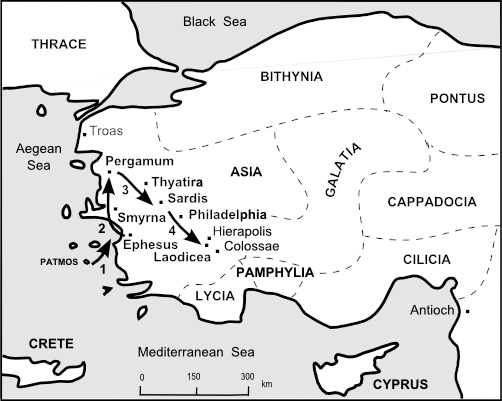
↑ Chapters

Source. All 54 notes come from the Revelation folder of the vault — the A2K Online Church series. Each was converted from its markdown file with no text added, removed or reworded; the conversion was checked word-for-word against the originals.

Two gaps carried over from the source. There is no session 35 — that video duplicates session 34. Two images embedded in the session 7 note are referenced but not present in the vault, so their references are shown in place. The three notes in the Deep Study subfolder are research files rather than session notes and are not included here.