This is the second death

Rev 20:14-15

Rev 20:14-15

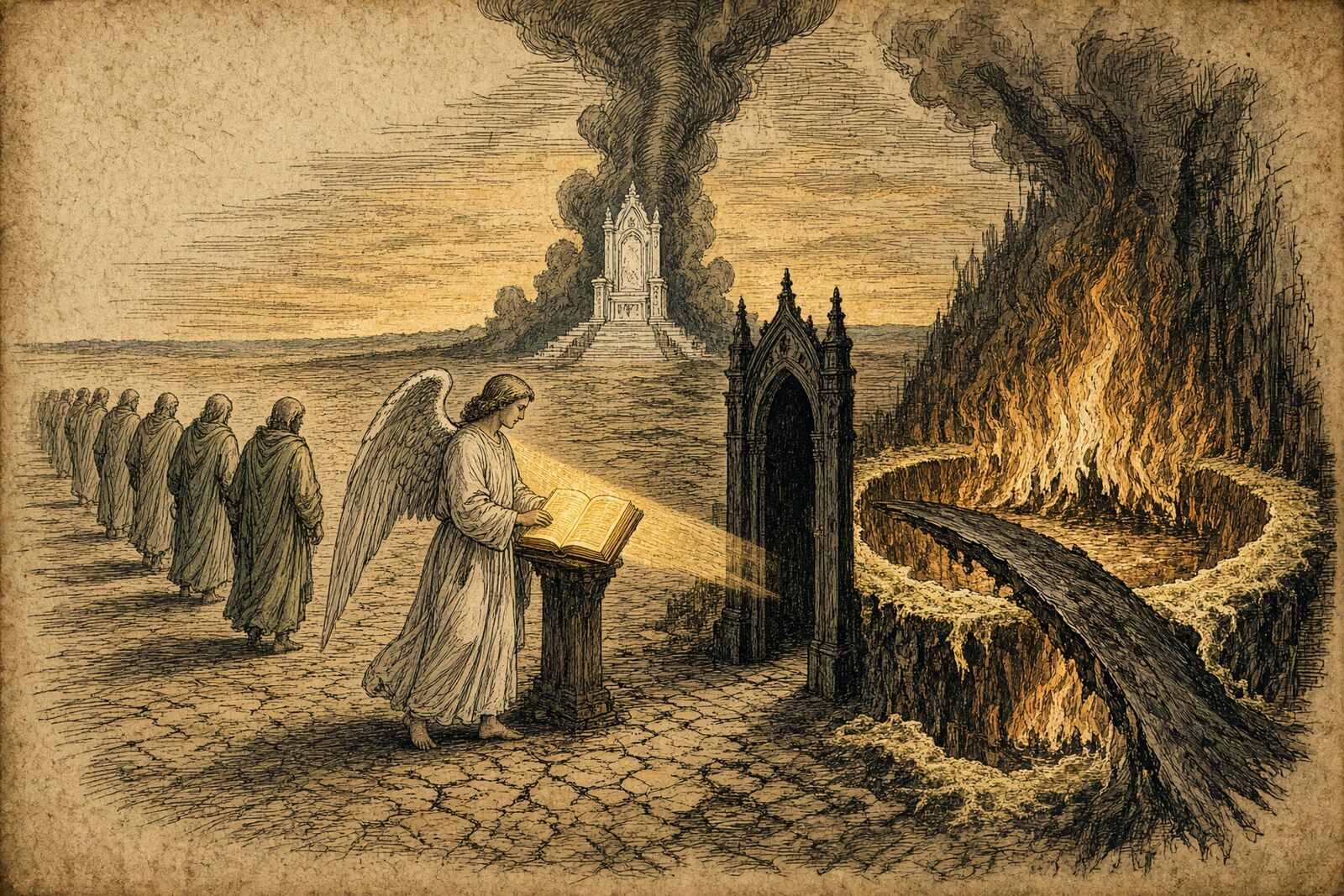
14 And death and hell were cast into the lake of fire. This is the second death.

15 And whosoever was not found written in the book of life was cast into the lake of fire.

← Revelation Illuminated Bible

Explanations

The Tale of Two Cities

The Tale of Two Cities

Revelation 17–22 Introduction — The Tale of Two Cities

Session 40 | An introduction to the contrasting visions of Babylon (the harlot) and New Jerusalem (the bride). Revelation presents two cities and two women — each demanding the reader’s allegiance. Source: A2K Online Church Archive — Babylon & New Jerusalem - An Introduction to Revelation’s Two Cities


The Structure of Revelation’s Final Section

From chapter 17 through chapter 22, Revelation presents two contrasting cities personified as women:

Babylon (Chs. 17–19) New Jerusalem (Chs. 21–22)
A harlot / prostitute The bride of Christ
Drunk on the blood of saints Pure, prepared for her husband
Clothed in purple and scarlet Clothed with the glory of God
Holds a golden cup of abominations Holds the water of life
Rides a scarlet beast Descends from heaven
Destined for destruction Eternal and enduring

These are not merely literal cities — they represent two realities, two value systems, two ways of life:

  1. Fallen Babylon = the world system organized in opposition to God; the culture of empire, self-glorification, and violence
  2. New Jerusalem = the people of God living under his reign; the community of the faithful, pure and prepared for Christ

Why This Introduction Is Necessary

The teacher devotes this session to orienting readers to the “two cities” framework because the details of both visions are dense and easily misunderstood. Before diving into the specifics:

  • Babylon = Rome for the first readers, but Babylon is a recurring reality in every age
  • New Jerusalem = the church as the bride of Christ, already descending from heaven as a present spiritual reality
  • The reader must choose which city to be a citizen of

How the Two Cities Function

Revelation does not present these two cities as mere information. They are rhetorical — designed to persuade and motivate:

Babylon

  • Unmasks evil — shows Rome for what it truly is rather than its propaganda
  • Discourages compromise — associating with Babylon brings judgment
  • Shows the end of evil — Babylon’s destruction is certain

New Jerusalem

  • Gives hope — God’s people have a glorious future
  • Encourages faithfulness — the reward is worth the suffering
  • Defines identity — believers are citizens of heaven, not of earthly empires

The Practical Application

“This really challenged me into how I view the church today.”

The two cities call the reader to:

  • Discern which “city” they are building their life in
  • Reject the values of Babylon (greed, violence, self-glorification, idolatry)
  • Embrace the values of New Jerusalem (faithfulness, purity, worship, love)
  • Recognize that every generation has its own “Babylon” — and its own call to “come out of her”

Summary

Babylon New Jerusalem
Harlot Bride
Drunk on blood Clothed in righteousness
Worldly wealth Divine glory
Destined for destruction Eternal
Demands allegiance to Caesar Calls for allegiance to the Lamb
Built by human empire Built by God

“Revelation puts two cities in front of you and says: choose. You can be a citizen of Babylon or a citizen of New Jerusalem — but you cannot be both.”

The Thousand Years

The Thousand Years

Revelation 20 — The Thousand Years (Part 1)

Session 46 | The teacher walks through his previous (now rejected) interpretation of Revelation 20 and explains why he changed his mind. An exercise in humility, critical thinking, and accepting uncertainty. Source: A2K Online Church Archive — Revelation 20 (Part 1 of 2)


Introduction: A Confession

“I’m going to walk you through this passage the way I was taught it and the way I have taught it to others — and I’m going to show you where I was wrong.”

The teacher begins by acknowledging that he previously held and taught a premillennial interpretation of Revelation 20 — the belief that Christ will return and establish a literal 1,000-year earthly reign before the final judgment. He no longer believes this is the best reading.

This session is part one of two — an exercise in critical thinking, humility, and discernment. He wants to show why he changed his mind before offering an alternative reading.


The Traditional Reading (Premillennialism)

The passage is typically broken into three sections:

  1. vv. 1–3 — Satan bound for 1,000 years
  2. vv. 4–6 — The first resurrection; saints reign with Christ for 1,000 years
  3. vv. 7–15 — Satan released, final battle, great white throne judgment

The Standard Premillennial View

  • Satan is bound — unable to deceive the nations during the millennium
  • The 1,000 years — a literal future period
  • The first resurrection — bodily resurrection of believers at Christ’s return
  • Saints reign on earth — with Christ in a restored Jerusalem
  • Satan released — after 1,000 years, leads a final rebellion
  • Great white throne judgment — final judgment of all the unrighteous

Why the Teacher Changed His Mind

1. The Problem of Presuppositions

The teacher admits that he was taught to read Revelation 20 through the lens of a pre-constructed end-times timeline (dispensational premillennialism). This timeline required:

  • A literal 1,000 years
  • A future national restoration of Israel
  • A physical earthly kingdom
  • A distinction between the “church age” and the “kingdom age”

But when he began to read Revelation as a first-century document to first-century churches, this framework became difficult to maintain.

2. The Symbolic Nature of Numbers in Revelation

Throughout Revelation, numbers are consistently symbolic:

  • 7 = fullness/completeness
  • 3.5 = limited persecution
  • 12 = God’s people
  • 666 = imperfection

The teacher asks: If every other number in Revelation is symbolic, why must 1,000 be literal?

3. The Genre of Revelation

Revelation is apocalyptic literature — it communicates through symbols and visions. Reading chapter 20 as a literal news report of future events is inconsistent with how every other chapter functions.

4. The Timing of the Binding of Satan

If Satan is bound now (as Colossians 2:15; Matthew 12:29; Hebrews 2:14 suggest), then the millennium is not a future event but a present reality — the church age between Christ’s first and second comings.


What This Session Accomplishes

This session does not present a full alternative interpretation. It is designed to:

  • Deconstruct faulty assumptions
  • Admit past interpretive errors
  • Create space for a different reading

The teacher emphasizes that honest Christians disagree on Revelation 20. The goal is not to win an argument but to read the text responsibly.


Summary

Element The Teacher’s Previous View Why He Changed
1,000 years Literal future period Inconsistent with Revelation’s symbolic numbers
Satan bound Future event NT suggests Satan is already bound in a sense
First resurrection Future bodily resurrection May refer to spiritual resurrection now
Reigning with Christ Future earthly reign May refer to present reign of believers
Approach “End-times timeline” Read it as apocalyptic literature to first-century readers

“I’ve been wrong before. I might be wrong again. But I want to be honest about how I read this text rather than just repeating what I was told.”

The Thousand Years

The Thousand Years

Revelation 20 — The Thousand Years (Part 2)

Session 47 | A positive presentation of an alternative reading of Revelation 20: the millennium as a symbolic depiction of the present church age. Source: A2K Online Church Archive — Revelation 20 (Part 2 of 2)


Context: Two Honest Views

The teacher notes that among professional biblical scholars, there is roughly a 50/50 split between the two major views:

  1. Premillennialism — the 1,000 years is a literal future period beginning with Christ’s return
  2. Amillennialism — the 1,000 years is symbolic of the present church age

Both views are held by honest, careful Christians. The teacher now leans toward the second view.


The Binding of Satan (vv. 1–3)

*“An angel laid hold of the dragon… and bound him for a thousand years, and threw him into the abyss.””

What “Binding” Means

In the amillennial view, Satan’s binding is already accomplished through Christ’s death and resurrection (Matthew 12:29; Colossians 2:15; Hebrews 2:14). What is now bound?

Not his ability to tempt or afflict believers (1 Peter 5:8 warns he is still active) But his ability to deceive the nations — preventing the spread of the gospel

Before Christ, salvation was largely confined to Israel. Since Christ, the gospel has gone to all nations — Satan cannot stop the Great Commission.

The Abyss and the Seal

Satan is thrown into the abyss and sealed — not removed from activity, but restricted in scope. His power is contained by God’s sovereignty.


The First Resurrection (vv. 4–6)

*“I saw thrones, and they sat on them, and judgment was given to them… They came to life and reigned with Christ for a thousand years.””

Who Are “They”?

The ones who sit on thrones are:

  • Those martyred for their witness to Jesus
  • Those who did not worship the beast or receive his mark

What Is the First Resurrection?

In the amillennial view, the first resurrection is spiritual — the new birth, being raised with Christ (Colossians 3:1; Romans 6:4). When a person is baptized, they are raised to new life in Christ.

Reigning with Christ is present — believers already reign with Christ in the heavenly places (Ephesians 2:6).

“Blessed and Holy Is the One Who Has Part in the First Resurrection”

This is the second death having no power over them. Believers who have been raised spiritually with Christ will not face condemnation.


Satan Released and the Final Battle (vv. 7–10)

*“When the thousand years are completed, Satan will be released from his prison, and will come out to deceive the nations.””

What Is the “Release”?

In this view, the release of Satan represents a future apostasy — a final outbreak of evil before Christ’s return. The church age (symbolized by 1,000 years) will end with a period of intense persecution and deception.

Gog and Magog

These names come from Ezekiel 38–39, symbolizing the nations assembled against God’s people. This is not a literal battle but a symbolic picture of evil’s final, desperate assault.

Fire from Heaven

God intervenes directly — no human army defeats Satan. Fire comes from heaven and devours the enemies. The devil is thrown into the lake of fire where the beast and false prophet already are.


The Great White Throne Judgment (vv. 11–15)

*“I saw a great white throne and Him who sat upon it, from whose presence earth and heaven fled away.””

The Judge

God (or Christ) sits on the throne. Earth and heaven flee from His presence — the old creation gives way to the new.

The Books Opened

Two sets of books:

  1. The books — containing the deeds of every person
  2. The book of life — containing the names of the redeemed

Judgment by Works

*“The dead were judged from the things which were written in the books, according to their deeds.””

This does not mean salvation by works. It means that judgment is based on what people actually did — their deeds reveal their true allegiance.

Death and Hades Thrown into the Lake of Fire

Personified Death and Hades are destroyed. The second death is the lake of fire — final, eternal separation from God.

Anyone Not Written in the Book of Life

*“If anyone’s name was not found written in the book of life, he was thrown into the lake of fire.””

This is the final, sobering conclusion: at the end of all things, there are only two categories — those written in the Lamb’s book of life and those not.


Summary

Element Premillennial View Amillennial View
1,000 years Literal future period Symbolic of the church age
Binding of Satan Future event Already accomplished through Christ
First resurrection Future bodily resurrection Spiritual resurrection at conversion
Reigning with Christ Future earthly reign Present spiritual reign
Release of Satan After literal 1,000 years End of church age / final apostasy
Gog and Magog Literal battle Symbolic final rebellion
Great white throne Final judgment Final judgment

“Honest Christians disagree on Revelation 20. I don’t think you should base all of your theology on one chapter. But however you read it, the point is the same: God wins.”
Millennial position

Amillennial

Four Lenses on Revelation — Amillennial

The return is at the end of the present age — there is no separate period either side of. Chapter 20 recapitulates, going back to the first coming. The thousand years is the present age. Satan bound is a present restraint: that he should deceive the nations no more. Wheat and tares grow together until the harvest.