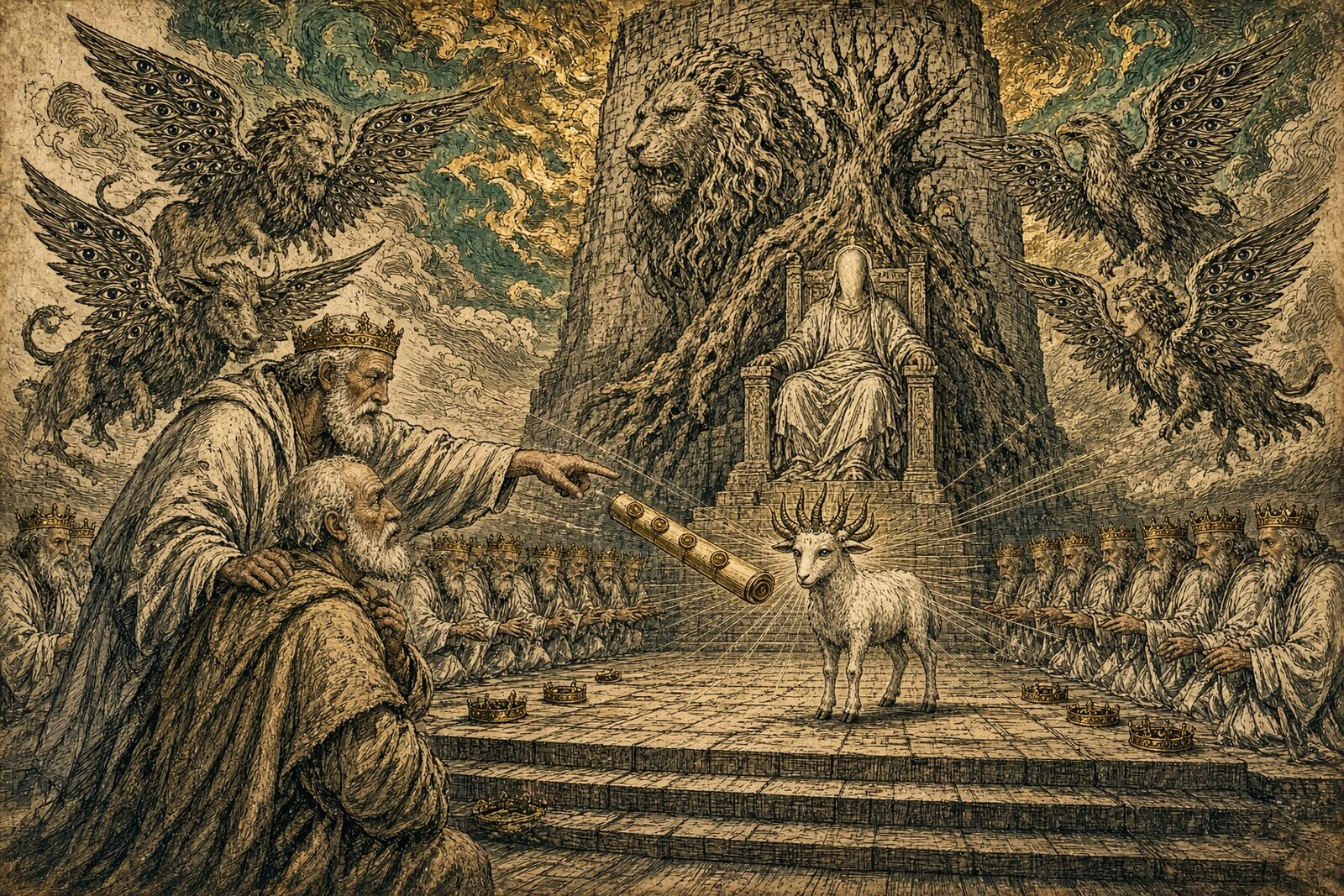
Session 18 | Covers Revelation 5:7-14: the Lamb takes the scroll from God, the prayers of the saints, the new song, redemption from every tribe, the already/not-yet of the kingdom, and the cosmic worship of all creation.
Source: A2K Online Church Archive — Revelation 5:7-14
How Jesus Redefines Conquering
Before proceeding with the text, the teacher restates Revelation’s counter-cultural definition of conquering — the theme that runs through all seven letters and now reaches its climax in the figure of the Lamb:
Rome’s definition: Conquer by defeating enemies with military force, shedding their blood, subjugating them
Revelation’s definition (modeled on Jesus):
- Preach the gospel faithfully — announce the kingdom, maintain witness
- Persevere non-violently — endure suffering without retaliating with violence
- Be faithful unto death — do not deny the faith even if it costs your life
Jesus did all three. This is why he alone is worthy to open the scroll.
“And He came and took the book out of the right hand of Him who sat on the throne.”
This is the central moment of chapter 5. The Lamb — the slain-yet-standing Jesus — approaches God’s throne and takes the scroll from God’s hand.
The perfect tense of the Greek here (in the grammatical structure surrounding this moment) indicates an action completed in the past with ongoing effects in the present. Jesus’s conquering (death and resurrection) happened in the past, but its effects — his authority, his worthiness, his right to open the scroll — are still operative right now.
The scroll is the central narrative device of Revelation. It contains God’s purposes for history — judgment of the wicked, vindication of the martyrs, redemption of creation, the establishment of the kingdom. As each seal is broken (chapters 6-8), portions of this purpose are enacted.
The key point: only the Lamb can open it. History’s direction is not in the hands of Caesar, Rome, or any human power. It is in the hands of the slain Lamb who conquered through faithful witness.
The Elders Fall Before the Lamb (Rev 5:8)
“When He had taken the book, the four living creatures and the twenty-four elders fell down before the Lamb, each one holding a harp and golden bowls full of incense, which are the prayers of the saints.”
The Prayers of the Saints as Incense
Two items characterize the elders’ worship:
- Harps — instruments of worship and the presence of God; the Levitical priests played harps in the temple (1 Chronicles 25); the psalms are full of harp music before God
- Golden bowls full of incense = the prayers of the saints
Revelation here explicitly interprets its own imagery: the incense = the prayers of God’s people. This connects to the daily priestly offering of incense in the Jerusalem temple — morning and evening the incense was burned before God as part of the temple liturgy.
The implication: The prayers of ordinary Christians — persecuted, marginalized, sometimes imprisoned — rise before God’s throne as priestly incense. Their prayers are not ignored. They are not lost. They are stored in golden bowls before God himself.
This is an extraordinary encouragement to persecuted believers who might feel their prayers disappear into silence. Revelation reveals: your prayers are before God’s throne, held in golden bowls, offered continuously in his presence.
What Prayers Does God Hear?
Looking at what follows in the narrative:
- Revelation 6:9-11 — the martyrs under the altar cry “How long, O Lord?”
- Revelation 8:3-5 — the prayers of the saints are offered with incense and then fire from the altar is thrown to the earth, causing the trumpet plagues
The prayers of God’s people for justice, for vindication, for the advancement of the kingdom — these are what drive the narrative of Revelation forward. The saints’ prayers are not passive. They participate in the unfolding of God’s purposes.
The New Song (Rev 5:9-10)
“And they sang a new song, saying: ‘Worthy are You to take the book and to break its seals; for You were slain, and purchased for God with Your blood men from every tribe and tongue and people and nation. You have made them to be a kingdom and priests to our God; and they will reign upon the earth.’”
Why a “New Song”?
In the Old Testament, a “new song” was sung when God had done something unprecedented — a new act of salvation or victory that called for new praise (Psalms 33, 40, 96, 98, 144, 149; Isaiah 42). The new song marks a new thing God has done.
What is the new thing? The Lamb has purchased a people from every tribe, tongue, people, and nation — not just Israel, but all nations. This is the fulfillment of God’s promise to Abraham that all nations would be blessed through his seed (Genesis 12:3). The new song celebrates this universal redemption.
The Ground of the Lamb’s Worthiness
The song gives two grounds for the Lamb’s worthiness:
- “You were slain” — his death is the basis of his worthiness. Not military conquest. Not political power. Death as a faithful martyr.
- “You purchased for God with Your blood men from every tribe” — his blood accomplished cosmic, universal redemption. He didn’t just die — his death accomplished something. It purchased (redeemed, liberated) people from every part of the human family.
Kingdom and Priests — Already
“You have made them to be a kingdom and priests to our God.”
Past tense. This has already happened. Not “you will make them” — “you have made them.” This echoes Revelation 1:6 (which we saw at the very beginning) and connects to Exodus 19:6 (God’s original calling for Israel). Christians are already a kingdom, already priests.
“They will reign upon the earth”
This is future — the full consummation of the kingdom, when Jesus returns and his people reign with him over the renewed earth. But the foundation is already laid. The future reign is the completion of a reality already begun.
The Beast as Parody of the Lamb
The teacher notes a major structural parallel that will become important in chapter 13:
- The Lamb has seven horns (complete power) and seven eyes (complete knowledge)
- The Beast in chapter 13 has seven heads and ten horns — a parody, trying to match and exceed the Lamb’s power symbols
The whole satanic system in Revelation is a parody of the true God:
- Satan parodies God (he claims power that belongs to God)
- The first beast parodies the Lamb (political power that demands worship)
- The second beast parodies the Spirit (religious propaganda that enforces worship of the beast)
Revelation is unmasking not just Rome but the whole structure of fallen human civilization as a parody of God’s kingdom.
Myriads of Angels Worship the Lamb (Rev 5:11-12)
“Then I looked, and I heard the voice of many angels around the throne and the living creatures and the elders; and the number of them was myriads of myriads, and thousands of thousands, saying with a loud voice: ‘Worthy is the Lamb that was slain to receive power and riches and wisdom and might and honor and glory and blessing.’”
Myriads of myriads — an uncountable number, the highest numerical expression available. The entire angelic host, innumerable, joins the song.
Seven acclamations — power, riches, wisdom, might, honor, glory, blessing. The number seven = completeness. The Lamb receives the complete, total attribution of worth from all of heaven.
This is the counter to imperial Rome: emperors were acclaimed with titles of power and glory. But the true acclamation of true power belongs to the Lamb who died — not to any Caesar.
All Creation Worships God and the Lamb (Rev 5:13-14)
“And every created thing which is in heaven and on the earth and under the earth and on the sea, and all things in them, I heard saying: ‘To Him who sits on the throne, and to the Lamb, be blessing and honor and glory and dominion forever and ever.’”
Every created thing — the four cosmic regions cover everything:
- Heaven (angelic beings)
- Earth (humanity and land creatures)
- Under the earth (those in the realm of death)
- The sea (sea creatures)
This is total, universal worship. Nothing in all of creation is excluded.
“To Him who sits on the throne, and to the Lamb” — God and the Lamb receive joint worship. They are not identical (two distinct persons), but they receive the same worship together. The Lamb’s authority is derived from God and exercised on God’s behalf — but in that capacity, he receives the same honor.
The four living creatures say “Amen” — and the twenty-four elders fall in worship. The vision closes with the entirety of creation in prostration before God and the Lamb.
The Already and Not-Yet of the Kingdom
The song of verses 9-10 captures both aspects:
| Already |
Not Yet |
| “You have made them a kingdom and priests” (past tense) |
“They will reign upon the earth” (future) |
| Jesus has conquered |
The consummation of his kingdom awaits |
| Christians are already priests in God’s new temple |
The full exercise of reigning is still coming |
| The Lamb has the scroll |
The seals are still to be opened |
Revelation consistently holds these tensions together. The mistake is collapsing them — either saying “the kingdom is entirely present” (realized eschatology) or “the kingdom is entirely future” (futurism). Both dimensions are true simultaneously.
Summary
| Element |
Meaning |
| Lamb takes the scroll |
History’s direction is in Jesus’s hands, not Caesar’s |
| Perfect tense |
Jesus’s past conquering has ongoing present effects and authority |
| Harps and incense bowls |
The elders’ worship uses priestly instruments; the incense = the prayers of the saints |
| Prayers stored in golden bowls |
God hears and holds the prayers of persecuted believers — they are not lost |
| New song |
Celebrates the unprecedented universal redemption accomplished by the Lamb |
| “Were slain” — worthiness |
Death as a faithful martyr is the basis of the Lamb’s authority — not military conquest |
| From every tribe |
Universal redemption; the fulfillment of God’s promise to Abraham |
| Kingdom and priests — already |
Past tense; Christians are already made into this identity |
| They will reign |
Future consummation; the full realization is still coming |
| Parody of the Lamb |
The Beast in ch. 13 is a satanic imitation of the Lamb’s power |
| Myriads of angels |
The entire angelic host joins the song of the Lamb’s worthiness |
| All creation worships |
Universal worship: heaven, earth, under earth, and sea — everything created |
| God and the Lamb together |
Joint worship; distinct persons, shared honor |