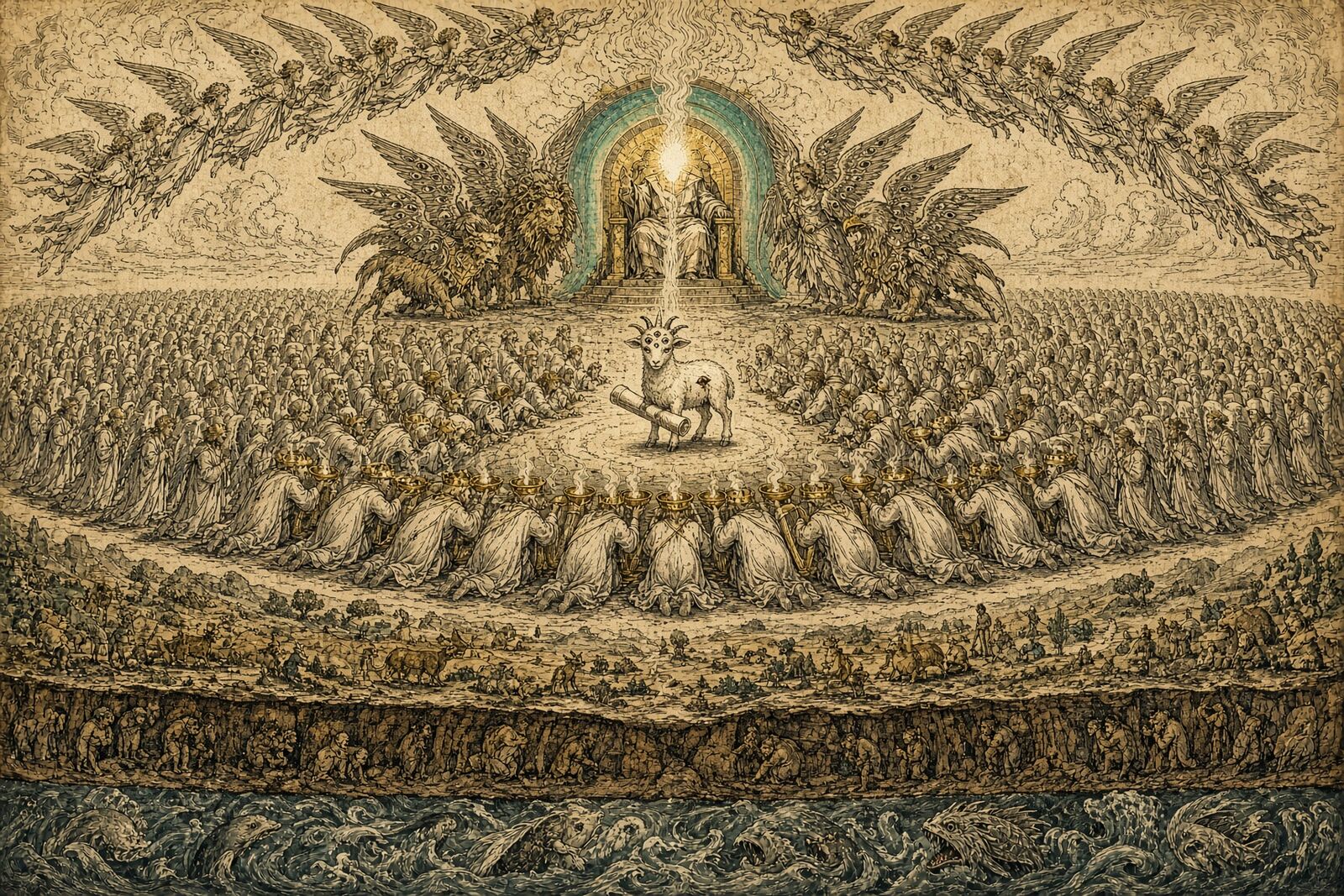
Worthy is the Lamb that was slain

Rev 5:8-14

Rev 5:8-14

8 And when he had taken the book, the four beasts and four and twenty elders fell down before the Lamb, having every one of them harps, and golden vials full of odours, which are the prayers of saints.

9 And they sung a new song, saying, Thou art worthy to take the book, and to open the seals thereof: for thou wast slain, and hast redeemed us to God by thy blood out of every kindred, and tongue, and people, and nation;

10 And hast made us unto our God kings and priests: and we shall reign on the earth.

11 And I beheld, and I heard the voice of many angels round about the throne and the beasts and the elders: and the number of them was ten thousand times ten thousand, and thousands of thousands;

12 Saying with a loud voice, Worthy is the Lamb that was slain to receive power, and riches, and wisdom, and strength, and honour, and glory, and blessing.

13 And every creature which is in heaven, and on the earth, and under the earth, and such as are in the sea, and all that are in them, heard I saying, Blessing, and honour, and glory, and power, be unto him that sitteth upon the throne, and unto the Lamb for ever and ever.

14 And the four beasts said, Amen. And the four and twenty elders fell down and worshipped him that liveth for ever and ever.

← Revelation Illuminated Bible

Explanations

The Four Living Creatures, Worship, and Transition to the Lamb

The Four Living Creatures, Worship, and Transition to the Lamb

Revelation 4-5 — The Four Living Creatures, Worship, and Transition to the Lamb

Session 16 | Wraps up the chapter 4 throne room vision (four living creatures, creation worship, the priestly temple structure) and begins the transition into chapter 5’s central figure: the Lamb. Source: A2K Online Church Archive — Revelation 4:7-11


Review: The Priestly and Temple Structure of Revelation 4

Before moving to new content, the teacher summarizes how Revelation 4 is saturated with temple and priestly imagery:

  • The lampstands (chapter 1) = the churches = the new temple
  • The sea of glass = the bronze laver in Solomon’s temple (where priests washed)
  • The seven lamps of fire = the seven-branched lampstand (menorah)
  • The four living creatures = the cherubim who guarded the Ark of the Covenant and the Holy of Holies
  • The twenty-four elders = possibly corresponding to the 24 divisions of Levitical priests who served in the Jerusalem temple

All of this reinforces the central claim of the New Testament: the people of God are now the new temple, and God’s presence now dwells among them, not in a building in Jerusalem.


The Four Living Creatures and Creation

The four living creatures represent all of creation in its four major categories — wild animals (lion), domestic animals (calf/ox), humanity (man), and birds (eagle). This means all creation is gathered around God’s throne in worship.

Why This Matters for Revelation’s Message

One of the things Revelation will eventually promise is a renewed creation — the new heavens and new earth, where all things are made right. By showing all of creation already worshipping around God’s throne, Revelation is previewing the end: creation’s worship of God will be fully realized when all things are renewed. Creation is not disposable in God’s plan; it is the subject of his redemptive purposes.

God as Creator Who Renews

The worship song in Revelation 4:11 praises God as creator: “For You created all things, and because of Your will they existed and were created.”

This is the basis of all worship: God made everything. That means he has rightful authority over everything he made, and everything he made owes him worship. It also means God cares about creation — the renewal of creation is not an afterthought but central to his purposes.


“Holy, Holy, Holy” — Isaiah 6 Connection

The cry of the four living creatures echoes Isaiah’s throne room vision (Isaiah 6). In Isaiah’s vision, the seraphim cry “Holy, holy, holy is the Lord of hosts; the whole earth is full of his glory.”

The Significance of Three “Holies”

Hebrew uses repetition for emphasis — “holy, holy, holy” (a triad) indicates the absolute, incomparable, superlative holiness of God. There is no God like this God; his holiness is in a category by itself. This is not just an attribute he has; it is who he is.

Isaiah 6 as the Template

Isaiah’s vision is one of the key Old Testament templates Revelation draws on:

  • Isaiah saw the Lord “high and lifted up, with his train filling the temple”
  • He saw seraphim with six wings (compare Revelation’s living creatures with six wings)
  • He heard the trisagion (the three-fold “holy”)
  • He was overwhelmed and declared himself undone

John’s vision updates and expands Isaiah’s, now with the Lamb added in chapter 5.


The Martyrs Under the Altar (Preview from Revelation 6:9-11)

The teacher uses this point to briefly address a question about suffering and God’s sovereignty:

In Revelation 6:9-11, the souls of martyred believers cry out: “How long, O Lord, holy and true, will you refrain from judging and avenging our blood on those who dwell on the earth?” They are told to wait a little longer until “the number of their fellow servants… would be completed.”

The question this raises: If God is on the throne and all-powerful, why does he allow the martyrs to die? Why doesn’t he stop it?

Revelation’s answer is nuanced:

  1. God is sovereign and in control
  2. Evil is also real and currently operative (Satan is described as the god of this age, 2 Cor. 4:4; the whole world lies in the evil one, 1 John 5:19)
  3. God has not yet brought final judgment — he is being patient, allowing time for repentance (the trumpets and bowls are warnings designed to call people to repentance, not just punishment)
  4. The martyrs’ deaths are not random — they complete a testimony, a witness, that contributes to God’s redemptive purposes

This is the tension that Revelation holds: God is sovereign and evil is real and human choices matter and God’s patience allows time for repentance and final judgment is certain.


Satan Falling Like Lightning — Luke 10

The teacher connects Revelation’s unmasking of Satan as the power behind Rome to Jesus’s statement in Luke 10:18: “I saw Satan fall like lightning from heaven.” Jesus’s ministry and the proclamation of the kingdom is the event through which Satan’s power is being overcome — not all at once, but progressively, through the faithful witness of his followers.

The church’s witness, its gospel proclamation, its perseverance — these are the means by which the kingdom advances and Satan’s dominion is challenged and dismantled.


The Two Beasts in Revelation 13 (Preview)

The teacher briefly introduces what the two beasts in chapter 13 represent, as context for understanding the larger narrative:

  • The first beast (from the sea) = the Roman Imperial political-military system — the oppressive governmental power that demands worship and persecutes those who refuse
  • The second beast (from the land, also called the False Prophet) = the Imperial cult — the religious propaganda arm that promotes worship of the Emperor and enforces compliance

Together, the two beasts form a satanic parody of God and Jesus:

  • Satan = false father, the power behind the empire
  • First beast = false lord, the political power
  • Second beast = false prophet/spirit, the religious enforcement mechanism

Revelation unmasks these as a trinity of evil that parodies the true God. The church’s call is to refuse allegiance to this satanic system and to give full allegiance to God and the Lamb.


The Call-and-Response Hymn Structure

Revelation 4 demonstrates a liturgical call-and-response structure:

  1. The four living creatures lead the worship (v. 8)
  2. The twenty-four elders respond by falling, casting their crowns, and singing (vv. 10-11)

This hymnic structure continues throughout Revelation. The book is structured partially as a series of heavenly worship songs that punctuate the narrative. These songs interpret the events of the visions and provide the theological framework for understanding what is happening.

Why hymns? Because worship is the appropriate response to what God is and what he does. The theological truths about God — his holiness, his creatorship, his covenant faithfulness — naturally produce worship. And worship is the church’s primary act of resistance against the claims of fallen empires.


God Is Worthy Because He Is Creator

The final song of chapter 4 establishes the ground of all worship:

“Worthy are You, our Lord and our God, to receive glory and honor and power; for You created all things, and because of Your will they existed and were created.”

God is worthy (axios) — the same Greek word that will be applied to the Lamb in chapter 5. Worthiness is the key concept:

  • God is worthy because he is the creator — he made everything, everything exists by his will
  • The Lamb (chapter 5) is worthy because he redeemed what was lost — he purchased people for God by his blood

The two grounds of worship in Revelation:

  1. Creation (chapter 4)
  2. Redemption (chapter 5)

Together they form the complete basis of Christian worship: we worship God as creator and as redeemer.


Transition to Chapter 5

Chapter 4 establishes God’s sovereignty and the structure of heavenly worship. Chapter 5 will introduce the Lamb — the key player who alone is worthy to open the scroll that determines the course of history.

The relationship between chapters 4 and 5:

  • Chapter 4 = God on the throne (the foundation)
  • Chapter 5 = The Lamb before the throne (the agent of redemption and history’s unfolding)

Together they form the theological center of the entire book. Everything before (the seven letters) sets up why this vision matters. Everything after (seals, trumpets, bowls, Babylon, New Jerusalem) flows from this central vision of God and the Lamb.


Summary

Element Meaning
Temple imagery throughout ch. 4 The people of God are the new temple; priestly worship is the church’s identity
Four living creatures = all creation Creation represents itself in worship; God will renew all of it
“Holy, holy, holy” The absolute, incomparable, superlative holiness of God — Isaiah 6 connection
Martyrs under the altar God is sovereign; evil is real; his patience allows time for repentance
Two beasts Satanic parody of God’s own trinity — unmasked by Revelation
Call-and-response hymns Worship is the framework for interpreting the visions; liturgical structure
“Worthy because you created” God’s worthiness: creation (ch. 4) + redemption (ch. 5) = the complete basis of worship

The Lamb Takes the Scroll

The Lamb Takes the Scroll

Revelation 5 — The Lamb Takes the Scroll (Part 2)

Session 18 | Covers Revelation 5:7-14: the Lamb takes the scroll from God, the prayers of the saints, the new song, redemption from every tribe, the already/not-yet of the kingdom, and the cosmic worship of all creation. Source: A2K Online Church Archive — Revelation 5:7-14


How Jesus Redefines Conquering

Before proceeding with the text, the teacher restates Revelation’s counter-cultural definition of conquering — the theme that runs through all seven letters and now reaches its climax in the figure of the Lamb:

Rome’s definition: Conquer by defeating enemies with military force, shedding their blood, subjugating them

Revelation’s definition (modeled on Jesus):

  1. Preach the gospel faithfully — announce the kingdom, maintain witness
  2. Persevere non-violently — endure suffering without retaliating with violence
  3. Be faithful unto death — do not deny the faith even if it costs your life

Jesus did all three. This is why he alone is worthy to open the scroll.


The Lamb Takes the Scroll (Rev 5:7)

“And He came and took the book out of the right hand of Him who sat on the throne.”

This is the central moment of chapter 5. The Lamb — the slain-yet-standing Jesus — approaches God’s throne and takes the scroll from God’s hand.

The perfect tense of the Greek here (in the grammatical structure surrounding this moment) indicates an action completed in the past with ongoing effects in the present. Jesus’s conquering (death and resurrection) happened in the past, but its effects — his authority, his worthiness, his right to open the scroll — are still operative right now.

What Does the Scroll Represent?

The scroll is the central narrative device of Revelation. It contains God’s purposes for history — judgment of the wicked, vindication of the martyrs, redemption of creation, the establishment of the kingdom. As each seal is broken (chapters 6-8), portions of this purpose are enacted.

The key point: only the Lamb can open it. History’s direction is not in the hands of Caesar, Rome, or any human power. It is in the hands of the slain Lamb who conquered through faithful witness.


The Elders Fall Before the Lamb (Rev 5:8)

“When He had taken the book, the four living creatures and the twenty-four elders fell down before the Lamb, each one holding a harp and golden bowls full of incense, which are the prayers of the saints.”

The Prayers of the Saints as Incense

Two items characterize the elders’ worship:

  1. Harps — instruments of worship and the presence of God; the Levitical priests played harps in the temple (1 Chronicles 25); the psalms are full of harp music before God
  2. Golden bowls full of incense = the prayers of the saints

Revelation here explicitly interprets its own imagery: the incense = the prayers of God’s people. This connects to the daily priestly offering of incense in the Jerusalem temple — morning and evening the incense was burned before God as part of the temple liturgy.

The implication: The prayers of ordinary Christians — persecuted, marginalized, sometimes imprisoned — rise before God’s throne as priestly incense. Their prayers are not ignored. They are not lost. They are stored in golden bowls before God himself.

This is an extraordinary encouragement to persecuted believers who might feel their prayers disappear into silence. Revelation reveals: your prayers are before God’s throne, held in golden bowls, offered continuously in his presence.

What Prayers Does God Hear?

Looking at what follows in the narrative:

  • Revelation 6:9-11 — the martyrs under the altar cry “How long, O Lord?”
  • Revelation 8:3-5 — the prayers of the saints are offered with incense and then fire from the altar is thrown to the earth, causing the trumpet plagues

The prayers of God’s people for justice, for vindication, for the advancement of the kingdom — these are what drive the narrative of Revelation forward. The saints’ prayers are not passive. They participate in the unfolding of God’s purposes.


The New Song (Rev 5:9-10)

“And they sang a new song, saying: ‘Worthy are You to take the book and to break its seals; for You were slain, and purchased for God with Your blood men from every tribe and tongue and people and nation. You have made them to be a kingdom and priests to our God; and they will reign upon the earth.’”

Why a “New Song”?

In the Old Testament, a “new song” was sung when God had done something unprecedented — a new act of salvation or victory that called for new praise (Psalms 33, 40, 96, 98, 144, 149; Isaiah 42). The new song marks a new thing God has done.

What is the new thing? The Lamb has purchased a people from every tribe, tongue, people, and nation — not just Israel, but all nations. This is the fulfillment of God’s promise to Abraham that all nations would be blessed through his seed (Genesis 12:3). The new song celebrates this universal redemption.

The Ground of the Lamb’s Worthiness

The song gives two grounds for the Lamb’s worthiness:

  1. “You were slain” — his death is the basis of his worthiness. Not military conquest. Not political power. Death as a faithful martyr.
  2. “You purchased for God with Your blood men from every tribe” — his blood accomplished cosmic, universal redemption. He didn’t just die — his death accomplished something. It purchased (redeemed, liberated) people from every part of the human family.

Kingdom and Priests — Already

“You have made them to be a kingdom and priests to our God.”

Past tense. This has already happened. Not “you will make them” — “you have made them.” This echoes Revelation 1:6 (which we saw at the very beginning) and connects to Exodus 19:6 (God’s original calling for Israel). Christians are already a kingdom, already priests.

“They will reign upon the earth”

This is future — the full consummation of the kingdom, when Jesus returns and his people reign with him over the renewed earth. But the foundation is already laid. The future reign is the completion of a reality already begun.


The Beast as Parody of the Lamb

The teacher notes a major structural parallel that will become important in chapter 13:

  • The Lamb has seven horns (complete power) and seven eyes (complete knowledge)
  • The Beast in chapter 13 has seven heads and ten horns — a parody, trying to match and exceed the Lamb’s power symbols

The whole satanic system in Revelation is a parody of the true God:

  • Satan parodies God (he claims power that belongs to God)
  • The first beast parodies the Lamb (political power that demands worship)
  • The second beast parodies the Spirit (religious propaganda that enforces worship of the beast)

Revelation is unmasking not just Rome but the whole structure of fallen human civilization as a parody of God’s kingdom.


Myriads of Angels Worship the Lamb (Rev 5:11-12)

“Then I looked, and I heard the voice of many angels around the throne and the living creatures and the elders; and the number of them was myriads of myriads, and thousands of thousands, saying with a loud voice: ‘Worthy is the Lamb that was slain to receive power and riches and wisdom and might and honor and glory and blessing.’”

Myriads of myriads — an uncountable number, the highest numerical expression available. The entire angelic host, innumerable, joins the song.

Seven acclamations — power, riches, wisdom, might, honor, glory, blessing. The number seven = completeness. The Lamb receives the complete, total attribution of worth from all of heaven.

This is the counter to imperial Rome: emperors were acclaimed with titles of power and glory. But the true acclamation of true power belongs to the Lamb who died — not to any Caesar.


All Creation Worships God and the Lamb (Rev 5:13-14)

“And every created thing which is in heaven and on the earth and under the earth and on the sea, and all things in them, I heard saying: ‘To Him who sits on the throne, and to the Lamb, be blessing and honor and glory and dominion forever and ever.’”

Every created thing — the four cosmic regions cover everything:

  • Heaven (angelic beings)
  • Earth (humanity and land creatures)
  • Under the earth (those in the realm of death)
  • The sea (sea creatures)

This is total, universal worship. Nothing in all of creation is excluded.

“To Him who sits on the throne, and to the Lamb” — God and the Lamb receive joint worship. They are not identical (two distinct persons), but they receive the same worship together. The Lamb’s authority is derived from God and exercised on God’s behalf — but in that capacity, he receives the same honor.

The four living creatures say “Amen” — and the twenty-four elders fall in worship. The vision closes with the entirety of creation in prostration before God and the Lamb.


The Already and Not-Yet of the Kingdom

The song of verses 9-10 captures both aspects:

Already Not Yet
“You have made them a kingdom and priests” (past tense) “They will reign upon the earth” (future)
Jesus has conquered The consummation of his kingdom awaits
Christians are already priests in God’s new temple The full exercise of reigning is still coming
The Lamb has the scroll The seals are still to be opened

Revelation consistently holds these tensions together. The mistake is collapsing them — either saying “the kingdom is entirely present” (realized eschatology) or “the kingdom is entirely future” (futurism). Both dimensions are true simultaneously.


Summary

Element Meaning
Lamb takes the scroll History’s direction is in Jesus’s hands, not Caesar’s
Perfect tense Jesus’s past conquering has ongoing present effects and authority
Harps and incense bowls The elders’ worship uses priestly instruments; the incense = the prayers of the saints
Prayers stored in golden bowls God hears and holds the prayers of persecuted believers — they are not lost
New song Celebrates the unprecedented universal redemption accomplished by the Lamb
“Were slain” — worthiness Death as a faithful martyr is the basis of the Lamb’s authority — not military conquest
From every tribe Universal redemption; the fulfillment of God’s promise to Abraham
Kingdom and priests — already Past tense; Christians are already made into this identity
They will reign Future consummation; the full realization is still coming
Parody of the Lamb The Beast in ch. 13 is a satanic imitation of the Lamb’s power
Myriads of angels The entire angelic host joins the song of the Lamb’s worthiness
All creation worships Universal worship: heaven, earth, under earth, and sea — everything created
God and the Lamb together Joint worship; distinct persons, shared honor

The Scroll and the Lamb

The Scroll and the Lamb

Revelation 5 — The Scroll and the Lamb (Part 1)

Session 17 | The central vision of the book: the sealed scroll, the weeping of John, the Lion/Lamb paradox, and the meaning of Jesus’s worthiness. This is the theological heart of Revelation. Source: A2K Online Church Archive — Revelation 5:1-6


Chapter 5 in the Structure of the Book

If chapter 4 established that God is on the throne — the ground and foundation of all Christian hope — chapter 5 answers the question: who has the authority to act? Who can move history toward its redemptive conclusion?

The answer: the Lamb. Chapter 5 is entirely about Jesus.

The relationship:

  • Chapter 4 — who God is (creator, sovereign, eternal)
  • Chapter 5 — who the Lamb is (the redeemer, the conqueror, the one worthy to open the scroll)

These two chapters together form the theological and narrative center of Revelation. Every vision that follows — the seals, trumpets, bowls, the fall of Babylon, the New Jerusalem — flows out of the authority established here.


The Sealed Scroll (Rev 5:1)

“I saw in the right hand of Him who sat on the throne a book written inside and on the back, sealed up with seven seals.”

“Book” should be translated as scroll — books as we know them didn’t exist yet. Christians were among the first people to create the codex (bound pages) in the second century.

Written on Both Sides

The scroll is written on the inside and on the back — both sides are covered with writing. In ancient practice, a scroll written on both sides (opisthograph) signaled a complete, full message with nothing more to add. This scroll contains everything God wants to communicate about history and redemption.

The Ezekiel 2 Connection

Ezekiel 2:9-10: Ezekiel’s call vision included a scroll that was written on both sides with “lamentations, mourning, and woe.” He was told to eat it and go preach to rebellious Israel. The scroll contained God’s judgment message — but when Ezekiel ate it, it was “sweet as honey.”

The scroll in Revelation 5 echoes this: it contains God’s full message, including both judgment and redemption. John will also eat a scroll in Revelation 10, with the same sweet-bitter experience.

Seven Seals

Seven seals secure the scroll. Before its contents can be revealed and enacted, someone must be found worthy to break each seal.


The Word “Worthy” (Axios)

“Who is worthy to open the book and to break its seals?” (v. 2)

Axios (worthy) is the key word of chapter 5 — appearing in the throne room songs and central to the entire vision. The same word was used in chapter 4’s song of God the Creator. Now it is applied to the Lamb.

Worthiness and Imperial Claims

In the first-century Roman world, imperial proclamations often began with the Emperor being declared “worthy” (axios) of honor, glory, and worship. Gladiatorial crowds would shout axios to acclaim victorious fighters. It was a term of acclamation for those who had earned distinction through their achievements.

Revelation takes this term and asks: who is truly worthy? Not Caesar. Not any gladiator. The only one in all of creation who is worthy to open the scroll of history is the one who conquered in the paradoxical way — through faithful witness, suffering, and death.


No One Found Worthy (Rev 5:3-4)

“No one in heaven or on the earth or under the earth was able to open the book or to look into it. Then I began to weep greatly because no one was found worthy to open the book or to look into it.”

The search goes to three cosmic regions — heaven, earth, under the earth — and comes up empty. No one in all of creation is worthy. Not the elders, not the angels, not any human being.

John weeps greatly. This is not a mild emotional response — this is anguish. If no one can open the scroll, history has no meaningful direction; God’s redemptive purposes cannot be carried out; justice will never be served; the martyrs will never be vindicated; creation will never be renewed.

John’s weeping represents the weight of what is at stake.


The Lion of the Tribe of Judah (Rev 5:5)

“Stop weeping; behold, the Lion that is from the tribe of Judah, the Root of David, has overcome so as to open the book and its seven seals.”

One of the elders intervenes. He points to two messianic titles:

“The Lion of the tribe of Judah” — from Genesis 49:9-10, Jacob’s blessing of Judah: “Judah is a lion’s cub… The scepter shall not depart from Judah.” The lion represents power, strength, and military conquest. The conquering warrior-king.

“The Root of David” — from Isaiah 11:1-10, the shoot from the stem of Jesse who will judge with righteousness and rule the nations. A messianic king who will restore the Davidic dynasty and bring God’s justice.

Both titles are intensely conquering images. The elder uses the verb “has conquered” (nikaō). Jesus has already conquered.

The announcement creates a specific expectation: John should look and see a mighty warrior-king, a ferocious conquering lion.


The Lamb Standing as If Slain (Rev 5:6)

“And I saw between the throne (with the four living creatures) and the elders a Lamb standing, as if slain, having seven horns and seven eyes, which are the seven spirits of God sent out into all the earth.”

He was told to look for a lion. He sees a Lamb — and not just any lamb: a lamb that bears the marks of having been slaughtered. Standing (alive), but visibly bearing the wounds of death.

The Lion-Lamb Paradox: Revelation’s Central Theological Move

This is the hearing-before-seeing principle in its most powerful form:

  • Heard: A conquering lion
  • Saw: A slaughtered lamb

These are not two different beings. They are the same person, seen from two different perspectives.

Jesus conquered as a lion — by dying as a lamb.

This is paradoxical conquering. This is the upside-down victory that Revelation proclaims. The way to conquer, the way to win, the way to exercise power is not through military force or violent subjugation. It is through faithful witness, self-giving sacrifice, and death.

Rome’s definition of conquering: defeat your enemies by force, shedding their blood. Jesus’s definition of conquering: be faithful to God’s purposes even unto death, shedding your own blood.

Seven Horns and Seven Eyes

  • Seven horns — horns symbolize strength and power; seven horns = perfect, complete power
  • Seven eyes — complete, all-seeing wisdom; knowing all things perfectly

The Lamb who appears weak is actually omnipotent and omniscient. This is the paradox in symbolic form.


Genesis 49 and Isaiah 11: The Two Messianic Sources

Genesis 49:9-10 — The Lion of Judah

The original context: Jacob’s deathbed blessing of Judah. Judah is compared to a crouching lion — powerful, resting after conquest. “The scepter shall not depart from Judah.” This promise of royal, conquering leadership in the Davidic line is what “Lion of Judah” points to.

Isaiah 11:1-5 — The Root of Jesse

The messianic figure here:

  • Is empowered by the Spirit of the Lord (the spirit of wisdom, understanding, counsel, strength, knowledge)
  • Will not judge by what he sees with his eyes
  • Will judge the poor with righteousness
  • Will strike the earth with “the rod of his mouth” and slay the wicked with the breath of his lips

Key: His weapon of judgment is his mouth — his words, his gospel. This is the same two-edged sword from Jesus’s mouth in chapter 1. The Messiah conquers not with a physical sword but with his proclamation.


Conquering Precedes Opening the Scroll

The elder says the Lion “has conquered so as to open the book.” The conquering is past tense — it happened in Jesus’s death and resurrection. The authority to open the scroll derives from the act of conquering. Jesus earned this authority through his faithful martyrdom.

This is the logical structure:

  1. Jesus faithfully proclaimed the gospel (faithful witness)
  2. Jesus suffered and died without responding with violence (non-violent perseverance)
  3. Jesus was faithful unto death (martyrdom)
  4. Therefore God raised him and exalted him with all authority
  5. Therefore Jesus alone is worthy to open the scroll and direct the course of history

The three themes of conquering in Revelation (gospel proclamation, non-violent endurance, faithfulness unto death) are exactly what Jesus himself did — and it is what qualified him for supreme authority.


Summary

Element Meaning
Scroll written on both sides A complete, full message — nothing more to add; echoes Ezekiel 2
Seven seals The contents cannot be enacted until the worthy one breaks each seal
“Worthy” (axios) The key acclamation word; who truly deserves honor and authority?
No one found worthy The hopelessness of history without the Lamb — John’s tears represent this weight
Lion of Judah Expected image: powerful, conquering warrior-king
Slaughtered Lamb What John actually sees: weakness, sacrifice, death — the means of conquest
Lion/Lamb paradox The central theological claim: Jesus conquered by dying; power through self-giving
Seven horns and eyes Complete power and complete wisdom — the apparent weakness conceals omnipotence
Conquering = faithfulness unto death The three-part pattern of ch. 2-3 is embodied in Jesus himself