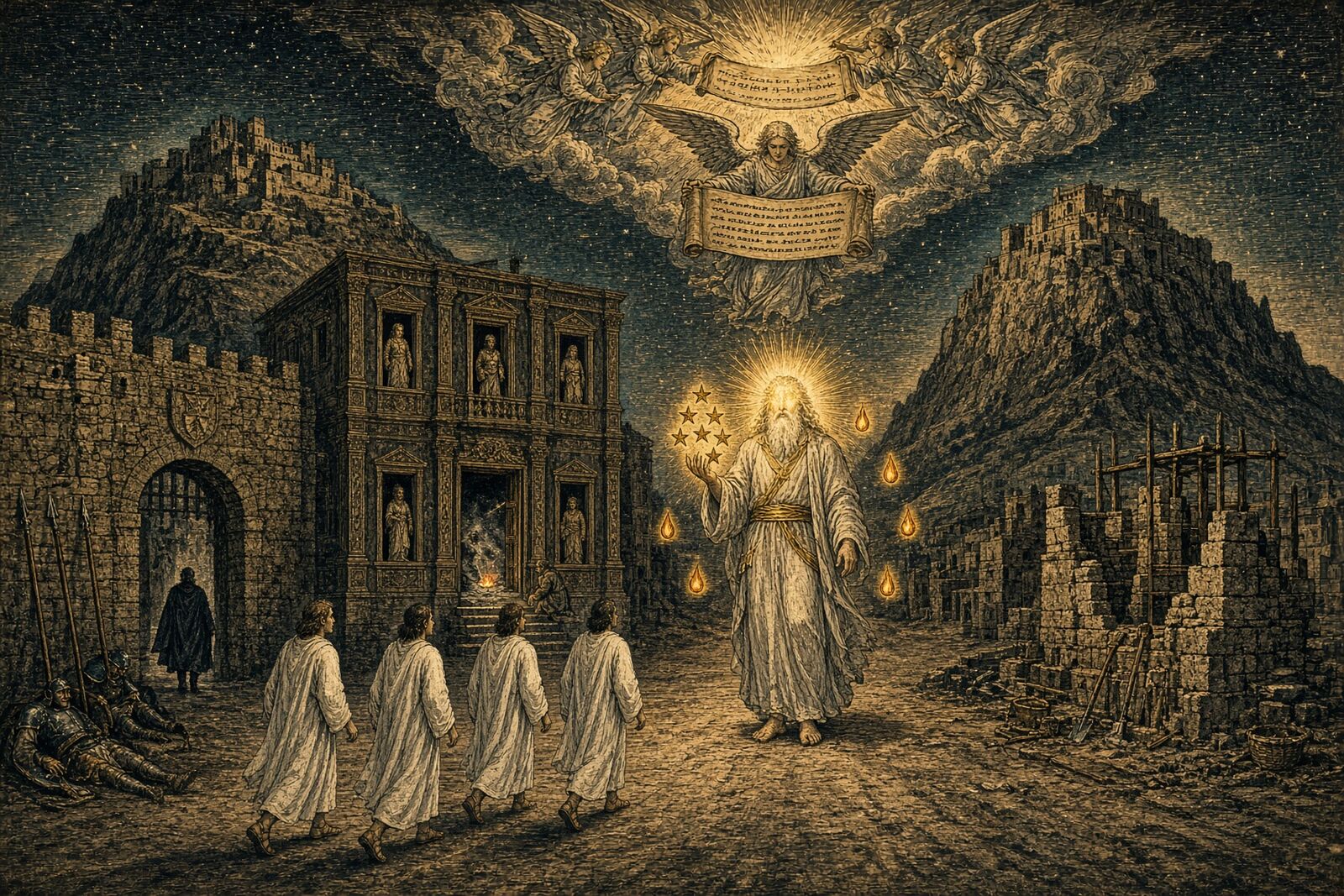
The Letter to Sardis — Revelation 3:1-6
Session 11 | The church with a reputation for life but which is actually dead. Background on Sardis’s two-part city and its Acropolis — twice captured while guards slept — then the text on waking up, soiled garments, and the Book of Life.
Source: A2K Online Church Archive — Revelation 3:1-6
The City of Sardis
Key facts:
- 40 miles southeast of Thyatira
- Population estimated between 60,000 and 100,000
- The city name in Greek is actually plural — because the city had two distinct parts:
- The lower city: flat, fertile, where most people lived and worked
- The upper city: a fortified Acropolis at the summit of the nearby mountain (Tmolus)
The Earthquake
Both parts of the city suffered a devastating earthquake in 17 AD. Rome helped rebuild: Emperor Tiberius exempted the city from taxes for five years and provided financial assistance. In response, the citizens called themselves “Caesarean Sardians” and erected monuments to Tiberius as the “founder of the city.”
This pattern (Rome’s benefaction → the city’s devoted loyalty) was consistent across all seven cities.
The Acropolis: A History of Sleeping Guards
The defining story of Sardis is its Acropolis — and how it was conquered.
The cliffs of the Acropolis were so steep that the phrase “to capture the Acropolis of Sardis” became a Greek idiom for achieving the impossible. No army should have been able to scale it.
Yet it was captured twice — and both times by the same method:
First capture, 494 BC — Cyrus the Persian:
- Historian Herodotus records that Cyrus sent climbers up the mountain
- One climber, Hyroiades, discovered a hidden trapdoor under an unguarded section of the wall
- He waited until nightfall, when the guards had fallen asleep, entered, and opened the gates
- The Persian army marched in; Sardis fell
Second capture, 218 BC — Antiochus III:
- Historian Polybius records that he deliberately studied Cyrus’s method
- He sent climbers up while the guards were again asleep
- Sardis fell a second time by the same means
The city that prided itself on the impregnable fortress was taken both times not by superior military force — but by inattentive, sleeping guards.
Jesus’s rebuke to this church draws directly on this history.
The Imperial Cult in Sardis
Like the other six cities, Sardis was deeply loyal to Rome:
- Had a municipal temple to Emperor Augustus by the end of the 1st century BC
- Citizens renamed themselves after Rome’s benefaction
- The local calendar was organized around whichever priest of the goddess Roma was serving that year
- Olympic games were held at the city stadium, dedicated to the Caesar
- A local benefactor deeply involved in the slave trade served as a priest of the Imperial cult
The Letter: Revelation 3:1-6
Jesus’s Introduction (v. 1)
“The one who has the seven spirits of God and the seven stars.”
He holds the angels and all of heaven’s resources. He is fully equipped to deal with whatever is wrong in this church.
The Rebuke Without Praise
In most of the letters, Jesus opens with praise before the rebuke. He does not do that here. The only church that receives a similar treatment is Laodicea. The rebuke begins immediately.
“You Have a Name That You Are Alive, But You Are Dead” (v. 1)
The church has a reputation for being lively — perhaps a buzzing congregation, lots of activity, a great name in the Christian community. But from Jesus’s perspective: they are dead.
This is not physical death — these are living, breathing people. It is a spiritual metaphor: their deeds are not complete in the sight of God, their works are insufficient, something essential has died in them.
The application for today: churches can have reputations for being vibrant, growing, well-resourced, and theologically active — and still be spiritually dead. External indicators of church health are not what Jesus is looking at.
“Wake Up” (v. 2)
“Wake up, and strengthen the things that remain, which were about to die.”
To the city whose guards fell asleep and who was conquered twice by thieves in the night — Jesus says: wake up.
This word means not just to rouse from sleep but to be vigilant, to be alert, to pay close attention. The call is not merely “don’t be asleep” but “be actively watchful.”
The things that remain — some good deeds, some faithfulness — are barely alive. They need to be strengthened before they die completely.
Why are they dead? Jesus gives the reason in the same verse: “I have not found your deeds completed in the sight of my God.” Their works are incomplete. They may be doing some good things, but not enough — not fully, not faithfully.
The most likely interpretation, consistent with the other letters: they have stopped being faithful witnesses of the gospel. They have allowed the surrounding culture to compromise their identity and mission.
“Remember What You Have Received and Heard, and Keep It, and Repent” (v. 3)
What have they received and heard? The gospel — the message of the kingdom, Jesus’s testimony, the Great Commission that sent them out as witnesses into the world. They received it, they heard it, and they have let it go dormant.
Jesus calls them to:
- Remember — recover awareness of what they once had
- Keep it — maintain, obey, hold on to it (the same verb tēreō surveyed earlier)
- Repent — change their minds, which will change their behavior
“I Will Come Like a Thief” (v. 3)
“If therefore you do not wake up, I will come like a thief, and you will not know at what hour I will come to you.”
This is an unmissable reference to Sardis’s history. The city’s legendary Acropolis — the one everyone thought was impregnable — was twice captured because the guards weren’t watching. Jesus says: if you don’t watch, I will come on you the same way.
This is not the second coming — it is a threat of immediate judgment on this specific church for failure to repent. Just as Jesus removed the lampstand from Ephesus (and that church no longer exists), he can come suddenly in judgment on a sleeping, dead church.
The Few Who Have Not Soiled Their Garments (v. 4)
Even in this dead church, there is a faithful remnant — a few who “have not soiled their garments.” Their reward: they will walk with Jesus in white, because they are worthy.
Soiled garments = compromising with the fallen culture; allowing the world to contaminate their identity in Christ
White garments = righteous deeds, faithfulness, holiness, not compromising
This clothing imagery runs throughout Revelation:
- Revelation 7:14 — the saints have washed their robes and made them white in the blood of the Lamb (their responsibility, not passive reception)
- Revelation 16:15 — blessed is the one who stays awake and keeps his clothes
- Revelation 19:8 — the fine linen of the bride is “the righteous acts of the saints”
- Revelation 22:14 — blessed are those who wash their robes — they receive access to the Tree of Life
The consistent pattern: the responsibility for keeping white garments belongs to Christians themselves. We choose whether to soil them through compromise or keep them clean through faithful, righteous living.
“I Will Not Erase His Name from the Book of Life” (v. 5)
The promise to the conqueror: “The one who overcomes will thus be clothed in white garments; and I will not erase his name from the Book of Life.”
The implicit threat is clear: If you do not overcome, your name can be erased from the Book of Life.
This is not once-saved-always-saved. The Book of Life can be written in and erased from. Precedents:
- Psalm 69:28 — the psalmist prays that evil people be “blotted out of the book of life”
- Exodus 32 — Moses intercedes for Israel after the golden calf, asking God to blot him out if he won’t forgive them — confirming the book can be edited
The city of Sardis itself had a civic register of citizens, from which a condemned person’s name was struck before execution. Jesus’s hearers would have understood the image immediately.
“I Will Confess His Name Before My Father” (v. 5)
Faithful conquerors receive this additional promise: Jesus will acknowledge them before God. This is the inverse of Matthew 10:33 (“whoever denies me before men, I will deny before my Father”).
Jesus here is the advocate, the intercessor who stands before God and says: “This one is worthy. They kept their white garments. Their name stays.”
Summary
| Element |
Meaning |
| Twice captured by sleeping guards |
The city’s history makes “wake up” personally loaded — they know exactly what it means |
| Alive reputation, but dead |
External church vitality means nothing if deeds are incomplete in God’s sight |
| Wake up |
Not just “don’t sleep” — be actively vigilant and watchful |
| Remember, keep, repent |
Three-step call: recover what was received, maintain it, change behavior |
| Come like a thief |
Immediate judgment threat — as happened to Sardis twice when guards slept |
| Few faithful |
Even in a dead church, a remnant keeps their garments clean |
| White garments |
Righteous acts; the responsibility of Christians to maintain through faithfulness |
| Book of Life erasure |
Real threat; not once-saved-always-saved; names can be removed |
| Jesus confesses your name |
The reward for faithfulness: advocacy before God |
“The application is simple: Christians should expect to be reproved. If Jesus had to rebuke five of seven first-century churches, the odds are good that he would find something to rebuke in us too — and the right response is humility, remembrance, and repentance.”