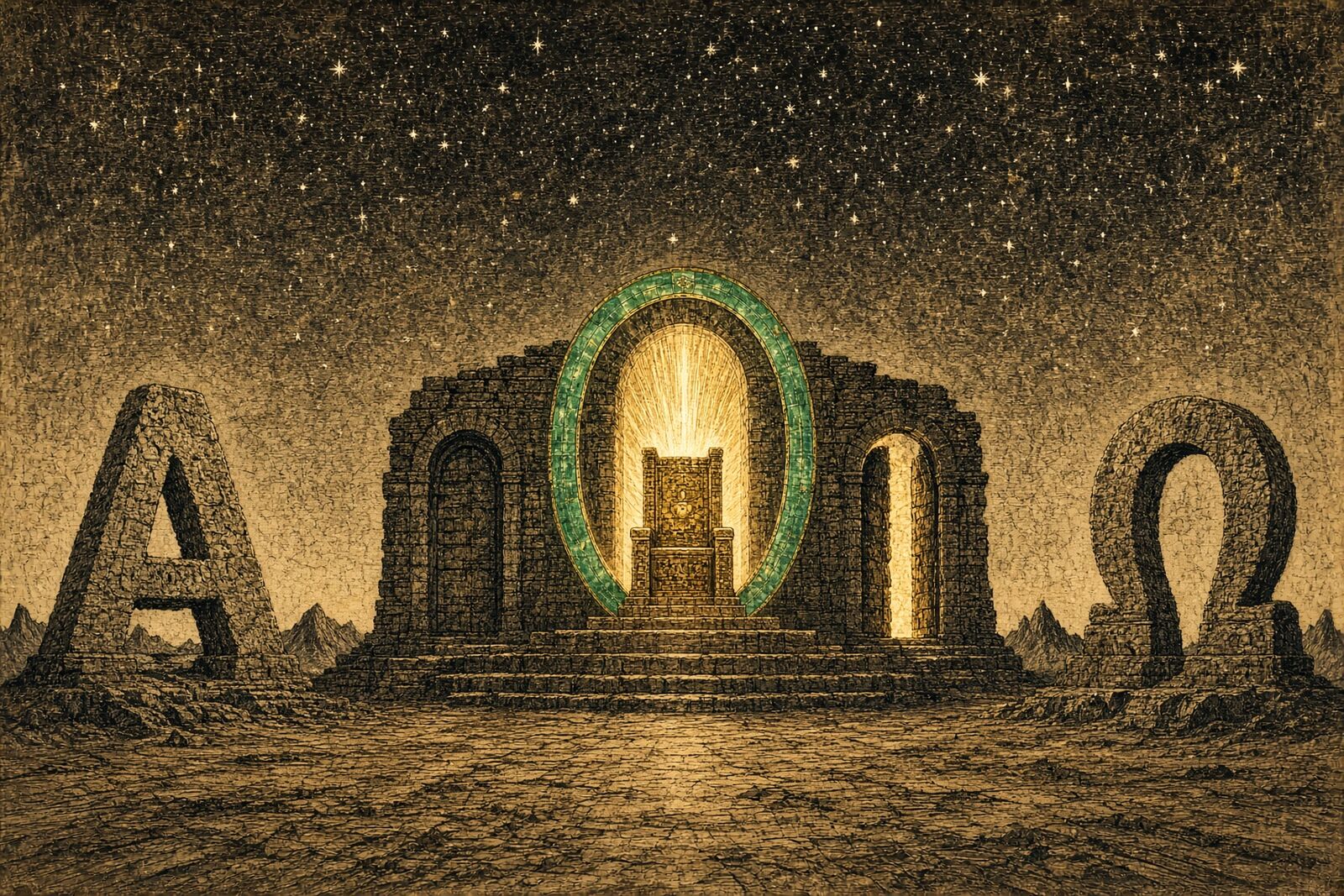
Revelation 1:5-8 — Jesus the Faithful Witness, Priests, and Alpha & Omega
Session 4 | Continuing the verse-by-verse study of Revelation 1, covering verses 5–8.
Source: A2K Online Church Archive — Revelation 1:5-8
The Twofold Purpose of Apocalyptic Literature
Before continuing in the text, the teacher restates the core purpose of this genre and the entire study:
- To give hope to believers suffering persecution, tribulation, or hardship — pointing them toward resurrection, vindication, and the coming kingdom
- To rebuke and prod Christians who have grown comfortable, apathetic, or compromised with the surrounding fallen world.
The practical question that should drive every reading: How can this book encourage me in whatever I’m going through — and how can it shake me out of apathy?
Three Descriptions of Jesus (Rev 1:5)
Jesus is introduced with three progressive titles that form a theological argument:
1. The Faithful Witness (martys)
The very first description of Jesus in Revelation is not “King” or “Lord” — it is the faithful witness, which is literally the faithful martyr. Jesus is held up first and foremost as someone who:
- Preached the gospel faithfully
- Died because of that preaching
- Is the model for Christian discipleship
The teacher makes a critical application: if Jesus is the faithful evangelist who died for his witness, then we who follow him are also called to preach the kingdom — even in the midst of a culture that glorifies another kingdom (Rome in the first century; whatever fallen Babylon looks like in ours).
2. The Firstborn of the Dead
After martyrdom comes resurrection. As the firstborn of the dead:
- Jesus is the first of many who will be raised — his resurrection is a preview and guarantee of ours
- “Firstborn” implies privilege and priority; Jesus has been exalted to the highest position of any creature
3. The Ruler of the Kings of the Earth
Jesus is already the ruler of the kings of the earth — not just at the second coming, but now. This is one of the central claims Revelation wants its readers to believe despite appearances to the contrary. The New Testament consistently teaches this “already/not yet” tension:
- 1 Corinthians 15: “He must reign until he puts all enemies under his feet” — he is reigning now
- Psalm 110:1: “Sit at my right hand until I make your enemies your footstool” — he is currently seated, not idle
The overlap of the ages: The age to come has already broken into the present. Jesus’s exaltation is real, even if the consummation of his kingdom is still future.
Implication for Christians: Because Jesus is already ruler of the kings of the earth, we belong to his empire — not Rome’s, not any nation’s. Our allegiance is to a different kingdom.
Love That Reproves and Disciplines (Rev 3:19 cross-reference)
Revelation says Jesus “loves us” (1:5), but the book immediately defines what that love looks like in practice. Turning to Revelation 3:19:
“Those whom I love I reprove and discipline.”
This is crucial: Jesus’s love in Revelation is expressed through correction and rebuke, not just comfort and reassurance. Of the seven churches, five receive rebuke. The practical application:
- When we read Revelation and feel convicted, that is the love of Christ at work
- Being freed from sin means Jesus, not sin, now governs our behavior
- Christians should welcome reproof rather than resist it
Made a Kingdom and Priests (Rev 1:6)
Jesus has already made the body of believers:
- A kingdom — We are already citizens of God’s kingdom, not merely waiting for a future one. This parallels Philippians 3:20 (“your citizenship is in heaven”) and the Lord’s Prayer (“your kingdom come… on earth as in heaven”).
- Priests — Drawing on Exodus 19:6 (“you will be a kingdom of priests and a holy nation”), Jesus has now fulfilled this calling through the church. This is picked up again in 1 Peter 2:9 (“a royal priesthood”).
What Does Being a Priest Mean?
The teacher leads a discussion and identifies key priestly responsibilities for Christians today:
- Intercession — standing between God and the people, praying for others and pointing them to right relationship with God
- Holy behavior — being set apart for God’s purposes, distinct from the fallen culture
- Living sacrifices — Paul’s Romans 12:1 teaching that God never wanted animal sacrifices as an end in themselves; what he wanted was the complete giving of oneself to God
- Temple workers — if we are priests, we serve in a temple; that temple is the body of Christ (1 Cor. 6:19)
The Body of Christ as the New Temple
The church is described throughout the New Testament as God’s new temple:
- Paul: “You are the temple of God” (1 Cor. 3:16)
- Revelation: The churches are called lampstands — the lampstand (menorah) was a fixture of the Jerusalem temple
- This means the church’s identity is that of a holy, priestly, temple community — affecting both behavior (holiness, distinctness from the world) and mission (being a light to the world through gospel proclamation)
The Lamb as the Most Common Image of Jesus
The most common title for Jesus in Revelation is not “King” or “Lord” but the Lamb — specifically, a slaughtered Passover lamb. This is theologically deliberate:
- It identifies Jesus with weakness, sacrifice, and death
- To be identified with Jesus means to be identified with this slain lamb
- Christians as “followers of the Lamb” carry the same image: sacrifice, not domination
“Behold, He Is Coming With the Clouds” (Rev 1:7)
This is a double citation from two Old Testament texts:
- Daniel 7:13 — the Son of Man coming in the clouds
- Zechariah 12 — “those who pierced him” mourning
John uses Zechariah here in a completely reinterpreted way. In Zechariah, the people who “pierced” God were Israelites who spurned him. John takes this and applies it to the rejection and crucifixion of Jesus — not because the original context demands it, but because he is freely reappropriating Old Testament scripture for a new purpose.
The key point of verse 7: When Jesus returns, every eye will see him, and all the tribes of the earth will mourn over him. This mourning is not the mourning of defiance — it is the godly mourning of repentance.
“Blessed are those who mourn, for they will be comforted.” (Matthew 5:4) — mourning one’s sin leads to change, repentance, and comfort.
Revelation here is not just announcing Jesus’s return as an event of destruction. It is calling the nations to mourn their sin, to repent, and to follow the Lamb. The heart of God in this book is for repentance and conversion, not merely punishment.
“The Amen” and Its Function
The word Amen in verse 6 is not a casual sign-off. When the original readers said “Amen” to the descriptions of Jesus — faithful witness, firstborn of the dead, ruler of the kings of the earth, lover of our souls, freer from sin, maker of priests — they were verbally committing themselves to these truths. It is an act of allegiance, not just agreement.
God as Alpha and Omega, the Almighty (Rev 1:8)
God the Father is introduced with two important titles:
Alpha and Omega
The first and last letters of the Greek alphabet — a way of saying God is the beginning and the end, the one who initiates and consummates all things. This is not primarily about omniscience; it is about total sovereignty over history.
Importantly, later in Revelation (11:17) God is described as “the one who is and who was” — with the phrase “who is to come” dropped — because at that point in the narrative God has already arrived in judgment.
Pantocrator — The Almighty
The Greek word for “Almighty” (Pantocrator) means ruler of all things (pan = all; krateo = to rule). Archaeologists have found inscriptions in four of the seven cities (Ephesus, Smyrna, Sardis, Laodicea) calling the Roman Emperor the Autocrator — the self-ruler. Revelation counters: God is the true Pantocrator, the ruler of all things. Caesar is nothing by comparison.
Summary Table
| Element |
Meaning |
| Faithful Witness |
Jesus preached the gospel and died for it — he is the model for Christian evangelism |
| Firstborn of the Dead |
His resurrection guarantees ours; his exaltation is the highest ever given to a creature |
| Ruler of the Kings of the Earth |
Already true — not just future; we belong to his kingdom now |
| Love that reproves |
Jesus’s love includes discipline and correction, not just comfort |
| Kingdom and Priests |
Christians are already both — affecting identity, behavior, and mission |
| New Temple |
The church is where God’s presence now dwells; lampstand = temple imagery |
| He is coming |
The nations will mourn — a call to repentance, not just a threat of judgment |
| Amen |
An act of public commitment and allegiance to these truths |
| Pantocrator |
God is the true Almighty Ruler — not Caesar, not any human empire |
“This book is so incredibly practical. It doesn’t matter if it was written 2,000 years ago or written today — it is so practical, and we could use this in our lives.”