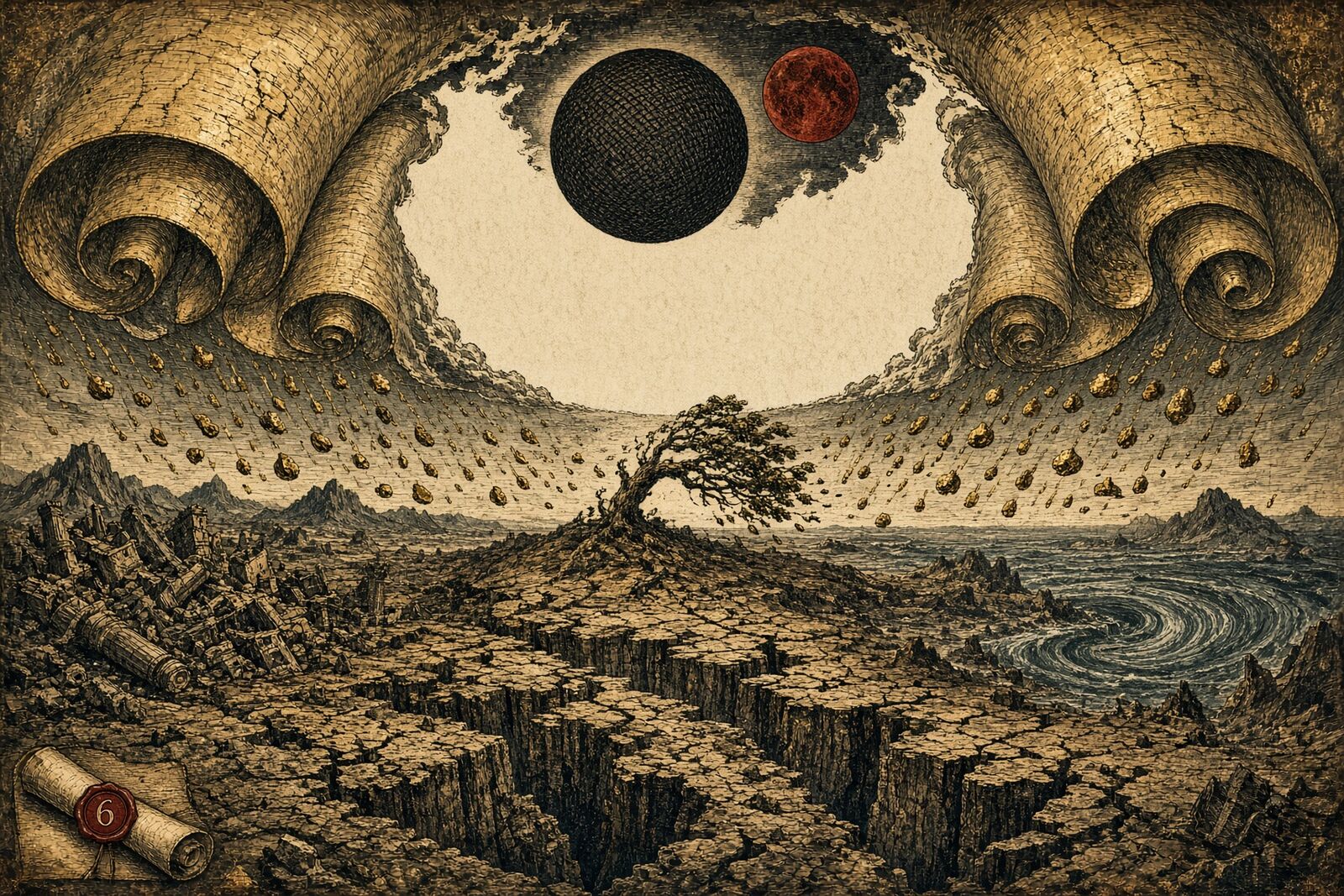
Revelation 6 — The Seven Seals: The Four Horsemen
Session 19 | The opening of the first four seals and the four horsemen. Historical background on Zechariah’s horses, the meaning of each horseman, Domitian’s grain edict, and Rome’s false peace exposed.
Source: A2K Online Church Archive — Revelation 6:1-8
Opening Approach: Symbolic Vision
Revelation is now fully in its visionary mode. The key interpretive question for every image is not “what literal event does this predict?” but rather:
- What does this symbol mean in its Old Testament background?
- How would the original recipients have understood this?
- What is God revealing about reality from his perspective?
The seven seals, seven trumpets, and seven bowls do not form a simple chronological timeline. They are thematically organized visions, each presenting a different angle on the same underlying realities. This is consistent with how apocalyptic literature works.
Framing Chapter 6 in the Big Picture
The scroll (chapter 5) contains God’s purposes for history. As each seal is opened, portions of this content are enacted. But the seals are not the contents of the scroll — they are the preparation and approach to the scroll’s contents.
Think of it this way: the breaking of the seals is like unlocking a door. Once all seven seals are broken, the scroll’s full content can be unrolled and read (this happens more fully in the trumpet and bowl sequences).
Patterns in Seals, Trumpets, and Bowls
All three sequences (seals, trumpets, bowls) share similar content — war, famine, death, cosmic upheaval, prayer of the martyrs, and final judgment. They are not three separate periods of history happening sequentially. They are three overlapping perspectives on the same realities of the church age — viewing the same territory from different altitudes, as it were.
Zechariah’s Horses as the Old Testament Background
Before examining each horseman, the teacher grounds the vision in its Old Testament source: Zechariah 1 and 6.
In Zechariah 1:7-11, the prophet sees horses of different colors sent out to patrol the earth. The earth is described as “at rest” — deceptively peaceful — but God’s temple has not been rebuilt and his purposes have not yet been completed.
In Zechariah 6:1-8, four groups of horses pull chariots and go out to the four winds of heaven. They represent God’s sovereign agents moving through the earth to accomplish his purposes.
Key takeaway: The horses in Revelation 6 are not unprecedented. They are drawn from Zechariah’s vision of God’s sovereign agents at work in the world — not demonic forces or random disasters, but God’s active governance of history (including allowing the consequences of human sin and imperial violence).
The First Seal: White Horse of Conquest (Rev 6:1-2)
“I looked, and behold, a white horse, and he who sat on it had a bow; and a crown was given to him, and he went out conquering and to conquer.”
Is this Jesus? Some interpret this as Christ (based on the white horse in 19:11 where Jesus returns). The teacher argues this is not Jesus for these reasons:
- The riders in seals 1-4 form a thematic group of four — war, famine, death, etc. Jesus would be out of place in this sequence
- Jesus is the one opening the seals — he would not also be one of the beings released by the seals
- The rider has a bow — Revelation never associates Jesus with a bow (his weapon is the sword from his mouth)
- This rider represents conquest and imperial aggression — Rome’s violence and expansion
The Bow, the Parthians, and Rome’s Vulnerability
The bow was specifically associated with the Parthians — Rome’s most dangerous enemy on its eastern frontier. The Parthians were the only people to defeat Rome in major battle during this period. To Roman readers and their subjects, a bowman on a white horse would evoke the terror of Parthian horsemen.
This has two possible readings:
- The first horseman represents Rome itself — its conquest of the world (Rome rode to conquest)
- The first horseman represents the threat to Rome — Parthia, the power that could bring Rome down
Either way, the first seal opens the reality of imperial conquest and violence as a feature of the fallen world that God’s people must navigate.
The Second Seal: Fiery/Red Horse of War (Rev 6:3-4)
“Another, a red horse, went out; and to him who sat on it, it was granted to take peace from the earth, and that men would slay one another; and a great sword was given to him.”
The red horse takes peace from the earth — the peace Rome claimed to have brought (the Pax Romana) is exposed as false. Rome’s “peace” was achieved through violent conquest and maintained through the threat of overwhelming force.
Tacitus (a Roman historian writing in the same period) quotes a British chieftain who spoke against Rome: “They make a desert and call it peace.” Roman peace was not genuine peace — it was the silencing of resistance through superior violence. The second horseman reveals this.
The red horse brings the reality of war — not God causing war arbitrarily, but the natural outworking of a world organized around violent power.
The Third Seal: Black Horse of Famine (Rev 6:5-6)
“Behold, a black horse, and he who sat on it had a pair of scales in his hand. And I heard something like a voice in the center of the four living creatures saying, ‘A quart of wheat for a denarius, and three quarts of barley for a denarius; and do not damage the oil and the wine.’”
Scales = rationing; measuring out food in desperate shortage
A denarius = a day’s wage; one quart of wheat = one day’s work just to eat
This is extreme economic deprivation — a person earns exactly enough to feed themselves but cannot feed their family, and certainly cannot afford anything beyond the basics.
“Do not damage the oil and the wine” — these luxury goods are protected even while staples become unaffordable. This is a specific critique of economic inequality: the wealthy maintain their luxuries while the poor struggle to eat. This directly critiques Rome’s economic system.
Domitian’s Grain Edict (92 AD)
The teacher connects this to a real historical event: Emperor Domitian ordered that grape production be halved empire-wide because of a grain shortage — devastating the economy of wine-producing cities like Philadelphia and Laodicea. This edict caused real poverty and is likely one of the specific realities Revelation has in mind.
Revelation Against Luxury and Exploitation
This seal is part of Revelation’s consistent economic critique of Rome. Later in chapters 17-18, the fall of Babylon is mourned by merchants who grew rich from her — the list of trading goods in 18:12-13 ends with “slaves and human souls.” The empire’s wealth was built on exploitation and slavery, and Revelation denounces it.
The Fourth Seal: Ashen Horse of Death (Rev 6:7-8)
“Behold, an ashen horse; and he who sat on it had the name Death; and Hades was following with him. Authority was given to them over a fourth of the earth, to kill with sword and with famine and with pestilence and by the wild beasts of the earth.”
“Ashen” — the pale green color of death; the color of a corpse before embalming. This is not a natural color for a living creature. It is death visible.
The rider is explicitly named Death, with Hades following behind — gathering up those who die.
“A fourth of the earth” — not the whole earth, not a majority. This is limited in scope. Remember the symbolic use of numbers: “one-fourth” means significant but partial. God’s judgment here is not total annihilation — it is a severe warning shot, limited in extent, leaving room for repentance.
Four means of death are listed — sword, famine, pestilence, wild beasts. These are the “four sore acts of judgment” from Ezekiel 14:21, where God says he will send his four severe judgments on Jerusalem for its unfaithfulness. Revelation draws on Ezekiel’s language to describe the general realities of the fallen age.
Tacitus and Rome’s False Peace
The teacher cites Tacitus to show that this critique of Rome was not unique to Revelation:
Tacitus himself, a Roman historian writing in the same general period, was deeply critical of the Imperial system’s corruption, violence, and pretension to peace. The Agricola and Annals of Tacitus portray an empire that spoke of justice and civilization while practicing oppression and violence.
Revelation is not giving an uniquely paranoid anti-Roman perspective — it is articulating what thoughtful observers of the empire recognized: Rome’s “peace” was purchased with blood and maintained by terror.
Summary: The Four Horsemen
| Seal |
Horse |
Meaning |
| First |
White |
Conquest and imperial aggression — the violence at the heart of imperial power |
| Second |
Red |
War — Rome’s “peace” unmasked as coercive silence of resistance |
| Third |
Black |
Famine and economic inequality — the poor suffer while luxuries are protected |
| Fourth |
Ashen |
Death, mortality, pestilence — the natural end of a world organized around violence |
What the four horsemen together reveal:
These are not random catastrophes or specific future events to decode on a calendar. They are the abiding features of the fallen world — the realities of life under a world system organized around power, violence, economic exploitation, and death. They represent what the world looks like when it is organized around the values of Fallen Babylon rather than the values of the Lamb.
For persecuted Christians in Asia Minor: these are the forces you are living under. Jesus’s opening of these seals does not mean he is causing them — it means he is revealing them and naming them for what they are. Rome is not bringing peace and civilization; Rome is bringing conquest, war, famine, and death.
The appropriate Christian response: not despair, not violent resistance, but faithful witness — the gospel of a different kingdom, a different Lord, a different kind of peace.
Why This Matters
The four horsemen are not a schedule of coming events. They are a theological unmasking:
- Imperial conquest is violence, not civilization
- Rome’s peace is maintained by war
- Economic prosperity for the few comes at the cost of poverty for the many
- The end of a world organized around power is death
Christians who understand this cannot be comfortable with uncritical allegiance to any empire — then or now. The horsemen challenge Christians in every era to ask: whose kingdom am I building?