Revelation 7 — The 144,000 and the Great Multitude (Part 2)
Session 22 | Answering the three key questions: What is the 144,000? How do the military census and symbolic numbers work? Are the 144,000 and the great multitude the same group? And what is their ultimate destiny?
Source: A2K Online Church Archive — Revelation 7:4-17
The Three Key Questions Revisited
From the previous session, three questions were raised about the 144,000:
- Is the number literal or symbolic?
- Are these ethnic Jews or the people of God more broadly?
- Are the 144,000 and the great multitude the same group or different groups?
This session works through all three.
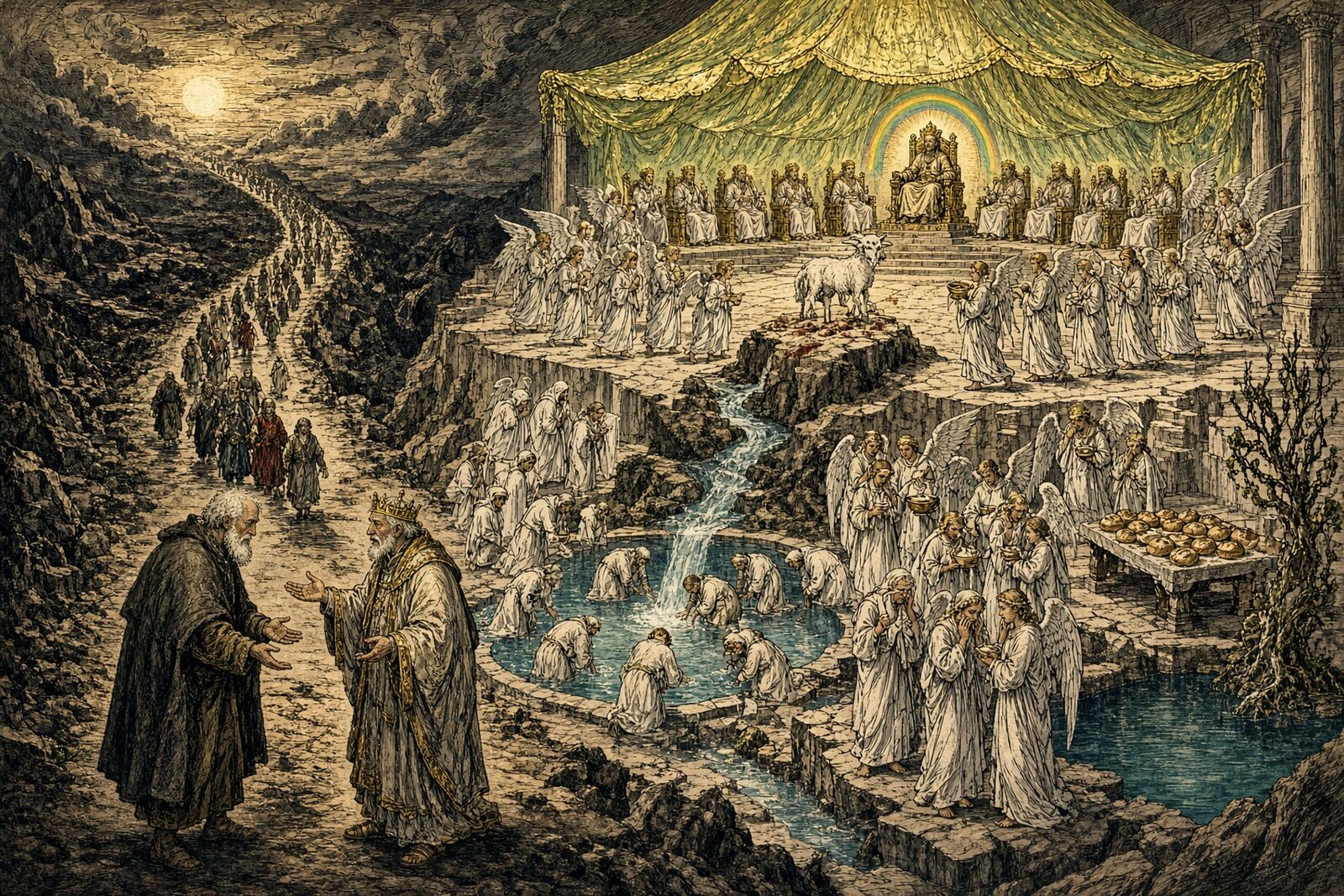
The Shepherd and Springs of Living Water (Rev 7:17)
Before answering the questions, the teacher notes the beautiful promise at the end of the chapter:
“For the Lamb in the center of the throne will be their shepherd, and will guide them to springs of the water of life; and God will wipe every tear from their eyes.”
The shepherd imagery takes the Lamb — the slaughtered animal, the weakest possible symbol — and calls him a shepherd. The same one who was sacrificed now guides and protects and provides for his flock. The one who died to save us now leads us to living water and wipes our tears.
This is comfort for persecuted believers. Whatever they are going through — suffering, poverty, martyrdom — there is a shepherd who sees them, guides them, and will wipe away their tears.
Symbolic Numbers: 12, 1,000, and Completeness
144,000 = 12 × 12 × 1,000
To understand whether the number is literal or symbolic, it helps to understand how each component functions:
12 = the number of the fullness of God’s people. In the Old Testament, 12 tribes = all of Israel. In the New Testament, Jesus chose 12 apostles to represent the reconstituted people of God. Twelve = God’s complete community.
12 × 12 = 12 (God’s people) multiplied by 12 (God’s people) = an intensified expression of completeness
× 1,000 = a large multiplier indicating a vast number; a thousand is used throughout Scripture to indicate a large but not necessarily literal count
144,000 = the complete, full number of God’s people — a symbolic representation of the totality of those who belong to him, not a literal headcount of 144,000 specific individuals.
This is consistent with how numbers work throughout Revelation:
- 7 = completeness
- 12 = the fullness of God’s people
- 1,000 = large magnitude
- 666 = imperfect, falling short of 777
The Census in Numbers 1 and Military Imagery
The structure of the 144,000 listing (12,000 from each of 12 tribes) deliberately echoes Numbers 1 — the military census of Israel.
In Numbers 1, God commands Moses to count all the men “able to go to war” from each tribe. The census has a military purpose: these are the fighting men of Israel.
Revelation’s 144,000, structured in the same way, represents the church as an army — but an army that fights in the same way Jesus fought: through faithful witness, non-violent perseverance, and willingness to die rather than deny the faith.
This is consistent with the military imagery elsewhere in Revelation: Christians are soldiers, but their weapons are the word of God and the blood of the Lamb (12:11), not physical weapons.
The 144,000 are Christians understood as God’s army of faithful witnesses.
The 144,000 Identified as Christians in Revelation 14
The hearing-before-seeing pattern provides the decisive evidence. In Revelation 14:1-5, the 144,000 appear again:
“Then I looked, and behold, the Lamb was standing on Mount Zion, and with Him one hundred and forty-four thousand, having His name and the name of His Father written on their foreheads.”
And they are described as:
- Following the Lamb wherever he goes
- Having been purchased from among men as first fruits to God and to the Lamb
- In whose mouth no lie was found
- Blameless
This is a description of faithful Christians — those who follow Jesus, who bear his name and his Father’s name, who have maintained their integrity. There is nothing in the description that limits this to ethnic Jews.
Furthermore, Revelation 14 explicitly identifies the 144,000 as purchased from among men — a phrase echoing the new song in chapter 5 (“purchased for God with Your blood men from every tribe and tongue and people and nation”). The 144,000 in chapter 14 = the redeemed from every nation in chapter 5 = the same group.
The Hear/See Interpretive Pattern Applied
Chapter 7 follows the hearing-before-seeing pattern exactly:
- John hears (vv. 4-8): A specific, numbered group — 144,000 from the twelve tribes of Israel, 12,000 from each tribe
- John sees (vv. 9-17): An uncountable multitude from every nation, tribe, people, and tongue
What he hears — the 144,000 — is clarified by what he sees — the great multitude. The 144,000 heard (specific structure, Jewish tribal categories, numbered completeness) and the great multitude seen (universal, innumerable, every nation) are two perspectives on the same group.
This is exactly what happened in chapter 5: John heard “Lion of Judah” and saw “slain Lamb.” One reality, two complementary images.
The 144,000 and the Great Multitude Are One People
The 144,000 = God’s people viewed through the lens of their identity and completeness — structured like the census of Israel, organized, numbered (symbolically), bearing God’s seal
The great multitude = God’s people viewed through the lens of their diversity and uncountability — from every nation, impossible to number, standing before the throne
The same group of faithful Christians, the body of Christ, is described:
- As a complete, organized army (144,000) — their identity is structured and secure in God
- As an uncountable multitude (9:9) — their actual number is beyond human calculation; they come from everywhere
New Jerusalem’s Dimensions and 144,000
A further confirmation: in Revelation 21, the New Jerusalem is described in detail. Its walls measure 144 cubits. The city itself is a cube with dimensions of 12,000 stadia per side. The surface area of such a city works out to a number related to 144,000.
Since New Jerusalem = the Bride of Christ = the people of God, and since the number 144,000 appears in the city’s dimensions, this is another indicator that 144,000 is the symbolic number of the people of God — not a specific literal count.
The Holy of Holies Connection
The New Jerusalem is also a cube — and the only other perfect cube in Scripture is the Holy of Holies in Solomon’s temple (1 Kings 6:20, the inner sanctuary was 20 cubits × 20 cubits × 20 cubits).
The Holy of Holies was the most sacred space in Israel — the place where God’s presence dwelt, where the high priest entered once a year on the Day of Atonement, where only the most holy could approach.
If New Jerusalem = a cube = the Holy of Holies, then New Jerusalem = the ultimate Holy of Holies — the place where God’s presence fully and permanently dwells among his people. Not just once a year. Forever.
And the people of God are the living stones of this eternal Holy of Holies.
New Jerusalem as the Bride and Body of Christ
This all coheres with Revelation 21:9-10, where the angel says “I will show you the bride, the wife of the Lamb” and then shows John the holy city, New Jerusalem. The city = the bride = the people of God.
New Jerusalem is not primarily an architectural future city — it is the metaphor for the people of God in their ultimate, perfected, glorified state. The 144,000, the great multitude, the Bride of Christ, the New Jerusalem — these are all the same group of people described from different angles.
Washing Robes and the Righteous Acts of the Saints
The great multitude is described in 7:14 as having “washed their robes and made them white in the blood of the Lamb.” The teacher revisits this image:
- White robes = righteous acts (Revelation 19:8 explicitly interprets this)
- “Washed them” — the active subject is the saints themselves, not God doing it to them
- “Made them white in the blood of the Lamb” — paradox: you can’t make something white with blood; this signals it is a spiritual and metaphorical washing
Christians “wash their robes” by:
- Maintaining faithful loyalty to God and the Lamb
- Not soiling their garments through compromise with Fallen Babylon
- Living out the righteous acts that define their identity as God’s people
This is not a passive transformation — it requires active, ongoing choice.
Coming Out of Great Tribulation (Present Tense)
“These are the ones who come out of the great tribulation.”
The verb “come” is present tense — they are coming out, continually, right now. The “great tribulation” is not a future seven-year period. It is the ongoing experience of the church under pressure — the tribulation John himself shares with the seven churches (1:9). Christians are continually coming through this tribulation by virtue of their faithfulness to the Lamb.
Summary
| Element |
Meaning |
| 144,000 = symbolic |
12 × 12 × 1,000 = complete number of God’s people |
| Military census echo |
Christians as God’s army — fighting with witness, not weapons |
| Rev. 14 identification |
144,000 = those who follow the Lamb = Christians from every nation |
| Hear/See pattern |
144,000 (heard) = great multitude (seen) — two perspectives on one group |
| New Jerusalem dimensions |
144,000 appears in the city’s structure — God’s people and their eternal home align |
| Holy of Holies |
New Jerusalem is a cube = the ultimate Holy of Holies; God permanently present |
| White robes |
Righteous acts; the saints wash them actively, not passively |
| “Come out” — present tense |
Ongoing; the church continuously emerges through tribulation by faith |
| “Who is able to stand?” |
Answer: those sealed by God, who follow the Lamb wherever he goes |
“The 144,000 is not a club of 144,000 special individuals. It is a symbol for the complete, organized, armed community of faithful Christians — God’s army of witnesses — seen from two angles: numbered and complete, and innumerable in their diversity.”