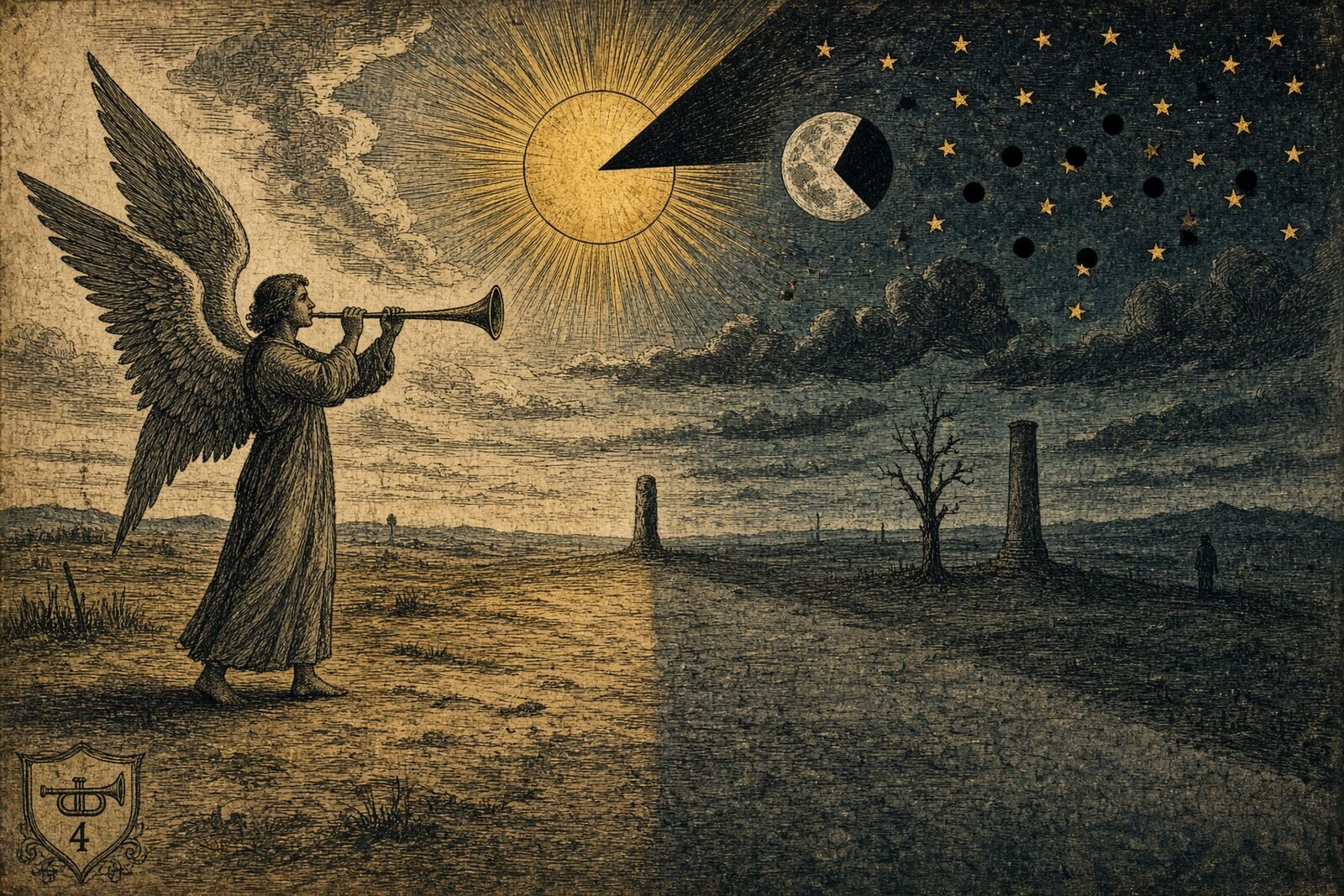
Revelation 8 — The Seven Trumpets Begin
Session 23 | The seventh seal opens into the seven trumpets. The silence in heaven, the incense and prayers of the saints, the purpose of the trumpets (repentance, not destruction), the Exodus plague parallels, and Greco-Roman omen literature as background.
Source: A2K Online Church Archive — Revelation 8 (Part 1 of 2)
Revelation as an Ongoing Narrative
The teacher reemphasizes that Revelation must be read as a continuous narrative, not a set of disconnected visions to decode individually. Every new section builds on what came before and connects forward to what comes after. The visions recapitulate, overlap, and intensify — they do not form a linear chronological sequence.
The structural pattern:
- Seals 1-6 → Interlude (chapter 7) → Seal 7 opens into trumpets
- Trumpets 1-6 → Interlude (chapters 10-11) → Trumpet 7 opens into bowls
- Bowls 1-7 → Climax (Fallen Babylon falls; New Jerusalem revealed)
Each series recapitulates the same underlying realities (the fallen world, God’s sovereignty, the call to repentance) at increasing intensity.
The Seventh Seal: Silence in Heaven (Rev 8:1)
“When the Lamb broke the seventh seal, there was silence in heaven for about half an hour.”
“Silence in heaven” — this is one of the most evocative images in Revelation. After the continuous worship of the four living creatures (“holy, holy, holy… day and night they do not cease”), and the continuous songs of the elders, and the myriads of angels praising the Lamb — everything stops. Complete silence for half an hour.
Why?
The Dramatic Pause
The silence serves as a dramatic moment of anticipation and solemnity. What is about to unfold — the seven trumpets — is serious. Heaven itself pauses in the face of what is coming.
Zephaniah 1:7 — “Be silent before the Lord God! For the day of the Lord is near.” Silence in the face of God’s coming action was a known posture in Old Testament prophetic literature.
The half-hour suggests something measured and temporary, not permanent silence. The pause creates space for what follows.
The Martyrs’ Prayer Under the Altar (Rev 6:9-11 Connection)
The teacher connects the opening of the seventh seal directly back to the martyrs’ prayer in the fifth seal:
- The martyrs cried out: “How long, O Lord, will you refrain from judging and avenging our blood?”
- They were told to wait “a little while longer”
- Now the seventh seal opens — and the first thing we see is the prayers of the saints being offered before God
The prayers of the persecuted church are driving the narrative of Revelation. The whole sequence of seals and now trumpets is connected to this prayer for justice. Heaven’s silence is the moment when those prayers are about to be answered.
Silence in Heaven and Prayers as Incense (Rev 8:3-5)
“Another angel came and stood at the altar, holding a golden censer; and much incense was given to him, so that he might add it to the prayers of all the saints on the golden altar which was before the throne. And the smoke of the incense, with the prayers of the saints, went up before God out of the angel’s hand. Then the angel took the censer and filled it with the fire of the altar, and threw it to the earth; and there followed peals of thunder and sounds and flashes of lightning and an earthquake.”
The golden altar = the altar of incense in the tabernacle/temple, where incense was burned twice daily as part of the priestly liturgy. This altar stood before the curtain that separated the outer court from the Holy of Holies.
Incense + prayers = the same thing. Psalm 141:2 — “May my prayer be counted as incense before You.” The prayers of God’s people rise to him as fragrant incense.
The sequence:
- The angel adds incense to the prayers of the saints
- The combined offering rises before God’s throne
- The angel then takes fire from the altar and throws it to the earth
- Cosmic signs follow (thunder, lightning, earthquake)
Interpretation: The prayers of the persecuted saints — the “how long, O Lord?” — are received by God, combined with the sweetness of the incense offering, and then God responds by throwing fire from the altar onto the earth. The trumpet plagues that follow are God’s response to the prayers of his people.
Psalm 141: Prayers Likened to Incense
“May my prayer be counted as incense before You; the lifting up of my hands as the evening offering.” (Psalm 141:2)
This confirms that the incense = prayer imagery is not unique to Revelation — it is deeply embedded in the Psalter’s understanding of prayer as a priestly act. Christians as “priests to God” (Rev. 1:6) offer their prayers as priestly incense.
The Purpose of the Trumpets: Repentance, Not Destruction
This is one of the teacher’s key interpretive points. The seven trumpets are warnings designed to call people to repentance, not final punishments intended to destroy.
Evidence:
- After the fifth and sixth trumpets, Revelation explicitly states: “The rest of mankind, who were not killed by these plagues, did not repent of the works of their hands… they did not repent of their murders nor of their sorceries nor of their immorality nor of their thefts.” (9:20-21)
- The text emphasizes their failure to repent — which only makes sense if the purpose of the plagues was to bring them to repentance
- If the purpose was simply to destroy, there would be no need to note their failure to repent
The heart of God: As we saw in the letters to the seven churches (especially Thyatira and Laodicea), God gives time for repentance. He is long-suffering, not eager to destroy. The trumpets are escalating warnings — like a fire alarm going off louder and louder — calling people to turn back before it is too late.
Echoes of the Exodus Plagues
The seven trumpets deliberately parallel the ten plagues of Egypt in Exodus 7-12:
| Exodus Plague |
Trumpet Vision |
| Water turned to blood |
Sea turns to blood (2nd trumpet) |
| Hail and fire |
Hail and fire mixed with blood (1st trumpet) |
| Darkness |
Sun, moon, stars darkened (4th trumpet) |
| Locusts |
Locusts from the abyss (5th trumpet) |
| Death of firstborn |
Death from the armies (6th trumpet) |
Why the Exodus parallels?
The Exodus was God’s great act of liberation and judgment — liberating Israel from slavery while judging Pharaoh and Egypt for their oppression. The purpose of the plagues was explicitly stated in Exodus: that Pharaoh would know that Yahweh is Lord (Exodus 7:5), and ultimately that Pharaoh would release God’s people.
The plagues were escalating warnings. Pharaoh did not repent — his heart was hardened — and the result was increasing devastation culminating in the death of the firstborn and the exodus.
Revelation applies this same pattern to Rome and the fallen world: God is sending trumpet-plagues as warnings. The point is not mere destruction but the opportunity for repentance. As with Pharaoh, those who harden their hearts will face escalating consequences.
The church = the new Israel being called out of a new Egypt (Rome/Fallen Babylon). The trumpets = a new set of plagues against the empire that oppresses God’s people.
The Second Trumpet: A Burning Mountain and Blood (Rev 8:8-9)
“Something like a great mountain burning with fire was thrown into the sea; and a third of the sea became blood, and a third of the creatures which were in the sea and had life, died; and a third of the ships were destroyed.”
“Something like a great mountain” — note the comparative (“like”) — John is again signaling that this is symbolic, not literal description.
A burning mountain in the Old Testament often refers to a great kingdom or empire brought to ruin (Jeremiah 51:25 — God speaks of Babylon as “O destroying mountain… I will make you a burnt-out mountain”). This could represent a powerful empire collapsing.
Blood in the sea, fish dying, ships destroyed — maritime commerce and Rome’s economic empire, which depended on Mediterranean shipping routes, is threatened. This is consistent with Revelation’s economic critique of Rome.
A third — limited, not total. Partial judgment leaving room for repentance.
Greco-Roman Context for the Trumpet Visions
The teacher introduces an important piece of cultural background: Roman omen literature.
In Greco-Roman culture, extraordinary natural events were understood as omens (omina) — signs from the gods of coming disaster or good fortune. Roman authors kept records of remarkable celestial events, natural disasters, and cosmic phenomena as portents.
Cicero (106-43 BC)
Cicero wrote about omens in his work De Divinatione — noting that extraordinary events in the sky, the appearance of blood, unusual natural phenomena, were understood as divine warnings of coming disaster. This was standard Roman belief.
Ovid
Ovid recorded that before Julius Caesar’s assassination, extraordinary signs appeared: the sun’s light was hidden, there were blood-colored phenomena, and other terrifying portents. The Romans understood these as warnings that divine displeasure was coming.
Trumpets as Omens in Roman Culture
The sound of trumpets in the sky (without visible cause) was recorded as one of the most terrifying omens — a sign of impending divine action. Trumpet sounds in the heavens signaled that the gods were about to act decisively.
The relevance for Revelation: When John’s original recipients in Asia Minor heard of heavenly trumpets, cosmic upheaval, blood in the sea, and stars falling — they would have understood these in the framework of Roman omen culture as divine warnings of coming catastrophe. Revelation deliberately uses this cultural idiom to communicate its message in terms the first-century audience would recognize.
The message: the warnings you see in the world — the natural disasters, the upheavals, the crises — these are not random. They are signals. They are the trumpets of God’s angels calling the world to repentance before the final judgment comes.
The First Trumpet: Hail and Fire Mixed with Blood (Rev 8:7)
“The first sounded, and there came hail and fire, mixed with blood, and they were thrown to the earth; and a third of the earth was burned up, and a third of the trees were burned up, and all the green grass was burned up.”
Exodus parallel: The seventh plague was hail and fire mixed together (Exodus 9:24).
“A third” — consistent with the principle of limited judgment. Two-thirds of the earth remains; there is space for repentance.
Hail and fire — weather and fire as instruments of God’s judgment in the Old Testament (Isaiah 28:2, Ezekiel 38:22, Psalm 18:13).
“All the green grass was burned up” — this seems more total than “a third.” Some take this as a rhetorical intensification; others see it as a separate clause referring to a specific category. Either way, the overall point is agricultural devastation — affecting food production and human survival.
Summary: The Purpose and Pattern of the Trumpets
| Element |
Meaning |
| Seventh seal = silence |
Dramatic pause; the solemnity of what is about to unfold |
| Prayers of the saints |
The prayers of persecuted believers drive the narrative; they rise before God |
| Fire thrown to earth |
God’s response to the saints’ prayers for justice |
| Trumpets = warnings |
Designed to produce repentance; escalating in intensity |
| Failure to repent |
The repeated note; the people hear the warnings but do not change |
| Exodus parallels |
New plagues against a new Pharaoh/Egypt (Rome); the church is the new Israel being liberated |
| “A third” |
Limited judgment; partial, leaving room for response |
| Greco-Roman omen culture |
The cosmic upheaval language would be understood as divine warning signs by the original audience |
“God is not trying to destroy the world with the trumpets. He is doing what he did with Pharaoh — sending escalating warnings. The tragedy, as Revelation will show, is that ‘the rest of mankind did not repent.’ The plagues are refused. The warnings are ignored. God’s patience is not infinite.”