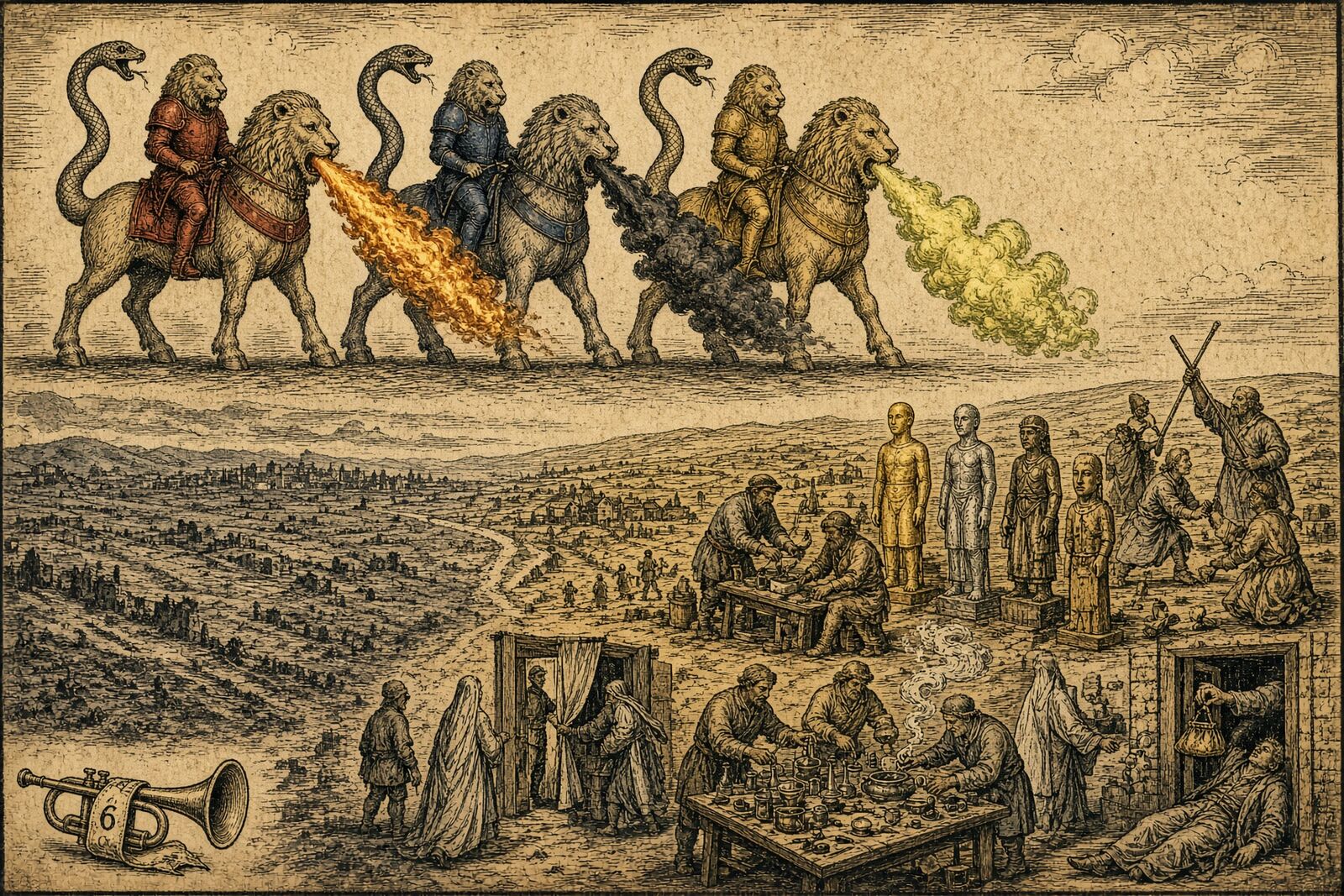
Revelation 9 — The Fifth and Sixth Trumpets
Session 25 | The locust plague and the army from the Euphrates. The teacher demonstrates how the trumpets function as a “what-if” scenario, examines Old Testament backgrounds (Exodus 10, Joel 2, Deuteronomy 28), and introduces the Apollo/locust connection.
Source: A2K Online Church Archive — Revelation 9:1-12
The Seven Trumpets as a “What-If” Scenario
Before examining the individual trumpets, the teacher offers a crucial framing device for the entire sequence.
The seven trumpets answer a hypothetical question that emerges from the martyrs’ prayer in Revelation 6:
“How long, O Lord, will you refrain from judging and avenging our blood?”
The trumpets are Revelation’s way of asking: What would it look like if God responded to the world’s evil with the full weight of his judgment? The visions show catastrophic consequences — plague, death, economic ruin, cosmic upheaval.
And then: the world still does not repent (9:20-21).
This reveals the purpose of the trumpets is not prediction of literal future events but a rhetorical demonstration: even extraordinary divine warnings will not bring people to repentance if their hearts are hardened. The only thing that actually produces repentance is the faithful preaching of the gospel — the “mystery of God” that will be revealed in chapter 10.
The Answer: Faithful Gospel Witness
The logic of chapters 9-10 together:
- Dramatic divine warnings (trumpets 5-6): They did not repent
- The little scroll and the mystery of God (ch. 10): The answer is the preaching of the gospel
- The two witnesses (ch. 11): The church’s faithful witness to the nations
The trumpets are not the solution. The gospel is the solution.
The Fifth Trumpet: Locusts from the Abyss (Rev 9:1-12)
“The fifth angel sounded, and I saw a star from heaven which had fallen to the earth; and the key of the bottomless pit was given to him. He opened the bottomless pit, and smoke went up out of the pit, like the smoke of a great furnace… then out of the smoke came locusts upon the earth.”
The Bottomless Pit: The Opposite of Heaven
The “bottomless pit” (abyssos) — the abyss — is the realm of evil, the domain of chaos and darkness in Revelation. It is the opposite of heaven in every way:
- Heaven = God’s realm, order, light, the dwelling of God and the faithful
- The Abyss = chaos, darkness, the realm of the evil one
A beast that comes from the abyss (11:7; 17:8) is immediately identified as evil by its identification. Conversely, anything associated with heaven carries divine authority.
Key Old Testament References
Exodus 10: Locusts and Pharaoh
The locust plague of Exodus 10 provides the primary template. Key observations:
- God sent the locusts to warn Pharaoh and give him opportunity to repent
- Pharaoh’s response was conditional: “I will let you go” — only to harden again
- The locusts were severe but not permanent — they were removed when Pharaoh asked
- The function of locusts is to threaten judgment in order to bring change — not to destroy for its own sake
This pattern directly informs Revelation 9’s locusts: they are threatening agents designed to provoke repentance, not permanent executors of final judgment.
Joel 2: The Locust Army
Joel 2 describes a devastating locust army and frames it explicitly as a call to repentance:
“‘Yet even now,’ declares the Lord, ‘return to me with all your heart, with fasting, with weeping, and with mourning; and rend your hearts and not your garments.’ Return to the Lord your God…” (Joel 2:12-13)
The locusts in Joel are described in military terms (just as Revelation’s locusts have military features), and God’s explicit purpose is that the people repent and return.
Revelation’s fifth trumpet is doing the same thing — using Joel’s imagery to depict a threatening force whose purpose is repentance.
The Locusts’ Limited Power: Torment Not Death (Rev 9:5)
“They were not permitted to kill anyone, but to torment for five months.”
The key limitation reveals the purpose: these are not executioners, they are persuaders. They cause suffering severe enough to make people desperately wish for death, but they do not kill. The suffering is designed to break hardness of heart.
“Five months” = the natural lifespan of a locust swarm. Another symbolic/natural limitation reminding readers this is bounded and temporary.
Apollo and the Locust Connection
The teacher introduces a fascinating historical detail: Apollo, the patron deity of several of the seven churches (especially Thyatira), was specifically associated with locusts.
Apollo was worshipped as the god who:
- Protected crops from locusts
- Had the power to send or withhold locust plagues
- Was associated with the Oracle at Delphi and the Python spirit
In Revelation 9:11, the king of the locusts is named Apollyon (Greek: destroyer) or Abaddon (Hebrew: destruction). The Greek name is a direct wordplay on Apollo.
The implication for first-century readers: the god the culture worshipped for protection against locusts — Apollo — has a name that sounds like “destroyer.” Revelation is unmasking the patron deity of their cities as not a protector but the very force of destruction.
Abaddon, Apollyon, and the Angel of the Abyss
The king over the locusts is described as the “angel of the abyss.” In the Old Testament, Abaddon appears several times as a synonym for the realm of death and destruction (Job 26:6, Ps. 88:11, Prov. 15:11). Here it is personified as the ruler of this destructive force.
The combination of Abaddon (Hebrew destruction) + Apollyon (Greek Apollo-destroyer) makes the anti-imperial point unmistakable: what the culture calls its protective deity is in reality the agent of destruction.
Locusts as Judgment in Deuteronomy 28
Deuteronomy 28 lists the covenant curses for disobedience, including locusts:
“You shall carry much seed out to the field but you will gather in little, for the locust will consume it.” (Deut. 28:38)
Locust plagues in the Old Testament were understood as covenant consequences — divine discipline for unfaithfulness. Revelation appropriates this imagery for a new context: the failure of the nations to worship the true God brings covenant-like consequences.
Scorpions as Discipline in 1 Kings 12
The locust-like creatures in Revelation 9 have scorpion tails. In 1 Kings 12, Rehoboam threatens Israel with scorpions instead of whips — an image of intensified discipline. Revelation layers this imagery onto the locusts: they are instruments of discipline that sting and hurt, but their purpose is correction.
Proverbs 30: Locusts Have No King — But Revelation Changes This
“The locusts have no king, yet all of them march in rank.” (Proverbs 30:27)
Proverbs notes that locusts are a force without a king — they organize spontaneously. Revelation 9:11 explicitly gives the locusts a king — Abaddon/Apollyon. This is another example of Revelation taking an Old Testament observation and reshaping it for new purposes: the destructive force now has a named commander, identified with the abyss and with the Apollo myth.
The Sixth Trumpet: The Army from the Euphrates (Rev 9:13-19)
“Release the four angels who are bound at the great river Euphrates… The number of the armies of the horsemen was two hundred million.”
The River Euphrates as Symbol of Threat
The Euphrates was the eastern boundary of the Roman Empire — the frontier beyond which lay the Parthian Empire, Rome’s most feared enemy.
Several times in the first century, Parthian armies crossed or threatened to cross the Euphrates. For Roman citizens and their subjects in Asia Minor, the Euphrates represented the edge of civilization — beyond it was the threat that could bring Rome down.
To first-century readers, an army released from “the great river Euphrates” immediately evokes Parthia.
The Nero Redivivus Myth
There was a widespread first-century belief that Nero — who had committed suicide in 68 AD — had not actually died but had fled to Parthia and would return with a Parthian army to retake Rome. This was called the Nero redivivus (“Nero revived”) myth.
Several false Neros appeared in the years following 68 AD claiming to be the returned emperor. The myth persisted well into the second century.
Revelation’s vision of an army from the Euphrates would resonate with this cultural anxiety: the threat from the east, the possible return of a terrible ruler, the destabilization of the empire that claimed to be invincible.
God’s Sovereign Control Over Timing
“The four angels who had been prepared for this hour and day and month and year were released.” (Rev. 9:15)
The precision of “this hour and day and month and year” emphasizes that nothing in this sequence is outside God’s control. The timing is exact. The release of these forces is not random — it is orchestrated by God according to his purposes.
This is comfort for persecuted believers: the chaos they experience is not God losing control. God has set the boundaries, the timing, and the scope of everything that is happening.
The Chimera: Hybrid Beasts of War
The vision describes horses with lion heads, breathing fire, smoke, and sulfur, with serpent-tail stings. This imagery recalls the chimera — the hybrid monster of Greek mythology.
For readers steeped in Greek mythological imagery, hybrid beasts of war represented the ultimate in terrifying military force. Revelation uses this cultural vocabulary to convey the extreme destructiveness of this army.
Wrath Alone Fails to Bring Repentance
“The rest of mankind, who were not killed by these plagues, did not repent.” (9:20)
Despite the extraordinary severity of the sixth trumpet — an army that kills a third of humanity — the response is continued idolatry and unrepentance. The catalogue of their sins:
- Worshipping demons and idols
- Murder
- Sorcery
- Sexual immorality
- Theft
The theological conclusion: Punishment alone — even catastrophic punishment — does not produce genuine repentance. This sets up the transition to chapter 10: the answer to the world’s hardness of heart is not more judgment but the mystery of God, the preaching of the gospel.
Summary
| Element |
Meaning |
| Trumpets as “what-if” |
What if God judged directly? Answer: people still wouldn’t repent |
| Exodus 10 |
Locusts = warning to produce repentance, not final punishment |
| Joel 2 |
Locust army explicitly calls for repentance |
| Abaddon / Apollyon |
The destroyer-king = wordplay on Apollo, unmasking the patron deity |
| Locusts torment but don’t kill |
Purpose is persuasion, not execution |
| Euphrates army |
Parthian threat; Nero redivivus myth; the eastern danger to Rome’s empire |
| God controls the timing |
“Prepared for this hour” — God is sovereign over the sequence |
| “They did not repent” |
The climactic failure that sets up the gospel answer in chapter 10 |