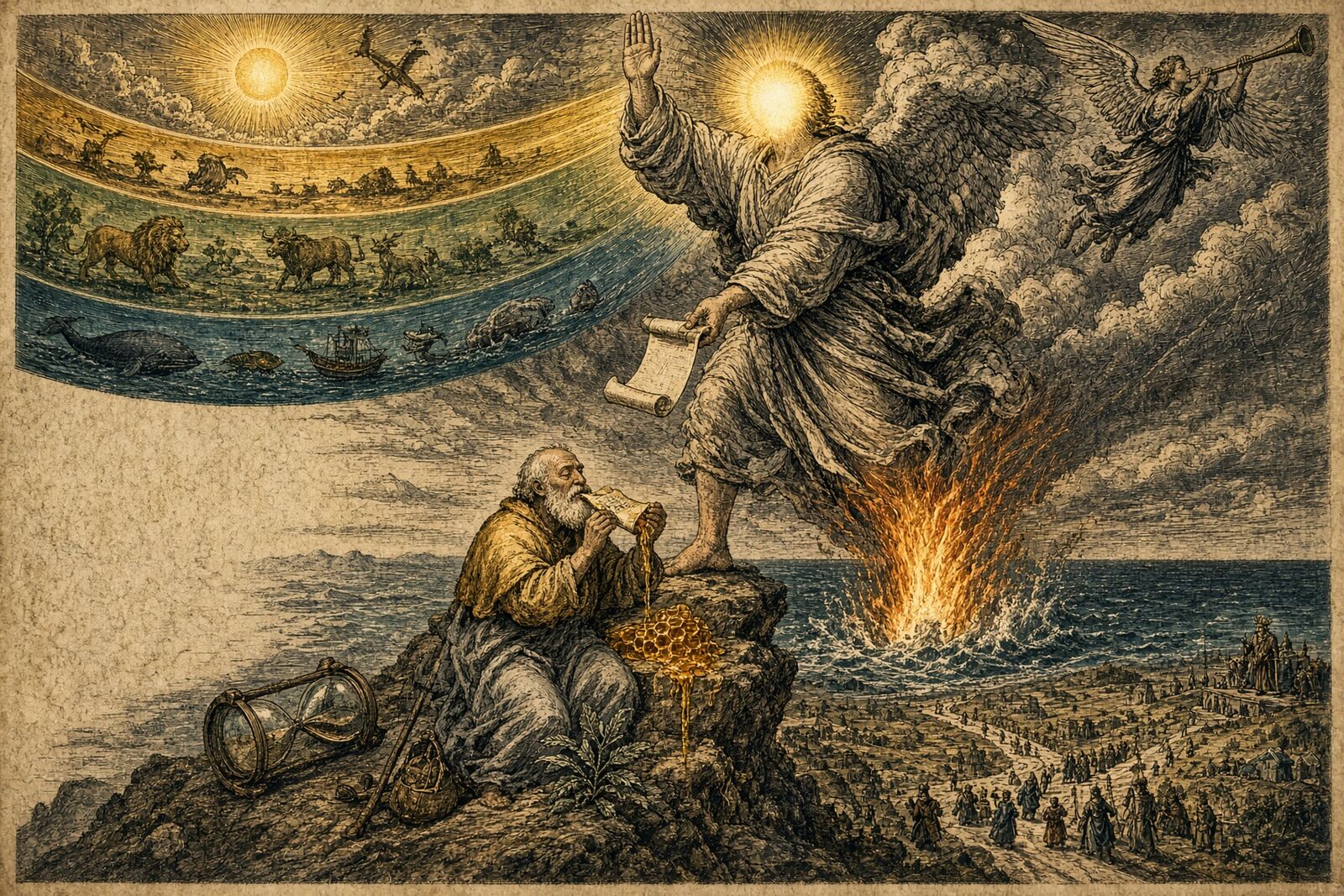
Session 26 | The army from the Euphrates completed, then the pivotal interlude of chapter 10: the mighty angel, the seven thunders sealed, the little scroll, and the “mystery of God” as the gospel that produces true repentance.
Source: A2K Online Church Archive — Revelation 9:13-10:11
Overview: The Long Pause Between Trumpets
Just as chapter 7 functioned as a dramatic interlude between the sixth and seventh seals, chapter 10 (and 11:1-14) forms the interlude between the sixth and seventh trumpets.
The structural pattern in Revelation:
- Seals 1-6 → Interlude (ch. 7) → Seal 7
- Trumpets 1-6 → Interlude (chs. 10-11:14) → Trumpet 7
The pause here is significantly longer than the seal interlude — nearly two full chapters. This signals the interlude’s importance: it answers the question the sixth trumpet has raised. The world has been hit with devastating judgment and still has not repented. What is the solution?
The answer: the mystery of God, which is the gospel.
The River Euphrates as Symbol of Threat
Completing the sixth trumpet from the previous session:
The Euphrates was the eastern border of the Roman Empire — beyond it lay Parthia, Rome’s most feared rival. In Jewish prophetic literature, threats from the east and north were stock imagery for divine judgment on Israel’s enemies (Jeremiah 46:2, Isaiah 7-8). For Revelation’s readers, an army from the Euphrates meant the destabilization of the empire that looked invincible.
The Nero Redivivus Myth
A persistent first-century rumor held that Nero — who died by suicide in 68 AD — had actually fled to Parthia and would return with a Parthian army. This “Nero revived” (Nero redivivus) myth circulated widely and several imposters claiming to be Nero appeared in the years following his death.
Revelation draws on this cultural anxiety. The “beast who was and is not and is about to come up from the abyss” (17:8) likely alludes to this myth. The threat from beyond the Euphrates would carry specific resonances of Nero’s possible return.
God’s Sovereign Control Over Timing
The four angels are “prepared for this hour and day and month and year” (9:15) — an extraordinarily precise statement about divine orchestration. Not a minute of this is outside God’s purposes. For persecuted believers wondering if God has lost control: he has not. The chaos is bounded and timed.
Wrath Alone Fails to Bring Repentance (Rev 9:20-21)
The devastating army kills a third of humanity — and still:
“The rest of mankind, who were not killed by these plagues, did not repent of the works of their hands, so as not to worship demons, and the idols of gold and of silver and of brass and of stone and of wood… and they did not repent of their murders nor of their sorceries nor of their immorality nor of their thefts.”
This is the definitive theological conclusion of the trumpet section: judgment and punishment alone cannot produce genuine repentance. Hearts hardened against God do not soften under pressure; they harden further.
This conclusion drives the narrative into chapter 10: if wrath doesn’t work, what does?
The Angel Descends from Heaven (Rev 10:1-4)
“I saw another strong angel coming down out of heaven, clothed with a cloud; and the rainbow was upon his head, and his face was like the sun, and his feet like pillars of fire; and he had in his hand a little book which was open.”
The description of this mighty angel draws on imagery associated with God himself (cloud, rainbow, face like the sun) — but he is clearly an angel, not God or Jesus, since he swears by “him who lives forever and ever” (10:6) rather than being the one sworn by.
This angel straddles both sea and land (10:2) — the two realms of the evil beasts in chapter 13. His authority extends over the whole fallen world.
The angel cries out and seven thunders respond — another vision sequence begins.
The Seven Thunders Sealed Up (Rev 10:3-4)
“When the seven thunders had spoken, I was about to write; and I heard a voice from heaven saying, ‘Seal up the things which the seven thunders have spoken and do not write them.’”
This is the only vision in Revelation that is explicitly sealed and not shared. John hears it but is forbidden to record it.
Why? Several possibilities:
- It emphasizes that God’s purposes are not exhaustively disclosed — there is divine mystery beyond what is revealed
- It prevents readers from treating Revelation as a complete calendar of end-times events
- It humbles interpretation: we do not have all the answers
Whatever the seven thunders said, it remains between John and God. Revelation does not permit speculation about it.
The angel holds a “little scroll” (biblaridion in Greek) that is already open. This connects to the scroll sealed with seven seals in chapter 5, which the Lamb had been opening throughout chapters 6-9.
The “little scroll” represents the same scroll, now largely unrolled — its contents, the purposes of God in history, are now being revealed more fully. John is commanded to eat it — to internalize it and then proclaim it.
“Take it and eat it; it will make your stomach bitter, but in your mouth it will be sweet as honey.”
This deliberately echoes Ezekiel 2-3, where Ezekiel was commanded to eat a scroll and then go preach to rebellious Israel. The scroll was sweet in his mouth.
Sweet in the mouth / bitter in the stomach:
- Sweet: The gospel is good news — redemption, forgiveness, the coming kingdom, God’s love
- Bitter: The gospel also carries a word of judgment for those who reject it; the witness of the church will lead to suffering and martyrdom
The two-sided nature of the gospel corresponds to the two-edged sword from Jesus’s mouth in chapter 1. It comforts the faithful and confronts the unrepentant.
The Mystery of God Is the Gospel (Rev 10:7)
“But in the days of the voice of the seventh angel, when he is about to sound, then the mystery of God is finished, as He preached to His servants the prophets.”
The mystery of God (mystērion tou Theou) — this phrase is the theological key to the chapter.
In Paul’s letters, “mystery” does not mean something incomprehensible or hidden. It means something previously hidden but now disclosed — specifically the gospel:
- Romans 16:25-26: “the mystery… now manifested… by the scriptures of the prophets”
- Colossians 1:26-27: “the mystery hidden for ages… now manifested… which is Christ in you”
- Ephesians 3:4-6: the mystery of Christ = Gentiles included as co-heirs through the gospel
The mystery of God in Revelation 10 = the gospel of the kingdom, which God had been preaching through the prophets and which is now being fully revealed and proclaimed through the witness of the church.
When the seventh trumpet sounds, this mystery will be “completed” — not as a new event but as the culmination of what has been building throughout all of history: God’s redemptive plan fulfilled.
The Gospel Brings True Repentance
The structure of chapters 9-10-11 now becomes clear:
- Chapter 9: Wrath (trumpets 5-6) → they did not repent
- Chapter 10: The mystery of God = the gospel → this is the actual means of repentance
- Chapter 11: The two witnesses = the church preaching the gospel → some respond; the nations give glory to God (11:13)
The contrast is stark:
- Judgment alone: no repentance
- Gospel preaching: some repent and give glory to God
This confirms Revelation’s consistent theme: the primary weapon of the church is the gospel, not violence or coercion. The church conquers by preaching, not by the sword. And it is the gospel — not punishment — that has the power to transform hearts.
Summary
| Element |
Meaning |
| Interlude between trumpets 6 and 7 |
Chapters 10-11 answer why wrath doesn’t work and what does |
| Euphrates / Nero redivivus |
Eastern threat; cultural anxiety about Nero’s return; God’s timing is precise |
| “They did not repent” |
Wrath alone cannot produce genuine repentance |
| Mighty angel straddling sea and land |
Authority over all the fallen world’s realms |
| Seven thunders sealed |
Not all of God’s purposes are disclosed; humility in interpretation |
| Little scroll = same as chapter 5 scroll |
The purposes of God now more fully unrolled and revealed |
| Sweet and bitter |
The gospel comforts the faithful and confronts the unrepentant |
| Mystery of God = the gospel |
The secret now disclosed: God’s redemptive plan through Christ |
| Gospel produces repentance |
Chapter 11’s witnesses succeed where the trumpets failed: some people respond |