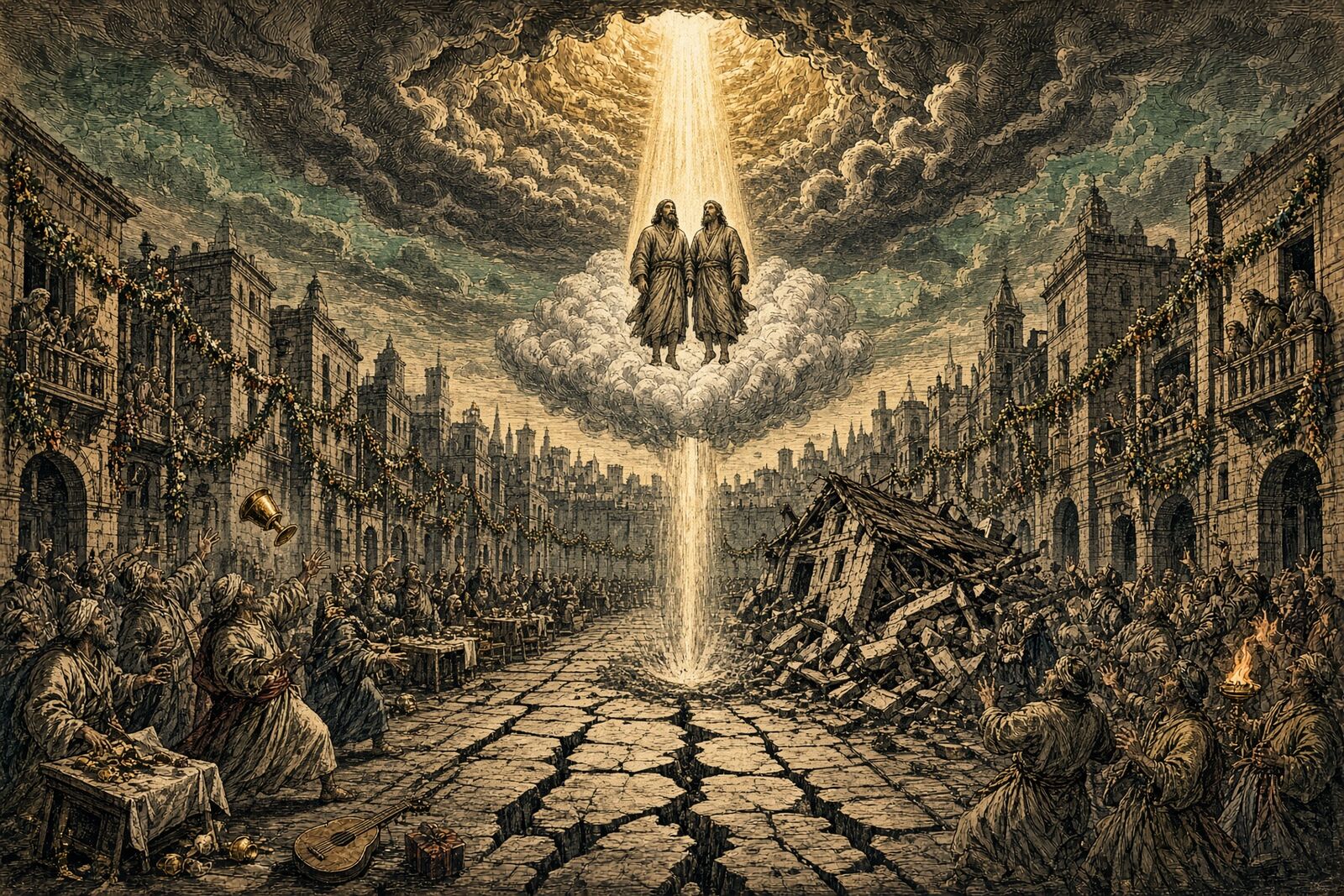
Revelation 11 — The Seventh Trumpet
Session 28 | The climax of the trumpet sequence: the kingdom arrives, God’s wrath is enacted, the dead are judged, the righteous are rewarded, and the ark of the covenant is revealed. The teacher addresses what happens at the second coming and argues for one final judgment.
Source: A2K Online Church Archive — Revelation 11:15-19
The Challenge of Reconsidering Assumptions
The teacher opens by acknowledging that the teaching today will challenge things some people have been taught. The goal is not controversy but honest engagement with what the text actually says. If the text requires changing previously held views, that is a sign of growth, not defeat.
The Seventh Trumpet (Rev 11:15-19)
“Then the seventh angel sounded; and there were loud voices in heaven, saying, ‘The kingdom of the world has become the kingdom of our Lord and of His Christ; and He will reign forever and ever.’”
This is the climax of the entire trumpet sequence — and one of the most theologically dense passages in Revelation.
Why the Trumpets Were Given
The purpose of the trumpet sequence was to call the world to repentance (9:20-21). By the time the seventh trumpet sounds, that opportunity has run its course. The mystery of God — the gospel — has been preached through the witness of the church (chapter 10-11). Now the final consummation arrives.
The Kingdom of the World Becomes God’s Kingdom
“The kingdom of the world has become the kingdom of our Lord and of His Christ; and He will reign forever and ever.”
This is the fulfillment of Daniel 7:14 and 7:27 — the promise that the kingdom of God would replace all human kingdoms. The kingdoms of the world (Rome and every empire that has ever opposed God) are subsumed into the one kingdom of God and his Christ.
Already vs. not yet: Throughout Revelation, Jesus is “already” the ruler of the kings of the earth (1:5) in a partial, inaugurated sense. Here that rule is fully consummated — the not-yet becomes reality.
The 24 Elders Respond with Worship and Thanks (Rev 11:16-18)
The twenty-four elders fall before God and worship, offering a song that identifies what happens at the seventh trumpet:
“We give You thanks, O Lord God, the Almighty, who are and who were, because You have taken Your great power and have begun to reign.”
Notice: “who are and who were” — the phrase “who is to come” is absent. This is significant. Earlier in Revelation, God is described as the one “who is and who was and who is to come” (1:4, 1:8, 4:8). But here, the “who is to come” is dropped.
God No Longer “Is to Come” — He Has Arrived
The removal of “who is to come” signals that God has arrived in judgment. There is no longer a “coming” because he has come. The consummation has happened.
Three Events at the Second Coming (Rev 11:18)
The elders’ song lists what happens when God “takes his great power and begins to reign”:
“And the nations were enraged, and Your wrath came, and the time came for the dead to be judged, and the time to reward Your bond-servants the prophets and the saints and those who fear Your name, the small and the great, and to destroy those who destroy the earth.”
Three simultaneous events:
- The wrath of God — final judgment on the unrepentant
- The dead are judged — resurrection and judgment of all the dead
- Reward for the righteous — the faithful receive their inheritance
These three things happen at the same moment — they are not separated by a thousand-year gap or multiple stages. This is the teacher’s argument for one final judgment at the second coming.
The Dead Are Judged: Old Testament Evidence
The teacher surveys Old Testament passages that connect the resurrection and judgment:
Daniel 12:1-3:
“Many of those who sleep in the dust of the ground will awake, these to everlasting life, but the others to disgrace and everlasting contempt.”
A single resurrection event with two outcomes: life for the righteous, contempt for the wicked. No temporal gap between the two.
Ezekiel 37 (the valley of dry bones): The resurrection is a collective event for the whole people of God, not a phased multi-stage process.
Isaiah 26:19: The dead will rise; the earth will give up its dead.
In all of these Old Testament passages, resurrection is presented as a single, definitive event — not a series of raptures and resurrections separated by centuries.
The Dead Are Judged: Jesus’s Teaching
John 5:28-29:
“Do not marvel at this; for an hour is coming, in which all who are in the tombs will hear His voice, and will come forth; those who did the good deeds to a resurrection of life, those who committed the evil deeds to a resurrection of judgment.”
“All who are in the tombs” come forth together — the righteous to life, the wicked to judgment. One event, one “hour,” two outcomes.
John 11:24 (Martha speaking): “I know that he will rise again in the resurrection on the last day.” — The resurrection is “the last day” (singular), not “the first of several days.”
The Sheep and the Goats: One Judgment
Matthew 25:31-46 — the judgment of the sheep and the goats:
- All nations gathered before the Son of Man
- Separation into righteous (sheep) and unrighteous (goats)
- Simultaneously: righteous inherit the kingdom, wicked go to eternal punishment
This is a single judgment scene with two outcomes, not two separate judgments at different times.
The teacher’s conclusion: the New Testament consistently presents one final judgment at the second coming, not multiple resurrections and judgments spread across a thousand-year period.
Destroying the Wicked: Annihilation, Not Eternal Torment
The elders’ song mentions God will “destroy those who destroy the earth” (11:18). The teacher uses this as a jumping-off point to address the nature of the wicked’s final fate.
Key passages:
- Matthew 10:28: “Fear him who is able to destroy both soul and body in Gehenna” — destruction, not eternal conscious torment
- 2 Thessalonians 1:9: The wicked “will pay the penalty of eternal destruction, away from the presence of the Lord” — eternal qualifies the permanence, not the process; they are eternally destroyed
- Philippians 3:19: Those who are enemies of the cross — “whose end is destruction”
- Revelation 20:14: “The lake of fire… this is the second death” — death as cessation of existence, not eternal suffering
The teacher’s position: The wicked face annihilation (the second death) — permanent, irreversible destruction — rather than eternal conscious torment. The punishment is described as “eternal” because its effects are permanent, not because the process is ongoing.
This is not “universalism” — the wicked are judged and destroyed. It is also not the traditional view of hell as endless conscious suffering. It is a third option: final, permanent destruction.
Recap: One Judgment at the Second Coming
The teacher summarizes: at the second coming, all of the following happen together:
- God’s wrath is poured out on the unrepentant
- The dead are raised — both righteous and wicked
- The righteous receive their reward (the kingdom, eternal life)
- The wicked are destroyed (the second death)
This happens once, at one moment, when Jesus returns.
The Heavenly Temple Opened (Rev 11:19a)
“And the temple of God which is in heaven was opened; and the ark of His covenant appeared in His temple.”
The opening of the heavenly temple signals access to God’s presence — the veil is torn, the barrier removed. What was hidden in the Holy of Holies is now revealed.
The Ark of the Covenant Revealed
The ark was the most sacred object in Israel’s worship — the footstool of God’s throne, containing the Law. It was lost after the Babylonian destruction of Jerusalem (587 BC) and never recovered.
Here in heaven, the true ark is revealed — the ark that the earthly one was always only a shadow of. This is the fulfillment of the temple imagery that has run throughout Revelation: the true dwelling of God is not a building in Jerusalem but the heavenly throne room itself.
Its appearance at the consummation signals that God’s covenant with his people has been completely fulfilled.
Lightning, Thunder, and God’s Presence in Judgment (Rev 11:19b)
“And there were flashes of lightning and sounds and peals of thunder and an earthquake and a great hailstorm.”
These cosmic signs accompany every major divine action in Revelation:
- They occurred at the original giving of the Law at Sinai (Exodus 19)
- They accompanied the opening of the seventh seal (8:5)
- They appear at the seventh bowl (16:18)
They are the standard biblical language for a divine theophany — God’s overwhelming presence acting in history. At the seventh trumpet, the full weight of God’s presence arrives to complete what he has been working toward throughout all of redemptive history.
Three Practical Applications
The teacher offers applications for the original readers and for today:
1. Live in light of the coming kingdom. The kingdom of the world will become the kingdom of God. Every earthly empire is temporary. Christians should orient their lives around the coming kingdom, not around the values of Fallen Babylon.
2. Take the resurrection seriously. The dead will be judged. What we do in this life matters eternally. Revelation calls us to faithful witness, not passive waiting.
3. Find comfort in God’s sovereignty. The timing of the consummation is in God’s hands. Christians do not need to calculate or anxiously watch for signs. They need to be faithful witnesses — preaching the gospel, persevering non-violently, remaining faithful unto death if necessary. God will take care of the rest.
Summary
| Element |
Meaning |
| “The kingdom of the world has become God’s kingdom” |
Final consummation; Daniel 7’s promise fulfilled |
| “Who are and who were” (not “who is to come”) |
God has arrived; no more future coming — the consummation is here |
| Three events at the seventh trumpet |
Wrath, judgment of the dead, and reward for the righteous — simultaneous |
| OT + Jesus: one resurrection/judgment |
Daniel 12, John 5, Matthew 25 — one event, not multiple stages |
| Annihilation of the wicked |
The second death = permanent destruction, not eternal torment |
| Heavenly temple opened |
God’s true dwelling revealed; the veil permanently removed |
| Ark of the covenant |
God’s covenant with his people completely fulfilled |
| Cosmic signs |
Standard biblical language for divine theophany — God’s overwhelming presence |