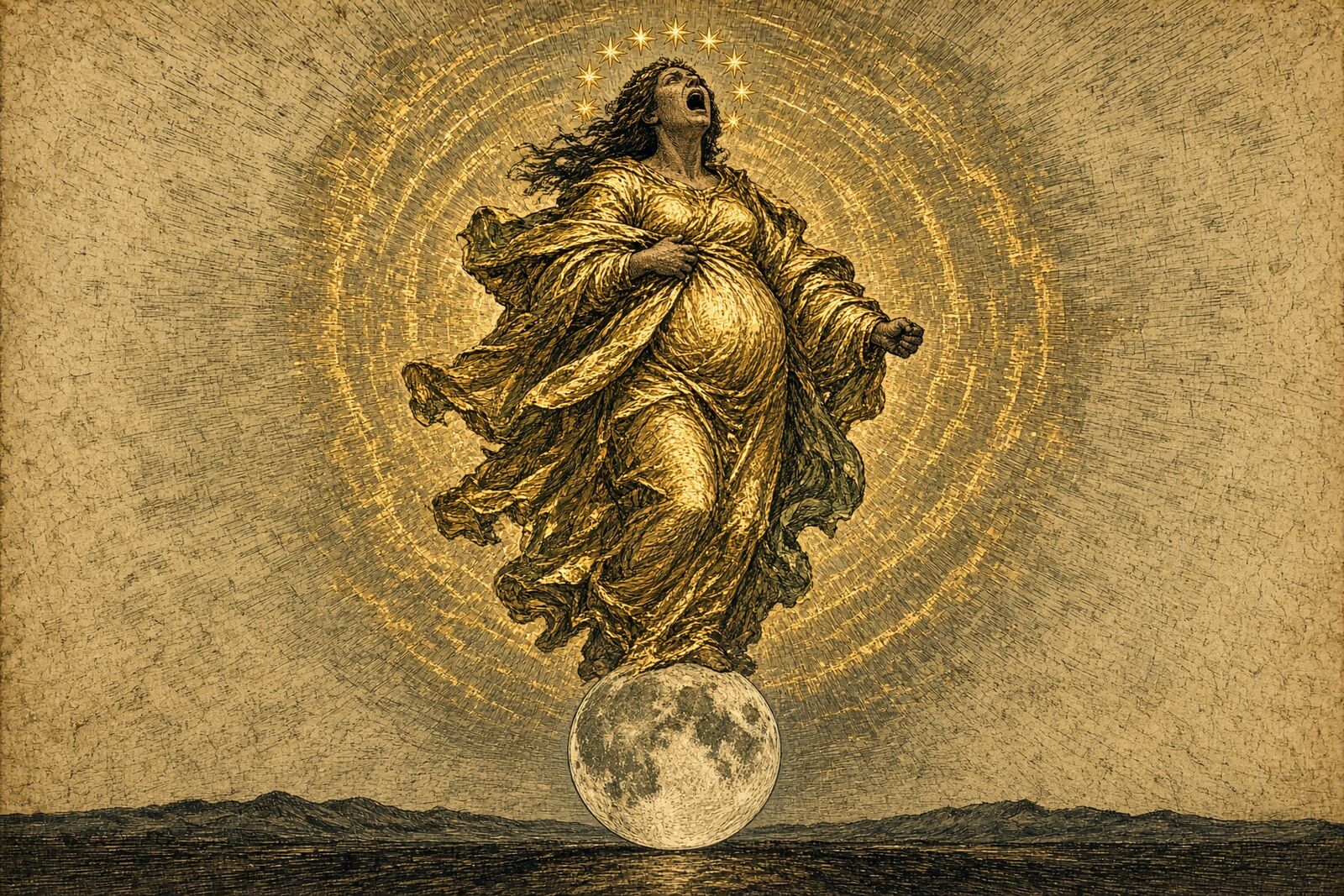
Revelation 12:1-6 — The Woman, the Dragon, and the Male Child
Session 29 | The symbolism is dramatically heightened in chapter 12. The teacher identifies the Leto/Apollo myth that Revelation is subverting, explains who the woman is using Old Testament imagery, and unpacks the dragon’s seven heads and ten horns.
Source: A2K Online Church Archive — Revelation 12:1-6
The Symbolism Is Heightened
Chapter 12 marks a significant shift. Up to this point the symbolism was intense; now it becomes fully cinematic and cosmic. The teacher identifies several indicators:
- Verses 1 and 3 explicitly call what follows “a great sign” — flagging symbolic imagery
- Numbers cluster densely: twelve stars, seven heads, ten horns, 1,260 days
- Descriptions are vivid: a woman clothed with the Sun, a great red dragon
- The narrative is far more cosmic than anything before: now we see who the real players are — not just Rome, not just the Imperial cult, but the actual cosmic forces behind all of it
The main characters of the entire book are now introduced in dramatic full-relief: the woman (the people of God), the dragon (Satan), and the male child (Jesus).
How Would the Original Recipients Have Heard This?
The teacher asks the essential interpretive question: how would first-century Christians in Asia Minor have understood this passage?
Answer: they would have recognized it immediately as a subversion of a widely known myth.
The Leto/Apollo/Python Myth
A story circulating for at least 500 years before Revelation was written told of:
- A dragon named Python who was warned by an oracle that a child of the woman Leto would destroy him
- Leto became pregnant by Zeus (king of the gods)
- Python pursued Leto during her pregnancy, trying to devour her child before it was born
- Leto was whisked away to safety on the island of Delos (about 40 miles from Patmos, where John received his vision)
- She gave birth to Apollo, the son of God/Zeus
- Apollo grew up, hunted down Python, and slew him
This story appeared in both Greek (Herodotus, 5th century BC) and Latin (Virgil/Hyginus). It was widespread across the Greek-speaking world.
The Imperial Twist
Crucially for Revelation’s context: Emperor Domitian was presented by Imperial propaganda as Apollo — the son of the gods, the slayer of the dragon, the bringer of peace. Imperial coins and inscriptions identified Domitian with Apollo.
So the cultural framework being activated was:
- Dragon = Python = evil
- Woman = Leto = divine mother
- Child = Apollo = son of God, savior of the world, destroyer of evil
Domitian’s propaganda said: “I am Apollo. I have slain the dragon. I am the true lord.”
Revelation says: “No. Let me tell you who these characters really are.”
How Revelation Subverts the Myth
| Myth Character |
Revelation’s Truth |
| Python (the dragon) |
Satan |
| Leto (the woman) |
The people of God |
| Apollo (the male child) |
Jesus Christ |
| Zeus (the divine father) |
God the Father |
| Apollo slaying Python |
Jesus (and the church) conquering Satan through the blood of the Lamb, gospel testimony, and faithful witness |
Revelation takes the story the culture already knows and says: you have the characters wrong. The true son of God is not Domitian-as-Apollo. The true dragon to be slain is not some mythological Python but the actual devil. The true woman is not a pagan goddess but God’s faithful people.
This is one of the most powerful examples in Revelation of counter-Imperial theology — using the empire’s own cultural mythology against it.
The Woman: The People of God (Rev 12:1)
“A great sign appeared in heaven: a woman clothed with the sun, and the moon under her feet, and on her head a crown of twelve stars.”
Old Testament Precedent
In the Old Testament, the people of God are frequently personified as a woman — specifically a woman in labor:
- Isaiah 52:2; 66:7-9 — Zion as a woman in labor, God delivering her
- Jeremiah 6:23-24 — Israel’s distress described as “anguish like a woman in childbirth”
- Micah 4:10 — “Rive and labor to give birth, O daughter of Zion… you will be rescued”
The pattern is consistent: the people of God → personified as a woman → in labor pains (= persecution/trial) → God delivers and rescues.
This is not a new teaching of Revelation. It draws on hundreds of years of prophetic tradition.
The Crown of Twelve Stars
Genesis 37:9 — Joseph’s dream: “the sun and the moon and eleven stars were bowing down to me.” The eleven stars = Joseph’s brothers = the eleven other tribes of Israel. Joseph = the twelfth.
Twelve stars = twelve tribes = the fullness of God’s people.
The Sun and Moon: Cosmic imagery elevating the magnitude of this vision. Together with the twelve stars, the description marks this woman as representing something of cosmic significance: the complete people of God across all time.
Who Is the Woman? Not Mary, Not Israel Alone
While it was historically popular to interpret the woman as Mary or ethnic Israel, Revelation itself tells us: the woman’s children are “those who keep the commandments of God and hold to the testimony of Jesus” (12:17). That is the definition of the Christian church — Jewish and Gentile believers together.
The woman = the people of God, past and present, personified.
She Was With Child (Rev 12:2)
“She was with child; and she cried out, being in labor and in pain to give birth.”
Isaiah 26:16-17 similarly uses a woman in labor to describe the nation before God increases the community. The labor pains = the persecution and trials the people of God endure before the birth of the messianic child.
The birth of the male child from the woman also implies Jesus’s humanity — he comes forth from the people of God, born of a human mother.
The Dragon: Satan (Rev 12:3)
“Then another sign appeared in heaven: and behold, a great red dragon having seven heads and ten horns, and on his heads were seven diadems.”
Old Testament Background
Evil rulers are depicted as dragons in the Old Testament:
- Jeremiah 51:34 — Nebuchadnezzar described as a monster (LXX: dragon)
- Ezekiel 29:3 — Pharaoh described as “the great dragon who lies in the midst of his rivers”
Dragons = persecuting empires and their rulers. Revelation takes this imagery and applies it to the ultimate persecutor: Satan himself.
Seven Heads and Ten Horns
When you add up the heads and horns of Daniel’s four beasts (Daniel 7), you get seven heads and ten horns total:
- Lion: 1 head
- Bear: 1 head
- Leopard: 4 heads
- Fourth beast: 1 head + 10 horns
Revelation’s dragon combines all the evil of all four successive world empires into a single terrifying figure. The dragon is not one of those empires — he is the spiritual power behind all of them.
Seven heads = the complete (7) magnitude of the threat. This is not a minor enemy.
Ten horns = power symbols. Yet the Lamb has seven horns (5:6) — and seven (completeness) exceeds ten because perfection exceeds raw quantity. The dragon is powerful, but not more powerful than the Lamb.
Seven diadems = royal crowns of rulership. But these are diadems (metal crowns of authority), not stephanos (laurel wreaths of victory given to conquerors). The dragon’s crowning is a different kind than the Christians’ — he conquers by subjugation, they conquer by faithfulness.
His Tail Swept a Third of the Stars (Rev 12:4a)
“And his tail swept away a third of the stars of heaven and threw them to the earth.”
Daniel 8:10 uses similar language of Antiochus Epiphanes — a human being described as growing to the host of heaven and causing stars to fall. This is heightened prophetic/poetic language for great destruction. It is not meant literally.
In Revelation’s context, this likely refers to the angels who followed Satan in his fall — a third of the heavenly host aligned with the dragon.
The Dragon Pursues the Woman (Rev 12:4b)
“And the dragon stood before the woman who was about to give birth, so that when she gave birth he might devour her child.”
This is the Python myth made explicit: the dragon positions himself to devour the child at birth. It also echoes Herod’s attempt to kill the baby Jesus (Matthew 2) — another historical echo of this pattern.
The Male Child: Jesus (Rev 12:5)
“And she gave birth to a son, a male child, who is to shepherd all the nations with a rod of iron; and her child was caught up to God and to His throne.”
The male child = Jesus. No one disputes this. Three key observations:
-
Shepherd the nations — the verb is poimainō (to shepherd), not “rule.” The Messiah’s role toward the nations is pastoral guidance, not violent subjugation. (See Video 29/Thyatira session for fuller treatment.)
-
The narrative jumps from birth to ascension — bypassing ministry, death, and resurrection. Not because those don’t matter, but because the ascension (being “caught up to God and to his throne”) is what the dragon cannot prevent. He tried to devour the child; instead the child was exalted beyond his reach.
-
“Caught up to God and to his throne” = the resurrection and ascension of Jesus, which constitutes his enthronement at God’s right hand (Acts 2:33, Phil. 2:9-11).
The Woman Flees to the Wilderness (Rev 12:6)
“Then the woman fled into the wilderness where she had a place prepared by God, so that there she would be nourished for 1,260 days.”
The wilderness in Scripture = a place of refuge and divine provision:
- Moses fled from Pharaoh to the wilderness (Exodus 2)
- David fled from Saul into the wilderness (1 Samuel 23)
- Elijah fled from Jezebel into the wilderness (1 Kings 19)
- Jesus was in the wilderness during temptation (Matthew 4)
Each time, God’s people retreat from persecution into the wilderness — and God provides for them there.
1,260 days = three and a half years = the symbolic period of limited persecution. The woman’s time of refuge is real but temporary. God nourishes her through the trial.
The verb for “nourish” (trephō) is used of a mother nursing her infant and of God feeding the birds (Matthew 6:26 — “your heavenly Father feeds them”). God is the nurturing provider who sustains his people through persecution, though he does not immediately remove the persecution.
Four Practical Applications
-
Recognize the threat: The devil is not a minor opponent. Seven heads, ten horns. This is a massive, powerful enemy — not to be taken lightly.
-
Understand the attacks: The dragon attacks the people of God through temptation to compromise, failure to preach the gospel, false worship, and the lure of Fallen Babylon’s citizenship. These are the same attacks the seven churches faced.
-
Follow the Shepherd: Christ shepherds the nations — and invites his people to share in that shepherding vocation (as seen in the letter to Thyatira). We guide, comfort, protect, and direct.
-
Find refuge in God: During persecution, we run to God, not away from him. He is the nourisher in the wilderness. He does not immediately remove suffering, but he sustains us through it.
Summary
| Element |
Meaning |
| Heightened symbolism |
Chapter 12 is a cosmic drama — the real players are now revealed |
| Leto/Apollo/Python myth |
The cultural story Revelation is subverting — Domitian is not Apollo; Jesus is |
| Woman = people of God |
OT tradition of personifying Israel as a woman in labor; continued in the church |
| Dragon = Satan |
The real power behind all the persecuting empires of history |
| Seven heads and ten horns |
Combines all of Daniel’s four beasts — embodiment of all evil |
| Male child = Jesus |
Born, exalted to God’s throne — the dragon cannot prevent it |
| Shepherd the nations |
Pastoral guidance, not violent subjugation |
| 1,260 days in the wilderness |
Symbolic limited period — God nourishes his people through persecution |