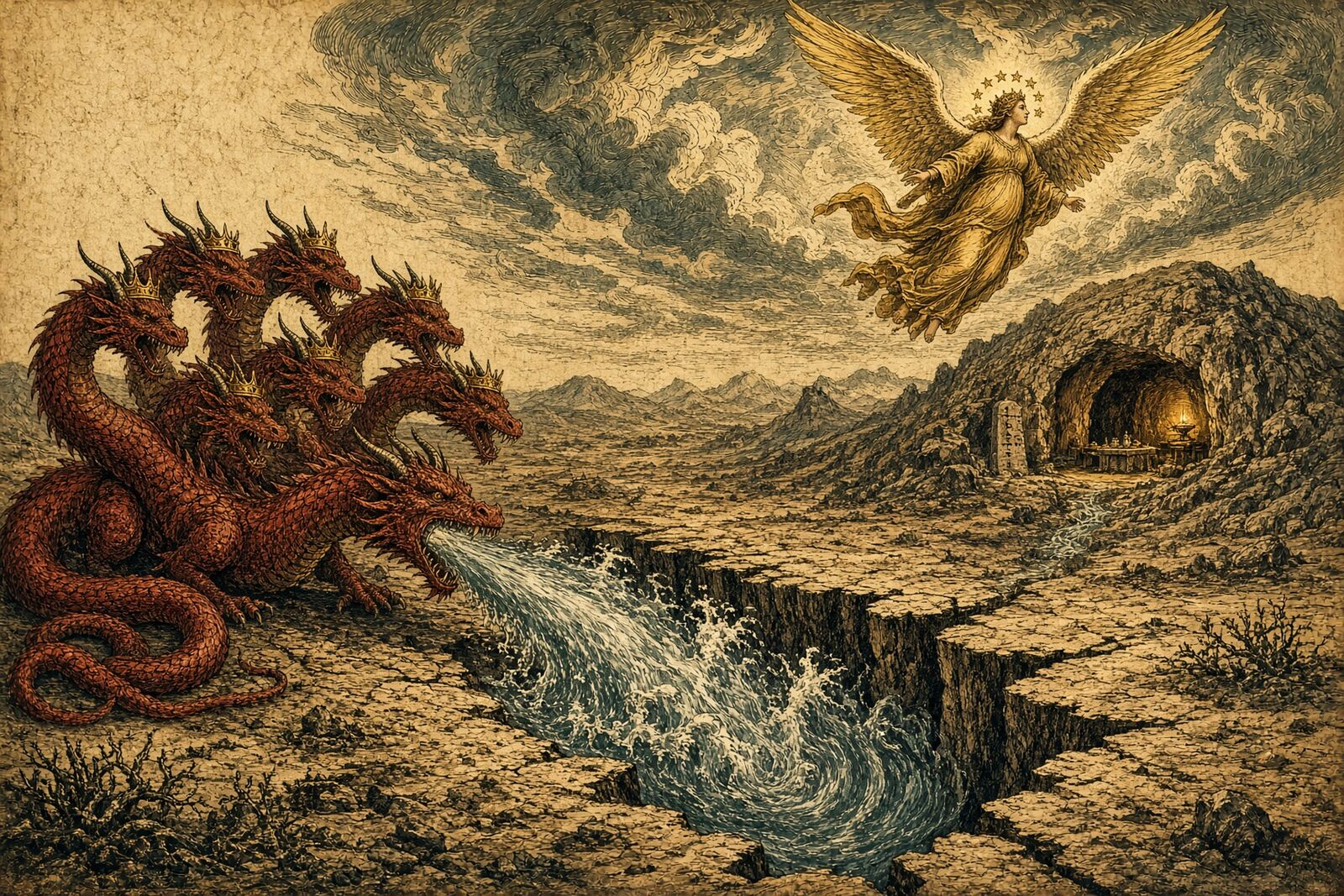
Revelation 12:7-17 — War in Heaven, Satan Cast Down, and the Woman Pursued
Session 30 | Michael and his angels defeat the dragon; Satan is cast to earth; the hymn of victory explains how Christians conquer; the woman is given eagle wings; and the dragon makes war on her children.
Source: A2K Online Church Archive — Revelation 12:7-17
The Context: Chapter 12 as One Narrative
Though verses 1-6 and 7-17 are naturally divided, the whole of Revelation 12 tells one continuous story. The teacher begins by noting that the second half (verses 7-17) is equally symbolic and must not be read literally. The multiple images — war in heaven, rivers of water from a serpent’s mouth, the earth helping the woman — are all poetic and visionary, drawing deeply on the Old Testament.
War in Heaven: Michael and the Dragon (Rev 12:7-9)
“And there was war in heaven, Michael and his angels waging war with the dragon. The dragon and his angels waged war, and they were not strong enough, and there was no longer a place found for them in heaven. And the great dragon was thrown down, the serpent of old who is called the devil and Satan, who deceives the whole world.”
The Initiative Is on God’s Side
An important Greek grammatical point: the force of the text indicates that Michael and his angels went to wage war — they took the initiative. This is not a rebellion by Satan that God had to respond to; it is God’s forces evicting Satan. The initiative belongs to God’s side.
The War Breaks Out Because of Jesus’s Ascension
The war in heaven is triggered by the exaltation of Jesus to God’s throne (verse 5). When Jesus was “caught up to God and to his throne,” Michael and the angels went to evict the dragon. The resurrection and ascension of Jesus set off this heavenly battle.
This is not a primordial fall before Genesis. The plain reading of the passage situates this event after Jesus’s death and ascension. What the book of Job portrays (Satan having access to God’s presence to accuse) is no longer the situation after Jesus’s exaltation.
Angels Represent Communities in Apocalyptic Literature
In Daniel, angels represent nations: the Prince of Persia, the Prince of Greece, and Michael as the prince/angel of Israel (Daniel 10:12-21, 20-21). Every letter to the seven churches addresses “the angel of the church” — communities have angelic representatives. When angels battle in heaven in apocalyptic works, it precedes and symbolizes conflicts on earth between the communities they represent.
The war in heaven between Michael (Israel/church) and the dragon (Satan/Rome) will be reflected in the conflict on earth between the church and the forces of evil.
Revelation Unveils the True Enemy
Up to chapter 12, the enemies of the seven churches looked like:
- Slandering Jews
- Imperial agents
- Pagan gods
- Roman emperors
- False teachers within the church
Now Revelation pulls back the curtain: behind all of these is Satan himself — the great red dragon. This is the true enemy, and he is real.
The Dragon Loses His Place (Rev 12:8-9)
“There was no longer a place found for them in heaven.”
The word “place” (topos) is thematically significant in Revelation 12. There is:
- A place for the dragon — but it is taken away
- A place prepared for the woman in the wilderness (12:6)
- A place for her in the wilderness again (12:14)
The devil loses his place; God’s people are given a place. The cosmic geography of the chapter maps onto this exchange.
The Hymn of Victory (Rev 12:10-12)
One of Revelation’s worship hymns, interpreting the theological significance of the dragon’s defeat:
“Now the salvation, and the power, and the kingdom of our God and the authority of His Christ have come, for the accuser of our brethren has been thrown down, who accuses them before our God day and night.”
The Already of the Kingdom
The arrival of salvation, power, kingdom, and authority is connected to Satan’s eviction from heaven — not to the final consummation. This is the “already” of the kingdom inaugurated by Jesus’s resurrection and ascension, not the “not yet” of the final fullness.
Compare Jesus in Luke 10:18: “I was watching Satan fall from heaven like lightning” — said in the context of the disciples preaching the gospel and demons being subject to them. The gospel preaching = Satan’s defeat, already in process.
Three Ways Christians Conquer the Dragon (Rev 12:11)
“And they overcame him because of the blood of the Lamb and because of the word of their testimony, and they did not love their life even when faced with death.”
This is the practical heart of the chapter — one of the teacher’s favorite verses in Revelation:
1. The blood of the Lamb
Christians conquer the dragon not by killing him but because the dragon killed Jesus. The paradox: our enemy’s action against our Lord is the very means of his defeat. We conquer by identifying with Jesus’s sacrificial death, washing our garments in his blood.
2. The word of their testimony
“The word” (logos) is the gospel message, not the Bible. Christians preach the gospel of a different kingdom — the kingdom of God — as an act of resistance against the kingdom of Rome/Babylon. When we faithfully witness, we participate in the dragon’s defeat (compare Luke 10:18). Preaching the gospel is the primary non-violent weapon.
3. They did not love their life even when faced with death
The most paradoxical of the three: Christians conquer by being willing to die. In Rome’s definition, you conquer by killing. In Revelation’s definition, you conquer by enduring faithfully even if it costs you your life. This is Jesus’s own conquering pattern — he was conquered in Rome’s terms but conquered in God’s terms.
Together these three define Christian conquering: identify with the Lamb’s death, preach the gospel faithfully, remain loyal even unto martyrdom.
Rejoice in Heaven, Woe to the Earth (Rev 12:12)
“For this reason, rejoice, O heavens and you who dwell in them. Woe to the earth and the sea, because the devil has come down to you, having great wrath, knowing that he has only a short time.”
“Those who dwell in heaven” = those identified with heaven = the redeemed. They are commanded to rejoice because the dragon has been defeated and expelled from heaven.
“Those who dwell on the earth” = the unredeemed. “Earth” here is an identification of character and loyalty, not just a physical location. Woe to them because the defeated dragon, knowing his time is short, now focuses his rage on those below.
The devil has a short time = the symbolic 1,260 days / three and a half years. He is fierce but limited. His rage is great but his time is constrained.
The Dragon Pursues the Woman (Rev 12:13-16)
“And when the dragon saw that he was thrown down to the earth, he persecuted the woman who gave birth to the male child. But the two wings of the great eagle were given to the woman, so that she could fly into the wilderness to her place.”
Eagle Wings and Old Testament Imagery
God gives the woman eagle wings — a rich image of divine protection:
- Exodus 19:4: “I bore you on eagle’s wings and brought you to myself” — God’s rescue of Israel from Egypt
- Isaiah 40:31: “Those who wait for the Lord will gain new strength; they will mount up with wings like eagles”
- Deuteronomy 32:11-12: God like an eagle that “stirs up its nest, that hovers over its young, he spread his wings and caught them, he carried them on his pinions”
The eagle wings = sustained care and renewed strength from God. God doesn’t always remove persecution; he provides strength and refuge within it.
“Time, Times, and Half a Time” = 1,260 Days
Reiterating the symbolic period: the woman is nourished “for a time and times and half a time” — Daniel’s phrase (Daniel 7:25, 12:7) meaning one + two + half = three and a half periods. This is the same as 1,260 days and 42 months.
The River from the Serpent’s Mouth
“And the serpent poured water like a river out of his mouth after the woman, so that he might cause her to be swept away with the flood. But the earth helped the woman.”
Just as the faithful Christian conquerors use their mouths to speak the gospel, the serpent uses his mouth to send destructive forces against the people of God. The counter-images are intentional.
The earth opening to swallow the river echoes Moses and the Red Sea — where the earth (sea bed) helped Israel escape Pharaoh’s pursuing army. Psalm 32:6 and 69:14-15 describe persecution as being swept away by floods; God’s protection as being rescued from those waters.
The water from God’s side in Revelation is always life-giving (the river of the water of life in 22:1). The serpent’s water is destructive. Which water do you drink from?
The Dragon Makes War on the Rest of Her Children (Rev 12:17)
“So the dragon was enraged with the woman, and went off to make war with the rest of her offspring, who keep the commandments of God and hold to the testimony of Jesus.”
“Her children” (sperma in Greek = seed) — possibly an allusion to Genesis 3:15, where God declares enmity between the serpent’s seed and the woman’s seed. The church is the fulfillment of that ancient promise.
Definition of the children: Those who keep God’s commandments and hold to the testimony of Jesus. This is the practical definition of faithfulness in Revelation — obedience to God’s ethical instructions and faithful proclamation of Jesus’s gospel. Just as Jesus himself kept God’s commandments and preached his own testimony, his followers are to do the same.
The dragon cannot destroy the male child (Jesus) — he was caught up to heaven. So he turns his fury on the church — the rest of the woman’s children. This is the explanation for why the church faces persecution: we are the targets of the same cosmic enemy who tried to devour Jesus.
Three Practical Applications
1. We can participate in the reign of God right now by conquering the dragon through the blood of the Lamb, faithful gospel witness, and willingness to be faithful even unto death.
2. The resurrection and ascension of Jesus dealt Satan a critical defeat — this calls for worship and rejoicing. The church’s celebration of Jesus’s victory is a counter-testimony to the empire’s claims.
3. Persecution is inevitable for those who faithfully obey Jesus. God offers nourishment, strength, and comfort in the wilderness — not escape from the trial, but sustenance through it. We run to God, not away from him.
Summary
| Element |
Meaning |
| Michael evicts Satan |
God’s initiative; Satan had access to heaven before Jesus’s ascension |
| War follows Jesus’s exaltation |
The resurrection/ascension triggers Satan’s expulsion |
| “No longer a place found” |
Satan loses his place; God’s people gain a place |
| Three ways to conquer |
Blood of the Lamb + gospel testimony + faithfulness unto death |
| “Short time” |
Satan is fierce but limited; his rage is bounded |
| Eagle wings |
Divine strength and sustenance through persecution — OT imagery of God’s care |
| Serpent’s river vs. God’s living water |
Two waters, two mouths, two kingdoms |
| War on the rest of her children |
The church is the target because we are Jesus’s family |
| Definition of the children |
Obedience to God’s commands + testimony of Jesus = Christian faithfulness |