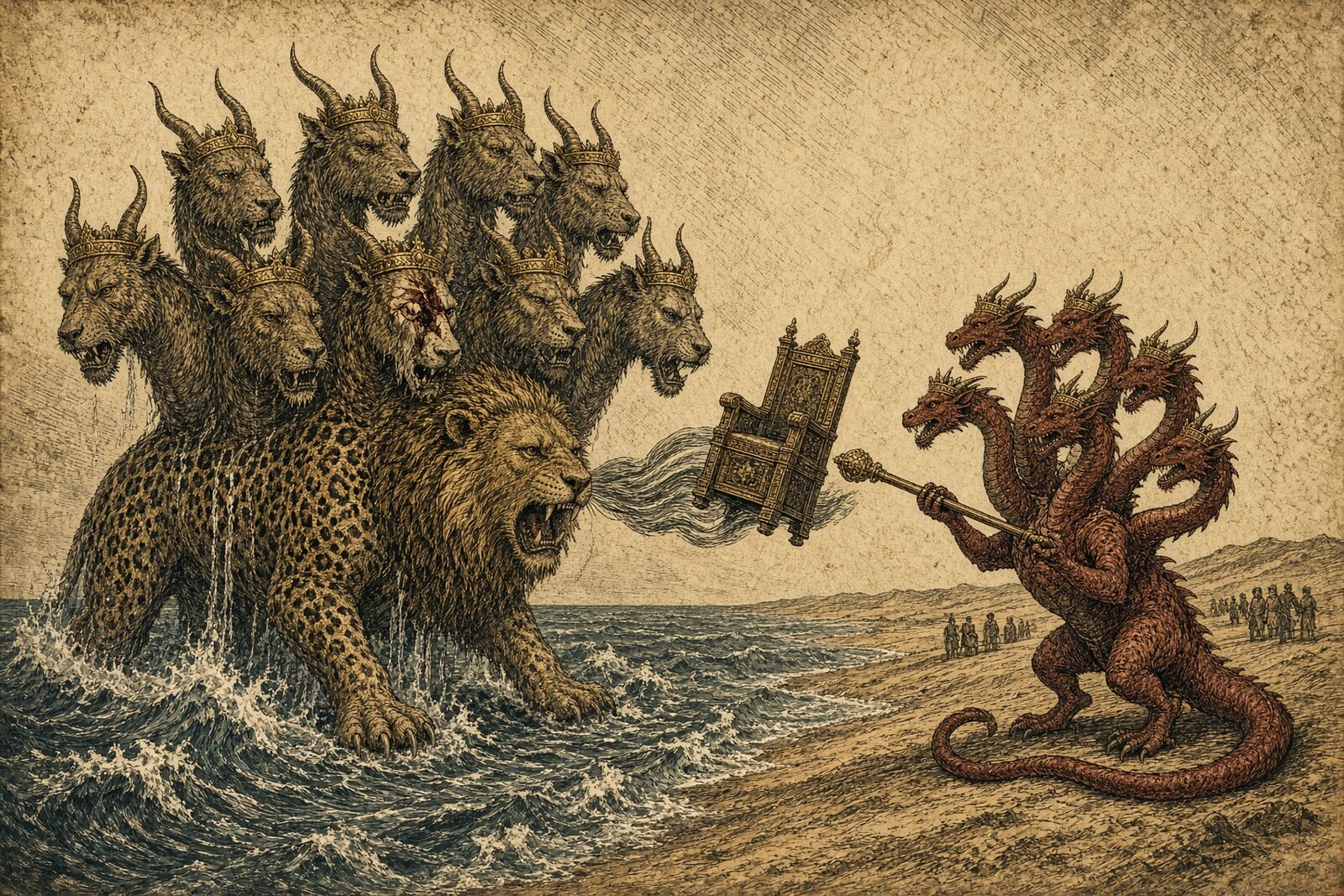
Revelation 13:1-10 — The Beast from the Sea (Part 2)
Session 32 | Completing verses 1-10: Antiochus imagery in verse 5, the divine passive theology, authority over every tribe and nation, the book of life, captivity and martyrdom, and the call to perseverance and faith.
Source: A2K Online Church Archive — Revelation 13:5-10
Recap: The Beast from the Sea = Rome
Building on the previous session, the teacher recaps the key conclusions:
- Two beasts in Revelation 13, not one
- The beast from the sea combines the imagery of all four of Daniel’s beasts
- It represents the Roman Empire — the only realistic candidate for first-century readers
- The fatal wound and healing = the Year of the Four Emperors (68-69 AD) and Rome’s dramatic recovery
Verse 5: Antiochus Epiphanes Imagery
“There was given to him a mouth speaking arrogant words and blasphemies, and authority to act for forty-two months was given to him.”
The imagery of a mouth speaking arrogant words draws directly on Daniel 7:8 — the description of Antiochus Epiphanes IV, who called himself Epiphanes (“God manifest”) and desecrated the Jerusalem temple in 167 BC.
Antiochus is the most apt historical parallel for the Roman beast because:
- He applied divine titles to himself (epiphanes = God made manifest)
- He desecrated and sought to swallow up the temple of God
- He suppressed Jewish religious identity through forced assimilation
- He persecuted the people of God specifically for their religious distinctives
For the seven churches, many of whose members would have been Jews who knew Hanukkah (commemorating deliverance from Antiochus), this connection was immediate. Rome = the new Antiochus.
The Divine Passive (Four Times in Three Verses)
The teacher counts four occurrences of the divine passive in verses 5-7:
- “There was given to him a mouth speaking arrogant words”
- “Authority to act for forty-two months was given to him”
- “It was given to him to make war with the saints”
- “Authority over every tribe and people and tongue and nation was given to him”
The theological weight: God is not absent. God is not defeated. God is allowing this. The divine passive is Revelation’s way of preserving God’s sovereignty while acknowledging the reality of evil and persecution.
The application for persecuted believers: when the beast persecutes you, God has not abandoned you. God has set the limits. God will act in his time. “It was given to him” means God gave it — and what God gives, God can also take away.
The Forty-Two Months: Deliberate Echoing of Antiochus
The forty-two months (three and a half years) also echoes the historical duration of Antiochus’s desecration — approximately 167-164 BC, three and a half years. The Maccabean revolt ended his reign of terror.
Revelation uses this period not as a literal prediction but as a symbolic assurance: just as the Antiochus persecution was bounded and ended, so Rome’s persecution is bounded and will end. The symbolism says: this will pass.
Blasphemy Against God and “Those Who Dwell in Heaven” (Verse 6)
“He opened his mouth in blasphemies against God, to blaspheme His name and His tabernacle, that is, those who dwell in heaven.”
“Those who dwell in heaven” = those identified with heaven = the redeemed. This is not people physically living in the sky; it is Revelation’s identification language. Christians “dwell in heaven” in the sense that their citizenship is in heaven (Philippians 3:20) and they are identified with New Jerusalem.
By calling Roman Imperial titles blasphemous, Revelation is saying: when Caesar calls himself Lord and God and Savior, he is blaspheming both God (whose titles these are) and God’s people (who are described by their heavenly identity).
Additionally: in Revelation 4, the 24 elders who symbolically represent the conquering people of God are “in heaven.” So blaspheming “those who dwell in heaven” includes blaspheming the church — the target of Rome’s propaganda against Christians.
Making War on the Saints (Verse 7)
“It was also given to him to make war with the saints and to overcome them; and authority over every tribe and people and tongue and nation was given to him.”
This is the same beast first mentioned in 11:7 — the beast from the abyss that made war on the two witnesses. The same language appears: “make war… overcome them.” Revelation expects its readers to recognize the connection.
The irony: Christian conquerors are likely to be conquered. Those who try to avoid being conquered by compromising will never be true conquerors. The faithful may suffer, be arrested, even die — but they are the true conquerors because they conquer like the Lamb (through faithful witness, endurance, willingness to die).
The fourfold grouping — “every tribe and people and tongue and nation” — appears throughout Revelation. When applied to the beast’s authority, it describes the unredeemed world under his sway. When applied to those purchased by the Lamb (5:9), it describes the redeemed who have been freed from that group. You either remain under the beast’s authority or you have been purchased out of it.
Confiscation of Property: A Historical Note
Not everyone in the seven churches would be killed. But many could expect:
- Social ostracization
- Loss of business
- Property confiscation
Hebrews 10:34 — written to Christians in Rome — commends them for “accepting joyfully the seizure of your property, knowing that you have for yourselves a better possession.” Property confiscation for Christians refusing to honor the Emperor was a documented reality.
The Book of Life (Verse 8)
“All who dwell on the earth will worship him, everyone whose name has not been written from the foundation of the world in the book of life of the Lamb who has been slain.”
The Lamb slain from the foundation of the world — this phrase (grammatically linked to the Lamb in the Greek word order, not to the names) indicates Jesus’s death was in God’s purposes from before creation. This is “notional pre-existence” — Jesus was in God’s plans and purposes from the beginning, though his actual death occurred in history.
“Those who dwell on the earth” — the technical phrase for the unredeemed. They will worship the beast. Their names are not in the book of life.
The implicit call: Make sure your name is in the book of life. The way your name gets there — and stays there — is by refusing to worship the beast. Revelation 3:5 promises the conqueror: “I will not erase his name from the book of life.” The corollary is clear: accommodation to the beast is a salvation issue.
If Anyone Has an Ear, Let Him Hear (Verse 9)
“If anyone has an ear, let him hear.”
This phrase appears seven times in the letters to the seven churches (chapters 2-3) — at the end of each letter’s exhortation. Its reappearance here signals the same function: pay close attention; obedience is required.
“To hear” in biblical idiom means to listen with the intent to obey, not merely to register sound. The severity of what has just been described — a satanic beast whose power comes from the dragon — demands a response. Don’t just hear this and move on. Act.
Captivity and the Sword: The Call to Perseverance (Verse 10)
“If anyone is to go into captivity, to captivity he goes; if anyone is to be killed with the sword, with the sword he is to be killed. Here is the perseverance and the faith of the saints.”
This draws on Jeremiah 15:2 and 43:11 — passages where God tells disobedient Israel that those destined for death will die, for captivity will go to captivity. In Jeremiah, these are covenant punishments for the unfaithful.
Revelation’s reapplication: The same fates (captivity, execution) come to Christians — but not as punishment for unfaithfulness. Rather, as the consequence of being faithful. Christians who refuse to compromise face arrest. Christians who refuse to recant face execution.
Just as Jesus was:
- Taken into captivity (arrested by Rome)
- Executed (killed by the sword, in the broad sense)
…and yet was the ultimate faithful person — so his followers may face the same. This is not punishment; it is participation in the Lamb’s path.
“Here is the perseverance and faith of the saints” — this is what perseverance looks like: not fighting back violently, not running away, not recanting under pressure. Going into captivity with faithfulness intact. Facing death without denying Christ.
The final word of this section is not doom but discipleship: this is what it means to be a saint.
Applications
1. Living as citizens of New Jerusalem regardless of residence. Wherever Christians live — the seven churches in Asia Minor, or us today — the surrounding culture will press us to compromise. Revelation summons us to maintain our true citizenship and not allow the culture to define our worship or values.
2. God remains in control. The divine passive, repeated four times, assures believers that even the worst the beast can do is operating within God’s sovereign purposes. God has not lost control. God will act.
3. Resistance through faithful witness, not violence. The solution is not to fight back with weapons or political power. It is to keep preaching the gospel of the true kingdom, remain faithful, and trust God to vindicate us.
Summary
| Element |
Meaning |
| Antiochus imagery |
Rome = new Antiochus; arrogant divine claims, desecration of God’s people |
| Divine passive (×4) |
God allows this; it is within his sovereign purposes; there are limits |
| 42 months |
Echoes Antiochus’s three and a half years; symbolic — this will end |
| War on the saints |
Same beast as in 11:7; Christians may be conquered while being true conquerors |
| Fourfold grouping |
Tribe/people/tongue/nation = the unredeemed world; Christians have been purchased out |
| Book of life |
Names written there stay there through faithfulness; accommodation is a salvation issue |
| “If anyone has an ear” |
The call to obedience — don’t just hear, act |
| Captivity and execution |
The fate of faithful Christians — not punishment, but participation in the Lamb’s path |
| “Perseverance and faith” |
This is what sainthood looks like — faithful endurance, non-violent, to the end |