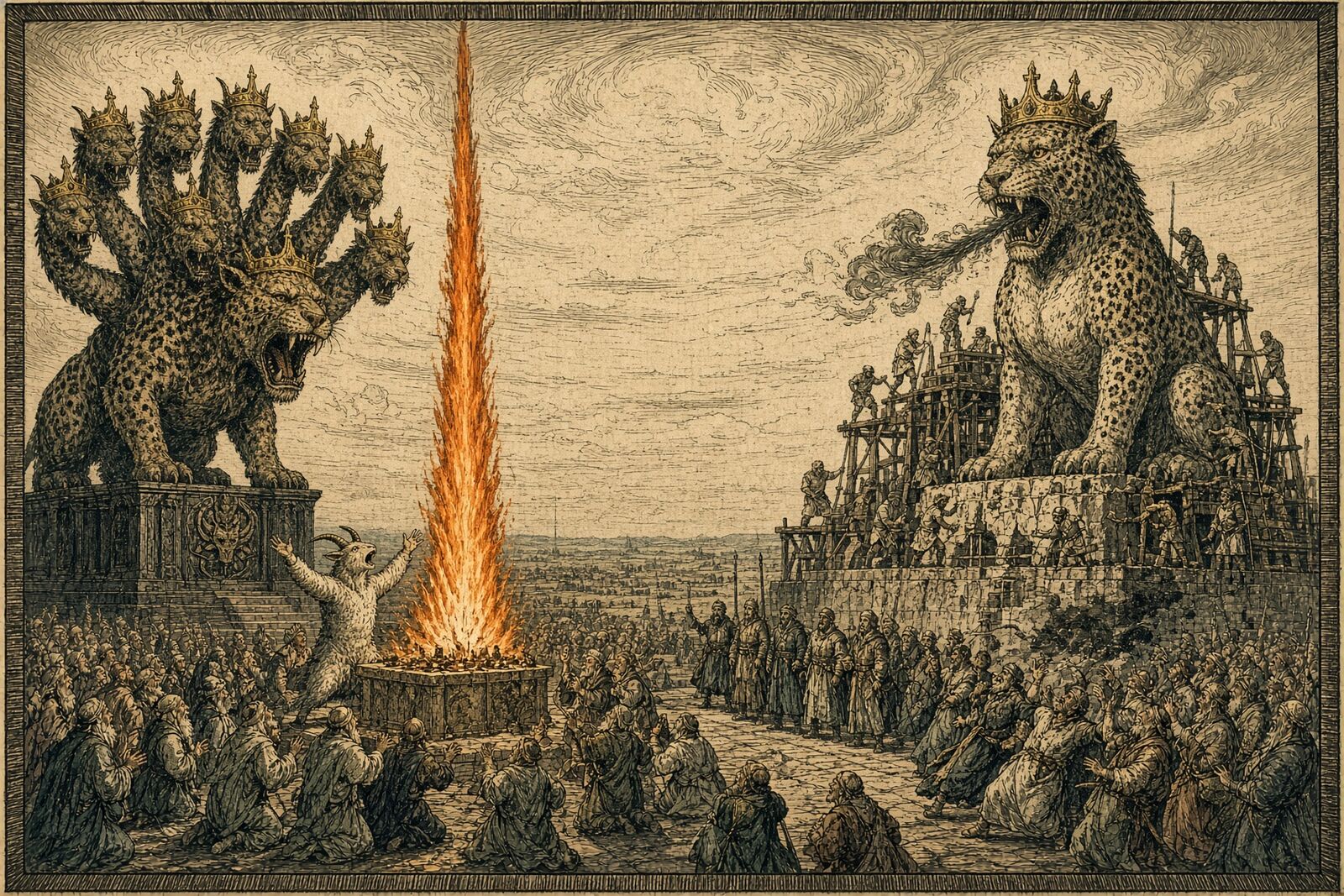
Revelation 13:11-18 — The Beast from the Land and the Mark of the Beast
Session 33 | The second beast (the false prophet), its role as Imperial cult promoter, the mark of the beast as allegiance not technology, talking statues from archaeology, and 666 as Nero Caesar in Hebrew gematria.
Source: A2K Online Church Archive — Revelation 13:11-18
Two Beasts in Revelation 13
Revelation chapter 13 presents two distinct evil beasts:
- Verses 1-10: The beast from the sea = the Roman Empire
- Verses 11-18: The beast from the land = the Imperial cult’s social elite promoters
Later in Revelation, the beast from the land is renamed “the false prophet” (16:13, 19:20, 20:10). So the familiar pairing “the beast and the false prophet” is really both beasts from chapter 13, just with the second given a new name.
The Beast from the Land (Rev 13:11-12)
“Then I saw another beast coming up out of the earth; and he had two horns like a lamb and he spoke as a dragon.”
The Behemoth Connection
Just as the beast from the sea recalls Leviathan (sea monster), the beast from the land recalls Behemoth (land monster) from Job 40. Both are powerful creatures presented in Job as awesome but ultimately under God’s control. Revelation deploys them as images of terrifying earthly power — still within God’s sovereignty.
Looks Like a Lamb, Speaks Like a Dragon
Two horns like a lamb — appearing innocent, approachable, even religious. But it speaks like the dragon. This is the wolf in sheep’s clothing Jesus warned about (Matthew 7:15). The false prophet’s whole function is deception — appearing safe while serving Satan’s purposes.
Who Is the Beast from the Land?
The consensus of modern Revelation scholarship: the second beast represents the social elites in the seven cities of Asia Minor who actively promoted the Imperial cult — the worship of the Roman Emperor.
Evidence:
- These were wealthy, civic-minded local leaders who voluntarily funded Imperial temples
- They petitioned Rome for the right to build provincial temples
- They held priesthoods in the Imperial cult
- They organized festivals in the Emperor’s honor
- They used their social influence to pressure others into participation
Rome didn’t force this on the people. The people — led by their elites — did it voluntarily. The false prophet represents this local, voluntary promotion of Caesar worship.
The Beast from the Land as Counter-Image to the Two Witnesses
The teacher draws out a point-for-point contrast between the two witnesses (chapter 11) and the false prophet (chapter 13):
| Two Witnesses |
False Prophet |
| Represent the church’s gospel witness |
Represent the Imperial cult’s propaganda |
| Single figure symbolizing a wider body |
Single figure symbolizing a wider body |
| Authority from God |
Authority from the first beast (Rome) |
| Call for worship of the true God |
Encourages worship of Caesar |
| Fire from their mouth (gospel judgment) |
Fire from heaven (false miracles) |
| Died as martyrs and were raised |
Puts to death those who refuse to comply |
| Follow the Lamb |
Serve the dragon |
These are deliberately constructed as mirror opposites — one calling people to the true God, one driving them toward the false god.
The Verb “To Do” — Repeated Emphasis
The verb poiō (to do/make/perform) appears an unusually high number of times in this section, emphasizing that the false prophet is a mover and shaker — a doer, a performer, an active agent of deception. He performs signs, he makes people worship, he causes the image to speak, he causes people to receive marks. He is relentlessly active in his deception.
False Signs and Miracles (Rev 13:13-14)
“He performs great signs, so that he even makes fire come down out of heaven to the earth in the presence of men.”
The Old Testament is clear: miracles do not validate a prophet’s truth. Deuteronomy 13:1-3 explicitly warns that a prophet who performs signs but leads people to worship other gods is a false prophet — and their signs do not make their message true.
The test of a true prophet is not miracle-working but whom they direct people to worship.
Fire from Heaven
Fire from heaven = lightning = associated with Zeus in Greek culture. The false prophet attempts to demonstrate Zeus-level divine authority by producing lightning-like phenomena. For Roman citizens steeped in mythology, this would look like divine endorsement of the Emperor.
Talking Statues: Archaeological Evidence
The teacher presents remarkable archaeological evidence confirming the practice described in verse 15:
“It was given to him to give breath to the image of the beast, so that the image of the beast would even speak.”
Archaeologists have discovered hollowed-out temple idols with moving parts — operated by unseen priests behind the scenes. The second-century writer Lucian describes in detail how a false prophet named Alexander had a statue of Asclepius with:
- A snake’s tongue controlled by horsehairs
- A crane’s windpipe passed through the head so the priest could speak into it from the outside
- The resulting voice made it appear the god was speaking
This was as common as stage magic — priests operating the mechanisms while worshippers believed they were hearing their gods. The “image of the beast that speaks” reflects the real practice of animated temple statues used in Imperial cult worship.
The Mark of the Beast (Rev 13:16-17)
“He causes all, the small and the great, and the rich and the poor, and the free men and the slaves, to be given a mark on their right hand or on their forehead, and he provides that no one will be able to buy or sell, except the one who has the mark, either the name of the beast or the number of his name.”
The Mark Is Not Physical Technology
The popular interpretation of the mark as a microchip, barcode, credit card, or future biometric implant completely misses the point and ignores everything Revelation has already established about marks.
Revelation’s own framework for marks:
- The faithful receive the name of the Lamb and his Father written on their foreheads (7:3, 14:1, 22:4)
- These are clearly markers of allegiance and identity, not literal tattoos
- The mark of the beast is the exact counter-image — an allegiance marker for those who belong to Rome’s system
The forehead and hand symbolize:
- Forehead = one’s religious orientation, what you think and believe
- Hand/right hand = one’s deeds and actions
The Shema (Deuteronomy 6:8) commanded Israel to bind God’s words “as a sign on your hand” and as “frontlets between your eyes” — this is the Old Testament background. The mark of the beast is a direct parody of this: instead of God’s commandments defining your hand and forehead, Caesar’s mark does.
The mark = allegiance to Caesar’s system — participating in the Imperial cult, trading within Rome’s economic framework that required honoring Caesar, living according to the values of Fallen Babylon.
Economic Exclusion
“No one can buy or sell” without the mark — those who refused to participate in the Imperial cult faced:
- Social exclusion
- Business isolation (fellow guild members wouldn’t trade with known dissenters)
- Possible property confiscation
This was not universal enforcement but targeted social pressure. Christians who refused to participate in Emperor worship faced real economic consequences. Revelation acknowledges this reality while calling them to faithfulness regardless of cost.
666: Nero Caesar in Hebrew Gematria
“Let him who has understanding calculate the number of the beast, for the number is that of a man; and his number is six hundred and sixty-six.”
Gematria: How It Works
Gematria is the ancient practice of assigning numerical values to letters. In Greek, Hebrew, and Latin, each letter had a numerical equivalent:
- A = 1, B = 2… through 10, then 20, 30… then 100, 200, 300…
The number of a word or name = the sum of its letters’ numerical values.
The teacher notes this was so common it appeared in Pompeii graffiti — someone scratched “I love the woman whose number is 545” into a wall.
The Solution: Nero Caesar (נרון קסר)
When you write “Nero Caesar” in Hebrew letters (nrwn qsr) and calculate the gematria:
- נ (nun) = 50
- ר (resh) = 200
- ו (waw) = 6
- ן (nun final) = 50
- ק (qoph) = 100
- ס (samekh) = 60
- ר (resh) = 200
- Total = 666
Additionally, the word “beast” in Hebrew (therion) = 666.
This is the near-unanimous conclusion of modern Revelation scholarship: 666 = Nero Caesar.
Why Nero?
- Nero was the first Roman emperor to actively persecute Christians (64 AD)
- He tortured and murdered Christians in Rome, including (tradition holds) Peter and Paul
- His name in Hebrew gematria = 666
- The “Nero redivivus” myth (that Nero would return) makes him the perfect embodiment of the beast
The point for Revelation’s readers: By encoding Nero’s name as 666, Revelation:
- Identifies the beast’s prototype
- Uses language only insiders would understand (protecting the text from Roman authorities)
- Labels Rome’s terror as triply incomplete — 666 is three sixes, each one short of seven (completion). Rome is fundamentally imperfect no matter how powerful it appears
Application: Avoiding the Mark Today
The mark of the beast is not about future technology. It is about:
- Allegiance — to whom do you give ultimate loyalty?
- Worship — whom do you honor as ultimate authority over your life?
- Compromise — are you allowing the surrounding culture to define your identity and values?
The mark of the beast = identifying yourself as a citizen of Fallen Babylon rather than a citizen of New Jerusalem.
For every generation of Christians, the question is: What is your culture’s equivalent of the Imperial cult? What are the blasphemous titles being given to human powers? Where are you being pressured to give Caesar the allegiance that belongs to God alone?
Revelation’s consistent answer: Name it for what it is. Resist the compromise. Be faithful to God and the Lamb alone. The beast looks impressive and powerful. But it is triply incomplete — 666 — always falling short of the perfect completeness of God.
Summary
| Element |
Meaning |
| Beast from the land |
Social elites promoting the Imperial cult — voluntary, not coerced |
| “Looks like a lamb, speaks like a dragon” |
Wolf in sheep’s clothing; the false prophet’s deceptive appearance |
| Counter-image to the two witnesses |
The church’s gospel witness vs. the Empire’s propaganda machine |
| Animated statues |
Archaeological reality — temple statues with hidden mechanisms to appear to speak |
| Mark of the beast |
Allegiance marker — not physical technology but spiritual/political loyalty |
| Forehead and hand |
Religious orientation (forehead) + actions (hand); echoes the Shema |
| Economic exclusion |
Real social pressure faced by Christians who refused Imperial participation |
| 666 = Nero Caesar |
Hebrew gematria; Rome’s prototype persecutor; triply incomplete |
| Application |
Every generation faces its own version of the mark; faithfulness means refusing to give Caesar what belongs to God |