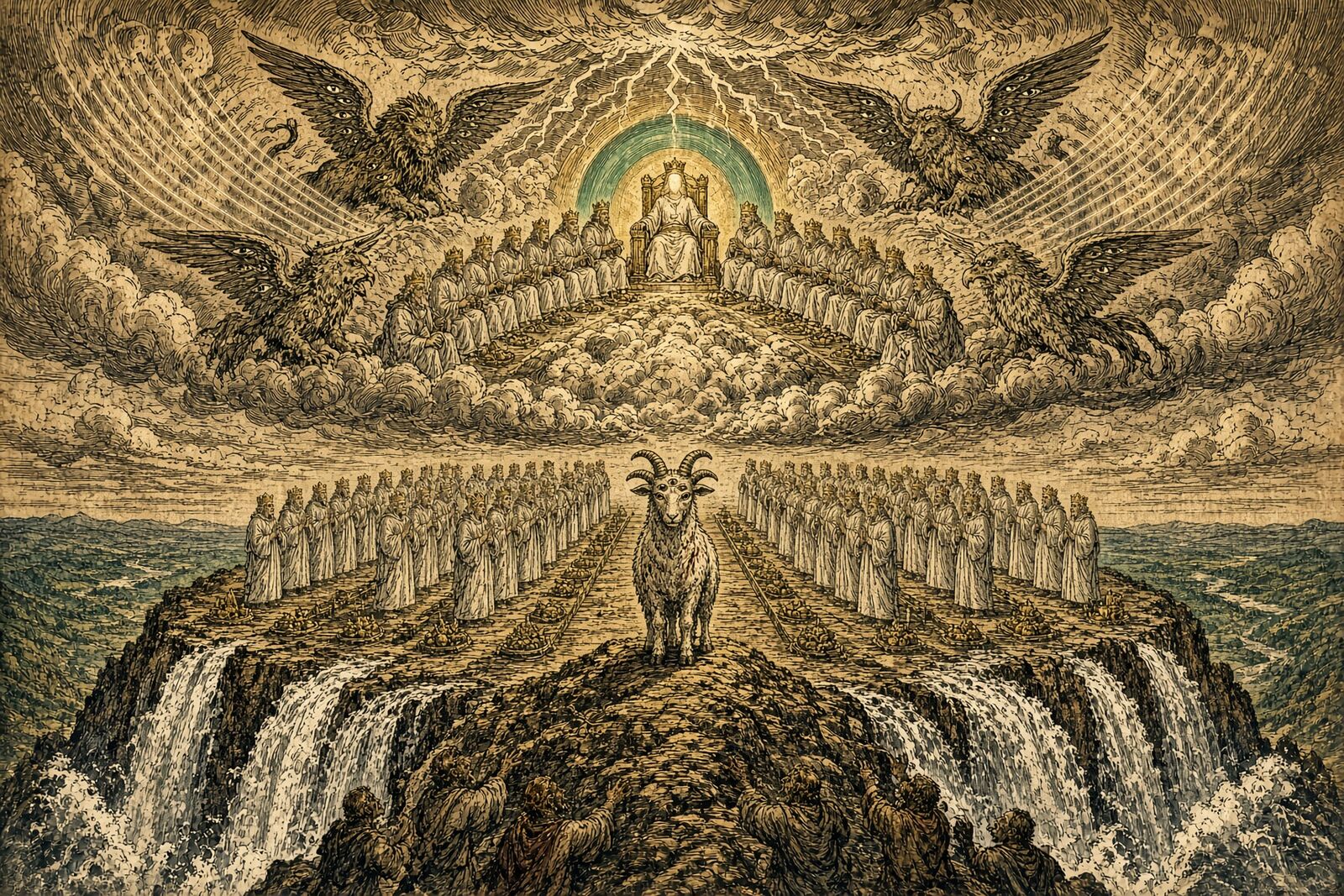
Revelation 14:1-5 — The 144,000 on Mount Zion
Sessions 34–43 | These ten sessions all cover Revelation 14:1-5, taught to different fellowship groups. The core content is the same across all sessions: the 144,000 on Mount Zion, the harp from heaven, the new song, and the five ethical descriptions of the faithful.
Source: A2K Online Church Archive — Revelation 14:1-5
Context: Coming After the Two Beasts
Revelation 14:1-5 is placed immediately after the two beasts of chapter 13 — the beast from the sea (Rome) and the beast from the land (the false prophet/Imperial cult promoters). This placement is deliberate. The reader has just been confronted with:
- 666 — the number of Rome’s prototype persecutor, triply incomplete
- The mark of the beast — allegiance to Caesar’s system
- The worship of the beast by “all who dwell on the earth”
Now, in sharp contrast, comes the 144,000 on Mount Zion — a vision of the complete, pure, faithful people of God, standing with the Lamb, bearing the name of God instead of the mark of the beast.
The immediate rhetorical effect: Two options are set side by side. Which animal will you follow? With whose name will your forehead be marked? In which city is your citizenship? The contrast is intentional and stark.
The Text: Revelation 14:1-5
“Then I looked, and behold, the Lamb was standing on Mount Zion, and with Him one hundred and forty-four thousand, having His name and the name of His Father written on their foreheads. And I heard a voice from heaven, like the sound of many waters and like the sound of loud thunder, and the voice which I heard was like the sound of harpists playing on their harps. And they sang a new song before the throne and before the four living creatures and the elders; and no one could learn the song except the one hundred and forty-four thousand who had been purchased from the earth. These are the ones who have not been defiled with women, for they have kept themselves chaste. These are the ones who follow the Lamb wherever He goes. These have been purchased from among men as first fruits to God and to the Lamb. And no lie was found in their mouth; they are blameless.”
The Lamb Standing on Mount Zion
Standing, Not Sitting
Jesus is typically described in Revelation as seated (enthroned) at God’s right hand. His standing here signals a triumphal, active posture — ready for action, not resting. It echoes Stephen’s vision at his martyrdom (Acts 7:56 — Jesus standing), as if to honor faithful witnesses.
The contrast with chapter 13: the dragon stands upon the sea and the land (13:1, 13:11) — the realms of the unredeemed. The Lamb stands upon Mount Zion — the place of refuge and the redeemed.
Mount Zion: A Place of Refuge and Messianic Kingship
“Mount Zion” appears 19 times in the Old Testament. In approximately half of those occurrences, it serves as a symbol of rescue and refuge for the faithful remnant:
- 2 Kings 19:31: “From Jerusalem will go forth a remnant and out of Mount Zion survivors”
- Psalm 125:1: “Those who trust in the LORD are as Mount Zion, which cannot be moved, but abides forever”
- Isaiah 4:5: God creates a shelter and shade over Mount Zion for his people
- Obadiah 17: “But on Mount Zion there will be those who escape”
The Lamb on Mount Zion = the Lamb in the place of safety and victory with his people.
Already present reality: Hebrews 12:22 already says: “You have come to Mount Zion and to the city of the living God, the heavenly Jerusalem.” Christians are described as having already arrived at the heavenly Mount Zion. It is a present spiritual reality, not only a future destination.
The 144,000: Christians, Not Non-Christian Jews
The 144,000 here are the same group as in Revelation 7 — confirmed by comparing the two passages:
- Revelation 7: They are sealed on their foreheads (7:3)
- Revelation 14: They have the Lamb’s name and the Father’s name on their foreheads (14:1)
If the seal in chapter 7 = the name of the Lamb in chapter 14, these are the same people. And anyone with the Lamb’s name is identified with Jesus — they are Christians. This rules out the interpretation that the 144,000 are non-Christian ethnic Jews.
144,000 remains a symbolic number: 12 × 12 × 1,000 = the complete, fulfilled people of God. Not a literal count of 144,000 individuals.
The teacher also notes that the 144,000 are:
- “Purchased from the earth” (14:3)
- “Purchased from among men” (14:4)
Compare Revelation 5:9: the Lamb “purchased for God with your blood men from every tribe and tongue and people and nation.” The 144,000 are the redeemed of all nations — not one ethnic group.
The Father’s Title vs. the Emperor’s Title “Father”
The passage emphasizes that the 144,000 bear “His name and the name of His Father.” This is counter-Imperial theology:
Roman emperors were commonly called “Father of the Fatherland” (Pater Patriae). Historians confirm:
- Tiberius included this title in his letters to kings (Dio Cassius)
- Augustus’s autobiography records the Roman Senate conferring this title on him
- Suetonius records the “whole body of citizens” unanimously offering Augustus the title “father of his country”
The title “father” on the Emperor’s lips = blasphemy in Christian ears. God alone is the true Father. The name written on the foreheads of the faithful is God’s name, not Caesar’s — a direct counter-claim to Imperial propaganda.
The Voice from Heaven and the Harps
Many Waters and Thunder
The voice from heaven sounds like many waters (Jesus’s voice in 1:15) and loud thunder (God’s throne in 4:5). The combined imagery signals both Jesus and the Father speaking in this vision.
The Ancient Kithara (Harp)
The “harps” are kitharai — ancient instruments quite different from modern harps. Crucially:
Greeks and Romans used the kithara to worship their gods, especially Apollo. It was a standard instrument in pagan temple worship. There is no evidence of early Christians using it in their own worship services.
Revelation’s use of kithara-playing in heavenly worship is therefore striking and counter-cultural: an instrument associated with pagan worship is now employed to celebrate the work of God and the Lamb. Revelation takes a pagan cultural symbol and transforms it — just as it takes the imperial myth of Apollo and subverts it for the truth about Jesus.
The New Song
“They sang a new song before the throne… and no one could learn the song except the 144,000 who had been purchased from the earth.”
“New song” in the Old Testament marks a new act of salvation — something unprecedented that calls for new praise (Psalms 33, 40, 96, 98, 149; Isaiah 42:10). The new song here celebrates the unprecedented universal redemption accomplished by the Lamb.
Psalm 144 is particularly relevant as background — it contains:
- A “new song” (144:9)
- Praise “upon a harp of ten strings”
- God who gives salvation to kings
- Prayer for rescue from those who “speak deceit” and whose “right hand is a right hand of falsehood”
These themes mirror the 144,000 passage: the new song, the harp, deliverance, and the contrast with the false prophet who has lies in his mouth.
“No one could learn the song except the 144,000” — the verb “learn” (manthanō) is the verbal form of mathētēs (disciple). To learn is to be a disciple — to understand and internalize. Only those who have truly followed the Lamb understand this song. It is not accessible to outsiders precisely because it celebrates a victory only experienced from the inside.
Five Ethical Descriptions of the 144,000 (Verses 4-5)
The teacher works through each of the five descriptions, drawing out practical application:
1. “Not Defiled with Women — They Have Kept Themselves Chaste”
This is not misogynistic. Read literally, it is incoherent (both male-defiled-by-women and female-virgin at the same time). These are symbolic images.
The military background: Old Testament soldiers were to abstain from sexual relations before battle (Deuteronomy 23:9-11; 1 Samuel 21:4-5). The 144,000 are depicted as God’s army — their “chastity” is the soldier’s focused, undivided commitment to the mission.
The “Jezebel” connection: In Thyatira (2:20), the false prophetess led people into “acts of fornication and eating things sacrificed to idols” — participation in pagan worship. To be “defiled with women” = to compromise with false worship, especially the idol meat and temple prostitution of the Imperial cult.
The Bride imagery: In 2 Corinthians 11:2, Paul describes the church as “a pure virgin” betrothed to Christ. To be a “virgin” = to remain faithful to the Bridegroom = to refuse spiritual adultery with other lords and gods.
Application: The 144,000 are pure because they have not compromised with idol worship, false teaching, or allegiance to Fallen Babylon. They have kept themselves faithful to the Lamb alone.
2. “These Are the Ones Who Follow the Lamb Wherever He Goes”
The call to discipleship from all four Gospels — “follow me” — is expressed here in its ultimate form: wherever he goes. No conditions, no exceptions.
Specifically, Revelation has identified where the Lamb goes: the Lamb is the faithful witness who preached the gospel, endured non-violently, and was faithful unto death. Following the Lamb “wherever he goes” means:
- Preach the gospel — as the Lamb did
- Persevere without violence — as the Lamb did
- Remain faithful even unto death — as the Lamb did
These are the three marks of Christian conquering that run through Revelation (the teacher’s doctoral dissertation theme).
Application: We follow the Lamb as our model in all three dimensions — not just in belief, not just in church attendance, but in the pattern of his entire life and death.
3. “Purchased from Among Men as First Fruits to God and to the Lamb”
“Purchased” (agorazō) = bought out of the slave market; redeemed. The same verb used in 5:9 (“purchased for God with Your blood men from every tribe”). The 144,000 have been freed from the dominion of the world system (Fallen Babylon) through Jesus’s atoning death.
“First fruits” (aparchē) = the first portion of a harvest offered to God, representing the whole harvest to come. The 144,000 as “first fruits” suggests they are the representation and pledge of a larger harvest — all those who will ultimately be redeemed.
Application: We have been bought at a price. Our lives are not our own. We belong to God and the Lamb. This is both liberation (free from the power of sin and the world) and obligation (consecrated to God’s purposes).
4. “No Lie Was Found in Their Mouth”
A direct echo of Isaiah 53:9 — describing the Suffering Servant: “nor was any deceit in his mouth.” This verse is applied to Jesus’s death in the New Testament (1 Peter 2:22-23). The 144,000 embody the same quality as Jesus on the cross — no lie, no falsehood.
The contrast with the false prophet is stark: the false prophet’s entire ministry is deception. The 144,000 speak only truth.
Revelation 21:8 includes “all liars” among those who will have their place in the lake of fire. This is not about white lies; it is about the fundamental orientation of one’s speech — toward truth or toward deception, toward God’s reality or toward Fallen Babylon’s illusions.
Application: Followers of the Lamb are people of truth — in their gospel proclamation, in their personal integrity, in their refusal to participate in the empire’s propaganda. Our speech reflects whose kingdom we belong to.
5. “They Are Blameless”
Blameless does not mean sinless perfection — the Bible never expects sinless perfection of human beings. Rather, “blameless” describes someone who:
- Does not have unrepentant sin in their life
- Is humble enough to acknowledge error and repent
- Is in good standing within the covenant relationship with God
This is the posture of the Bride of Christ: not perfect, but faithful. Not flawless, but responsive to correction. Not hiding sin, but bringing it to the light.
Application: We are called to live blamelessly — not as a claim to perfection but as a commitment to ongoing faithfulness, repentance, and covenant loyalty. When we find ourselves in error, we repent quickly and correct course.
The Passage in Its Rhetorical Setting
The five descriptions of the 144,000 function as a profile of the faithful conqueror — the person Revelation has been calling readers to be since the letters to the seven churches:
| Description |
Connection to the Seven Churches |
| Not defiled with women |
Avoiding the compromise of Ephesus, Thyatira, Pergamum |
| Follow the Lamb wherever |
The “first love” of Ephesus; the endurance of Smyrna and Philadelphia |
| Purchased as first fruits |
Citizens of New Jerusalem, not Fallen Babylon |
| No lie in their mouth |
Contrast to the false prophet; integrity in witness |
| Blameless |
The white garments of Sardis; the spotless bride |
Practical Summary
These five verses set the standard extremely high — but they do so not to discourage but to invite. The vision of the 144,000 standing with the Lamb on Mount Zion is what Christian faithfulness looks like from God’s perspective: complete, pure, joyful, safe, and singing a song only they can understand.
The practical call:
- Remain pure — do not be defiled by compromise with false worship or allegiance to Fallen Babylon
- Follow the Lamb — in gospel proclamation, non-violent endurance, and readiness to suffer
- Receive your purchased identity — you belong to God and the Lamb; live accordingly
- Speak truth — in gospel witness, in personal integrity, in refusal of the empire’s propaganda
- Live blamelessly — not through perfection but through ongoing covenant faithfulness and quick repentance
“The 144,000 is not a picture of 144,000 special individuals. It is a picture of what the entire people of God look like when they are living as God intends — purchased, pure, faithful, truthful, and following the Lamb wherever he leads.”
Note on Sessions 34–43
Videos 34, 35, 36 and 37–43 cover the same Revelation 14:1-5 passage delivered to different fellowship groups on different occasions. Each session adds nuances from its audience’s questions (e.g., the 144,000 and their relationship to Rev. 7, the meaning of the harps, the Father’s title vs. Caesar’s), but the core content is identical. This single explanation captures the full teaching.