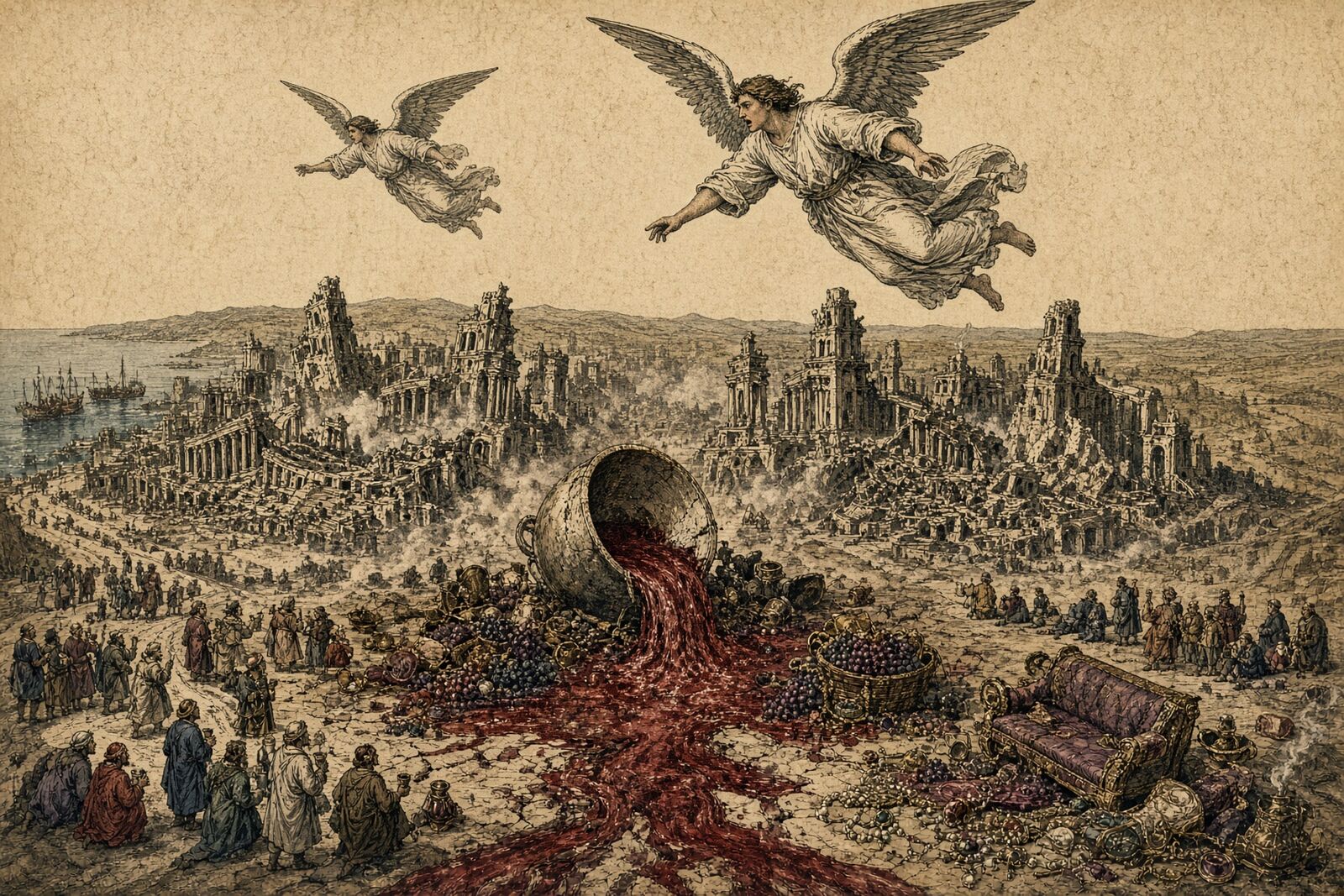
Revelation 14:6–13 — Good News, Bad News, and You Choose
Session 36 | Three angels announce an eternal gospel, the fall of Babylon, and a stark warning against worshiping the beast. The passage ends with a call to perseverance and a blessing on those who die in the Lord.
Source: A2K Online Church Archive — Revelation 14:6-13
Context: Where This Passage Fits
Immediately after the vision of the 144,000 on Mount Zion (14:1–5), the scene shifts to three angels flying in midheaven. Chapter 13 has just finished describing the two beasts — Rome and its Imperial cult promoters. Now the reader is given the divine response: a three-part proclamation of good news, bad news, and a choice.
The teacher notes a recurring pattern in Revelation: scary visions of judgment are never the final word. The narrative always circles back to place the reader in the presence of God and the Lamb in worship. This passage is one of those judgment scenes, but it is sandwiched between the 144,000 vision (14:1–5) and the worship scene of the conquerors (15:1–4).
The First Angel: Good News (vv. 6–7)
“I saw another angel flying in midheaven, having an eternal gospel to preach to those who live on the earth, and to every nation and tribe and tongue and people.”
The Eternal Gospel vs. Rome’s Gospel
The angel proclaims an eternal gospel — the true gospel about the kingdom of God, whose rule and dominion will never end. This stands in direct contrast to Rome’s own “gospel”: the Pax Romana (Roman Peace), which summoned hearers to give allegiance to Caesar as Lord, Savior, and Son of God. Rome’s poets (e.g., Ovid) called Rome “the Eternal City.”
The choice is stark: you cannot be a citizen of both Rome and New Jerusalem.
The Summons: Fear God, Worship the Creator
The angel’s message is: “Fear God and give Him glory, because the hour of His judgment has come; worship Him who made the heaven and the earth and the sea and springs of waters.”
- Fear God = a summons to repentance — turn from not fearing God to fearing Him
- Give Him glory = align your life to honor God
- Worship the Creator = reject idolatry; worship only the One who made all things
The description of God as the one who made “heaven, earth, sea, and springs of waters” echoes the fourth commandment (Exodus 20:11) and the praise of the twenty-four elders (Rev. 4:11).
Key point: True repentance requires abandoning idolatry — especially giving up the worship of the beast and his image. The compromise position (worship God on Sunday, Caesar on Monday, Zeus on Tuesday) is unacceptable.
The Second Angel: Bad News (v. 8)
“Another angel, a second one, followed, saying, ‘Fallen, fallen is Babylon the Great, she who has made all the nations drink of the wine of the passion of her immorality.’”
Rome as Babylon
Early Christians, including John, called Rome “Babylon” because of its destructive tendencies — specifically its destruction of the Jerusalem Temple in 70 AD, mirroring what ancient Babylon did in 587 BC.
| Event |
Babylon (587 BC) |
Rome (70 AD) |
| Conquered God’s people |
Yes |
Yes |
| Destroyed the Temple |
First Temple |
Second Temple |
| Took people into exile |
Yes |
Yes (diaspora) |
Prophetic Language: Isaiah 21:9
This passage alludes to Isaiah 21:9, where the eighth-century prophet Isaiah declared Babylon fallen — two hundred years before it actually happened. The repetition of “fallen, fallen” is Hebrew emphasis for complete destruction.
Just as God spoke through Isaiah and Jeremiah about Babylon’s judgment before it happened, Revelation prophetically announces Rome’s demise as already accomplished. Readers should therefore distance themselves from worshiping the beast and from deeds of immorality (unfaithful covenant behavior).
The Third Angel: The Choice (vv. 9–11)
“If anyone worships the beast and his image, and receives a mark on his forehead or on his hand, he also will drink of the wine of the wrath of God, mixed in full strength in the cup of His anger.”
Two Options
The reader is presented with a stark choice:
- Refuse participation in the Imperial cult → suffer persecution and tribulation
- Compromise allegiance (worship God + Caesar + local gods) → avoid persecution but face God’s judgment
This passage is doing everything it can to scare believers away from unholy compromise. These are among the harshest judgment visions in the entire Bible — and they are directed at believers who compromise with false worship, not at unbelievers.
The Wine of God’s Wrath
Babylon made the nations drunk with the wine of her immorality. The third angel warns of a far more potent wine: the wine of God’s wrath, mixed in full strength. The imagery is reciprocal — those who drink Babylon’s cup will also drink God’s.
Public Shaming
The judgment happens “in the presence of the holy angels and in the presence of the Lamb.” In the ancient world, public shame was the greatest fear. This is not just about torment — it is about being exposed before the angels and before Jesus himself, whom the compromising believer claimed to follow. This would have been deeply dissuasive.
The Smoke of Their Torment (v. 11)
“The smoke of their torment goes up forever and ever.”
This imagery is drawn from Isaiah 34 (judgment on Edom) and is echoed in Revelation 19:3 (judgment on Babylon the city). Since Edom is not still burning today, and since a city cannot perpetually burn, the image signifies:
- Complete destruction whose effects are eternal
- Not an endless burning, but an eternal end
- The destruction is total and irreversible
“No Rest Day or Night”
This is a counter-image to the worship of God in Revelation 4:8, where the living creatures “have no rest day or night” saying “Holy, holy, holy.” The reader chooses:
- No rest in the worship of the true God (life-giving)
- No rest in the worship of the beast (destructive)
The Call to Perseverance (v. 12)
“Here is the perseverance of the saints who keep the commandments of God and their faith in Jesus.”
John inserts his own commentary here (not an angel speaking). He defines what true perseverance looks like:
- Keep the commandments of God — ongoing, lifelong obedience to God’s ways
- Faith in Jesus / faithfulness of Jesus — the Greek is ambiguous
The teacher argues that the phrase likely means “the faithfulness of Jesus” — believers persevere by emulating Jesus’s own faithfulness. Jesus is the model:
- He preached the gospel of the kingdom
- He persevered without compromise and without retaliating in violence
- He remained faithful even unto martyrdom by Roman execution
One scholar wrote an entire book on the meaning of this single verse, concluding the same: it is about Jesus’s faithfulness as the example for believers.
The Blessing on Those Who Die in the Lord (v. 13)
“Blessed are the dead who die in the Lord from now on. Yes, says the Spirit, so that they may rest from their labors, for their deeds will follow them.”
“Die in the Lord”
To die in the Lord = to die within the sphere of allegiance to Jesus Christ. Those who obey the call to perseverance will likely suffer — perhaps even die for their faith.
“Rest from Their Labors”
The verb for “rest” in the context of death refers to the unconscious sleep of death — the dead are sleeping in their graves awaiting resurrection (cf. Daniel 12:13; Rev. 6:11). This is consistent with the biblical teaching that the dead are not conscious but will be raised at the resurrection.
“Their Deeds Will Follow Them”
Faithful deeds of loyalty to Jesus follow believers into the resurrection for reward. Conversely, the deeds of compromising believers follow them to judgment.
Application for the 21st Century
1. The Temptations to Compromise Are Plenty
Revelation discourages faithful behavior and urges continued obedience to God’s commands even if it results in suffering. We must teach both sides of the coin: the hope of eternal life and the threat of judgment to those who compromise.
2. The Lamb Set an Example
Jesus is not just someone we believe in — he is someone we follow and obey. His threefold example:
- Preaching the gospel of the kingdom
- Persevering without compromise or violent retaliation
- Remaining faithful even to martyrdom
3. Be Careful About Worship
Some of the harshest threats in Scripture are about false worship. We must be discerning about:
- The songs we sing and their recipients
- Anything that takes the place of God (idols of any kind)
- Worshiping only God and the Lamb — not the Holy Spirit, not Mary, not angels
Summary
| Element |
Meaning |
| First angel |
Proclaims the eternal gospel — God’s kingdom vs. Rome’s empire |
| Second angel |
Announces Babylon’s fall — Rome judged as another Babylon |
| Third angel |
Warns against beast worship — the wine of God’s wrath for compromisers |
| Choice |
Suffer now for faithfulness, or suffer eternally for compromise |
| Perseverance |
Keeping God’s commands + emulating Jesus’s faithfulness |
| Rest in death |
The dead sleep awaiting resurrection; their deeds follow them |
| Practical |
Temptations abound; follow the Lamb’s example; worship only God and Jesus |
“Revelation doesn’t leave its readers in the scary passages. It always circles back to place you in the presence of God and the Lamb, where worship is taking place.”