Revelation 14:14–20 — The Harvest
Session 37 | Two reapings — one grain harvest by the Son of Man, one grape harvest by an angel. A single event of judgment with two different groups and outcomes.
Source: A2K Online Church Archive — Revelation 14:14-20
Context and Structure
This passage immediately follows the three-angel announcement (14:6–13). The teacher argues that the passage describes one event but two different reapings involving two different reapers with two different purposes.
The passage is structured as a parallel:
| Element |
First Harvest (vv. 14–16) |
Second Harvest (vv. 17–20) |
| Reaper |
One like a Son of Man (Jesus) |
Another angel |
| Command |
“Put in your sickle and reap” |
“Gather the clusters of the vine” |
| Purpose |
“The harvest of the earth is ripe” |
“Her grapes are ripe” |
| Response |
Swung sickle; earth was reaped |
Gathered clusters; threw into winepress |
| Result |
The earth was reaped |
Blood to horses’ bridles for 200 miles |
The Grain Harvest (vv. 14–16) — The Righteous
“I looked, and behold, a white cloud, and sitting on the cloud was one like a son of man, having a golden crown on his head and a sharp sickle in his hand.”
The first reaper is the Son of Man — Jesus himself. He wears a golden crown (victory, kingship) and carries a sharp sickle.
An angel from the temple calls to him: “Put in your sickle and reap, for the hour to reap has come, because the harvest of the earth is ripe.”
Jesus swings his sickle and the earth is reaped.
Interpretation: This is the harvest of the righteous — the gathering of God’s people. The “Son of Man” imagery comes from Daniel 7:13–14, where the Son of Man receives dominion. Jesus as the Son of Man reaps the faithful.
Key clues this is the righteous harvest:
- The Son of Man (Jesus) is the reaper
- Grain harvest in the Old Testament symbolizes the gathering of God’s people
- It contrasts with the grape harvest (judgment) that follows
The Grape Harvest (vv. 17–20) — The Wicked
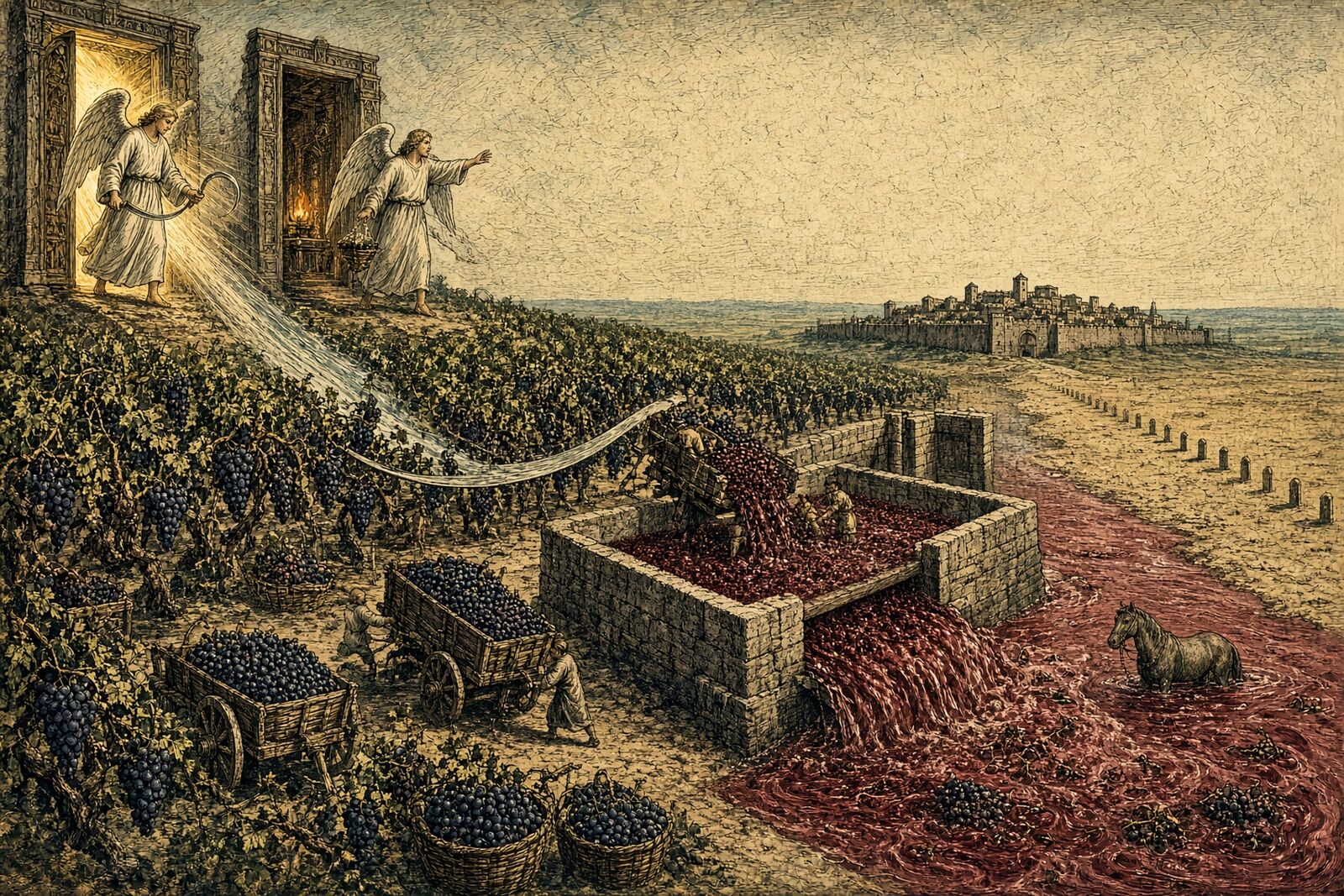
“Another angel came out of the temple which is in heaven, and he also had a sharp sickle.”
A second reaper appears — an angel (not Jesus). He is told: “Put in your sharp sickle and gather the clusters from the vine of the earth, because her grapes are ripe.”
The Winepress of God’s Wrath
“The angel swung his sickle to the earth and gathered the clusters from the vine of the earth, and threw them into the great winepress of the wrath of God.”
The vine of the earth represents the wicked — those who have aligned themselves with Babylon and the beast. While Israel is often called the “vineyard of the Lord” (Isaiah 5), this is the earthly vine — corrupt and destined for judgment.
The Treading Outside the City
“The winepress was trodden outside the city, and blood came out from the winepress up to the horses’ bridles, for a distance of about 200 miles.”
“Outside the city” likely refers to Jerusalem — evoking Old Testament imagery of judgment taking place outside the city gates (Joel 3:13; Isaiah 63:1–6). It may also anticipate Jesus being crucified “outside the gate” (Hebrews 13:12).
The 200 miles (1,600 stadia — 16 × 100) is a symbolic number:
- 16 = completeness of judgment
- The distance approximates the length of Palestine from north to south
- The hyperbole shows the totality of the judgment
The Hyperbolic Language
Blood to the horses’ bridles is clearly figurative — it is meant to convey the overwhelming scale and severity of God’s judgment on the wicked, not to be read as a literal measurement.
Summary
| Element |
Grain Harvest (vv. 14–16) |
Grape Harvest (vv. 17–20) |
| Reaper |
Son of Man (Jesus) |
Angel |
| What is reaped |
The earth (grain) |
The vine (grapes) |
| Who it represents |
The righteous / God’s people |
The wicked / the ungodly |
| Symbolism |
Gathering of the faithful |
Judgment on the wicked |
| Result |
Gathered to safety |
Thrown into God’s winepress of wrath |
“This is not all one reaper doing one thing. There are two reapings — one for the righteous and one for the wicked — within the same event of divine harvest.”