Revelation 15:1–4 — The Conquerors Who Worship
Session 38 | Before the seven bowl plagues are poured out, the conquerors stand on a sea of glass and sing the song of Moses and the Lamb. A vision of worship as the proper response to trial.
Source: A2K Online Church Archive — Revelation 15:1-4
Context: Answering a Lingering Question
Revelation 15:1–4 serves as an interlude between the announcement of the seven bowl plagues and their actual outpouring in chapter 16. More importantly, it answers a question that has been building since Revelation 12:
Who is worthy to receive worship?
The cosmic conflict from chapters 12–14 revolved around this question:
- Chapter 12: The dragon persecutes the woman (God’s people)
- Chapter 13:1–10: The beast from the sea summons all to worship it
- Chapter 13:11–18: The beast from the land promotes worship of the first beast
- Chapter 14:1–5: The 144,000 worship the Lamb on Mount Zion
- Chapter 14:6–13: Three angels call for worship of the Creator and warn against beast worship
Now, in 15:1–4, the answer is clear: the conquerors worship the true God and the Lamb.
The Sea of Glass Mixed with Fire
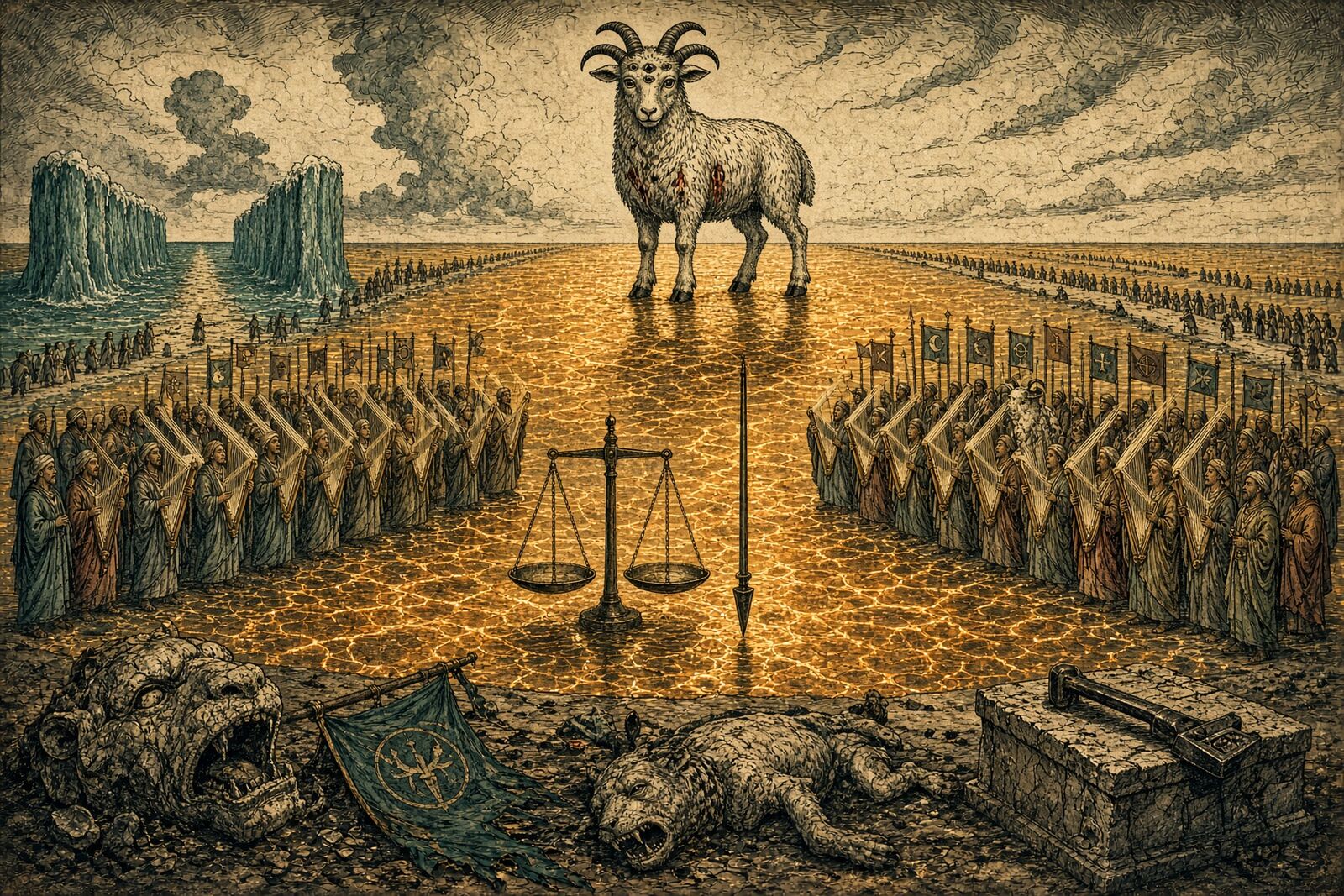
“I saw something like a sea of glass mixed with fire, and those who had been victorious over the beast and his image and the number of his name, standing on the sea of glass, holding harps of God.”
The Sea of Glass
This recalls the bronze sea in Solomon’s temple (1 Kings 7:23–26) and the pavement of sapphire under God’s feet in Exodus 24:10. It represents the firm foundation of heaven — stable, pure, transparent.
Mixed with Fire
Fire represents God’s presence and purification (Exodus 3:2; 19:18; Hebrews 12:29). The sea being “mixed with fire” suggests that God’s presence is both glorious and dangerous — a place of safety for the faithful but of judgment for the wicked.
“Those Who Had Been Victorious”
The Greek word is nikaō — to conquer — the same word used throughout the seven letters. These are believers who conquered as Jesus conquered:
- They refused to worship the beast and his image
- They rejected the mark (allegiance to Caesar)
- They persevered through suffering
They stand on the sea of glass — a position of victory and stability in God’s presence. They hold harps (kitharai), the same type of instrument used in pagan worship of Apollo, now repurposed for the worship of the true God.
The Song of Moses and the Song of the Lamb
*“They sang the song of Moses, the bond-servant of God, and the song of the Lamb.””
The conquerors sing two songs fused into one:
The Song of Moses
After God delivered Israel through the Red Sea and destroyed the Egyptian army, Moses and the Israelites sang (Exodus 15):
“I will sing to the LORD, for He is highly exalted; the horse and its rider He has hurled into the sea.”
The conquerors in Revelation have experienced the same kind of deliverance — they have been delivered from the beast (the new Pharaoh/Caesar) and now stand on the other side of tribulation.
The Song of the Lamb
This is the new song — celebrating the redemption accomplished by Jesus’s sacrifice. The two songs are sung together because the deliverance of the Exodus and the deliverance of the Cross are one continuous story of God’s salvation.
The Content of the Song (vv. 3–4)
“Great and marvelous are Your works, O Lord God the Almighty; righteous and true are Your ways, King of the nations!”
Great and Marvelous Works
God’s works are great (majestic) and marvelous (inspiring wonder and awe). The plagues about to be poured out are part of those works — they are acts of justice, not arbitrary destruction.
Righteous and True Ways
God’s judgment is not capricious. His ways are righteous (consistent with his character) and true (reliable, faithful to his promises).
King of the Nations
This is a direct counter-claim against Caesar. The Roman Emperor claimed to be king of the nations. Revelation reveals that God is the true King of the nations — and the nations will ultimately recognize this.
“Who Will Not Fear, O Lord, and Glorify Your Name?”
This echoes the language of the first angel’s message (14:6–7): “Fear God and give Him glory.” The song affirms that all nations will eventually come to worship God.
“For You Alone Are Holy”
Holiness means set apart — God alone is truly holy, distinct from all creation and all false gods. No Caesar, no beast, no idol shares this quality.
“All the Nations Will Come and Worship Before You”
This is the universal scope of God’s salvation. Not just Israel, not just the seven churches — all nations. The Great Commission’s goal is realized: people from every tribe, tongue, and nation worship the true God.
“Your Righteous Acts Have Been Revealed”
God’s righteous acts — his judgments and his salvation — are now publicly displayed. The apocalypse is unveiling what was hidden: God’s justice at work in history.
Summary
| Element |
Meaning |
| Sea of glass mixed with fire |
Heaven’s stable foundation; God’s presence as both glorious and dangerous |
| Conquerors standing on it |
Victorious through faithful endurance — they overcome as Jesus overcame |
| Harps of God |
Instruments of worship, repurposed from pagan use |
| Song of Moses |
Celebrates deliverance from oppression (Exodus) |
| Song of the Lamb |
Celebrates redemption through Jesus’s sacrifice |
| God’s works |
Great and marvelous — including the coming judgments |
| God’s ways |
Righteous and true — never arbitrary |
| King of the nations |
God, not Caesar, is the true King |
| Universal worship |
All nations will eventually come and worship |
“How do faithful Christians respond to difficult times? They worship. This is not the normal way we think about responding to trials, but it’s what Revelation calls us to do.”