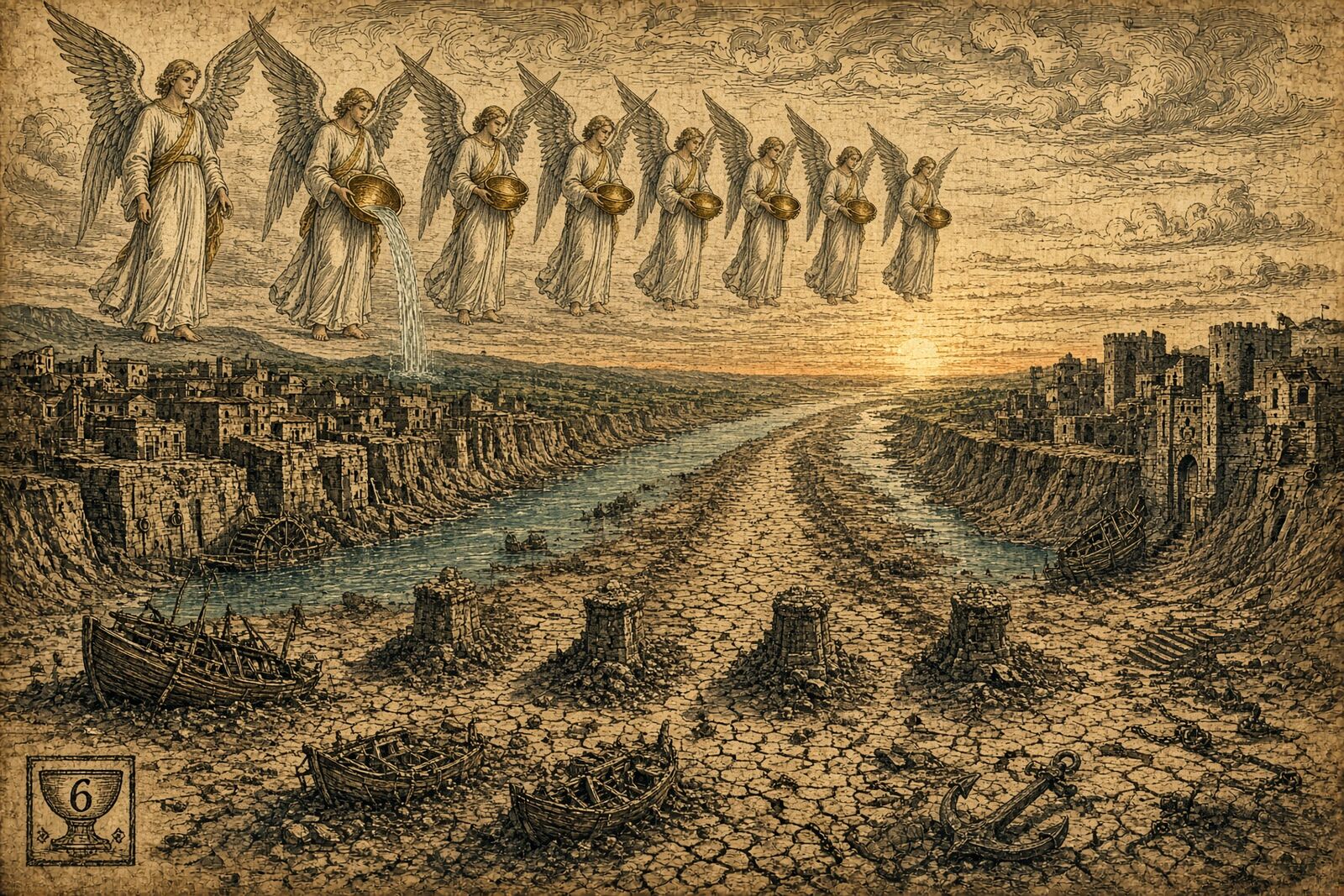
Revelation 15:5–16:21 — The Seven Plagues of a Just God
| Session 39 |
The seven angels with the seven golden bowls pour out God’s wrath on the earth. These plagues mirror the Exodus plagues but are directed specifically at those aligned with the beast. |
| Source: A2K Online Church Archive — *The Seven Plagues of a Just God |
Revelation 15:5-16:21* |
The Heavenly Temple Opens (15:5–8)
“The temple of the tabernacle of testimony in heaven was opened, and the seven angels who had the seven plagues came out of the temple.”
The tabernacle of testimony recalls the wilderness tabernacle that housed the ark of the covenant. Its opening signals that God’s judgment is now proceeding from his very presence.
The angels are:
- Clothed in linen (priestly garments) — their work is a sacred act
- Girded with gold sashes — royal and priestly
- Given seven golden bowls — not censers for incense, but bowls full of the wrath of God
The Temple Filled with Smoke
“The temple was filled with smoke from the glory of God and from His power, and no one was able to enter the temple until the seven plagues of the seven angels were finished.”
The smoke echoes Isaiah 6 (Isaiah’s vision of God’s holiness) and 1 Kings 8 (the dedication of Solomon’s temple). When the smoke fills the temple, no one can enter — the time for intercession is over; the time for judgment has come.
The First Bowl: Loathsome Sores (16:1–2)
“It became a loathsome and malignant sore on the people who had the mark of the beast and who worshiped his image.”
This mirrors the sixth Egyptian plague (boils, Exodus 9:8–12). The judgment is specific — it targets only those with the mark of the beast. God’s faithful are protected.
The Second Bowl: Sea Turned to Blood (16:3)
“It became blood like that of a dead man; and every living thing in the sea died.”
Mirrors the first Egyptian plague (turning water to blood, Exodus 7:14–24). The sea — source of commerce, travel, and the beast (who arose from the sea) — becomes death.
The Third Bowl: Rivers and Springs Turned to Blood (16:4–7)
*“They poured out the blood of saints and prophets, and You have given them blood to drink. They deserve it.”**
This is poetic justice. Those who shed the blood of God’s people are now given blood to drink. The angel of the waters declares God’s judgments righteous — a key theme throughout the plagues.
The Fourth Bowl: Scorching Sun (16:8–9)
“Men were scorched with fierce heat; and they blasphemed the name of God who has the power over these plagues, and they did not repent so as to give Him glory.”
A key observation: the people do not repent. Despite the severity of the plagues, the worshipers of the beast blaspheme God and refuse to repent. This shows the hardness of human hearts that have fully committed to evil.
The Fifth Bowl: Darkness on the Beast’s Throne (16:10–11)
“His kingdom became darkened; and they gnawed their tongues because of pain, and they blasphemed the God of heaven because of their pains and their sores; and they did not repent of their deeds.”
This mirrors the ninth Egyptian plague (darkness, Exodus 10:21–29). The darkness falls specifically on the throne of the beast — the seat of Roman Imperial power. Even in darkness and pain, the response is blasphemy, not repentance.
The Sixth Bowl: The Euphrates Dried Up (16:12–16)
“The sixth angel poured out his bowl on the great river, the Euphrates; and its water was dried up, so that the way would be prepared for the kings from the east.”
The Euphrates
The Euphrates was the eastern boundary of the Roman Empire and the traditional route for invading armies (Assyria, Babylon, Parthia). Drying it up removes the barrier, allowing kings from the east to invade.
The Unclean Spirits Like Frogs
“I saw coming out of the mouth of the dragon and out of the mouth of the beast and out of the mouth of the false prophet, three unclean spirits like frogs.”
This is a parody of the Trinity — dragon (Satan), beast (Rome), false prophet (Imperial cult promoters) — each producing a demonic spirit. The frog imagery likely derives from the second Egyptian plague (frogs, Exodus 8:1–15), where frogs were associated with the Egyptian god Heqet.
Armageddon
“They gathered them together to the place which in Hebrew is called Har-Magedon.”
Har-Magedon means “Mount of Megiddo.” Megiddo was a site of many Old Testament battles (Judges 5:19; 2 Kings 23:29). The teacher emphasizes that this is not a literal prediction of a future battle in northern Israel but a symbolic gathering of the forces of evil for their final confrontation with God. The point is that God gathers them to judgment — not that a literal battle takes place.
The Seventh Bowl: “It Is Done” (16:17–21)
“The seventh angel poured out his bowl into the air; and a loud voice came out of the temple from the throne, saying, ‘It is done.’”
“It Is Done”
The Greek gegonen — “It has happened” — is the same root as Jesus’s final cry on the cross: “It is finished” (John 19:30). God’s wrath is complete.
The Cosmic Upheaval
- Lightning, sounds, thunder — God’s presence
- Great earthquake — “such as had not occurred since man came to be upon the earth”
- Great Babylon remembered — God gives her “the cup of the wine of His fierce wrath”
- Every island fled, mountains disappeared
- 100-pound hailstones from heaven
Yet even this final display of divine power does not produce repentance:
“Men blasphemed God because of the plague of the hail, because its plague was extremely severe.”
Key Themes
The Purpose of the Plagues
These plagues are not random destruction — they are just recompense for those who shed the blood of God’s people. The plagues are targeted at the beast’s followers, not indiscriminately poured out.
The Refusal to Repent
A striking pattern: after nearly every bowl, the people blaspheme God and refuse to repent. This demonstrates that judgment does not produce repentance — hearts must be turned by God’s grace. Those who have fully embraced evil will not turn from it, even when directly experiencing God’s wrath.
Exodus Imagery
The plagues deliberately echo the Exodus plagues (boils, blood, darkness, frogs, hail). But while Pharaoh’s Egypt was judged for oppressing God’s people, here Rome is judged. The message: God is the same God who delivers his people and judges their oppressors.
Summary
| Bowl |
Plague |
OT Parallel |
Response |
| 1 |
Loathsome sores on beast-worshipers |
Egyptian boils |
— |
| 2 |
Sea becomes blood |
Nile to blood |
— |
| 3 |
Rivers/springs become blood |
Nile to blood |
Angel declares God righteous |
| 4 |
Sun scorches with fire |
— |
They blaspheme, do not repent |
| 5 |
Darkness on beast’s throne |
Egyptian darkness |
They gnaw tongues, blaspheme, do not repent |
| 6 |
Euphrates dried up; frogs; Armageddon |
Egyptian frogs |
Demonic spirits gather kings |
| 7 |
“It is done”; earthquake, hail |
Theophany at Sinai |
They blaspheme God |
“Pay attention to whom these plagues are poured out on and how the people respond. The plagues are just — and even then, the wicked refuse to repent.”