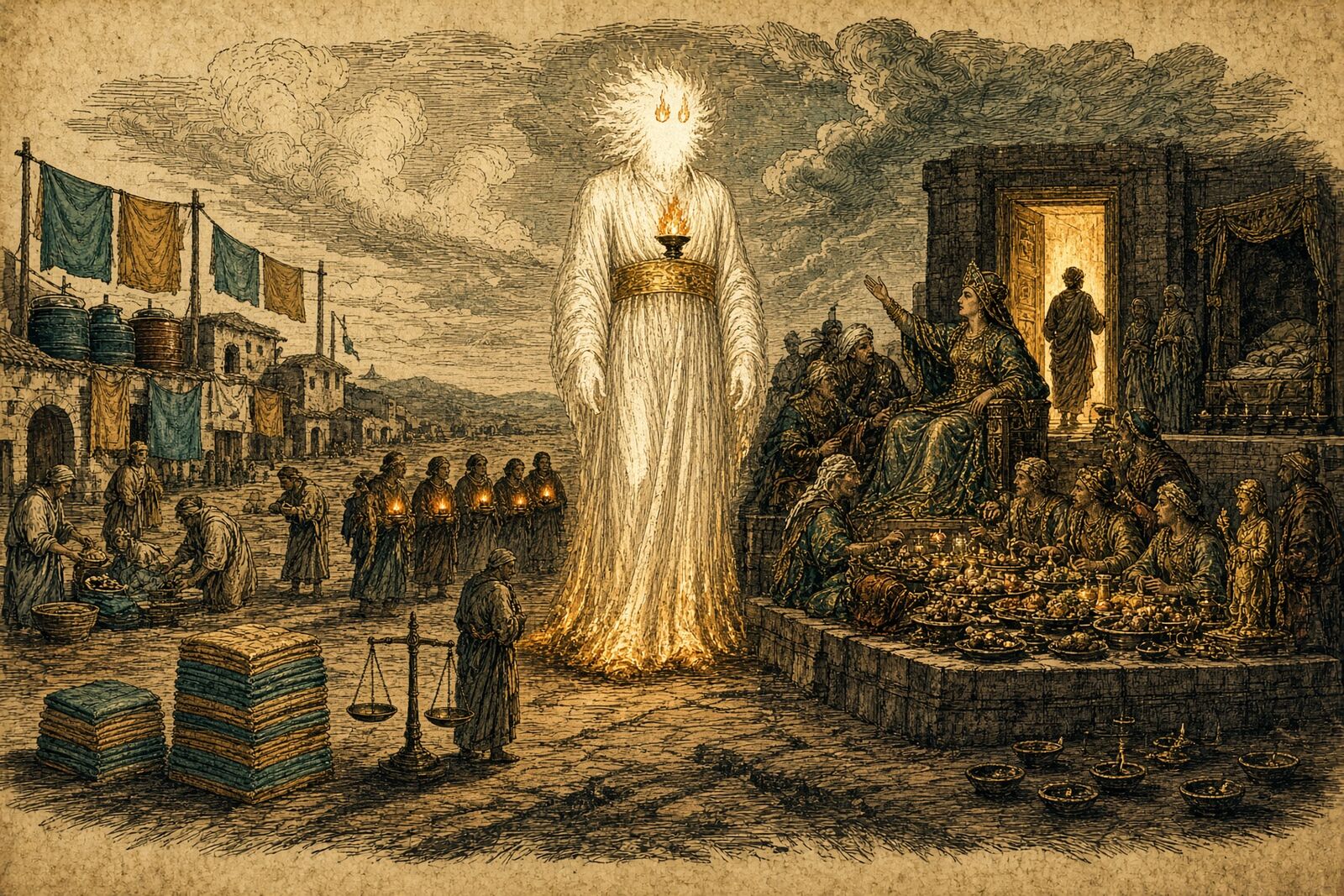
The Letter to Thyatira — Revelation 2:18-29
Session 10 | The longest letter to the smallest city. Background on Thyatira’s trade guilds, Apollo as the “son of God” sun deity, and the rebuke of Jezebel — with the promise of shepherding the nations.
Source: A2K Online Church Archive — Revelation 2:18-29
The City of Thyatira
Key facts:
- 50 miles southeast of Pergamum — the smallest of the seven cities
- Despite its small size, it receives the longest letter of the seven
- Had a theater and three gymnasia (education/athletics/civic centers)
- A major center of trade and slaves
- More trade guild inscriptions have been found here than in any other of the seven cities
Trade Guilds and the Problem for Christians
Thyatira’s defining cultural feature was its extensive system of trade guilds — organized associations of workers in specific industries. Guilds existed for:
Dyers, wool workers, linen workers, cloth cleaners, coppersmiths, potters, tanners, leather workers, shoemakers, and bakers (among others).
The critical issue: These guilds were not secular business associations. They combined commerce and pagan worship. Guild meetings included feasts dedicated to specific gods and the Roman Emperor, with food sacrificed to those gods. Membership in a guild was essential for economic participation in the city.
“It would be nearly impossible to be a Christian business owner who was able to avoid pagan worship linked with these guilds.”
A Christian who refused to participate in guild feasts would cut themselves off from their professional community, raise suspicion, lose clients, and face economic marginalization. This is the specific pressure this church faces.
Lydia in Acts 16:14 is mentioned as a convert from Thyatira — a seller of purple fabrics, a God-fearer. She is one example of the kind of business person from Thyatira who would have faced these exact pressures.
Apollo: Son of God and Sun God
The patron deity of Thyatira was Apollo — and understanding Apollo is essential to the letter.
Apollo’s identity:
- Son of Zeus — making him literally the son of God in their theology
- The Sun God (Helios) — deity of the sun, associated with light, warmth, crop growth, and divine illumination
- A deity sought to protect against grasshoppers and plant disease (vital for an agrarian culture)
- His principal oracle was at Delphi — associated with a Python spirit (see Acts 16:16, where a slave girl has a “spirit of divination” — literally spirit of pythons, associated with Apollo’s oracle)
Numismatic evidence: More coins from Thyatira feature Apollo than feature the Roman Emperor — remarkable, and indicating that Apollo was the dominant figure in this city’s religious imagination.
Jesus’s self-description response: Jesus introduces himself to Thyatira as “the Son of God, who has eyes like a flame of fire and feet like burnished bronze” — a solar image. He is the true Son of God, the true Sun — not Apollo.
The Letter: Revelation 2:18-29
Jesus’s Introduction (v. 18)
“The Son of God, who has eyes like a flame of fire and his feet are like burnished bronze.”
This is deliberately counter to Apollo. Jesus is the real Son of God. His eyes of fire (all-seeing knowledge) and feet like burnished bronze (the quality of the sun) are solar imagery applied to Jesus — subverting Apollo’s claims.
What Jesus Praises (vv. 19)
The church at Thyatira has:
- Love
- Faith / faithfulness
- Service / ministry (diakonia — serving others, contributing to the community)
- Perseverance
- And their latter works are greater than their former — they are growing, maturing, improving
This is a strong commendation. Jesus praises more here than in almost any other letter.
The Rebuke: Tolerating Jezebel (vv. 20-23)
“But I have this against you: you tolerate that woman Jezebel, who calls herself a prophetess, and she teaches and leads my bondservants astray to commit acts of immorality and eat things sacrificed to idols.”
Three groups in the church:
- Jezebel and her followers — actively teaching and participating in the compromise
- Those who tolerate Jezebel — not following her, but not opposing her either
- Those who reject her teaching — the faithful remnant (not burdened by Jesus beyond what they already have)
Jesus is against the first two groups. Toleration of false teaching is not a neutral act. Notice that the church has love — Jesus praised their love — but love does not mean toleration. Jesus can simultaneously praise love and condemn toleration.
Why “Jezebel”? The real name of this teacher is not given — Jesus uses the prophetic name of the infamous Old Testament queen (1 Kings 16, 21; 2 Kings 9) who:
- Married King Ahab and drew him into Baal worship
- Brought about spiritual harlotry and the worship of false gods
- Was remembered as the archetype of leading God’s people into idolatry
The false prophetess in Thyatira is doing the same thing: she teaches Christians that it is acceptable to participate in guild feasts (eating meat sacrificed to idols) and the sexual immorality that sometimes accompanied pagan temple practice.
The deeper meaning of immorality: In the Old Testament, the prophets used sexual immorality as a metaphor for idolatry — Israel “playing the harlot” with other gods (breaking the covenant with Yahweh, her husband). In Revelation, immorality carries both the literal meaning (actual sexual sin in pagan temples) and the figurative meaning (spiritual unfaithfulness through worship of other gods). Both are condemned.
Jesus gave her time to repent (v. 21): He is long-suffering. She was warned before, refused to change, and so now judgment is coming. The ball has been in her court.
Judgment (vv. 22-23):
- She is thrown “on a bed of sickness” — ironic punishment for the one who told Christians to “get in bed” with other gods
- Her followers face “great tribulation” unless they repent
- Her disciples will be killed — a warning to all the churches
This connects to 1 Corinthians 11:29-30 where some Corinthians died for abusing the Lord’s Supper. Present-tense judgment within the community of faith is a real biblical concept.
The Promise to the Conqueror (vv. 26-28)
To the one who conquers and keeps Jesus’s deeds until the end, Jesus promises:
Authority Over the Nations — “Shepherding” Them
“I will give authority over the nations; and he will shepherd them with a rod of iron.”
Critical translation note: The word translated “rule” is actually the Greek verb poimainō — to shepherd. This is confirmed by some translations (Holman CSB: “he will shepherd them with a rod of iron”). The NASB’s footnote also acknowledges this.
The rod of iron is not a tool of violent subjugation — it is the shepherd’s rod used to:
- Lead
- Guide
- Gather
- Protect
- Discipline when necessary (not to beat down, but to redirect)
This shepherding role is already shared by church leaders in the New Testament:
- John 21:16: Jesus tells Peter “Shepherd my sheep” (poimainō)
- Acts 20:28: Paul tells the Ephesian elders to “shepherd the church of God”
- 1 Peter 5:2: Peter exhorts elders to “shepherd the flock”
The conquerors share in Jesus’s shepherding responsibility over the nations — not a future act of violent rulership, but a present and future vocation to guide, direct, protect, and when necessary rebuke the nations toward God.
The Morning Star (v. 28)
“I will give him the morning star.”
In Revelation 22:16, Jesus says: “I am the root and descendant of David, the bright morning star.”
Jesus giving us the morning star = Jesus giving us himself — sharing his own status and identity with faithful conquerors. It is the ultimate gift: to be identified with Jesus the Morning Star.
Summary
| Element |
Meaning |
| Apollo |
The false “son of God” and sun deity — Jesus is the true Son of God with solar imagery |
| Trade guilds |
Combine commerce and pagan worship — the specific pressure to compromise in Thyatira |
| Five commendations |
Love, faith, service, perseverance, growing deeds — a model church on these metrics |
| Jezebel |
False prophetess teaching that accommodation to idol food and immorality is acceptable |
| Three groups |
Followers, tolerators, and the faithful — Jesus distinguishes between all three |
| Toleration ≠ love |
Jesus praises love and condemns toleration in the same letter |
| Shepherding the nations |
Not violent subjugation but guiding, directing, protecting — sharing Jesus’s role |
| Morning star |
Jesus giving himself — sharing his identity with the faithful conqueror |
“The problem in Thyatira is not abandonment of God — it is compromise. Jesus is against those who say: I can have both. He calls them to repent, to hold fast to his deeds, and to shepherd rather than succumb.”