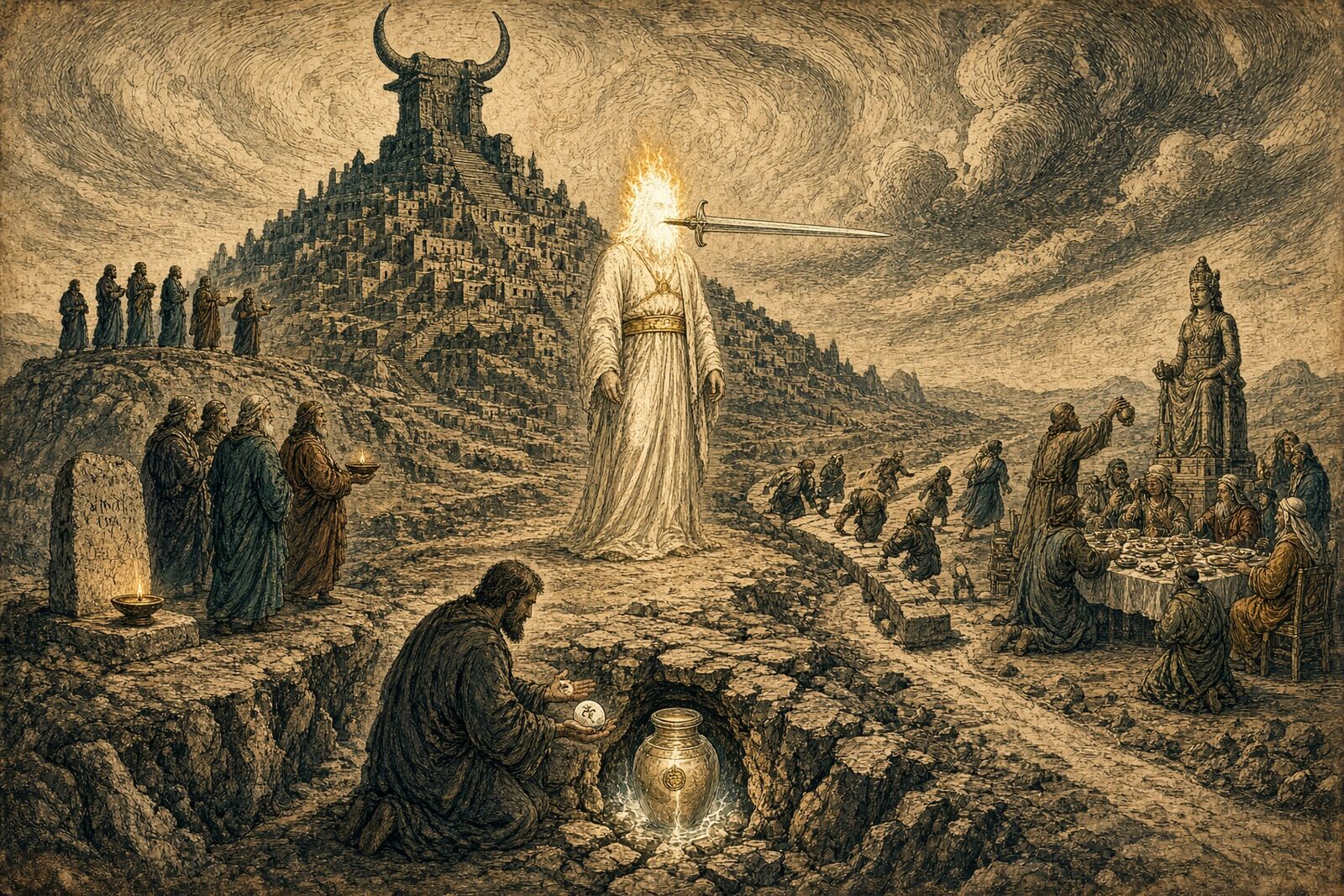
The Letter to Pergamum — Revelation 2:12-17
Session 9 | Extensive archaeological background on Pergamum followed by the letter’s text: Satan’s throne, holding fast to Jesus’s name, Antipas the martyr, the teaching of Balaam, and the rewards of hidden manna and the white stone.
Source: A2K Online Church Archive — Revelation 2:12-17
The City of Pergamum
Key facts:
- 65 miles north of Smyrna, 15 miles from the Aegean Sea (not a port city)
- Population estimated at 200,000 — the fifth largest city in the Roman Empire
- Home to the second-largest library in the ancient world (after Alexandria)
- Had allied with Rome since the 3rd century BC — one of Rome’s oldest allies in Asia Minor
The Acropolis and What Sat On It
The most defining feature of Pergamum was its massive hilltop Acropolis — a fortified summit visible from the entire valley below where most people lived. Strategically placed on this Acropolis were:
- An Imperial temple dedicated to Rome and Augustus — the first provincial imperial temple in all of Asia Minor, authorized in 29 BC
- A massive altar to Zeus — now reconstructed in the Pergamon Museum in Berlin; its distinctive shape resembles a throne
The teacher notes that some scholars think this altar is what Jesus refers to as “Satan’s throne.”
Patron Deity: Athena Nikephoros
The patron goddess of Pergamum was Athena Nikephoros — “Athena, the bringer of victory/Nike.” Her temple stood prominently on the Acropolis. Coins minted in Pergamum featured Athena alongside the goddess Nike. The culture was saturated with the theology of conquest — if you want victory, you pray to Athena who grants it.
Jesus’s concluding promise to conquerors directly counters this cultural framework.
The Asclepion — Pagan Healing Center
Pergamum had a famous temple complex to Asclepius, the god of healing — essentially the ancient equivalent of a hospital:
- Patients would stay on the premises (like hospital admission today)
- There were underground passageways, running water, baths, and prescribed diets
- Dreams from Asclepius supposedly directed healing
- The famous physician Galen (doctor to Emperor Marcus Aurelius) worked there
- The symbol: a serpent on a staff — still the symbol of medicine today (Asclepius, not Moses)
The critical connection: In Revelation, the serpent is identified with Satan. A Christian living near the Asclepion and tempted to go there for healing was also flirting with the satanic system Revelation is unmasking.
Seat of Roman Government — The Power of the Sword
This is perhaps the most important background fact for interpreting Jesus’s self-description in the letter:
Pergamum was the city where the Roman provincial governor lived and presided over judicial gatherings. The Roman jurist Justinian noted that those who govern provinces have “the full power of the sword” — the authority to condemn and execute.
Jesus introduces himself to this city as “the one who has the sharp two-edged sword.” The point is unmistakable: the Roman governor is not the true judge with the real sword — Jesus is.
The Letter: Revelation 2:12-17
Jesus’s Introduction (v. 12)
“The one who has the sharp two-edged sword.”
As explained in chapter 1, this sword comes from his mouth — it is his word, the gospel, which both comforts and judges. Applied specifically to Pergamum: Jesus is saying “I am the real judge in this city, not the Roman governor who has the power of the sword.”
Where Satan’s Throne Is (v. 13)
“I know where you dwell, where Satan’s throne is.”
What is Satan’s throne? The teacher argues it is most likely a general reference to Pergamum as the seat of Roman governmental and spiritual power — the place where Rome rules, where the governor holds court, where the altar to Zeus and the imperial temple dominate the skyline. Behind all of this, Revelation reveals, is Satan himself.
This is what apocalyptic literature does: it unmasks the spiritual reality behind visible political powers. Roman culture looks like civilization, prosperity, and order. Revelation says no — behind Rome is Satan. This should stop any Christian from being comfortable with casual accommodation to Roman culture.
What Jesus Praises (v. 13)
The church holds fast to:
- Jesus’s name — his entire package of teaching, his gospel of the kingdom (see Matthew 19:29 where “for my name’s sake” = “for the sake of the kingdom of God”)
- Jesus’s faith — the noun form; the body of teaching and gospel that Jesus himself possessed and proclaimed
They have done this even in the presence of Antipas, “my faithful witness” (martys — my faithful martyr), who was killed in Pergamum for his testimony.
Antipas is praised as an example of faithful evangelism unto death. He preached Jesus’s gospel, faced the Roman judicial system (likely in the governor’s court), and died for it. This is the model Jesus holds up.
The Rebuke: The Teaching of Balaam and the Nicolaitans (vv. 14-15)
Some people in the church hold to two related teachings that Jesus condemns:
The teaching of Balaam: Balaam (from Numbers 22-25) was a Gentile prophet who encouraged Israelites to compromise by eating food sacrificed to Baal and committing sexual immorality. Two meanings apply:
- Literal immorality — visiting temple prostitutes at pagan festivals (common in temples to Zeus, Asclepius, the Emperor)
- Spiritual/figurative immorality — “playing the harlot” by breaking covenant loyalty with God through worship of other gods
In Pergamum, both could overlap. The imperial temples and the Asclepion held festivals with food sacrificed to gods and sometimes involved temple prostitution. Christians who attended and participated — even thinking “these gods aren’t real, so it doesn’t matter” — were actually participating in what Paul calls fellowship with demons (1 Cor. 10).
The Nicolaitans (also mentioned in Ephesus): From context, they teach the same thing — that it is acceptable to eat meat sacrificed to idols and participate in acts of immorality in the pagan worship context.
The Call to Repentance (v. 16)
“Therefore repent; or else I am coming to you quickly and will make war against them with the sword of my mouth.”
Jesus coming “quickly” here is not the second coming. This is Jesus — presently in the midst of the churches — threatening to come in immediate judgment if they don’t repent. The word of Jesus’s mouth (his gospel of judgment) will deal with the unrepentant in the here and now.
The Promises to the Conqueror (v. 17)
Hidden Manna
The Nicolaitans are eating meat sacrificed to idols at pagan festivals. Jesus says: if you want real food, I will give it to you. The manna in the wilderness was nourishment directly from God — supernatural sustenance that kept Israel alive. Jesus is the bread of life (John 6). The hidden manna is the true nourishment of the gospel and of Jesus himself — not the steak at the imperial festival.
The White Stone with a New Name
The white stone draws on two cultural practices:
- Voting: In their culture, jurors cast votes using stones — a white stone for acquittal/approval, a black stone for condemnation. Jesus giving a white stone means: “I vote for you. You are acquitted. You are in.” Paul’s reference in Acts 26:10 to casting his stone against Christians uses the same Greek word.
- A new name on the stone: In the Bible, receiving a new name signals a new identity and a new covenant relationship with God (Abram → Abraham; Jacob → Israel; Simon → Peter). Jesus is giving faithful conquerors a new identity — a permanent, unlosable identity that no pagan culture can take from them.
The fact that “no one knows it except the one who receives it” underscores the personal, intimate nature of this new relationship. It cannot be confiscated, taxed, or condemned by any Roman court.
What Does Conquering Mean for Pergamum?
Based on what Jesus praised and what he condemned:
- Continue holding fast to Jesus’s name (his gospel of the kingdom) even in the shadow of Rome’s judicial power
- Continue honoring Antipas’s example of faithful witness even to the point of martyrdom
- Repent from and refuse any participation in food sacrificed to idols and the immorality associated with pagan temple worship
- Stop tolerating the Nicolaitan teaching that this accommodation is acceptable
Summary
| Element |
Meaning |
| Seat of Roman government |
The governor has the “power of the sword” — Jesus counters: I have the sword |
| Satan’s throne |
General reference to Pergamum as the spiritual and political center of Roman power |
| Antipas |
Model of faithful gospel witness to the point of martyrdom |
| Teaching of Balaam |
Accommodation to pagan worship festivals — eating idol meat, sexual immorality |
| Nicolaitans |
Same teaching: it’s okay to participate in pagan culture’s worship practices |
| Hidden manna |
True spiritual nourishment from Jesus — counter to the free steak at imperial festivals |
| White stone |
Acquittal and approval from Jesus; a new identity no one can take away |
“The temptation in Pergamum is compromise — not abandoning God entirely, but saying: I can have both. Jesus says you cannot. He calls them to repent, to hold fast to his name, and to emulate Antipas’s faithful witness.”