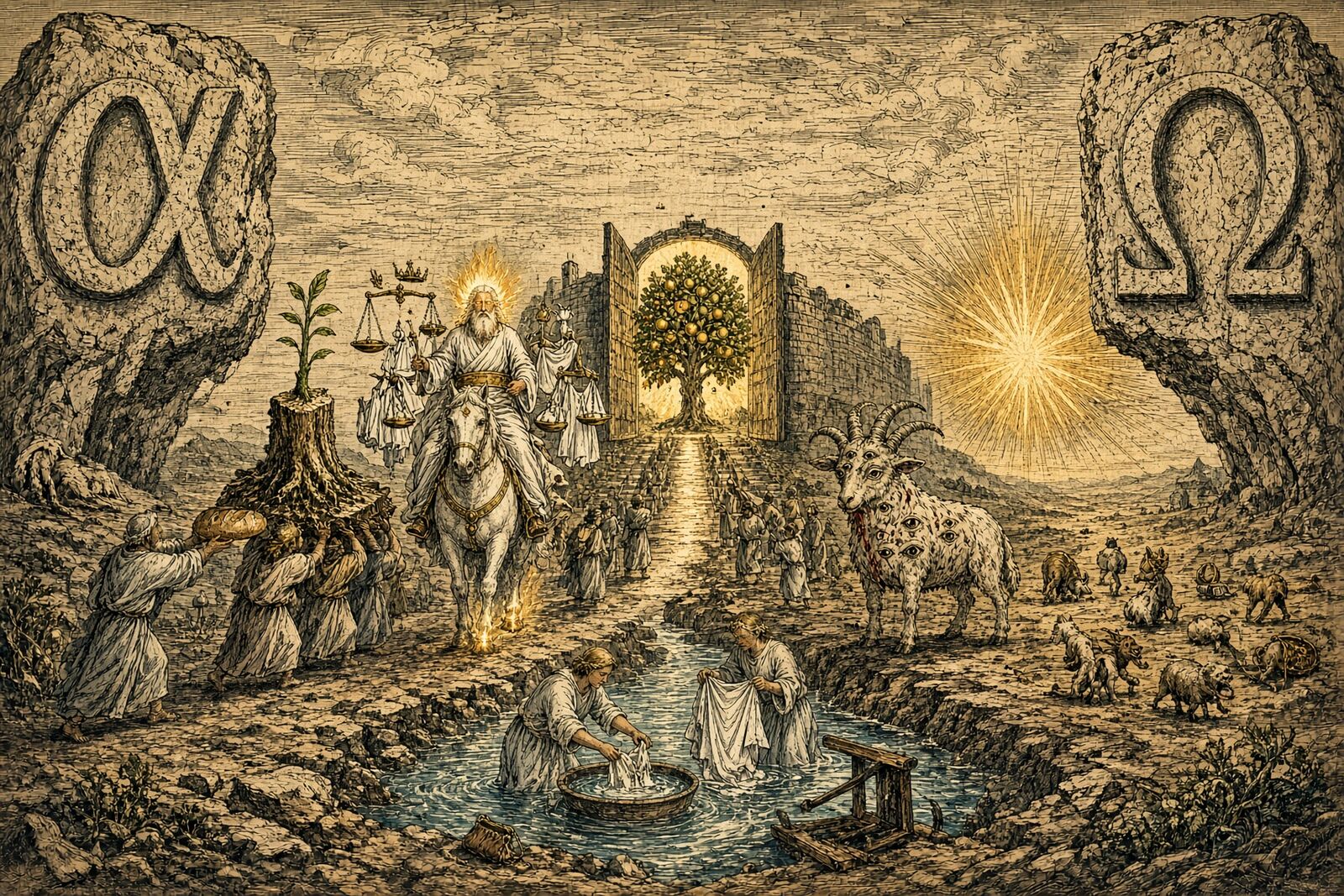
Revelation 22:10–21 — The End of the Apocalypse
| Session 51 |
The final verses of Revelation deliver an urgent ethical push: do not seal the book, Jesus is coming quickly, choose your side, and an invitation to “come.” |
| Source: A2K Online Church Archive — *The End of the Apocalypse |
Revelation 22:10-21* |
Overview: The Two-Minute Warning
The teacher notes that most New Testament letters end with brief greetings and benedictions. But Revelation’s final verses contain a heavy ethical push — like a coach’s speech at the two-minute warning. It is the final word the book wants readers to walk away with: a call to holy living.
“Do Not Seal Up the Words” (v. 10)
*“He said to me, ‘Do not seal up the words of the prophecy of this book, for the time is near.’””
Contrast with Daniel
In Daniel 12:9, the angel tells Daniel to seal up the words because they pertained to a distant future. But John is told not to seal Revelation — because the time is near. The message is for the original readers, not just a distant generation.
The Time Is Near
The kairos — the decisive moment — is always near. The book’s ethical demands are urgent and immediate, not a code to be cracked in the distant future.
“Let the One Who Does Wrong Still Do Wrong” (v. 11)
*“Let the one who does wrong still do wrong; and the one who is filthy still be filthy; and let the one who is righteous still practice righteousness; and the one who is holy still keep himself holy.””
This verse describes fixed character. By the time of the end, people are who they are — their choices have solidified. It is both:
- A warning — don’t wait; decide now
- A tragic reality — there comes a point when repentance is no longer possible
“I Am Coming Quickly” (vv. 12–13)
*“Behold, I am coming quickly, and My reward is with Me, to render to every man according to what he has done.””
Jesus speaks directly:
- “I am coming quickly” — not necessarily soon in time, but suddenly and certainly
- “My reward is with Me” — judgment and reward are simultaneous with his coming
- “According to what he has done” — deeds reveal allegiance; this is consistent with the entire book’s emphasis on faithful behavior
“I Am the Alpha and the Omega”
Jesus applies God’s own title to himself — the first and the last, the beginning and the end — affirming his deity.
“Blessed Are Those Who Wash Their Robes” (vv. 14–15)
*“Blessed are those who wash their robes, so that they may have the right to the tree of life and may enter by the gates into the city.””
This is the final beatitude of Revelation. “Washing robes” = repentance, forgiveness, and faithful living made possible by the Lamb’s blood (7:14).
Outside the City
*“Outside are the dogs and the sorcerers and the immoral persons and the murderers and the idolaters and everyone who loves and practices lying.””
“Dogs” — a term for those who are ceremonially unclean or morally impure (Deuteronomy 23:18; Philippians 3:2). The list mirrors 21:8: unrepentant sinners have no place in the new Jerusalem.
Jesus’s Self-Identification (v. 16)
*“I, Jesus, have sent My angel to testify to you these things for the churches. I am the root and the descendant of David, the bright morning star.””
Jesus identifies himself with three titles:
- Root of David — the source of the Davidic line; he is David’s Lord
- Descendant of David — the promised Messiah; he is David’s son
- Bright morning star — the herald of a new day; the true light
The Invitation (v. 17)
*“The Spirit and the bride say, ‘Come.’ And let the one who hears say, ‘Come.’ And let the one who is thirsty come; let the one who wishes take the water of life without cost.””
This is the gospel invitation at the close of the Bible:
- The Spirit — prompts the invitation
- The bride — the church extends the invitation
- The hearer — passes it on
- The thirsty — anyone who desires can come
- Without cost — salvation is a free gift
The Warning Against Adding or Taking Away (vv. 18–19)
*“I testify to everyone who hears the words of the prophecy of this book: if anyone adds to them, God will add to him the plagues which are written in this book; and if anyone takes away from the words of the book of this prophecy, God will take away his part from the tree of life and from the holy city.””
This is a solemn warning — not just about copying manuscripts, but about misinterpreting and misapplying the book’s message. The teacher notes he takes this warning personally.
“Come, Lord Jesus” (vv. 20–21)
*“He who testifies to these things says, ‘Yes, I am coming quickly.’ Amen. Come, Lord Jesus. The grace of the Lord Jesus be with all. Amen.””
The final response of the church: “Come, Lord Jesus” — the Aramaic Maranatha. This is the eager expectation of the bride for her groom. The book ends with grace — not judgment, not a threat, but grace.
Summary
| Verse |
Theme |
| v. 10 |
Do not seal — the time is near |
| v. 11 |
Fixed character — decide now |
| vv. 12–13 |
I am coming quickly; Alpha and Omega |
| vv. 14–15 |
Blessed who wash robes; outside the city |
| v. 16 |
Jesus: Root of David, Morning Star |
| v. 17 |
Come, take the water of life freely |
| vv. 18–19 |
Warning against adding or taking away |
| vv. 20–21 |
Come, Lord Jesus; grace be with all |
“The final word of this book is not a threat — it’s grace. ‘The grace of the Lord Jesus be with all.’ After all the judgments, all the warnings, all the visions — the last word is grace.”
Reflections on Completing the Series
Having spent over three years going through Revelation verse by verse, the teacher and participants reflect on how their understanding has changed:
- Revelation is not a coded end-times timeline but a book of encouragement and ethical instruction for believers in every age
- Its central call is to conquer as Jesus conquered — through faithful witness, non-violent endurance, and willingness to suffer
- The book reveals two paths — Babylon or New Jerusalem — and urges readers to choose wisely
- The message is practical — it changes how you live, not just what you believe