The Letter to Laodicea — Revelation 3:14-22
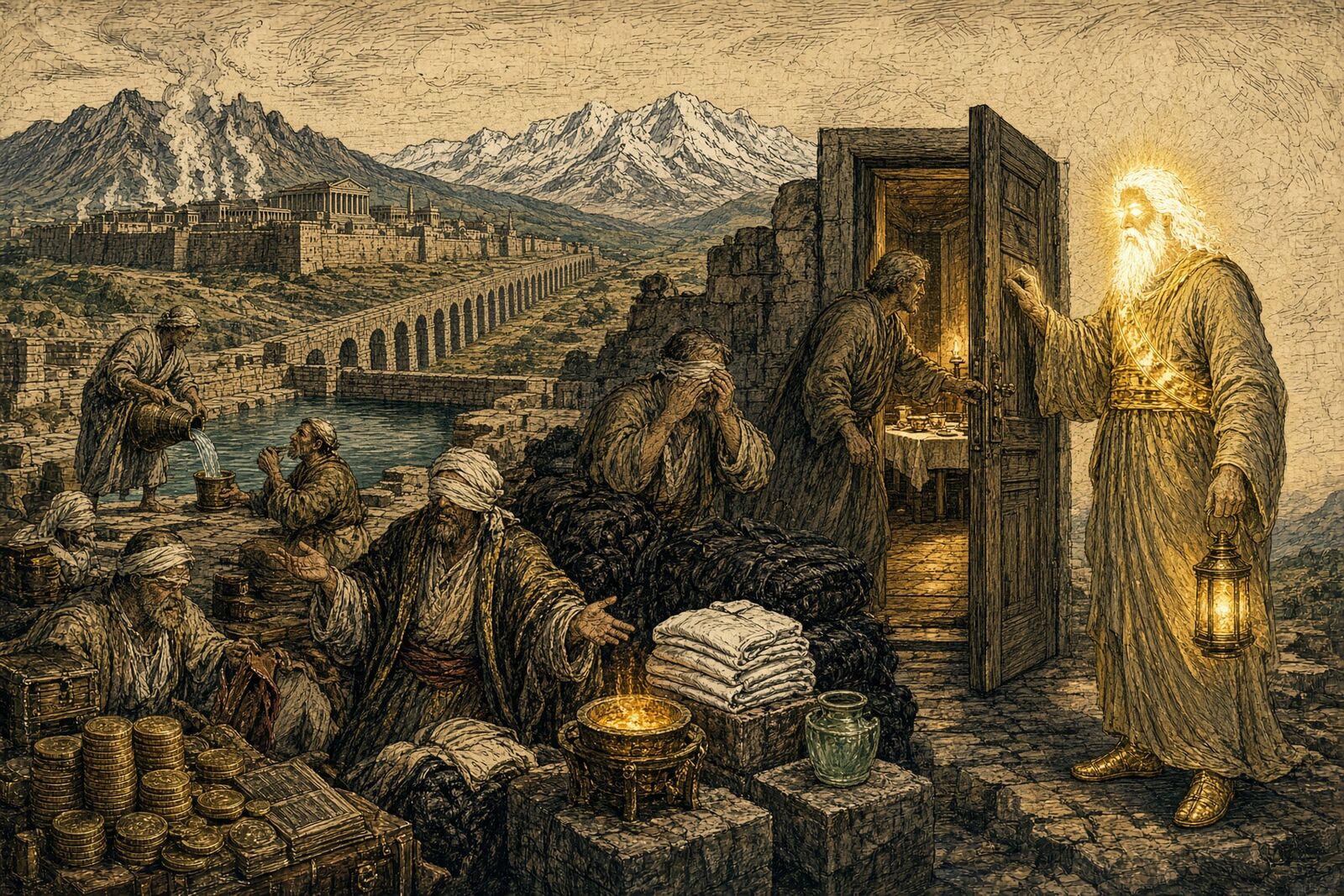
Session 13 | The final and most severely rebuked church. Background on Laodicea’s banking wealth, black wool, eye salve, and disastrous water supply. Text: lukewarm water, the boast of self-sufficiency, the call to buy true gold, and the promise of the throne.
Source: A2K Online Church Archive — Revelation 3:14-22
The City of Laodicea
Key facts:
- 60 miles southeast of Philadelphia, 100 miles west of Ephesus
- Exceptionally wealthy — a major center of banking and commerce
- Local Jewish temple taxes for the region were held here
- Famous for three signature products:
- Black wool — crossbred sheep produced a distinctive fine black coat
- Eye salve (Pergium powder)— a medicinal eye treatment produced for a famous Hellenistic medical school nearby
- Banking — wealthy individuals personally funded the beautification of the city
Self-Sufficiency After the Earthquake
When an earthquake struck in 60 AD, Laodicea is the only city in Asia Minor that refused Roman aid. While every other city gratefully accepted Rome’s financial and physical assistance, Laodicea said: “We have enough. We can handle this ourselves.” Wealthy local benefactors rebuilt the city from their own funds.
This civic pride and self-sufficiency directly informs Jesus’s rebuke. The city boasts of needing nothing — and this boast infects the church.
The Imperial Cult
Like the other six cities, Laodicea was loyal to Rome:
- A massive stadium dedicated to Emperor Titus in 79 AD
- A statue of Titus with the inscription “son of God”
- A local patron built a monumental gate dedicated to Domitian and Zeus in 85 AD
- Domitian received a temple between 89-90 AD with its own cult priests
- The local calendar was dated according to whoever was serving as Imperial cult priest at the time
The Water Supply Problem
This is the defining archaeological fact for understanding the letter’s central metaphor.
The problem: Laodicea received its water via aqueducts from a spring about 5 miles south. The water traveled through clay pipes over a long distance and arrived lukewarm. Due to the pipes’ high mineral content (calcium carbonate), the water was:
- Lukewarm by the time it arrived (neither hot nor cold)
- Too mineral-laden to drink safely without boiling or filtering
- In its unfiltered state, only useful for inducing vomiting — a common medical practice in Asclepius temples
Meanwhile:
- Colossi (nearby city) was known for cold, refreshing water
- Hierapolis (nearby city) was known for hot mineral springs used for bathing and healing
Laodicea’s water was neither hot (useful for healing baths) nor cold (useful for refreshing drinking). It was lukewarm and, unprocessed, would make you sick.
Jesus takes this local water problem and turns it into the central metaphor of his rebuke.
The Letter: Revelation 3:14-22
Jesus’s Introduction (v. 14)
“The Amen, the faithful and true Witness, the Beginning of the creation of God.”
“The Amen” — Jesus is the affirmation and fulfillment of all of God’s promises (2 Cor. 1:20)
“Faithful and true Witness” — his identity as the faithful martyr who proclaimed the gospel and died for it; the model the church must emulate
“Beginning of the creation of God” — the Greek word archē is ambiguous: it can mean “beginning” or “ruler.” The teacher argues for ruler, because:
- Every other letter’s introduction links back to Jesus’s description in chapter 1
- In Revelation 1:5, Jesus is described as “the ruler (archōn) of the kings of the earth” — the same semantic field
- The reward in 3:21 is sitting on Jesus’s throne — consistent with Jesus as ruler
- Jesus’s exalted post-resurrection status involves rulership, not chronological priority
“The ruler of the creation of God” — not a title of subordinate origin but of supreme authority over everything God made.
The Rebuke: Lukewarm (vv. 15-16)
“I know your deeds, that you are neither cold nor hot; I wish that you were cold or hot. So because you are lukewarm, and neither hot nor cold, I will spit you out of my mouth.”
Common misreading: Most people teach this as “hot = on fire for God (good), cold = cold toward God (bad), lukewarm = in the middle (worst).” This misses the cultural context entirely.
Correct reading: Both hot water and cold water were useful. Cold water is refreshing to drink; hot water is useful for bathing and healing. Lukewarm water is useless for either purpose. And Laodicea’s specific water — lukewarm and mineral-laden — would make you vomit.
Jesus is not saying they should be spiritually “on fire” as opposed to spiritually “cold.” He is saying: you are useless to me, the way lukewarm mineral water is useless to anyone. You have no effective function.
The verb is mellō — “I am about to vomit you out.” This is an imminent threat. Jesus is ready to expel them from his community right now if they do not repent.
Old Testament background: Leviticus 18:25-28 describes God warning Israel not to defile the land — or the land will “vomit them out” as it vomited out the nations before them. Vomiting as divine expulsion for disobedience has Old Testament precedent.
The Boast They Make (v. 17)
“Because you say, ‘I am rich, and have become wealthy, and have need of nothing.’”
This boast mirrors:
- Laodicea’s civic pride (refused Roman aid — “we have need of nothing”)
- Revelation 18:7 — the boast of Fallen Babylon/Rome: “I sit as a queen and am not a widow and will never see mourning”
The connection is significant: the Laodicean church has adopted the boast of Fallen Babylon. Their identity is shaped more by Rome’s culture of wealth and self-sufficiency than by the values of the Lamb.
The reality Jesus sees: “You are wretched, miserable, poor, blind, and naked.”
Each accusation targets one of the city’s signature strengths:
- Poor — though famous for banking, they are spiritually impoverished
- Blind — though they produced the famous eye salve, they cannot see their own condition
- Naked — though renowned for fine black wool garments, their spiritual clothing is gone
The Advice: Buy True Goods (v. 18)
Jesus gives advice in the form of commercial transactions — language the city would understand:
“I advise you to buy from me gold refined by fire so that you may become rich.”
Gold in Revelation:
A word study on chrysion (gold) in Revelation yields five occurrences:
- Rev. 3:18 — the gold Jesus offers (buy from me)
- Rev. 17:4 — the gold adorning the great harlot (Fallen Babylon’s wealth)
- Rev. 18:16 — the gold of Fallen Babylon mourned when she falls
- Rev. 21:18 — the city of New Jerusalem is pure gold
- Rev. 21:21 — the streets of New Jerusalem are pure gold
The contrast is clear: Fallen Babylon’s gold is what the world offers — and it will fall. The gold of New Jerusalem is what Jesus offers — genuine, lasting, imperishable. Laodicea is trusting the wrong gold.
White garments — not their famous black wool, but the righteous deeds of faithfulness (Rev. 19:8). The clothing that matters is not made in Laodicean factories.
Eye salve — not their famous medical product, but the spiritual perception that comes from obedience and attention to Jesus’s word.
Jesus Stands at the Door and Knocks (vv. 19-20)
“Those whom I love I reprove and discipline; therefore be zealous and repent. Behold, I stand at the door and knock; if anyone hears my voice and opens the door, I will come in to him and will dine with him, and he with me.”
“Those whom I love I reprove” — echoes Revelation 3:19 (same verse, cross-reference to the Thyatira section). Jesus’s love expresses itself through correction. This is not soft sentimentality; it is the love that tells the truth.
“I stand at the door and knock” — this is almost universally used in evangelism (“Jesus knocking at the heart’s door”), but the context is entirely different. This is Jesus speaking to a church — addressing people who already claim to be Christians. He is outside their fellowship, seeking to be let back in. They have become so comfortable with their wealth and self-sufficiency that they have effectively excluded Jesus from their communal life.
The invitation is for them to open the door to Christ — to repent, to change, to let him back into real relationship with them.
“I will dine with him” — sharing a meal in that culture was the deepest expression of fellowship, trust, and covenant relationship. Jesus is promising intimate communion with those who open the door.
The Promise to the Conqueror (v. 21)
“He who overcomes, I will grant to him to sit down with me on my throne, as I also overcame and sat down with my Father on his throne.”
How is conquering defined here? By Jesus’s own example: “just as I also overcame.” Jesus conquered by:
- Faithful gospel proclamation
- Non-violent perseverance through suffering
- Faithfulness unto death
The conqueror shares Jesus’s throne — which is the throne of David, exercised when Jesus returns to consummate the kingdom. In the present, Ephesians 2:6 says we have already been “seated with Christ in the heavenly places” — a mystical, inaugurated participation in his rule that will be fully realized at the consummation.
Summary: Three Themes of True Conquering (Final Summary of All Seven Letters)
The teacher closes the series on the seven churches by cataloging the three recurring themes of what it means to conquer across all seven letters:
| Theme |
Letters Where It Appears |
| Preach the gospel faithfully |
Ephesus, Smyrna, Pergamum, Sardis, Philadelphia, Laodicea (explicitly or implicitly) |
| Non-violent perseverance (hypomonē) |
Ephesus, Smyrna, Pergamum, Thyatira, Philadelphia, Laodicea |
| Faithful even to the point of death |
Smyrna, Pergamum, Thyatira, Philadelphia, Laodicea (explicitly or implicitly) |
These three are what Jesus means when he says “to the one who is conquering.” Not military victory. Not religious activism. Not doctrinal correctness alone.
True conquering = preaching the gospel + non-violent endurance + faithfulness unto death.
This is how Jesus conquered. This is how his followers conquer.
Summary of the Letter to Laodicea
| Element |
Meaning |
| “Ruler” not “beginning” |
Sovereign authority over creation, consistent with ch. 1 and the throne promise |
| Lukewarm water |
Neither hot nor cold = useless; Jesus is about to vomit them out |
| “Need of nothing” boast |
Echoes Fallen Babylon’s boast — the church has absorbed Rome’s values |
| Poor, blind, naked |
Each accusation targets one of the city’s famous strengths |
| True gold, white garments, eye salve |
The real goods come from Jesus, not from commerce |
| “I stand at the door” |
Jesus is outside this church’s fellowship — they must let him back in |
| Dining together |
Intimate covenant fellowship restored |
| Sharing Jesus’s throne |
Participating in his rule — already inaugurated, fully consummated at his return |