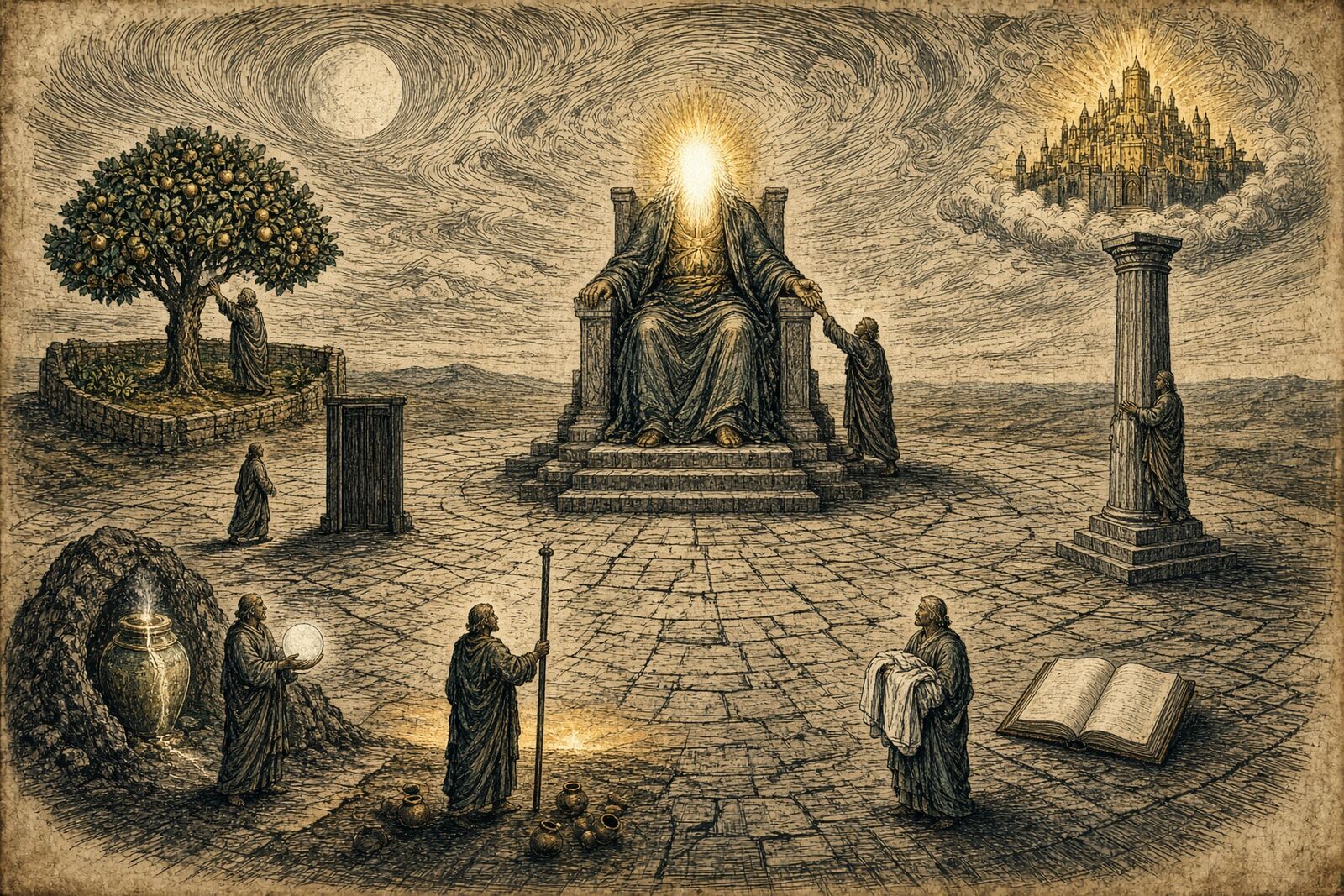
He that hath an ear, let him hear what the Spirit saith unto the churches

Rev 2:7, 11, 17, 26-28; 3:5, 12, 21

Rev 2:7, 11, 17, 26-28; 3:5, 12, 21

2:7 He that hath an ear, let him hear what the Spirit saith unto the churches; To him that overcometh will I give to eat of the tree of life, which is in the midst of the paradise of God.

2:11 He that hath an ear, let him hear what the Spirit saith unto the churches; He that overcometh shall not be hurt of the second death.

2:17 He that hath an ear, let him hear what the Spirit saith unto the churches; To him that overcometh will I give to eat of the hidden manna, and will give him a white stone, and in the stone a new name written, which no man knoweth saving he that receiveth it.

2:26 And he that overcometh, and keepeth my works unto the end, to him will I give power over the nations:

2:27 And he shall rule them with a rod of iron; as the vessels of a potter shall they be broken to shivers: even as I received of my Father.

2:28 And I will give him the morning star.

3:5 He that overcometh, the same shall be clothed in white raiment; and I will not blot out his name out of the book of life, but I will confess his name before my Father, and before his angels.

3:12 Him that overcometh will I make a pillar in the temple of my God, and he shall go no more out: and I will write upon him the name of my God, and the name of the city of my God, which is new Jerusalem, which cometh down out of heaven from my God: and I will write upon him my new name.

3:21 To him that overcometh will I grant to sit with me in my throne, even as I also overcame, and am set down with my Father in his throne.

← Revelation Illuminated Bible

Explanations

The Letter to Ephesus

The Letter to Ephesus

The Letter to Ephesus — Revelation 2:1-7

Session 7 | The first of the seven letters, with extensive historical background on the city of Ephesus before examining the text. Source: A2K Online Church Archive — Revelation 2:1-7


Why Historical Context Matters

These letters were written to actual Christian communities in actual first-century cities — not to symbolic future churches or abstract types. Reading them without understanding the cities is like reading Paul’s letter to Corinth without knowing anything about Corinthian culture. The more we know about the city, the more the letter’s specific details come alive.

Map showing the 7 Churches of Asia Minor


The City of Ephesus

Key facts:

  • Largest city in Asia Minor; third largest in the Roman Empire (after Rome and Alexandria)
  • Population over 250,000 — a major urban, industrial, and commercial center
  • The only port city among the seven churches — the natural first stop for a letter sent from Patmos
  • Seat of Roman provincial government for all of Asia Minor
  • Designated a “free city” — allowed to self-govern, but public business required scheduling with Rome

Religious Landscape

Four major religious forces shaped Ephesian life:

  1. A Jewish community — well established, significant
  2. The Imperial cult — worship of the Roman Emperor and his family (the fastest-growing religion in the first century)
  3. The goddess Artemis — patron deity of Ephesus, whose temple was one of the Seven Wonders of the Ancient World
  4. Christian communities — including those shaped by Paul, Timothy, and John’s Gospel

The Imperial Cult in Ephesus

Rome did not force these cities to worship the Emperor. The citizens chose this on their own:

  • Rome authorized Ephesus’s request to build a temple to Julius Caesar and the goddess Roma — at Ephesus’s initiative
  • Another temple was built in honor of Domitian (the Emperor when Revelation was written)
  • 13 inscriptions dedicated to Domitian were found in the temple
  • An 18-foot statue of Domitian stood outside
  • Emperor’s birthdays were celebrated as annual public festivals
  • Sacrifices to the Emperor were held publicly
  • Statues and busts of imperial family members filled streets and buildings
  • Coins bore the Emperor’s image alongside the goddess Nike (goddess of conquering/victory)

![[IMG_1164.jpeg]] ![[IMG_1165.jpeg]]

The key takeaway: if you lived in Ephesus, you could not avoid this. Emperor worship was on the coins in your pocket, the streets you walked, and every public building.


The Goddess Artemis

Artemis was potentially more important to Ephesus than even the Emperor:

  • Her temple was 425 feet long, 230 feet wide, 60 feet tall — the largest Greek temple in the world
  • A fertility goddess who attracted many female worshippers
  • Protected the city’s welfare; vast wealth was stored in her temple like a bank
  • Her temple was a “grove” associated with trees, growth, fertility, and life
  • An entire month of the calendar (spring) was devoted to her worship by the second century
  • A carved ivory plaque of a tree of life was excavated from the original temple foundation

The tree of life connection is not accidental — the reward promised to conquerors in Ephesus (Rev. 2:7) is “the right to eat of the Tree of Life in the paradise of God.” Jesus counters Ephesus’s Artemis-paradise with his paradise.


The Riot in Acts 19

Acts 19 records one of the most dramatic episodes of early Christianity in Ephesus. Paul and the church were so effective at preaching the gospel that:

  • Silversmiths who made small silver shrines to Artemis began going out of business
  • Demetrius the silversmith rallied the craftsmen: “This Paul has convinced a considerable number of people that gods made with hands are not gods”
  • A riot filled the 24,000-seat amphitheater with Roman citizens shouting “Great is Artemis of the Ephesians!” for two hours
  • The city clerk finally dispersed the crowd by noting they had no legal permission from Rome for this public assembly

Point: In the first-century heyday, the Church of Ephesus was so effective at evangelism that it economically threatened pagan idol worship across the entire city of 250,000 people.


The Letter: Revelation 2:1-7

Jesus’s Introduction (v. 1)

Jesus introduces himself as “the one who walks among the seven golden lampstands” — emphasizing his present, active presence in the churches. He is not distant. He knows exactly what is happening.

What Jesus Praises (vv. 2-3, 6)

Jesus commends the Ephesian church for:

  • Toil and perseverance — they have suffered but responded without violence and without giving up
  • Testing false apostles — they carefully examine the credentials and teachings of visiting teachers, and have identified liars
  • Enduring for Jesus’s name without growing weary
  • Hating the deeds of the Nicolaitans — a group whose teachings Jesus also hates (more below)

The Rebuke: Leaving Your First Love (v. 4)

“I have this against you: you have left your first love.”

This is almost universally interpreted in popular teaching as forgetting to love one another or God in a general sense. The teacher argues this is wrong, and the context supports a different reading:

“Your first love” = their initial love for gospel proclamation

The evidence:

  • In Acts 19, their defining characteristic was evangelistic passion so powerful it upended the economy of a 250,000-person city
  • The phrasing is not “you have forgotten to love” but “you have left your first love” — the original, initial love
  • Their zeal to preach the gospel had cooled, likely because persecution, harassment, and pressure had made it too costly

Jesus is not rebuking lovelessness in general — he is rebuking the abandonment of their evangelistic mission.

The Call to Repentance (v. 5)

“Remember from where you have fallen and repent and do the deeds you did at first.”

Repentance (metanoeo) means to change your mind, which then changes your behavior. This word appears more in Revelation than in any other New Testament book — and it is almost always addressed to Christians, not to pagans.

The threat: if they don’t repent, Jesus will remove their lampstand. Since lampstand = church, this means he will remove the church from the city. History confirms it: there is no Christian community in Ephesus today. Jesus made this threat and followed through.

The Nicolaitans (v. 6)

The Nicolaitans appear in two of the seven letters (Ephesus and Pergamum). From context:

  • In Pergamum (2:15), they are linked to “eating things sacrificed to idols and committing acts of immorality”
  • The Nicolaitans appear to have taught that Christians could participate in pagan worship practices and temple feasting without it affecting their faith
  • Jesus hates their deeds — this is one of the few things Jesus explicitly says he hates

The Promise to the Conqueror (v. 7)

“To the one who is conquering, I will grant to eat of the Tree of Life which is in the paradise of God.”

“Is conquering” — present participle, an ongoing lifestyle, not a past achievement

What does conquering mean for Ephesus specifically? Based on what Jesus praised and what he rebuked:

  • Continue demonstrating perseverance (non-violent endurance in persecution)
  • Return to faithful gospel proclamation — the “first love” they left
  • Continue rejecting the Nicolaitans’ compromising teachings

The Tree of Life promise: This directly counters Artemis worship — the goddess associated with trees, groves, and a paradise. Jesus says: if you want the real tree of life in the real paradise, get it from me, not from Artemis. The conqueror’s reward is specifically calibrated to the temptations of this particular city.


Key Themes

Theme Detail
First love = evangelism Their zeal had cooled under pressure; Jesus calls them back to the mission
Repentance for Christians More frequent in Revelation than in any Gospel; Christians must keep repenting
Lampstand removed The church in Ephesus no longer exists — Jesus’s threat was carried out
Conquering = persevering + preaching Two interlocking responsibilities for this church
Tree of Life Counter to Artemis’s tree/paradise — the true reward from the true God
Nicolaitans False teachers saying it’s okay to participate in pagan worship and immorality

Application

The letter to Ephesus is a warning to any church that has:

  • Sound doctrine ✓
  • Tested false teachers ✓
  • Endured persecution ✓
  • But quietly stopped preaching the gospel to the surrounding world

Jesus says: that is not enough. The mission matters. A church that is theologically precise but evangelistically silent has left its first love and needs to repent.

“He who has an ear, let him hear what the Spirit says to the churches.” — This is not just for Ephesus. It is for every church, including ours.

The Letter to Laodicea

The Letter to Laodicea

The Letter to Laodicea — Revelation 3:14-22

Session 13 | The final and most severely rebuked church. Background on Laodicea’s banking wealth, black wool, eye salve, and disastrous water supply. Text: lukewarm water, the boast of self-sufficiency, the call to buy true gold, and the promise of the throne. Source: A2K Online Church Archive — Revelation 3:14-22


The City of Laodicea

Key facts:

  • 60 miles southeast of Philadelphia, 100 miles west of Ephesus
  • Exceptionally wealthy — a major center of banking and commerce
  • Local Jewish temple taxes for the region were held here
  • Famous for three signature products:
    1. Black wool — crossbred sheep produced a distinctive fine black coat
    2. Eye salve (Pergium powder)— a medicinal eye treatment produced for a famous Hellenistic medical school nearby
    3. Banking — wealthy individuals personally funded the beautification of the city

Self-Sufficiency After the Earthquake

When an earthquake struck in 60 AD, Laodicea is the only city in Asia Minor that refused Roman aid. While every other city gratefully accepted Rome’s financial and physical assistance, Laodicea said: “We have enough. We can handle this ourselves.” Wealthy local benefactors rebuilt the city from their own funds.

This civic pride and self-sufficiency directly informs Jesus’s rebuke. The city boasts of needing nothing — and this boast infects the church.

The Imperial Cult

Like the other six cities, Laodicea was loyal to Rome:

  • A massive stadium dedicated to Emperor Titus in 79 AD
  • A statue of Titus with the inscription “son of God”
  • A local patron built a monumental gate dedicated to Domitian and Zeus in 85 AD
  • Domitian received a temple between 89-90 AD with its own cult priests
  • The local calendar was dated according to whoever was serving as Imperial cult priest at the time

The Water Supply Problem

This is the defining archaeological fact for understanding the letter’s central metaphor.

The problem: Laodicea received its water via aqueducts from a spring about 5 miles south. The water traveled through clay pipes over a long distance and arrived lukewarm. Due to the pipes’ high mineral content (calcium carbonate), the water was:

  • Lukewarm by the time it arrived (neither hot nor cold)
  • Too mineral-laden to drink safely without boiling or filtering
  • In its unfiltered state, only useful for inducing vomiting — a common medical practice in Asclepius temples

Meanwhile:

  • Colossi (nearby city) was known for cold, refreshing water
  • Hierapolis (nearby city) was known for hot mineral springs used for bathing and healing

Laodicea’s water was neither hot (useful for healing baths) nor cold (useful for refreshing drinking). It was lukewarm and, unprocessed, would make you sick.

Jesus takes this local water problem and turns it into the central metaphor of his rebuke.


The Letter: Revelation 3:14-22

Jesus’s Introduction (v. 14)

“The Amen, the faithful and true Witness, the Beginning of the creation of God.”

“The Amen” — Jesus is the affirmation and fulfillment of all of God’s promises (2 Cor. 1:20)

“Faithful and true Witness” — his identity as the faithful martyr who proclaimed the gospel and died for it; the model the church must emulate

“Beginning of the creation of God” — the Greek word archē is ambiguous: it can mean “beginning” or “ruler.” The teacher argues for ruler, because:

  1. Every other letter’s introduction links back to Jesus’s description in chapter 1
  2. In Revelation 1:5, Jesus is described as “the ruler (archōn) of the kings of the earth” — the same semantic field
  3. The reward in 3:21 is sitting on Jesus’s throne — consistent with Jesus as ruler
  4. Jesus’s exalted post-resurrection status involves rulership, not chronological priority

“The ruler of the creation of God” — not a title of subordinate origin but of supreme authority over everything God made.

The Rebuke: Lukewarm (vv. 15-16)

“I know your deeds, that you are neither cold nor hot; I wish that you were cold or hot. So because you are lukewarm, and neither hot nor cold, I will spit you out of my mouth.”

Common misreading: Most people teach this as “hot = on fire for God (good), cold = cold toward God (bad), lukewarm = in the middle (worst).” This misses the cultural context entirely.

Correct reading: Both hot water and cold water were useful. Cold water is refreshing to drink; hot water is useful for bathing and healing. Lukewarm water is useless for either purpose. And Laodicea’s specific water — lukewarm and mineral-laden — would make you vomit.

Jesus is not saying they should be spiritually “on fire” as opposed to spiritually “cold.” He is saying: you are useless to me, the way lukewarm mineral water is useless to anyone. You have no effective function.

The verb is mellō — “I am about to vomit you out.” This is an imminent threat. Jesus is ready to expel them from his community right now if they do not repent.

Old Testament background: Leviticus 18:25-28 describes God warning Israel not to defile the land — or the land will “vomit them out” as it vomited out the nations before them. Vomiting as divine expulsion for disobedience has Old Testament precedent.

The Boast They Make (v. 17)

“Because you say, ‘I am rich, and have become wealthy, and have need of nothing.’”

This boast mirrors:

  • Laodicea’s civic pride (refused Roman aid — “we have need of nothing”)
  • Revelation 18:7 — the boast of Fallen Babylon/Rome: “I sit as a queen and am not a widow and will never see mourning”

The connection is significant: the Laodicean church has adopted the boast of Fallen Babylon. Their identity is shaped more by Rome’s culture of wealth and self-sufficiency than by the values of the Lamb.

The reality Jesus sees: “You are wretched, miserable, poor, blind, and naked.”

Each accusation targets one of the city’s signature strengths:

  • Poor — though famous for banking, they are spiritually impoverished
  • Blind — though they produced the famous eye salve, they cannot see their own condition
  • Naked — though renowned for fine black wool garments, their spiritual clothing is gone

The Advice: Buy True Goods (v. 18)

Jesus gives advice in the form of commercial transactions — language the city would understand:

“I advise you to buy from me gold refined by fire so that you may become rich.”

Gold in Revelation: A word study on chrysion (gold) in Revelation yields five occurrences:

  1. Rev. 3:18 — the gold Jesus offers (buy from me)
  2. Rev. 17:4 — the gold adorning the great harlot (Fallen Babylon’s wealth)
  3. Rev. 18:16 — the gold of Fallen Babylon mourned when she falls
  4. Rev. 21:18 — the city of New Jerusalem is pure gold
  5. Rev. 21:21 — the streets of New Jerusalem are pure gold

The contrast is clear: Fallen Babylon’s gold is what the world offers — and it will fall. The gold of New Jerusalem is what Jesus offers — genuine, lasting, imperishable. Laodicea is trusting the wrong gold.

White garments — not their famous black wool, but the righteous deeds of faithfulness (Rev. 19:8). The clothing that matters is not made in Laodicean factories.

Eye salve — not their famous medical product, but the spiritual perception that comes from obedience and attention to Jesus’s word.


Jesus Stands at the Door and Knocks (vv. 19-20)

“Those whom I love I reprove and discipline; therefore be zealous and repent. Behold, I stand at the door and knock; if anyone hears my voice and opens the door, I will come in to him and will dine with him, and he with me.”

“Those whom I love I reprove” — echoes Revelation 3:19 (same verse, cross-reference to the Thyatira section). Jesus’s love expresses itself through correction. This is not soft sentimentality; it is the love that tells the truth.

“I stand at the door and knock” — this is almost universally used in evangelism (“Jesus knocking at the heart’s door”), but the context is entirely different. This is Jesus speaking to a church — addressing people who already claim to be Christians. He is outside their fellowship, seeking to be let back in. They have become so comfortable with their wealth and self-sufficiency that they have effectively excluded Jesus from their communal life.

The invitation is for them to open the door to Christ — to repent, to change, to let him back into real relationship with them.

“I will dine with him” — sharing a meal in that culture was the deepest expression of fellowship, trust, and covenant relationship. Jesus is promising intimate communion with those who open the door.


The Promise to the Conqueror (v. 21)

“He who overcomes, I will grant to him to sit down with me on my throne, as I also overcame and sat down with my Father on his throne.”

How is conquering defined here? By Jesus’s own example: “just as I also overcame.” Jesus conquered by:

  • Faithful gospel proclamation
  • Non-violent perseverance through suffering
  • Faithfulness unto death

The conqueror shares Jesus’s throne — which is the throne of David, exercised when Jesus returns to consummate the kingdom. In the present, Ephesians 2:6 says we have already been “seated with Christ in the heavenly places” — a mystical, inaugurated participation in his rule that will be fully realized at the consummation.


Summary: Three Themes of True Conquering (Final Summary of All Seven Letters)

The teacher closes the series on the seven churches by cataloging the three recurring themes of what it means to conquer across all seven letters:

Theme Letters Where It Appears
Preach the gospel faithfully Ephesus, Smyrna, Pergamum, Sardis, Philadelphia, Laodicea (explicitly or implicitly)
Non-violent perseverance (hypomonē) Ephesus, Smyrna, Pergamum, Thyatira, Philadelphia, Laodicea
Faithful even to the point of death Smyrna, Pergamum, Thyatira, Philadelphia, Laodicea (explicitly or implicitly)

These three are what Jesus means when he says “to the one who is conquering.” Not military victory. Not religious activism. Not doctrinal correctness alone.

True conquering = preaching the gospel + non-violent endurance + faithfulness unto death.

This is how Jesus conquered. This is how his followers conquer.


Summary of the Letter to Laodicea

Element Meaning
“Ruler” not “beginning” Sovereign authority over creation, consistent with ch. 1 and the throne promise
Lukewarm water Neither hot nor cold = useless; Jesus is about to vomit them out
“Need of nothing” boast Echoes Fallen Babylon’s boast — the church has absorbed Rome’s values
Poor, blind, naked Each accusation targets one of the city’s famous strengths
True gold, white garments, eye salve The real goods come from Jesus, not from commerce
“I stand at the door” Jesus is outside this church’s fellowship — they must let him back in
Dining together Intimate covenant fellowship restored
Sharing Jesus’s throne Participating in his rule — already inaugurated, fully consummated at his return

The Letter to Pergamum

The Letter to Pergamum

The Letter to Pergamum — Revelation 2:12-17

Session 9 | Extensive archaeological background on Pergamum followed by the letter’s text: Satan’s throne, holding fast to Jesus’s name, Antipas the martyr, the teaching of Balaam, and the rewards of hidden manna and the white stone. Source: A2K Online Church Archive — Revelation 2:12-17


The City of Pergamum

Key facts:

  • 65 miles north of Smyrna, 15 miles from the Aegean Sea (not a port city)
  • Population estimated at 200,000 — the fifth largest city in the Roman Empire
  • Home to the second-largest library in the ancient world (after Alexandria)
  • Had allied with Rome since the 3rd century BC — one of Rome’s oldest allies in Asia Minor

The Acropolis and What Sat On It

The most defining feature of Pergamum was its massive hilltop Acropolis — a fortified summit visible from the entire valley below where most people lived. Strategically placed on this Acropolis were:

  1. An Imperial temple dedicated to Rome and Augustus — the first provincial imperial temple in all of Asia Minor, authorized in 29 BC
  2. A massive altar to Zeus — now reconstructed in the Pergamon Museum in Berlin; its distinctive shape resembles a throne

The teacher notes that some scholars think this altar is what Jesus refers to as “Satan’s throne.”

Patron Deity: Athena Nikephoros

The patron goddess of Pergamum was Athena Nikephoros — “Athena, the bringer of victory/Nike.” Her temple stood prominently on the Acropolis. Coins minted in Pergamum featured Athena alongside the goddess Nike. The culture was saturated with the theology of conquest — if you want victory, you pray to Athena who grants it.

Jesus’s concluding promise to conquerors directly counters this cultural framework.

The Asclepion — Pagan Healing Center

Pergamum had a famous temple complex to Asclepius, the god of healing — essentially the ancient equivalent of a hospital:

  • Patients would stay on the premises (like hospital admission today)
  • There were underground passageways, running water, baths, and prescribed diets
  • Dreams from Asclepius supposedly directed healing
  • The famous physician Galen (doctor to Emperor Marcus Aurelius) worked there
  • The symbol: a serpent on a staff — still the symbol of medicine today (Asclepius, not Moses)

The critical connection: In Revelation, the serpent is identified with Satan. A Christian living near the Asclepion and tempted to go there for healing was also flirting with the satanic system Revelation is unmasking.

Seat of Roman Government — The Power of the Sword

This is perhaps the most important background fact for interpreting Jesus’s self-description in the letter:

Pergamum was the city where the Roman provincial governor lived and presided over judicial gatherings. The Roman jurist Justinian noted that those who govern provinces have “the full power of the sword” — the authority to condemn and execute.

Jesus introduces himself to this city as “the one who has the sharp two-edged sword.” The point is unmistakable: the Roman governor is not the true judge with the real sword — Jesus is.


The Letter: Revelation 2:12-17

Jesus’s Introduction (v. 12)

“The one who has the sharp two-edged sword.”

As explained in chapter 1, this sword comes from his mouth — it is his word, the gospel, which both comforts and judges. Applied specifically to Pergamum: Jesus is saying “I am the real judge in this city, not the Roman governor who has the power of the sword.”

Where Satan’s Throne Is (v. 13)

“I know where you dwell, where Satan’s throne is.”

What is Satan’s throne? The teacher argues it is most likely a general reference to Pergamum as the seat of Roman governmental and spiritual power — the place where Rome rules, where the governor holds court, where the altar to Zeus and the imperial temple dominate the skyline. Behind all of this, Revelation reveals, is Satan himself.

This is what apocalyptic literature does: it unmasks the spiritual reality behind visible political powers. Roman culture looks like civilization, prosperity, and order. Revelation says no — behind Rome is Satan. This should stop any Christian from being comfortable with casual accommodation to Roman culture.

What Jesus Praises (v. 13)

The church holds fast to:

  • Jesus’s name — his entire package of teaching, his gospel of the kingdom (see Matthew 19:29 where “for my name’s sake” = “for the sake of the kingdom of God”)
  • Jesus’s faith — the noun form; the body of teaching and gospel that Jesus himself possessed and proclaimed

They have done this even in the presence of Antipas, “my faithful witness” (martys — my faithful martyr), who was killed in Pergamum for his testimony.

Antipas is praised as an example of faithful evangelism unto death. He preached Jesus’s gospel, faced the Roman judicial system (likely in the governor’s court), and died for it. This is the model Jesus holds up.

The Rebuke: The Teaching of Balaam and the Nicolaitans (vv. 14-15)

Some people in the church hold to two related teachings that Jesus condemns:

The teaching of Balaam: Balaam (from Numbers 22-25) was a Gentile prophet who encouraged Israelites to compromise by eating food sacrificed to Baal and committing sexual immorality. Two meanings apply:

  1. Literal immorality — visiting temple prostitutes at pagan festivals (common in temples to Zeus, Asclepius, the Emperor)
  2. Spiritual/figurative immorality — “playing the harlot” by breaking covenant loyalty with God through worship of other gods

In Pergamum, both could overlap. The imperial temples and the Asclepion held festivals with food sacrificed to gods and sometimes involved temple prostitution. Christians who attended and participated — even thinking “these gods aren’t real, so it doesn’t matter” — were actually participating in what Paul calls fellowship with demons (1 Cor. 10).

The Nicolaitans (also mentioned in Ephesus): From context, they teach the same thing — that it is acceptable to eat meat sacrificed to idols and participate in acts of immorality in the pagan worship context.

The Call to Repentance (v. 16)

“Therefore repent; or else I am coming to you quickly and will make war against them with the sword of my mouth.”

Jesus coming “quickly” here is not the second coming. This is Jesus — presently in the midst of the churches — threatening to come in immediate judgment if they don’t repent. The word of Jesus’s mouth (his gospel of judgment) will deal with the unrepentant in the here and now.


The Promises to the Conqueror (v. 17)

Hidden Manna

The Nicolaitans are eating meat sacrificed to idols at pagan festivals. Jesus says: if you want real food, I will give it to you. The manna in the wilderness was nourishment directly from God — supernatural sustenance that kept Israel alive. Jesus is the bread of life (John 6). The hidden manna is the true nourishment of the gospel and of Jesus himself — not the steak at the imperial festival.

The White Stone with a New Name

The white stone draws on two cultural practices:

  1. Voting: In their culture, jurors cast votes using stones — a white stone for acquittal/approval, a black stone for condemnation. Jesus giving a white stone means: “I vote for you. You are acquitted. You are in.” Paul’s reference in Acts 26:10 to casting his stone against Christians uses the same Greek word.
  2. A new name on the stone: In the Bible, receiving a new name signals a new identity and a new covenant relationship with God (Abram → Abraham; Jacob → Israel; Simon → Peter). Jesus is giving faithful conquerors a new identity — a permanent, unlosable identity that no pagan culture can take from them.

The fact that “no one knows it except the one who receives it” underscores the personal, intimate nature of this new relationship. It cannot be confiscated, taxed, or condemned by any Roman court.


What Does Conquering Mean for Pergamum?

Based on what Jesus praised and what he condemned:

  • Continue holding fast to Jesus’s name (his gospel of the kingdom) even in the shadow of Rome’s judicial power
  • Continue honoring Antipas’s example of faithful witness even to the point of martyrdom
  • Repent from and refuse any participation in food sacrificed to idols and the immorality associated with pagan temple worship
  • Stop tolerating the Nicolaitan teaching that this accommodation is acceptable

Summary

Element Meaning
Seat of Roman government The governor has the “power of the sword” — Jesus counters: I have the sword
Satan’s throne General reference to Pergamum as the spiritual and political center of Roman power
Antipas Model of faithful gospel witness to the point of martyrdom
Teaching of Balaam Accommodation to pagan worship festivals — eating idol meat, sexual immorality
Nicolaitans Same teaching: it’s okay to participate in pagan culture’s worship practices
Hidden manna True spiritual nourishment from Jesus — counter to the free steak at imperial festivals
White stone Acquittal and approval from Jesus; a new identity no one can take away

“The temptation in Pergamum is compromise — not abandoning God entirely, but saying: I can have both. Jesus says you cannot. He calls them to repent, to hold fast to his name, and to emulate Antipas’s faithful witness.”

The Letter to Philadelphia

The Letter to Philadelphia

The Letter to Philadelphia — Revelation 3:7-13

Session 12 | The second church that receives only praise. Background on Philadelphia’s earthquakes, wine production, Jewish community, and relationship with Rome — then the text on the open door, the synagogue of Satan, keeping Jesus’s word, and the New Jerusalem revealed as a present people. Source: A2K Online Church Archive — Revelation 3:7-13


The City of Philadelphia

Key facts:

  • 30 miles east-southeast of Sardis
  • Founded on a known fault line — suffered two major earthquakes in the first century (17 AD and 60 AD)
  • Both were catastrophic enough that the population largely moved outside the city onto farmland because the city itself felt unsafe
  • Because of the frequency and severity of earthquakes, not a single standing ruin from the first century remains in Philadelphia today — the only one of the seven cities with this distinction

Wine Production

The fertile valley around Philadelphia produced excellent grapes for wine. This meant:

  • Dionysus (god of wine) was particularly favored there
  • Wine was the city’s primary economic product — a fact still true today in the modern city (Alaşehir, Turkey)

Domitian’s grain edict (92 AD): When there was a grain shortage, the Emperor required all grape production to be halved in favor of grain production. This devastated Philadelphia’s economy and drove many into poverty. Some scholars believe this is referenced in Revelation 6’s famine vision.

The Jewish Community

Philadelphia had a well-established Jewish community. By the second century, church father Ignatius writes that the local synagogue was so attractive that it was even drawing Christians back toward Judaism. A third-century inscription confirms the synagogue there had Gentile God-fearers attending it.

This sets up the conflict Jesus addresses in the letter — the same Jewish-Christian tension we saw in Smyrna.

Relationship with Rome

Philadelphia’s loyalty to Rome was demonstrated repeatedly:

  • Reorganized its local calendar around Augustus’s military victory at Actium (31 BC)
  • After the earthquake of 17 AD (helped by Tiberius), the city renamed itself “Neo-Caesarea” in gratitude
  • Later renamed itself again “Flavia Philadelphia” under the Flavian emperors (Vespasian, Titus, Domitian)
  • Built a local cult to Augustus and Rome

The city twice renamed itself after its Roman benefactors — a powerful statement of civic identity. Jesus will counter this by giving the faithful a new name from his identity.


The Letter: Revelation 3:7-13

This church, like Smyrna, receives only praise and no rebuke — one of just two such churches.

Jesus’s Introduction (v. 7)

“The one who is holy, who is true, who has the key of David, who opens and no one will shut, and who shuts and no one opens.”

Drawn from Isaiah 22:22, where God promises to give one of the Davidic kings the “key of the house of David” — authority to grant or deny access. This is about sovereignty and access-giving.

What door does Jesus open? The teacher argues this is not primarily an evangelistic open door (as often taught), but rather access to God’s perspective — the heavenly perspective that Revelation itself provides. This connects directly to the next verse (4:1): “After these things I looked, and behold, a door standing open in heaven.” The open door of chapter 3 prepares for the open door to heaven in chapter 4. Jesus grants access to see reality from God’s vantage point.

What Jesus Knows and Praises (v. 8)

“I know your deeds. Behold, I have put before you an open door which no one can shut, because you have a little power, and have kept my word, and have not denied my name.”

The church has:

  • Little power — they are not prestigious, wealthy, or influential; they are small and marginalized
  • Kept Jesus’s word — maintained his gospel message and their commission to witness it faithfully
  • Not denied his name — under pressure from the synagogue and the Roman authorities, they have not recanted

Jesus praises their faithfulness under weakness. They are not praised for great resources or impressive numbers — they are praised for clinging to Jesus’s gospel despite having very little.

The Synagogue of Satan (v. 9)

“Behold, I will cause those of the synagogue of Satan, who say that they are Jews and are not, but lie — I will make them come and bow down at your feet, and make them know that I have loved you.”

The dynamic here mirrors Smyrna: the Jewish synagogue is slandering the Christians and conspiring with Roman authorities to persecute them.

The Old Testament echo: Isaiah 60:14 promises that those who afflicted God’s people will come bowing down before them and acknowledge them as “the city of the Lord.” Jesus takes this passage and completely reverses the ethnic categories — in Isaiah, Gentiles bow before Jews; here, Jews bow before (mostly Gentile) Christians. This is how John uses the Old Testament: freely reinterpreting it for a new context and purpose.

“Have loved you” — Love here is a covenant term, meaning “I have chosen you.” Just as God chose Jacob over Esau (“Jacob I loved, Esau I hated” = “Jacob I chose, Esau I did not choose”), Jesus has chosen this community as his true people — regardless of what the synagogue claims.

Kept From the Hour of Testing (v. 10)

“Because you have kept the word of my perseverance, I also will keep you from the hour of testing.”

“The word of my perseverance” = Jesus’s teaching on non-violent, steadfast endurance. This church has maintained that teaching and lived it out.

“I will keep you from the hour of testing” — a specific reward for their specific faithfulness. This is not a promise to every church (Smyrna was faithful but was not spared from prison). It is a tailored reward for Philadelphia’s demonstrated perseverance.

“The hour of testing” is the trial about to come upon the world — a short, defined period (an hour, not indefinite) that will test “those who dwell upon the earth.” Note: “those who dwell on the earth” is a technical phrase in Revelation referring to the unbelieving, not Christians in general (see 6:10, 11:10, 13:8, 13:14, 17:2).

“Hold Fast What You Have” (v. 11)

“I am coming quickly; hold fast what you have, so that no one will take your crown.”

They already functionally have their crown — the reward is as good as theirs if they hold on. The conditional language implies the crown can be lost. Again, not once-saved-always-saved.


The Promise to the Conqueror (vv. 12-13)

A Pillar in God’s Temple

“He who overcomes, I will make him a pillar in the temple of my God, and he will not go out from it anymore.”

“Pillar” is a metaphor for foundational importance within the community of God’s people. Paul already used this language (Galatians 2:9 — James, Peter, and John are “pillars”). Christians are the new temple (1 Cor. 6:19), and the faithful will be permanent, foundational pillars in it.

“He will not go out from it anymore” — a direct comfort to a city where people had to leave the city for safety because of earthquakes. In God’s new temple, you never have to leave again.

Written With God’s Name, New Jerusalem, and Jesus’s New Name

“I will write on him the name of my God, and the name of the city of my God, the New Jerusalem, which comes down out of heaven from my God, and my new name.”

“The name of my God” — instead of being identified with Rome (as Philadelphia twice renamed itself for Roman benefactors), the conqueror will be identified with God.

“New Jerusalem” — this is the first occurrence of New Jerusalem in Revelation, and how it is introduced here establishes its meaning.


New Jerusalem as a Present Reality — A Major Teaching

The teacher presents what he acknowledges is the most controversial point of the session: New Jerusalem is not primarily a future city; it is a present identification for the people of God.

The Evidence

Galatians 4:25-26: Paul distinguishes “the present Jerusalem” (Old Covenant, in slavery) from “the Jerusalem above” (New Covenant, free) — and says: “She is our mother.” This is a present-tense statement. The New Jerusalem is our mother right now.

Hebrews 12:22: “You have come to Mount Zion and to the city of the living God, the heavenly Jerusalem.” — past tense; we have already arrived.

Revelation 3:12; 21:2; 21:10: Every single occurrence of New Jerusalem in Revelation uses a present participle — “coming down” (not “will come down”). It is descending, ongoing, present.

Revelation 21:9-10: The angel says, “Come, I will show you the bride, the wife of the Lamb” — and then shows John the holy city, New Jerusalem. The New Jerusalem is identified as the Bride of Christ, the body of believers.

What New Jerusalem Is

New Jerusalem is not primarily a physical city that will appear in the future. It is a metaphor for the people of God — the body of Christ, the Bride of the Lamb. It describes believers as a city-community, holy and glorious, the dwelling place of God.

This is consistent with:

  • The Holy of Holies being a cube — and New Jerusalem also being a cube
  • New Jerusalem’s surface area working out to 144,000 — which elsewhere in Revelation refers to the people of God
  • New Jerusalem being described as a bride — and the bride is always the church

The practical implication of this for Revelation’s message: the entire book is calling its readers to identify as citizens of New Jerusalem rather than as citizens of Fallen Babylon (Rome). The choice is between two cities, two women, two identities.


Summary

Element Meaning
Two earthquakes People lived outside the city; “never going out again” (v. 12) is direct comfort
City renamed twice for Rome Jesus gives a better name — from God and from New Jerusalem
Key of David Authority to open access to God’s perspective — the open door to heaven
Little power, faithful Praised not for resources but for clinging to the gospel under weakness
Synagogue of Satan Like Smyrna — Jews slandering and conspiring with Roman authorities
Isaiah 60 reversal Gentiles bow before Jews → reversed: Jews bow before Christians
Word of perseverance Non-violent endurance; their faithful practice earns them the protection from testing
Pillar in the temple Permanent, foundational identity in God’s new temple — can’t be shaken by earthquakes
New Jerusalem present Already the identification of the people of God; the bride is the church now
Two cities The whole book is a call to choose New Jerusalem over Fallen Babylon

The Letter to Sardis

The Letter to Sardis

The Letter to Sardis — Revelation 3:1-6

Session 11 | The church with a reputation for life but which is actually dead. Background on Sardis’s two-part city and its Acropolis — twice captured while guards slept — then the text on waking up, soiled garments, and the Book of Life. Source: A2K Online Church Archive — Revelation 3:1-6


The City of Sardis

Key facts:

  • 40 miles southeast of Thyatira
  • Population estimated between 60,000 and 100,000
  • The city name in Greek is actually plural — because the city had two distinct parts:
    • The lower city: flat, fertile, where most people lived and worked
    • The upper city: a fortified Acropolis at the summit of the nearby mountain (Tmolus)

The Earthquake

Both parts of the city suffered a devastating earthquake in 17 AD. Rome helped rebuild: Emperor Tiberius exempted the city from taxes for five years and provided financial assistance. In response, the citizens called themselves “Caesarean Sardians” and erected monuments to Tiberius as the “founder of the city.”

This pattern (Rome’s benefaction → the city’s devoted loyalty) was consistent across all seven cities.

The Acropolis: A History of Sleeping Guards

The defining story of Sardis is its Acropolis — and how it was conquered.

The cliffs of the Acropolis were so steep that the phrase “to capture the Acropolis of Sardis” became a Greek idiom for achieving the impossible. No army should have been able to scale it.

Yet it was captured twice — and both times by the same method:

First capture, 494 BC — Cyrus the Persian:

  • Historian Herodotus records that Cyrus sent climbers up the mountain
  • One climber, Hyroiades, discovered a hidden trapdoor under an unguarded section of the wall
  • He waited until nightfall, when the guards had fallen asleep, entered, and opened the gates
  • The Persian army marched in; Sardis fell

Second capture, 218 BC — Antiochus III:

  • Historian Polybius records that he deliberately studied Cyrus’s method
  • He sent climbers up while the guards were again asleep
  • Sardis fell a second time by the same means

The city that prided itself on the impregnable fortress was taken both times not by superior military force — but by inattentive, sleeping guards.

Jesus’s rebuke to this church draws directly on this history.


The Imperial Cult in Sardis

Like the other six cities, Sardis was deeply loyal to Rome:

  • Had a municipal temple to Emperor Augustus by the end of the 1st century BC
  • Citizens renamed themselves after Rome’s benefaction
  • The local calendar was organized around whichever priest of the goddess Roma was serving that year
  • Olympic games were held at the city stadium, dedicated to the Caesar
  • A local benefactor deeply involved in the slave trade served as a priest of the Imperial cult

The Letter: Revelation 3:1-6

Jesus’s Introduction (v. 1)

“The one who has the seven spirits of God and the seven stars.”

He holds the angels and all of heaven’s resources. He is fully equipped to deal with whatever is wrong in this church.

The Rebuke Without Praise

In most of the letters, Jesus opens with praise before the rebuke. He does not do that here. The only church that receives a similar treatment is Laodicea. The rebuke begins immediately.

“You Have a Name That You Are Alive, But You Are Dead” (v. 1)

The church has a reputation for being lively — perhaps a buzzing congregation, lots of activity, a great name in the Christian community. But from Jesus’s perspective: they are dead.

This is not physical death — these are living, breathing people. It is a spiritual metaphor: their deeds are not complete in the sight of God, their works are insufficient, something essential has died in them.

The application for today: churches can have reputations for being vibrant, growing, well-resourced, and theologically active — and still be spiritually dead. External indicators of church health are not what Jesus is looking at.

“Wake Up” (v. 2)

“Wake up, and strengthen the things that remain, which were about to die.”

To the city whose guards fell asleep and who was conquered twice by thieves in the night — Jesus says: wake up.

This word means not just to rouse from sleep but to be vigilant, to be alert, to pay close attention. The call is not merely “don’t be asleep” but “be actively watchful.”

The things that remain — some good deeds, some faithfulness — are barely alive. They need to be strengthened before they die completely.

Why are they dead? Jesus gives the reason in the same verse: “I have not found your deeds completed in the sight of my God.” Their works are incomplete. They may be doing some good things, but not enough — not fully, not faithfully.

The most likely interpretation, consistent with the other letters: they have stopped being faithful witnesses of the gospel. They have allowed the surrounding culture to compromise their identity and mission.

“Remember What You Have Received and Heard, and Keep It, and Repent” (v. 3)

What have they received and heard? The gospel — the message of the kingdom, Jesus’s testimony, the Great Commission that sent them out as witnesses into the world. They received it, they heard it, and they have let it go dormant.

Jesus calls them to:

  1. Remember — recover awareness of what they once had
  2. Keep it — maintain, obey, hold on to it (the same verb tēreō surveyed earlier)
  3. Repent — change their minds, which will change their behavior

“I Will Come Like a Thief” (v. 3)

“If therefore you do not wake up, I will come like a thief, and you will not know at what hour I will come to you.”

This is an unmissable reference to Sardis’s history. The city’s legendary Acropolis — the one everyone thought was impregnable — was twice captured because the guards weren’t watching. Jesus says: if you don’t watch, I will come on you the same way.

This is not the second coming — it is a threat of immediate judgment on this specific church for failure to repent. Just as Jesus removed the lampstand from Ephesus (and that church no longer exists), he can come suddenly in judgment on a sleeping, dead church.

The Few Who Have Not Soiled Their Garments (v. 4)

Even in this dead church, there is a faithful remnant — a few who “have not soiled their garments.” Their reward: they will walk with Jesus in white, because they are worthy.

Soiled garments = compromising with the fallen culture; allowing the world to contaminate their identity in Christ

White garments = righteous deeds, faithfulness, holiness, not compromising

This clothing imagery runs throughout Revelation:

  • Revelation 7:14 — the saints have washed their robes and made them white in the blood of the Lamb (their responsibility, not passive reception)
  • Revelation 16:15 — blessed is the one who stays awake and keeps his clothes
  • Revelation 19:8 — the fine linen of the bride is “the righteous acts of the saints”
  • Revelation 22:14 — blessed are those who wash their robes — they receive access to the Tree of Life

The consistent pattern: the responsibility for keeping white garments belongs to Christians themselves. We choose whether to soil them through compromise or keep them clean through faithful, righteous living.

“I Will Not Erase His Name from the Book of Life” (v. 5)

The promise to the conqueror: “The one who overcomes will thus be clothed in white garments; and I will not erase his name from the Book of Life.”

The implicit threat is clear: If you do not overcome, your name can be erased from the Book of Life.

This is not once-saved-always-saved. The Book of Life can be written in and erased from. Precedents:

  • Psalm 69:28 — the psalmist prays that evil people be “blotted out of the book of life”
  • Exodus 32 — Moses intercedes for Israel after the golden calf, asking God to blot him out if he won’t forgive them — confirming the book can be edited

The city of Sardis itself had a civic register of citizens, from which a condemned person’s name was struck before execution. Jesus’s hearers would have understood the image immediately.

“I Will Confess His Name Before My Father” (v. 5)

Faithful conquerors receive this additional promise: Jesus will acknowledge them before God. This is the inverse of Matthew 10:33 (“whoever denies me before men, I will deny before my Father”).

Jesus here is the advocate, the intercessor who stands before God and says: “This one is worthy. They kept their white garments. Their name stays.”


Summary

Element Meaning
Twice captured by sleeping guards The city’s history makes “wake up” personally loaded — they know exactly what it means
Alive reputation, but dead External church vitality means nothing if deeds are incomplete in God’s sight
Wake up Not just “don’t sleep” — be actively vigilant and watchful
Remember, keep, repent Three-step call: recover what was received, maintain it, change behavior
Come like a thief Immediate judgment threat — as happened to Sardis twice when guards slept
Few faithful Even in a dead church, a remnant keeps their garments clean
White garments Righteous acts; the responsibility of Christians to maintain through faithfulness
Book of Life erasure Real threat; not once-saved-always-saved; names can be removed
Jesus confesses your name The reward for faithfulness: advocacy before God

“The application is simple: Christians should expect to be reproved. If Jesus had to rebuke five of seven first-century churches, the odds are good that he would find something to rebuke in us too — and the right response is humility, remembrance, and repentance.”

The Letter to Smyrna

The Letter to Smyrna

The Letter to Smyrna — Revelation 2:8-11

Session 8 | Four verses of text, but extensive historical context on Smyrna: the Imperial cult, the Jewish tax (Fiscus Judaicus), crowns as a city symbol, and the call to be faithful unto death. Source: A2K Online Church Archive — Revelation 2:8-11


The City of Smyrna

Key facts:

  • About 40 miles north of Ephesus, also a port city on the coast
  • Architecturally as large as Ephesus, though perhaps smaller in population
  • Claimed to be the birthplace of Homer
  • One of the most beautiful cities in Asia Minor
  • The first city in all of Asia Minor to hold athletic games (1st century BC)
  • The city name (Smyrna) comes from the word myrrh — the fragrance used in burial preparation

The City That Died and Rose Again

Smyrna was captured and destroyed by the Lydians in 600 BC, and its residents were deported. For over 300 years, the city was essentially dead. But the descendants of those residents maintained their Smyrnaean identity through generations and eventually rebuilt and relocated the city around 290 BC.

This history is not incidental — Jesus introduces himself to this church as “the first and the last, who was dead and has come to life.” The city’s own story mirrors the resurrection. The description is chosen specifically for this city.


The Imperial Cult in Smyrna

Smyrna’s loyalty to Rome was among the deepest of any city in Asia Minor:

  • Built a temple to the goddess Roma in 195 BC — over 300 years before Revelation was written
  • Citizens petitioned Emperor Tiberius for permission to build a provincial imperial temple in 26 AD, which was granted — making Smyrna the second such temple in Asia Minor
  • This honor brought significant civic privileges
  • Festivals honoring the Emperor included sacrifices, banquets, and public celebrations
  • Inscriptions throughout the city dedicated temples and buildings to various Caesars, including calling Domitian “son of God” and “high priest”

The point: for Christians in Smyrna, refusing to honor the Emperor was a public act of defiance with serious social and legal consequences.


Smyrna and the Crown

The crown was a defining metaphor for Smyrna’s identity:

  • Citizens called Smyrna “the crown of Asia” because of its unmatched architectural beauty
  • The city’s buildings were literally arranged in a crown shape encircling the central hill
  • Smyrna was the first Asian city to award victor’s wreaths (crowns) at athletic games
  • Crowns were given for athletic victory, public service, and to honor royal visitors
  • Surviving coins from Smyrna feature crowns and wreaths on nearly every design

The payoff: Jesus promises the faithful in Smyrna “the crown of life” — not the laurel wreath of the goddess Nike, not the architectural crown of the city’s beauty, but the crown that comes from faithful witness even unto death. The language is chosen specifically for this city’s culture.


The Jewish Tax (Fiscus Judaicus)

This is crucial context that explains much of the conflict in Smyrna.

Background: After the Jews revolted against Rome in 66 AD and the temple was destroyed in 70 AD, Emperor Vespasian imposed the Fiscus Judaicus — a Jewish tax on all Jews throughout the empire. The money that had previously gone to maintaining the Jerusalem Temple was now redirected to building a pagan temple to Jupiter in Rome.

Scope of the original temple tax: Adult Jewish males aged 20–50 paid it.

Scope of the new Jewish tax: After 70 AD, all Jews — male and female, young and old, slave and free — were required to pay. Receipts from as far away as Egypt confirm it was widely enforced.

Domitian’s enforcement: The Emperor during Revelation’s writing went further, applying the tax to anyone who lived like Jews — those who were circumcised, rested on Saturday, or observed kosher food laws. He also went hard on Jews who tried to hide their identity. A contemporary historian (Suetonius) describes witnessing a 90-year-old Jewish man examined in a public court to determine if he was circumcised.

The effect on Jewish Christians in Smyrna:

Jewish believers who had converted to Christianity faced an impossible situation:

  • If they tried to distance themselves from Judaism to avoid the tax, the Jews in the synagogue could expose them as crypto-Jews
  • If they were exposed, they remained taxable — and if they refused to pay the tax (which funded a pagan temple), they faced prison
  • This cycle of slander, exposure, and poverty is exactly what Jesus describes in this letter

Jesus’s Introduction (Rev 2:8)

“The first and the last, who was dead and has come to life.”

Why this particular description for Smyrna?

  1. “First and last” — all-encompassing authority; Jesus is the beginning and end of all things
  2. “Was dead and has come to life” — directly mirrors the history of Smyrna as a city that died and was reborn after 300 years

This is not a random selection. Jesus deliberately chooses a self-description that resonates with the city’s identity. Every letter does this.


What Jesus Knows (Rev 2:9)

Jesus says: “I know your tribulation and your poverty — but you are rich.”

The contrast is between:

  • Financial poverty (real, caused by the Fiscus Judaicus, persecution, property confiscation) — a literal description
  • Spiritual richness (rich in faith, in eternal life, in God’s promises) — a figurative commendation

Why Were They Poor?

Possible causes:

  • Jewish Christians still paying the Fiscus Judaicus they couldn’t escape
  • Property confiscated because of refusal to worship the Emperor (see Hebrews 10:34: “you accepted joyfully the seizure of your property”)
  • Heads of households imprisoned, leaving families unable to provide for themselves

The Synagogue of Satan

Jesus says there are those “who say they are Jews and are not, but are a synagogue of Satan.”

This is strong language. Why?

In the Book of Acts, Jews repeatedly collaborated with pagan civic authorities to have Christians arrested (Acts 14, 16, 17, 18). They had no legal power themselves — only the Roman magistrates could imprison people. But Jews would inform on Christians to those authorities, effectively throwing Christians under the bus.

In Smyrna, the Jewish synagogue — which had immunity from Emperor worship as a recognized ancient religion — was apparently reporting Jewish Christians to the authorities, arguing they were no longer Jews and therefore no longer exempt from Imperial cult participation. This caused imprisonment and poverty.

Jesus says: if you are conspiring with Rome’s satanic system to persecute God’s true people, you are no longer a synagogue of the Lord — you are a synagogue of Satan. Revelation reveals that Rome is not merely a political empire — there is a mastermind behind it, and his name is Satan. Those who align with Rome align with him.


The Prison Test (Rev 2:10)

“The devil is about to cast some of you into prison, that you may be tested, and you will have tribulation for ten days.”

Prison in their culture: Unlike today, prison was not the ultimate punishment. It was a holding cell until trial. At trial, you might be exiled, sent to the mines, executed, or released. Being thrown in prison meant you were about to face a formal test of your faithfulness.

The testing: Roman officials would often use physical means (flogging, torture) to extract information or coerce compliance. “Testing” here involves real suffering.

Ten days: Drawing on Daniel 1:11-14, where Daniel and his friends were tested for exactly ten days to see if they would compromise their Jewish identity. They were faithful; God blessed them. In Revelation, “ten days” symbolizes a limited, complete period of testing — it will run its course, but it will end.

“Be faithful unto death” — Some in Smyrna will die. Jesus is not promising them escape from martyrdom. He is calling them to faithfulness through it.


The Crown of Life and the Second Death (Rev 2:10-11)

“Be faithful unto death and I will give you the crown of life.”

The true crown in Smyrna is not:

  • The goddess Nike’s laurel wreath on the city’s coins
  • The architectural crown of the city encircling its central hill
  • The crowns given to athletes and gladiators

The true crown is given by Jesus to those who are faithful unto death — a crown of life that only comes through the resurrection.

Historical fulfillment: Polycarp, bishop of Smyrna in the mid-2nd century, was martyred around 150 AD at about age 80. If he was 20 when this letter circulated, he read it. When offered a chance to deny Christ, he famously said he had served Christ for 80 years and would not renounce him now.

The second death (v. 11):

“The one who conquers will not be hurt by the second death.”

This is the first occurrence of the phrase “second death” in the Bible. Revelation will explain later (20:14): it is the lake of fire — the final judgment, annihilation, the death that comes after resurrection for those who are not part of God’s people.

The conqueror who is faithful even to physical death (first death) will be immune to the second death. Martyrdom does not end you — it is the path to resurrection.


Summary

Element Meaning
City died and rose again Mirrors Jesus’s self-description — chosen deliberately
Crown of Asia Smyrna’s pride; Jesus offers the real crown — the crown of life
Fiscus Judaicus Explains why Jewish Christians in Smyrna were poor
Synagogue of Satan Jews conspiring with Rome to persecute Christians
Prison test Real persecution; “ten days” = limited, complete period (echoing Daniel)
Faithful unto death The specific call to this church — some will be martyred
Crown of life The true Victor’s crown — given to those faithful unto death
Second death Final judgment; the conqueror who is faithful through the first death need not fear it

“Be faithful unto death and I will give you the crown of life.” — This is so powerful and so applicable. All we can do is be faithful to him to the end of our life, whether by natural causes or as a martyr.

The Letter to Thyatira

The Letter to Thyatira

The Letter to Thyatira — Revelation 2:18-29

Session 10 | The longest letter to the smallest city. Background on Thyatira’s trade guilds, Apollo as the “son of God” sun deity, and the rebuke of Jezebel — with the promise of shepherding the nations. Source: A2K Online Church Archive — Revelation 2:18-29


The City of Thyatira

Key facts:

  • 50 miles southeast of Pergamum — the smallest of the seven cities
  • Despite its small size, it receives the longest letter of the seven
  • Had a theater and three gymnasia (education/athletics/civic centers)
  • A major center of trade and slaves
  • More trade guild inscriptions have been found here than in any other of the seven cities

Trade Guilds and the Problem for Christians

Thyatira’s defining cultural feature was its extensive system of trade guilds — organized associations of workers in specific industries. Guilds existed for:

Dyers, wool workers, linen workers, cloth cleaners, coppersmiths, potters, tanners, leather workers, shoemakers, and bakers (among others).

The critical issue: These guilds were not secular business associations. They combined commerce and pagan worship. Guild meetings included feasts dedicated to specific gods and the Roman Emperor, with food sacrificed to those gods. Membership in a guild was essential for economic participation in the city.

“It would be nearly impossible to be a Christian business owner who was able to avoid pagan worship linked with these guilds.”

A Christian who refused to participate in guild feasts would cut themselves off from their professional community, raise suspicion, lose clients, and face economic marginalization. This is the specific pressure this church faces.

Lydia in Acts 16:14 is mentioned as a convert from Thyatira — a seller of purple fabrics, a God-fearer. She is one example of the kind of business person from Thyatira who would have faced these exact pressures.


Apollo: Son of God and Sun God

The patron deity of Thyatira was Apollo — and understanding Apollo is essential to the letter.

Apollo’s identity:

  • Son of Zeus — making him literally the son of God in their theology
  • The Sun God (Helios) — deity of the sun, associated with light, warmth, crop growth, and divine illumination
  • A deity sought to protect against grasshoppers and plant disease (vital for an agrarian culture)
  • His principal oracle was at Delphi — associated with a Python spirit (see Acts 16:16, where a slave girl has a “spirit of divination” — literally spirit of pythons, associated with Apollo’s oracle)

Numismatic evidence: More coins from Thyatira feature Apollo than feature the Roman Emperor — remarkable, and indicating that Apollo was the dominant figure in this city’s religious imagination.

Jesus’s self-description response: Jesus introduces himself to Thyatira as “the Son of God, who has eyes like a flame of fire and feet like burnished bronze” — a solar image. He is the true Son of God, the true Sun — not Apollo.


The Letter: Revelation 2:18-29

Jesus’s Introduction (v. 18)

“The Son of God, who has eyes like a flame of fire and his feet are like burnished bronze.”

This is deliberately counter to Apollo. Jesus is the real Son of God. His eyes of fire (all-seeing knowledge) and feet like burnished bronze (the quality of the sun) are solar imagery applied to Jesus — subverting Apollo’s claims.

What Jesus Praises (vv. 19)

The church at Thyatira has:

  • Love
  • Faith / faithfulness
  • Service / ministry (diakonia — serving others, contributing to the community)
  • Perseverance
  • And their latter works are greater than their former — they are growing, maturing, improving

This is a strong commendation. Jesus praises more here than in almost any other letter.

The Rebuke: Tolerating Jezebel (vv. 20-23)

“But I have this against you: you tolerate that woman Jezebel, who calls herself a prophetess, and she teaches and leads my bondservants astray to commit acts of immorality and eat things sacrificed to idols.”

Three groups in the church:

  1. Jezebel and her followers — actively teaching and participating in the compromise
  2. Those who tolerate Jezebel — not following her, but not opposing her either
  3. Those who reject her teaching — the faithful remnant (not burdened by Jesus beyond what they already have)

Jesus is against the first two groups. Toleration of false teaching is not a neutral act. Notice that the church has love — Jesus praised their love — but love does not mean toleration. Jesus can simultaneously praise love and condemn toleration.

Why “Jezebel”? The real name of this teacher is not given — Jesus uses the prophetic name of the infamous Old Testament queen (1 Kings 16, 21; 2 Kings 9) who:

  • Married King Ahab and drew him into Baal worship
  • Brought about spiritual harlotry and the worship of false gods
  • Was remembered as the archetype of leading God’s people into idolatry

The false prophetess in Thyatira is doing the same thing: she teaches Christians that it is acceptable to participate in guild feasts (eating meat sacrificed to idols) and the sexual immorality that sometimes accompanied pagan temple practice.

The deeper meaning of immorality: In the Old Testament, the prophets used sexual immorality as a metaphor for idolatry — Israel “playing the harlot” with other gods (breaking the covenant with Yahweh, her husband). In Revelation, immorality carries both the literal meaning (actual sexual sin in pagan temples) and the figurative meaning (spiritual unfaithfulness through worship of other gods). Both are condemned.

Jesus gave her time to repent (v. 21): He is long-suffering. She was warned before, refused to change, and so now judgment is coming. The ball has been in her court.

Judgment (vv. 22-23):

  • She is thrown “on a bed of sickness” — ironic punishment for the one who told Christians to “get in bed” with other gods
  • Her followers face “great tribulation” unless they repent
  • Her disciples will be killed — a warning to all the churches

This connects to 1 Corinthians 11:29-30 where some Corinthians died for abusing the Lord’s Supper. Present-tense judgment within the community of faith is a real biblical concept.


The Promise to the Conqueror (vv. 26-28)

To the one who conquers and keeps Jesus’s deeds until the end, Jesus promises:

Authority Over the Nations — “Shepherding” Them

“I will give authority over the nations; and he will shepherd them with a rod of iron.”

Critical translation note: The word translated “rule” is actually the Greek verb poimainō — to shepherd. This is confirmed by some translations (Holman CSB: “he will shepherd them with a rod of iron”). The NASB’s footnote also acknowledges this.

The rod of iron is not a tool of violent subjugation — it is the shepherd’s rod used to:

  • Lead
  • Guide
  • Gather
  • Protect
  • Discipline when necessary (not to beat down, but to redirect)

This shepherding role is already shared by church leaders in the New Testament:

  • John 21:16: Jesus tells Peter “Shepherd my sheep” (poimainō)
  • Acts 20:28: Paul tells the Ephesian elders to “shepherd the church of God”
  • 1 Peter 5:2: Peter exhorts elders to “shepherd the flock”

The conquerors share in Jesus’s shepherding responsibility over the nations — not a future act of violent rulership, but a present and future vocation to guide, direct, protect, and when necessary rebuke the nations toward God.

The Morning Star (v. 28)

“I will give him the morning star.”

In Revelation 22:16, Jesus says: “I am the root and descendant of David, the bright morning star.”

Jesus giving us the morning star = Jesus giving us himself — sharing his own status and identity with faithful conquerors. It is the ultimate gift: to be identified with Jesus the Morning Star.


Summary

Element Meaning
Apollo The false “son of God” and sun deity — Jesus is the true Son of God with solar imagery
Trade guilds Combine commerce and pagan worship — the specific pressure to compromise in Thyatira
Five commendations Love, faith, service, perseverance, growing deeds — a model church on these metrics
Jezebel False prophetess teaching that accommodation to idol food and immorality is acceptable
Three groups Followers, tolerators, and the faithful — Jesus distinguishes between all three
Toleration ≠ love Jesus praises love and condemns toleration in the same letter
Shepherding the nations Not violent subjugation but guiding, directing, protecting — sharing Jesus’s role
Morning star Jesus giving himself — sharing his identity with the faithful conqueror

“The problem in Thyatira is not abandonment of God — it is compromise. Jesus is against those who say: I can have both. He calls them to repent, to hold fast to his deeds, and to shepherd rather than succumb.”

Lenses