Revelation 4 — The Throne Room Vision
Sessions 14 & 15 | Moving from the seven letters into the visionary section. Revelation 4 introduces God on his throne and the worship of all creation. These two sessions cover the same chapter in detail.
Sources: Part 1 — A2K Online Church Archive — Revelation 4:1-4
Part 2: A2K Online Church Archive — Revelation 4:4-6
Transition: From Letters to Vision
Having spent extensive time in the practical letters to the seven churches (chapters 2–3), the book now shifts into its full visionary mode. The difficulty increases — but the purpose remains the same: to reveal God’s perspective on reality in order to encourage faithful, non-violent witness in the face of a fallen world.
Key interpretive reminder: Revelation is not a chronological timeline. The phrases “after these things” and “I saw/I looked” are narrative markers, not chronological indicators. The proof: in Revelation 11:15 the kingdom of God is consummated, but chapter 12 then describes the birth of Jesus — going backwards. The visions are organized thematically, not sequentially.
Structure: The Four “In the Spirit” Markers
The phrase “I was in the Spirit” appears four times in Revelation and marks four major divisions of the visionary experience:
| Occurrence |
Location |
What Follows |
| 1st |
Rev. 1:10 |
Jesus appears; the letters to seven churches |
| 2nd |
Rev. 4:2 |
Vision of the throne room in heaven (chapters 4–16) |
| 3rd |
Rev. 17:3 |
Vision of the woman/city of Fallen Babylon (chapters 17–19) |
| 4th |
Rev. 21:10 |
Vision of the woman/city of New Jerusalem (chapters 21–22) |
The book alternates between two women representing two cities: Fallen Babylon (the bad city, Rome as the archetype of all that opposes God) and New Jerusalem (the good city, the people of God). Revelation’s call is to choose which city you belong to.
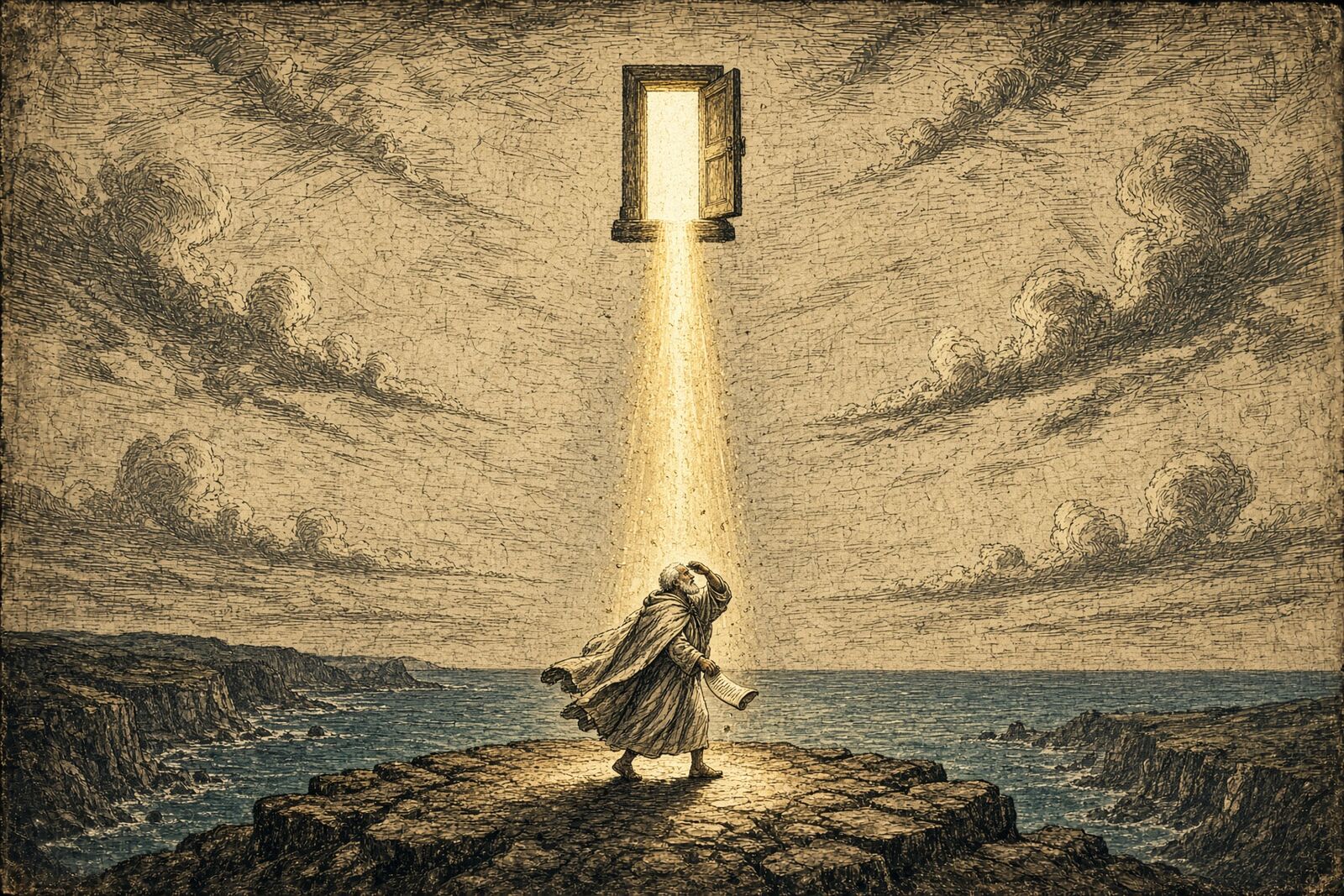
The Open Door (Rev 4:1)
“After these things I looked, and behold, a door standing open in heaven.”
Jesus (recognized by the trumpet-like voice of Rev. 1:10) invites John: “Come up here and I will show you what must take place after these things.”
What is this door? Not a literal wooden door. It is access to God’s perspective — the unveiling of reality as God sees it, which is the very meaning of “apocalypse.” Revelation 3:8 said Jesus placed an “open door” before Philadelphia; now that open door is to heaven itself.
Is John physically transported to heaven? Probably not. This is a prophetic trance experience — similar to Ezekiel’s visions or Paul’s being “caught up to the third heaven” (2 Cor. 12). The language describes a visionary experience, not a literal bodily ascent.
The Throne: The Dominant Image of Chapter 4
The word “throne” appears 14 times in 11 verses — more than in any other chapter anywhere in the Bible.
What does “God seated on his throne” convey?
The image communicates: God is in charge. God rules. God is not absent from or indifferent to what is happening in the world.
This is the foundational comfort of Revelation for persecuted believers: despite appearances, despite the power of Rome, despite the persecution, despite all that is going wrong — God is on the throne. He has not been displaced. He is not surprised. He is not powerless.
One Person on the Throne
“One seated on the throne.”
There is one person on the throne — not three. This is grammatically unambiguous. The throne room vision does not describe three co-equal persons. There is one God, and Jesus is distinct from him (Jesus will appear separately in chapter 5 as the Lamb who approaches the throne).
The Appearance: Jasper, Sardius, and Emerald (Rev 4:3)
God is not directly described — no face, no hair, no clothing. Instead, the vision approximates his glory through gemstone comparisons:
- Jasper — a clear, crystalline stone (described as clear in 21:11)
- Sardius (Sardis stone/carnelian) — fiery red
- Emerald rainbow encircling the throne
Connection to the High Priest’s Breastplate
The High Priest’s breastplate (Exodus 28) contained twelve gemstones, one for each tribe of Israel. The first stone was sardius and the last stone was jasper. When the High Priest appeared before God in the Holy of Holies, wearing these stones, he represented all twelve tribes before God.
Here, the two stones that appear around God’s throne are the first and last stones of that breastplate. The implication: God himself, on his throne, is wearing Israel — he carries his people before him. He has not forgotten them. The stones that surround God’s glory are the stones that represented God’s people.
This is a profound comfort to a persecuted church wondering if God has forgotten them.
The Rainbow
The rainbow evokes God’s covenant with Noah (Genesis 9) — a universal promise of faithfulness to all of creation. The God on the throne is not arbitrary or capricious; he is the covenant-keeping God who has made lasting promises to his people and to creation.
The Twenty-Four Elders (Rev 4:4)
“Around the throne were twenty-four thrones, and upon the thrones I saw twenty-four elders sitting, clothed in white garments and golden crowns on their heads.”
Who are these elders? Most likely heavenly angelic beings who function as a royal council around God’s throne — not human saints or apostles. Evidence:
- They function like the royal court (boulē) around an ancient king
- They worship before the throne throughout Revelation
- They interpret visions for John (like angels elsewhere in apocalyptic literature)
- Old Testament: the Divine Council (Job 1-2, Isaiah 6, 1 Kings 22)
Twenty-four: Probably representing completeness — 12 tribes of Israel + 12 apostles, or simply 2 × 12 as a number of fullness. The council around God’s throne is complete.
White garments and crowns: Identifying marks of royalty and victory in Revelation’s symbolic vocabulary.
Lightning and Thunder (Rev 4:5)
“From the throne came flashes of lightning and sounds and peals of thunder.”
This imagery evokes Sinai — God’s theophany at Mount Horeb when he gave the Ten Commandments (Exodus 19-20). The presence of God is overwhelming, terrifying, and awe-inspiring. The same God who thundered at Sinai is on this throne.
The Seven Lamps / Seven Spirits of God (Rev 4:5)
Seven lamps burning before the throne — identified as the seven spirits of God (the seven angels). This connects back to the lampstand imagery: these are the heavenly representatives whose earthly counterparts are the seven churches. The cosmic and the earthly are linked.
The Sea of Glass (Rev 4:6)
“Before the throne there was something like a sea of glass like crystal.”
The sea in ancient Near Eastern cosmology represented chaos, danger, and the realm of evil. The sea before God’s throne is calm and crystalline — it is under perfect control. There is no chaos in God’s presence. Whatever threatens the churches in the world, God’s realm is utterly at peace.
The Four Living Creatures (Rev 4:6-8)
“In the center and around the throne, four living creatures full of eyes in front and behind. The first creature was like a lion, the second creature like a calf, the third had a face like that of a man, and the fourth was like a flying eagle.”
Connection to Ezekiel 1 and Isaiah 6: The four living creatures are the same class of beings as Ezekiel’s cherubim — the guardians of God’s throne. Isaiah saw the seraphim around God’s throne (Isaiah 6). These are the highest order of angelic beings, those who continuously worship nearest to God.
The four faces represent the totality of creation:
- Lion — wild animals; the highest of beasts
- Ox/Calf — domestic animals; the animals that serve humanity
- Human — humanity itself
- Eagle — birds; the highest of the air
All of creation — every category — surrounds God’s throne in worship. He is worshipped by everything he has made.
“Full of eyes” — symbolic of total awareness, all-seeing wisdom. Nothing escapes their attention; they miss nothing in God’s creation.
Six wings — like the seraphim in Isaiah 6, covered with wings: two to cover their faces (humility before God), two to cover their feet (reverence), two to fly (readiness for God’s service).
The Trisagion: “Holy, Holy, Holy” (Rev 4:8)
“Day and night they do not cease to say: ‘Holy, holy, holy is the Lord God Almighty, who was and who is and who is to come.’”
Connection to Isaiah 6: In Isaiah’s throne room vision, the seraphim call out “Holy, holy, holy is the Lord of hosts; the whole earth is full of his glory.” John is drawing directly on this vision.
“Pantocrator” — the Almighty, Ruler of all things (see also 1:8). The Roman Emperor was called Autocrator (self-ruler). God is the Pantocrator — the ruler of everything, whose authority is not self-derived but inherent to his eternal nature.
“Who was and who is and who is to come” — God’s eternal nature: always present across all time, not bound by temporal existence.
The Worship of the Twenty-Four Elders (Rev 4:9-11)
Whenever the four living creatures give glory and honor and thanks to God, the twenty-four elders:
- Fall down before him
- Worship him
- Cast their crowns before the throne
The crown-casting: In the ancient world, when a conquered king was brought before the conquering emperor, they would prostrate themselves and lay their crowns at the victor’s feet in submission. The elders — themselves crowned — cast their crowns before God in total, joyful submission.
Their song (v. 11):
“Worthy are You, our Lord and our God, to receive glory and honor and power; for You created all things, and because of Your will they existed and were created.”
God is worthy of worship for two reasons in this song:
- He is the creator of all things
- All things exist by his will
The Creator God is the worthy God. This is foundational. He is not a tribal deity of Israel; he is the God who made the universe and everything in it. His worthiness is cosmic.
Why This Vision Matters for Persecuted Believers
The seven churches in Asia Minor were being crushed by Rome’s empire — the most powerful political force in human history at that time. They could look out at Rome and see:
- Domitian being worshipped as “Lord and God” (a phrase he used of himself)
- The Imperial temples, festivals, and civic power
- The legal authority to imprison, torture, and execute Christians
Revelation 4 pulls back the curtain and says: look at the real picture. There is one God, and he is on the throne. Not Domitian. Not Caesar. The one who was, who is, and who is to come — that is who rules. The Pantocrator is not Rome’s emperor; it is the God of Israel, worshipped by all of creation, day and night without ceasing.
For Christians today facing any form of opposition, marginalization, or suffering: God is still on the throne.
Summary
| Element |
Meaning |
| “After these things” / “I saw” |
Narrative markers, not chronological sequence |
| Four “In the Spirit” transitions |
Mark the four major sections of Revelation’s visionary content |
| Throne (14x in 11 verses) |
God is in charge — the central comfort for persecuted believers |
| One on the throne |
One God; Jesus appears separately as the Lamb in chapter 5 |
| Jasper and sardius |
First and last stones of the High Priest’s breastplate — God “wears” his people |
| Rainbow |
God’s covenant faithfulness — he has not forgotten or abandoned his people |
| Twenty-four elders |
Heavenly royal council; likely angelic beings |
| Sea of glass |
Chaos is calmed in God’s presence |
| Four living creatures |
All of creation represented in worship — lion, ox, man, eagle |
| “Holy, holy, holy” |
Continuous worship from the highest beings near God’s throne |
| Casting crowns |
Total, joyful submission to God’s authority |
| “Worthy because you created” |
God’s worthiness is cosmic and inherent — not earned |