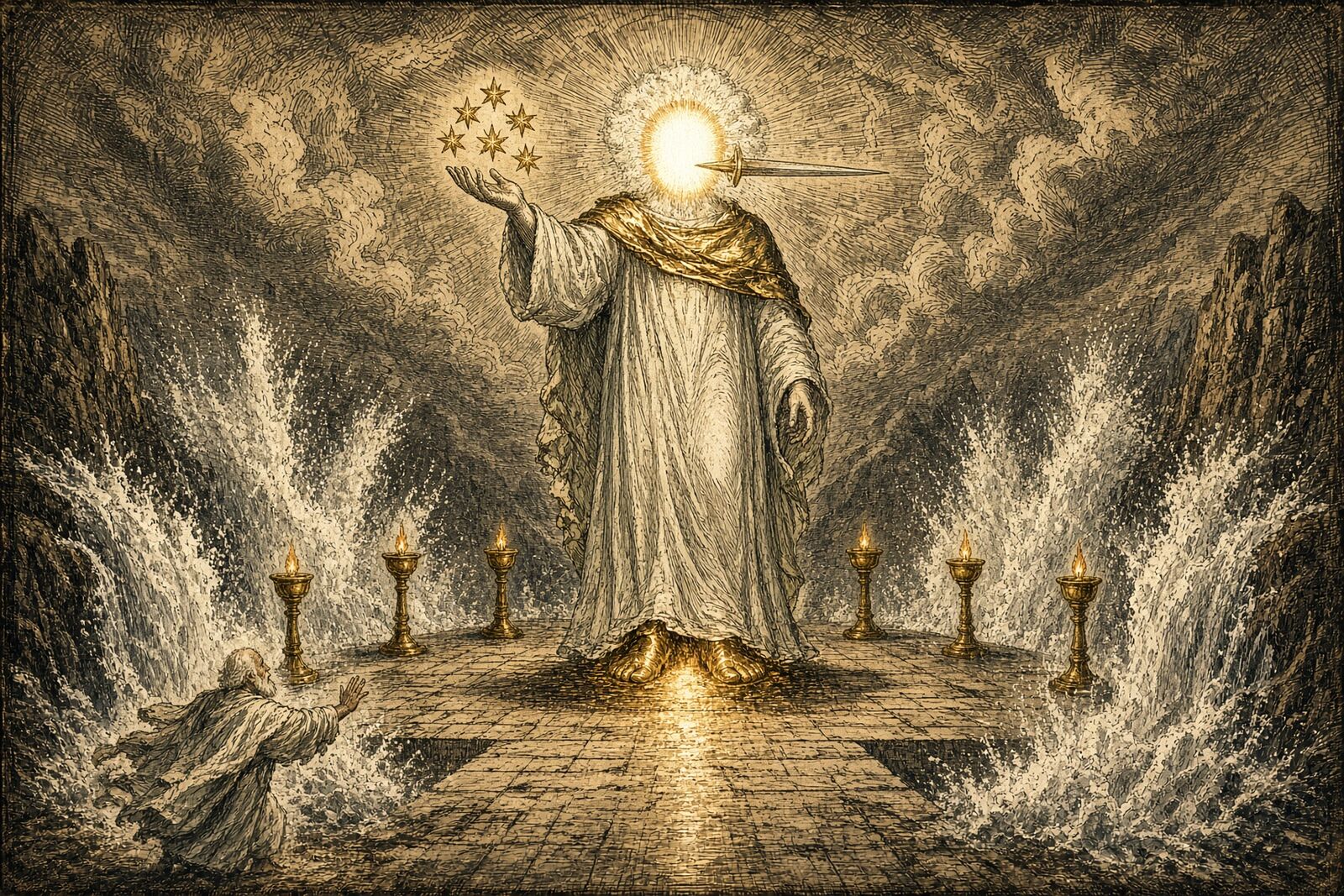
his countenance was as the sun shineth in his strength

Rev 1:13-16

Rev 1:13-16

13 And in the midst of the seven candlesticks one like unto the Son of man, clothed with a garment down to the foot, and girt about the paps with a golden girdle.

14 His head and his hairs were white like wool, as white as snow; and his eyes were as a flame of fire;

15 And his feet like unto fine brass, as if they burned in a furnace; and his voice as the sound of many waters.

16 And he had in his right hand seven stars: and out of his mouth went a sharp twoedged sword: and his countenance was as the sun shineth in his strength.

← Revelation Illuminated Bible

Explanations

John on Patmos, the Lord's Day, and Jesus Among the Lampstands

John on Patmos, the Lord's Day, and Jesus Among the Lampstands

Revelation 1:9-13 — John on Patmos, the Lord’s Day, and Jesus Among the Lampstands

Session 5 | Covers Revelation 1:9–13, the introduction of John, his situation on Patmos, the Lord’s Day, the trumpet-like voice, and the vision of the lampstands. Source: A2K Online Church Archive — Revelation 1:9-13


Authorship: Why It Matters to the Churches

John introduces himself not as an apostle but as a fellow brother who shares in three things with the seven churches. His authority doesn’t come from apostolic status — it comes from his prophetic experience of receiving this vision from the risen Jesus.

The practical reason authorship matters: if someone outside your community writes a letter claiming divine authority, you need a reason to listen to them. John’s credentials are:

  • He is a fellow sufferer — a partaker in the same tribulation
  • He received a direct vision from the risen Christ
  • He is a faithful gospel preacher (the “Word of God and testimony of Jesus”)

Three Things Shared with the Churches (Rev 1:9)

John says he is a fellow partaker (koinōnia) in three realities, all of which are “in Jesus”:

1. The Tribulation (thlipsis)

This is the tribulation — with a definite article. John and the seven churches are already experiencing it. It is not a future event. They suffer because of their identification with Jesus, not because they are law-breakers.

Note on “The Tribulation”: Some Christian theologies reserve this phrase for a future period. This text clearly says the Christians of the first century are already in it. Whether or not there is a future intensification of tribulation, the Christians receiving this letter are already suffering it right now.

2. The Kingdom

They are already partakers in the kingdom. This fits the New Testament’s consistent “already/not yet” pattern:

  • Romans 14:17: “The kingdom of God is not eating and drinking but righteousness, joy, and peace in the Holy Spirit”
  • Matthew 28:18: All authority has already been given to Jesus
  • Revelation 1:5: Jesus is already the ruler of the kings of the earth

The kingdom is not only future. Christians participate in God’s redemptive reign right now, even while awaiting its full consummation at Jesus’s return.

3. Perseverance (hypomonē)

This word will recur throughout Revelation as a major theme. The teacher has a full chapter in his doctoral dissertation on it. Its meaning in Revelation is specific:

Perseverance = steadfast, non-violent endurance

It means:

  • Not giving up the faith under pressure
  • Not responding to persecution with violence
  • Enduring faithfully even to the point of death

This is not passive resignation — it is active, costly faithfulness that refuses both defection and retaliation. It mirrors how Jesus himself responded to persecution.

The two wrong responses to persecution:

  1. Giving up the faith — not perseverance
  2. Taking up weapons to fight back — also not perseverance, and never endorsed by Jesus

The right response: faithful endurance, non-violent steadfastness, continuing to preach the gospel.


John on Patmos

John is on Patmos because of the Word of God and the testimony of Jesus — he is there in connection with his role as a faithful gospel preacher. Whether he was exiled there, went for safety, or went to evangelize is unclear from the Greek (it is grammatically ambiguous). What is clear:

  • Patmos was not a deserted island — there was a significant community there, a Greek gymnasium, and a temple to Artemis
  • It was not a prison colony — there were no mines on Patmos
  • His presence there is tied to his identity as a faithful witness of the gospel

This is the third reference in the first nine verses to faithful gospel preaching as a dominant theme. The book is deeply concerned with faithful witness.


“In the Spirit on the Lord’s Day” (Rev 1:10)

The Lord’s Day = Sunday

The phrase “Lord’s Day” (kyriakē hēmera) is an adjective form unique to this verse in the New Testament. Evidence from the early second century makes the meaning clear:

  • Ignatius (early 2nd century): Defined the Lord’s Day as “the day after the Sabbath, the resurrection day”
  • The Didache (~100 AD): “On the Lord’s Day come together, break bread, and hold the Eucharist”
  • Acts 20:7: Paul and Luke gathered with believers “on the first day of the week” to break bread
  • 1 Corinthians 16:2: The collection was taken “on the first day of every week”

All evidence points to the Lord’s Day = Sunday, the day of resurrection, the day of Christian assembly.

“In the Spirit” = A Trance-Like Visionary Experience

John is not simply writing a letter — he is recording what he experienced in a prophetic, visionary state. This is similar to:

  • Ezekiel’s visions
  • Paul’s being “caught up to the third heaven” (2 Cor. 12)
  • Old Testament prophets receiving visions from God

A Voice Like a Trumpet (Rev 1:10-11)

The trumpet-like voice commands John to write what he sees in a scroll and send it to the seven churches (listed in order of a clockwise circuit through Asia Minor, beginning at the port city of Ephesus).

Why seven churches when others exist? Colossi, Troas, and Hierapolis all had Christian communities in that region. The number seven is deliberate: it symbolizes completeness, meaning the letter is addressed to the whole church in all times and places, not only those seven congregations.

The geography: Starting at Ephesus (the port), the route goes clockwise: Ephesus → Smyrna → Pergamum → Thyatira → Sardis → Philadelphia → Laodicea. This was a natural postal route.


The Hearing-Before-Seeing Pattern

A key literary device in Revelation: John hears something first, then turns and sees — and what he sees clarifies and unpacks what he heard. This pattern appears at least three times:

  • Here in 1:10-13 (hears a trumpet voice; turns and sees lampstands and Jesus)
  • Revelation 5 (hears the Lion of Judah; looks and sees a slain Lamb)
  • Revelation 7 (hears the number 144,000; looks and sees an uncountable multitude)

The rule: What he sees is not a contradiction of what he heard — it is a clarification and deeper explanation. The second image unpacks the first. Always hold both together.


Seven Golden Lampstands = Seven Churches (Rev 1:12-13, 20)

John turns and sees seven golden lampstands, and Jesus is in their midst. Revelation 1:20 tells us exactly what these mean: the seven lampstands are the seven churches.

Why a Lampstand?

Two layers of meaning:

1. Temple imagery: The Solomon’s Temple had ten lampstands; Herod’s rebuilt temple had one (the menorah). The lampstand was a central fixture of the Jerusalem Temple. For Jews and Jewish Christians, a lampstand = the temple. Jesus here is saying the churches are the new temple — the place where God’s presence dwells.

This is not new to Revelation. Paul already said it:

  • “Do you not know that you are God’s temple and the Spirit of God dwells among you?” (1 Cor. 3:16)
  • “Your body is a temple of the Holy Spirit” (1 Cor. 6:19)

2. Light/evangelism imagery: A lampstand holds a lamp whose purpose is to give light. Jesus said in Matthew 5: “You are the light of the world” — addressing the disciples collectively (second person plural). Churches are lampstands not just to be holy, but to shine — to be outreach centers, evangelistic communities bearing light to a dark world.

The church’s dual identity in this image:

  • A holy place like the temple — affecting behavior, purity, and separation from the fallen culture
  • A light to the world — affecting mission, outreach, and gospel proclamation

Jesus Present in the Midst of His Churches

Jesus is described as walking in the midst of the seven lampstands (1:13). Since the lampstands are the churches, this means Jesus is currently present in his churches right now — not absent, not far away.

The practical implications:

  1. Comfort: Jesus knows what his people are suffering. He is aware of every trial and tribulation. He has not abandoned them.
  2. Warning: Jesus also knows every sin, every compromise, every failed deed. That is why he can say to each church “I know your works” — because he is there.
  3. No hiding: If Jesus is present in his churches, Christians cannot pretend everything is fine before God. He sees what is really going on.

This is consistent with Matthew 18:20 (“where two or three gather in my name, I am there among them”) and Matthew 28:20 (“I am with you always, to the end of the age”).

Parallels with present-tense judgment: Ananias and Sapphira (Acts 5) and the Corinthians abusing the Lord’s Supper (1 Cor. 11) demonstrate that Jesus and God do not wait until the final day to judge. Present-tense discipline happens within the church’s life right now.


Summary

Element Meaning
Fellow partaker in tribulation John and the churches suffer together — he is credible because he shares their experience
Kingdom in the present Already being experienced; not only future
Perseverance Steadfast, non-violent endurance — neither giving up nor fighting back
Patmos Connected to his vocation as a faithful gospel preacher
Lord’s Day = Sunday Confirmed by Ignatius, the Didache, Acts 20, and 1 Corinthians 16
In the Spirit A prophetic trance-like visionary experience
Seven churches Symbolic completeness — the letter is for all churches everywhere
Hear then see pattern What he sees unpacks and clarifies what he heard — hold both together
Lampstand = church Temple identity (holy, God’s dwelling) + evangelistic identity (light to the world)
Jesus among the lampstands Present in his churches now — brings both comfort and accountability

“The time is near. The decisive moment is always right in front of you. Jesus is in your midst, watching, shepherding, and calling.”

The Son of Man Vision and the Two Witnesses Preview

The Son of Man Vision and the Two Witnesses Preview

Revelation 1:13-20 — The Son of Man Vision and the Two Witnesses Preview

Session 6 | Covers the full description of the exalted Jesus in Revelation 1:13–20, including his appearance, the sword from his mouth, his titles, and a preview of the two witnesses in chapter 11. Source: A2K Online Church Archive — Revelation 1:13-20


The Hearing-Before-Seeing Pattern (Revisited)

The teacher re-emphasizes this key literary device: John first hears a trumpet-like voice, then turns and sees. What he sees clarifies and unpacks what he heard — the two images are not contradictions but complementary perspectives on the same reality.

Best example (preview from chapter 5): John hears that “the Lion of the tribe of Judah has conquered” — a powerful warrior image. But when he turns and looks, he sees a lamb that has been slain. The seeing unpacks the hearing: Jesus conquered as the slain lamb, not as a ferocious lion. This paradox is the heart of Revelation’s theology of conquering.


Description of the Exalted Jesus (Rev 1:13-16)

Jesus appears in John’s vision described with striking imagery drawn from two Old Testament figures in Daniel 7.

Daniel 7 and the Combination of Images

In Daniel 7, two distinct figures appear:

  • The Ancient of Days — God himself, described as having hair like white wool and sitting on a flaming throne
  • The Son of Man — a human figure distinct from the Ancient of Days, who comes in the clouds

Revelation takes both of these descriptions and applies them to Jesus. Jesus here is described with:

  • A robe reaching to his feet and a golden sash
  • Hair white like wool, like snow (from the Ancient of Days)
  • Eyes like flames of fire
  • Feet like burnished bronze (a new word — no prior occurrence in any literature)
  • Voice like the sound of many waters (like Niagara Falls — overwhelming, powerful)
  • Face shining like the sun in full strength

What Does This Mean?

This does not mean Jesus is God (the Ancient of Days). It means Jesus fully represents God and has been invested with God’s authority and name. The exalted Jesus, seated at God’s right hand, shares in God’s titles and attributes as God’s authorized agent and representative.

Philippians 2:9-10: “God has given Jesus the name which is above every name” — God shared his name with Jesus. Similarly here, God shared his descriptions with Jesus.

“Jesus is the closest human being to God that we have ever met. Jesus fully represents God in every possible way a human being can do so.”


The Seven Stars (Rev 1:16, 20)

In his right hand Jesus holds seven stars. Two important observations:

1. The right hand = authority and power. Jesus is at God’s right hand (the seat of authority). Whatever Jesus holds in his right hand is under his control and authority.

2. A counter-imperial image. A coin minted during the reign of Emperor Domitian (who ruled when Revelation was written) depicts his infant son sitting on a globe surrounded by seven stars, symbolizing Rome’s rule over the world. Revelation deliberately subverts this: it is Jesus who holds the seven stars, and it is Jesus who is already the ruler of the kings of the earth (1:5).

Revelation 1:20 identifies the seven stars as the angels of the seven churches — heavenly beings assigned to those communities. Jesus controls all the angels; seven (the number of completeness) represents his control over all angelic beings.


The Two-Edged Sword from His Mouth (Rev 1:16)

Out of Jesus’s mouth comes a sharp two-edged sword. This is the only weapon Jesus ever uses in the entire book of Revelation — and it is not a real weapon.

Old Testament Background

Isaiah 11:4 — The messianic figure “will strike the earth with the rod of his mouth and with the breath of his lips will slay the wicked.” His instrument of judgment is his words.

Isaiah 49:2 — The servant of God says: “He made my mouth like a sharp sword.” This is the same servant-figure through whom God’s salvation will reach to the ends of the earth — through the speaking of the gospel.

Hebrews 4:12 — “The word of God is living and active, sharper than any two-edged sword… able to judge the thoughts and intentions of the heart.”

What the Sword Means

The sword from Jesus’s mouth is his word — the gospel message — which functions in two directions:

  1. Comfort and shepherd: For those who are faithful, suffering, and persecuted, Jesus’s words guide, comfort, vindicate, and sustain
  2. Judgment and discipline: For those who are sinful and unrepentant, Jesus’s words rebuke, warn, chastise, and judge

This is exactly what Jesus does in his letters to the seven churches. He speaks to each of them with this two-edged word — praising what is good, rebuking what is wrong, calling to repentance.

The gospel itself is two-edged:

  • Good news of the kingdom — hope, forgiveness, resurrection
  • A word of judgment — repent or face consequences

“This is not automatically a negative judgmental image. Words can either be comforting and beneficial, or they can warn and discipline. That’s the sword.”


Jesus’s Face Shining Like the Sun

This connects to Moses descending from Sinai with a shining face (Exodus 34) — but amplified. The sun at full strength cannot be looked at directly; John had the same overwhelming experience. Jesus, having spent 2,000 years in the presence of God, simply radiates God’s glory in his glorified resurrection state.


John Falls as Dead; Jesus Places His Right Hand (Rev 1:17)

John’s response is to fall at Jesus’s feet “like a dead man.” There is no pride or arrogance here — the experience is overwhelming. Then Jesus does something beautiful: he places his right hand on John.

The same right hand that holds the seven stars — a symbol of power, authority, and sovereignty — becomes an instrument of comfort. The same Jesus who rules over everything still reaches down to comfort his struggling, overwhelmed people.


Jesus: First and Last, Living One, Keys of Death and Hades (Rev 1:17-18)

Jesus identifies himself with three more descriptions:

“I am the first and the last” — an all-encompassing title indicating sovereign authority over all of history

“I am the living one” — this phrase distinguishes Jesus from God. God has never died. Only Jesus can say “I was dead, and behold I am alive forevermore.” This is the crucial distinction in Revelation between God the Father and the Son.

“I hold the keys of death and Hades” — having conquered death through resurrection, Jesus now possesses authority over death itself. He can unlock that domain and bring people out of it. This is not a literal keychain — it is a metaphor for control and authority.


The Mystery Explained (Rev 1:20)

Jesus calls the vision a “mystery,” then immediately explains it — inviting readers into the inner counsel of God:

  • The seven stars = the seven angels of the seven churches
  • The seven lampstands = the seven churches

The reader is privileged to share in this explanation. This is a sign of honor and inclusion — you are given access to what God is revealing through Christ.


Preview: The Two Witnesses as the Church (Chapter 11)

The teacher offers a preview connecting the lampstand imagery from chapter 1 to chapter 11:

  • Revelation 1:20: Lampstands = churches
  • Revelation 11:3-4: The two witnesses are described as “the two lampstands that stand before the Lord of the earth”

If lampstands = churches, then the two witnesses are a vision of the church in its vocation to preach the gospel.

Additional supporting details:

  • The two witnesses share one mouth (verse 5 says “fire flows out of their mouth” — singular, not mouths plural)
  • If they are killed, they leave one body (verse 8 uses the singular form in Greek)
  • “Two witnesses” invokes the legal principle: “by the mouth of two or more witnesses, every fact is established” — the church’s testimony carries legal, authoritative weight in God’s court

The number two doesn’t refer to two individuals; it refers to the sufficiency of the church’s witness — the testimony is confirmed, authoritative, and complete.

“The two witnesses are not two future individuals flying around preaching. They are a vision of the church in its responsibility to be the light of the world, faithful lampstands preaching the gospel to the nations.”


Summary

Element Meaning
Ancient of Days + Son of Man combined in Jesus Jesus fully represents God — God’s authority and name shared with him
Seven stars in his right hand Control over all angels; counter-claim against Domitian’s imperial imagery
Two-edged sword from his mouth His word — the gospel — comforts the faithful and judges the unrepentant
Right hand on John Same hand of authority becomes the hand of comfort — Jesus is both sovereign and pastoral
First and Last / Living One Sovereign over all history; uniquely, the one who actually died and rose
Keys of death and Hades Authority over death because he conquered it
Lampstands = churches Temple identity (holy, God’s presence) + evangelistic identity (light to the world)
Two witnesses (ch. 11 preview) Vision of the church’s corporate witness — legally sufficient, gospel-bearing testimony

Lenses

The frame

Four Lenses on Revelation — Preterist

Must soon take place and the time is near are taken at face value — the book names its own audience, and a reading unintelligible to them fails its stated purpose. 1:7 divides the school: partial preterism keeps the return future; full preterism reads the coming with clouds of AD 70, with Matt 24:30 and 26:64 behind it.