Revelation 1:13-20 — The Son of Man Vision and the Two Witnesses Preview
Session 6 | Covers the full description of the exalted Jesus in Revelation 1:13–20, including his appearance, the sword from his mouth, his titles, and a preview of the two witnesses in chapter 11.
Source: A2K Online Church Archive — Revelation 1:13-20
The Hearing-Before-Seeing Pattern (Revisited)
The teacher re-emphasizes this key literary device: John first hears a trumpet-like voice, then turns and sees. What he sees clarifies and unpacks what he heard — the two images are not contradictions but complementary perspectives on the same reality.
Best example (preview from chapter 5): John hears that “the Lion of the tribe of Judah has conquered” — a powerful warrior image. But when he turns and looks, he sees a lamb that has been slain. The seeing unpacks the hearing: Jesus conquered as the slain lamb, not as a ferocious lion. This paradox is the heart of Revelation’s theology of conquering.
Description of the Exalted Jesus (Rev 1:13-16)
Jesus appears in John’s vision described with striking imagery drawn from two Old Testament figures in Daniel 7.
Daniel 7 and the Combination of Images
In Daniel 7, two distinct figures appear:
- The Ancient of Days — God himself, described as having hair like white wool and sitting on a flaming throne
- The Son of Man — a human figure distinct from the Ancient of Days, who comes in the clouds
Revelation takes both of these descriptions and applies them to Jesus. Jesus here is described with:
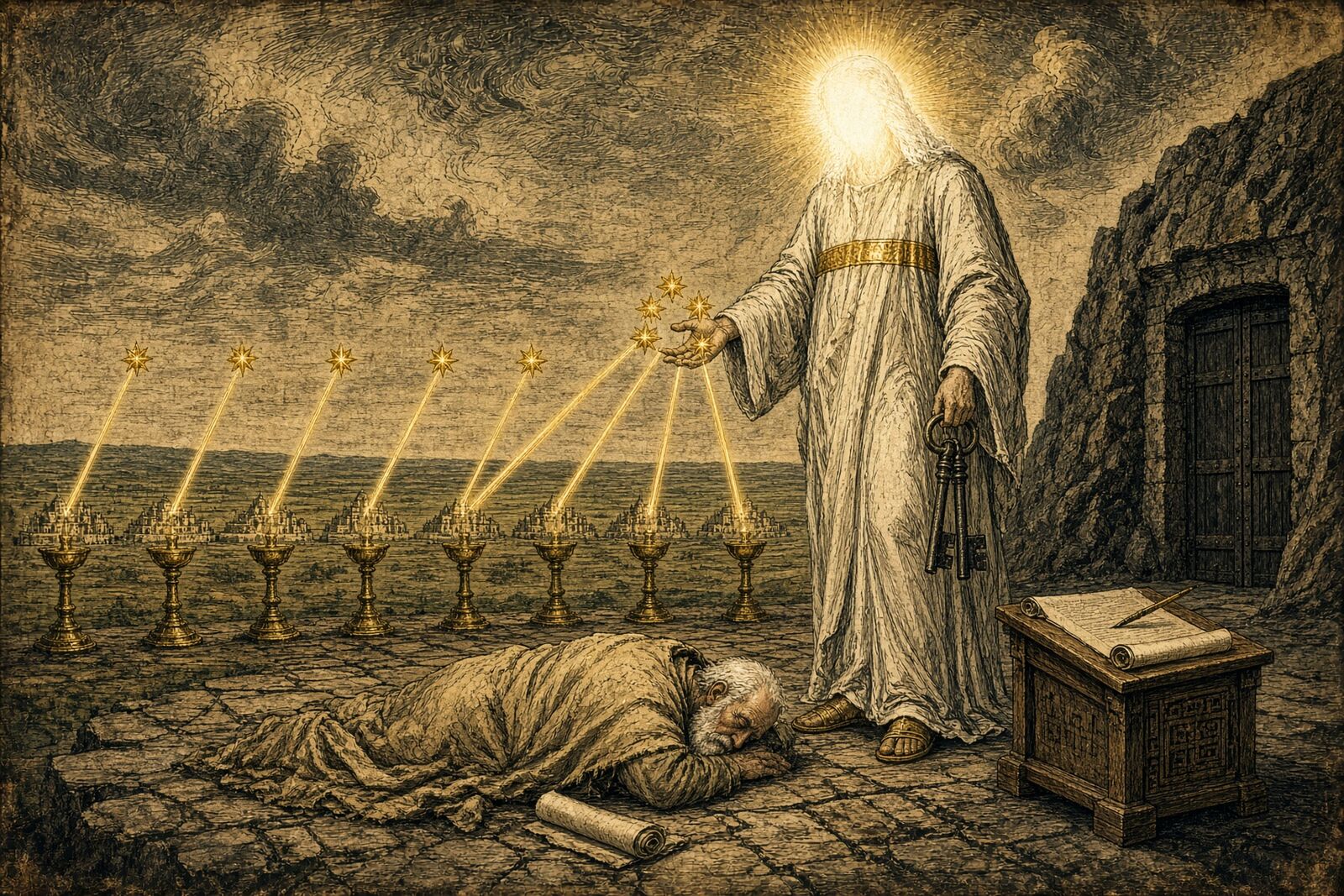
- A robe reaching to his feet and a golden sash
- Hair white like wool, like snow (from the Ancient of Days)
- Eyes like flames of fire
- Feet like burnished bronze (a new word — no prior occurrence in any literature)
- Voice like the sound of many waters (like Niagara Falls — overwhelming, powerful)
- Face shining like the sun in full strength
What Does This Mean?
This does not mean Jesus is God (the Ancient of Days). It means Jesus fully represents God and has been invested with God’s authority and name. The exalted Jesus, seated at God’s right hand, shares in God’s titles and attributes as God’s authorized agent and representative.
Philippians 2:9-10: “God has given Jesus the name which is above every name” — God shared his name with Jesus. Similarly here, God shared his descriptions with Jesus.
“Jesus is the closest human being to God that we have ever met. Jesus fully represents God in every possible way a human being can do so.”
The Seven Stars (Rev 1:16, 20)
In his right hand Jesus holds seven stars. Two important observations:
1. The right hand = authority and power. Jesus is at God’s right hand (the seat of authority). Whatever Jesus holds in his right hand is under his control and authority.
2. A counter-imperial image. A coin minted during the reign of Emperor Domitian (who ruled when Revelation was written) depicts his infant son sitting on a globe surrounded by seven stars, symbolizing Rome’s rule over the world. Revelation deliberately subverts this: it is Jesus who holds the seven stars, and it is Jesus who is already the ruler of the kings of the earth (1:5).
Revelation 1:20 identifies the seven stars as the angels of the seven churches — heavenly beings assigned to those communities. Jesus controls all the angels; seven (the number of completeness) represents his control over all angelic beings.
The Two-Edged Sword from His Mouth (Rev 1:16)
Out of Jesus’s mouth comes a sharp two-edged sword. This is the only weapon Jesus ever uses in the entire book of Revelation — and it is not a real weapon.
Old Testament Background
Isaiah 11:4 — The messianic figure “will strike the earth with the rod of his mouth and with the breath of his lips will slay the wicked.” His instrument of judgment is his words.
Isaiah 49:2 — The servant of God says: “He made my mouth like a sharp sword.” This is the same servant-figure through whom God’s salvation will reach to the ends of the earth — through the speaking of the gospel.
Hebrews 4:12 — “The word of God is living and active, sharper than any two-edged sword… able to judge the thoughts and intentions of the heart.”
What the Sword Means
The sword from Jesus’s mouth is his word — the gospel message — which functions in two directions:
- Comfort and shepherd: For those who are faithful, suffering, and persecuted, Jesus’s words guide, comfort, vindicate, and sustain
- Judgment and discipline: For those who are sinful and unrepentant, Jesus’s words rebuke, warn, chastise, and judge
This is exactly what Jesus does in his letters to the seven churches. He speaks to each of them with this two-edged word — praising what is good, rebuking what is wrong, calling to repentance.
The gospel itself is two-edged:
- Good news of the kingdom — hope, forgiveness, resurrection
- A word of judgment — repent or face consequences
“This is not automatically a negative judgmental image. Words can either be comforting and beneficial, or they can warn and discipline. That’s the sword.”
Jesus’s Face Shining Like the Sun
This connects to Moses descending from Sinai with a shining face (Exodus 34) — but amplified. The sun at full strength cannot be looked at directly; John had the same overwhelming experience. Jesus, having spent 2,000 years in the presence of God, simply radiates God’s glory in his glorified resurrection state.
John Falls as Dead; Jesus Places His Right Hand (Rev 1:17)
John’s response is to fall at Jesus’s feet “like a dead man.” There is no pride or arrogance here — the experience is overwhelming. Then Jesus does something beautiful: he places his right hand on John.
The same right hand that holds the seven stars — a symbol of power, authority, and sovereignty — becomes an instrument of comfort. The same Jesus who rules over everything still reaches down to comfort his struggling, overwhelmed people.
Jesus: First and Last, Living One, Keys of Death and Hades (Rev 1:17-18)
Jesus identifies himself with three more descriptions:
“I am the first and the last” — an all-encompassing title indicating sovereign authority over all of history
“I am the living one” — this phrase distinguishes Jesus from God. God has never died. Only Jesus can say “I was dead, and behold I am alive forevermore.” This is the crucial distinction in Revelation between God the Father and the Son.
“I hold the keys of death and Hades” — having conquered death through resurrection, Jesus now possesses authority over death itself. He can unlock that domain and bring people out of it. This is not a literal keychain — it is a metaphor for control and authority.
The Mystery Explained (Rev 1:20)
Jesus calls the vision a “mystery,” then immediately explains it — inviting readers into the inner counsel of God:
- The seven stars = the seven angels of the seven churches
- The seven lampstands = the seven churches
The reader is privileged to share in this explanation. This is a sign of honor and inclusion — you are given access to what God is revealing through Christ.
Preview: The Two Witnesses as the Church (Chapter 11)
The teacher offers a preview connecting the lampstand imagery from chapter 1 to chapter 11:
- Revelation 1:20: Lampstands = churches
- Revelation 11:3-4: The two witnesses are described as “the two lampstands that stand before the Lord of the earth”
If lampstands = churches, then the two witnesses are a vision of the church in its vocation to preach the gospel.
Additional supporting details:
- The two witnesses share one mouth (verse 5 says “fire flows out of their mouth” — singular, not mouths plural)
- If they are killed, they leave one body (verse 8 uses the singular form in Greek)
- “Two witnesses” invokes the legal principle: “by the mouth of two or more witnesses, every fact is established” — the church’s testimony carries legal, authoritative weight in God’s court
The number two doesn’t refer to two individuals; it refers to the sufficiency of the church’s witness — the testimony is confirmed, authoritative, and complete.
“The two witnesses are not two future individuals flying around preaching. They are a vision of the church in its responsibility to be the light of the world, faithful lampstands preaching the gospel to the nations.”
Summary
| Element |
Meaning |
| Ancient of Days + Son of Man combined in Jesus |
Jesus fully represents God — God’s authority and name shared with him |
| Seven stars in his right hand |
Control over all angels; counter-claim against Domitian’s imperial imagery |
| Two-edged sword from his mouth |
His word — the gospel — comforts the faithful and judges the unrepentant |
| Right hand on John |
Same hand of authority becomes the hand of comfort — Jesus is both sovereign and pastoral |
| First and Last / Living One |
Sovereign over all history; uniquely, the one who actually died and rose |
| Keys of death and Hades |
Authority over death because he conquered it |
| Lampstands = churches |
Temple identity (holy, God’s presence) + evangelistic identity (light to the world) |
| Two witnesses (ch. 11 preview) |
Vision of the church’s corporate witness — legally sufficient, gospel-bearing testimony |