Revelation 17 — Unveiling the Evil of Rome
Session 41 | The judgment of the great harlot, Babylon the Great, riding the scarlet beast. John exposes Rome’s true nature to Christians tempted to compromise.
Source: A2K Online Church Archive — Revelation 17:1-18
The Problem: Christians Who Didn’t Think Rome Was So Bad
Some first-century Christians believed they could ally with Rome for economic and social advantage. They thought: “If I don’t stick my neck out too much and I don’t talk about Jesus too much, nothing bad will happen to me.”
Revelation 17 unveils the evil of Rome — showing it for what it truly is: a murderous, idolatrous system drunk on the blood of God’s people. The chapter is designed to dissuade Christians from compromising with the Imperial system.
The Vision of the Harlot (vv. 1–6)
“Come here, I will show you the judgment of the great harlot who sits on many waters, with whom the kings of the earth committed acts of immorality.”
The Woman and the Beast
The harlot sits on a scarlet beast — the same beast from the sea (Rome). She:
- Is clothed in purple and scarlet — imperial colors, associated with wealth and royalty
- Is adorned with gold, precious stones, and pearls — excessive luxury
- Holds a gold cup full of abominations — the corruption of what is holy
- Has a name written on her forehead: “Babylon the Great, Mother of Harlots”
- Is drunk with the blood of the saints — she has murdered God’s people
“Mother of Harlots”
This title shows that Babylon is not just one sinful city — she is the origin and source of all spiritual unfaithfulness. Every manifestation of idolatry and rebellion traces back to this archetypal evil.
The Angel Explains the Mystery (vv. 7–18)
“Why do you wonder? I will tell you the mystery of the woman and of the beast that carries her.”
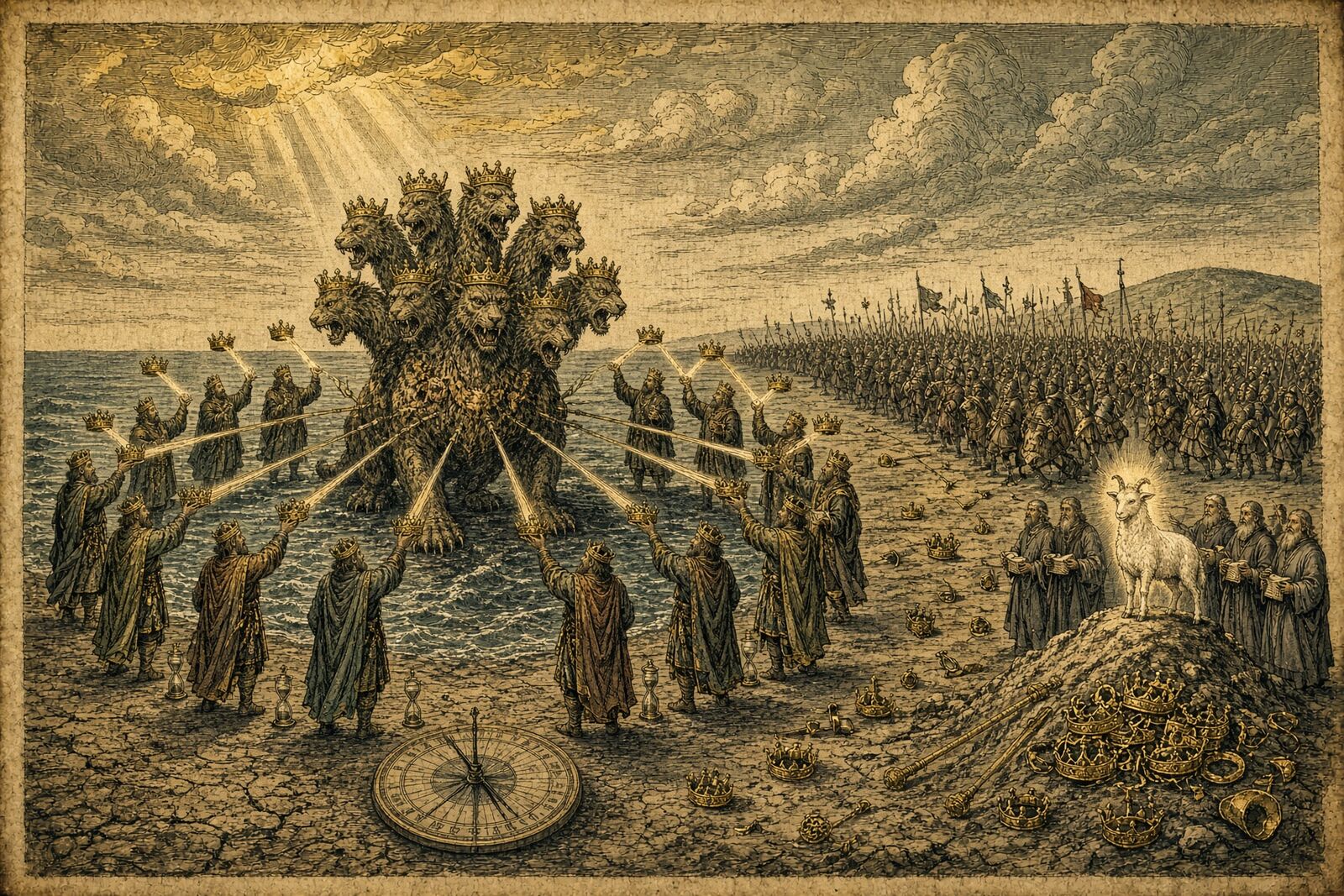
The Beast’s Seven Heads and Ten Horns
- Seven heads = seven mountains/hills (unmistakably Rome — the city on seven hills) AND seven kings
- Ten horns = ten kings who have not yet received a kingdom but will receive authority with the beast
The angel explains that the beast was, is not, and will come — a parody of God’s self-description (“who is and who was and who is to come”). The beast imitates divinity but is merely a counterfeit.
“The Beast That Was and Is Not”
This refers to the Nero redivivus myth — the belief that Nero (the first persecutor of Christians) did not truly die but would return. For John’s readers, Nero embodied the ultimate evil, and the beast represents that persecuting power concentrated in one figure.
The Seven Kings
The teacher explains that the seven kings represent a succession of Roman emperors. The exact identification is debated, but the point is clear: the beast embodies the cumulative evil of the Roman Imperial system, and its time is limited.
Who Are the “Called, Chosen, and Faithful”? (v. 14)
“These will wage war against the Lamb, and the Lamb will overcome them, because He is Lord of lords and King of kings, and those who are with Him are the called and chosen and faithful.”
In the midst of this dark vision, a promise shines: the Lamb wins. And those with him are described in three terms that describe Christian identity:
- Called — summoned by God
- Chosen — elected by God
- Faithful — those who have persevered
These are the conquerors — not those who fight with swords, but those who follow the Lamb in faithful witness.
The Harlot Destroyed by the Beast (vv. 16–17)
*“The ten horns and the beast will hate the harlot and will make her desolate and naked, and will eat her flesh and will burn her up with fire.””
In a striking twist, the beast and its allies turn on the harlot and destroy her. This shows:
- Evil is not unified — it eventually turns on itself
- Babylon’s fall comes from within as well as from God
- The corrupt system destroys its own supporters
Summary
| Element |
Meaning |
| The harlot |
Babylon/Rome — the corrupt world system |
| Sitting on many waters |
Control over nations, peoples, and commerce |
| Scarlet beast |
The Roman Empire that carries and supports Babylon |
| Seven heads |
Seven hills of Rome / seven kings |
| Ten horns |
Allied kings who serve the beast |
| Drunk on blood of saints |
Guilty of persecuting and martyring believers |
| “Called, chosen, faithful” |
The conquerors who follow the Lamb |
| Beast destroys harlot |
Evil turns on itself |
“Revelation unveils the evil of Rome because there were Christians who didn’t think Rome was evil at all. They thought compromise was harmless. Revelation shows them what they’re really dealing with.”