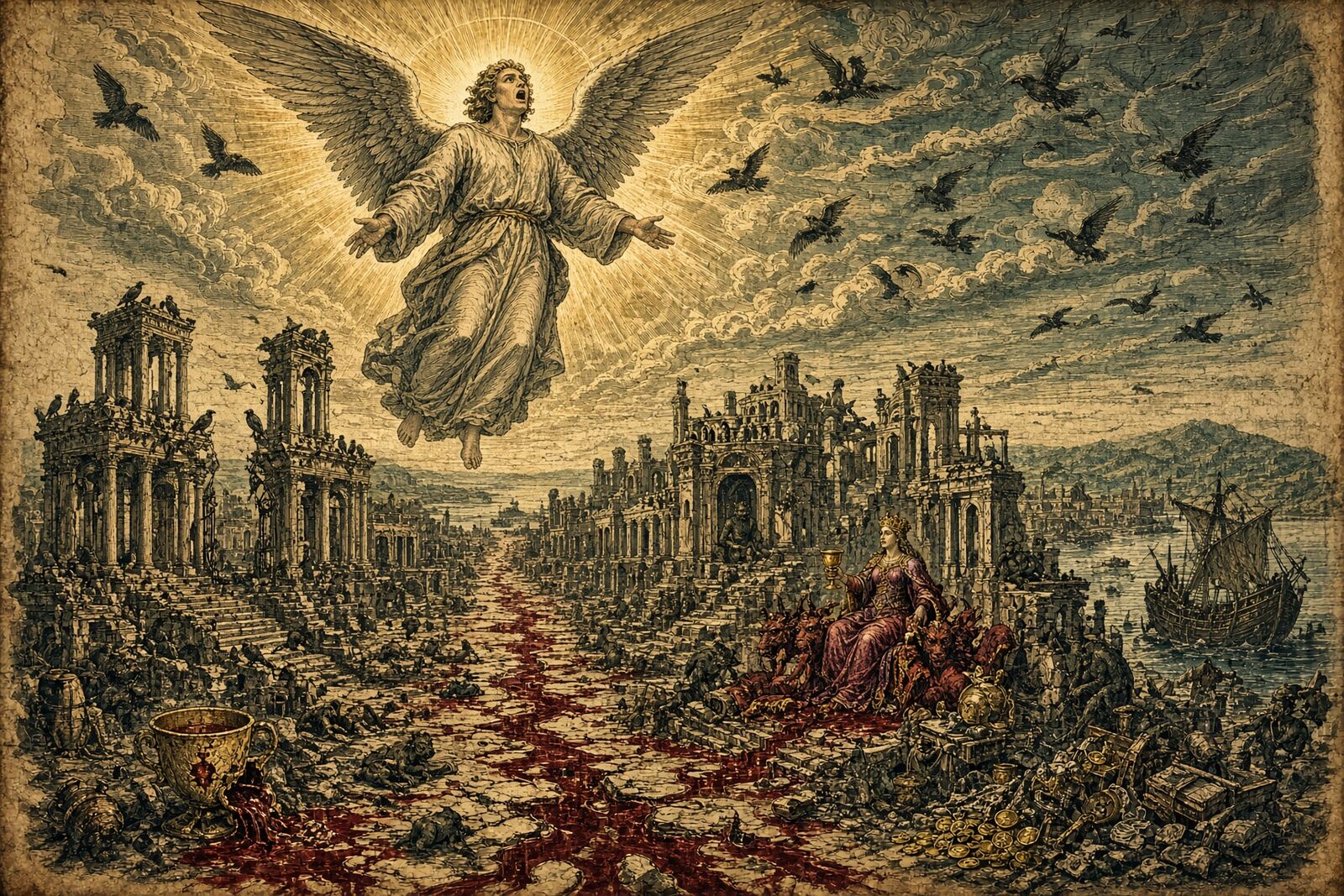
Revelation 18:1–24 — Fallen, Fallen Is Babylon the Great
Session 42 | A prophetic announcement of Babylon’s destruction with a call to “come out of her” — followed by laments from kings, merchants, and seafarers who profited from her.
Source: A2K Online Church Archive — Revelation 18:1-10
Overview
Chapter 18 is a prophetic denunciation of Babylon/Rome, structured as a funeral dirge. It is the companion to chapter 17 — where chapter 17 unveiled Babylon’s evil, chapter 18 announces her certain and complete destruction.
The teacher uses a picture of fire and destruction in the distance with a person stepping back — illustrating the right response: knowing destruction is coming and distancing yourself from it.
The Angel’s Announcement (vv. 1–3)
*“Fallen, fallen is Babylon the great! She has become a dwelling place of demons, a haunt of every foul spirit.””
An angel with great authority descends, and the earth is lit with his splendor. His announcement echoes Isaiah 21:9 (the fall of the original Babylon) and the second angel’s message in 14:8.
Babylon has become:
- A dwelling place of demons — what was once glorious is now haunted
- A haunt of every foul spirit — spiritually desolate
- The source of fornication for all nations — leading the world into idolatry
“Come Out of Her, My People” (vv. 4–8)
*“I heard another voice from heaven saying, ‘Come out of her, my people, so that you will not participate in her sins and receive of her plagues.’””
This is the practical call of the chapter. God’s people are in Babylon — they live within the Roman Empire, participate in its economy, and are tempted to adopt its values. The command is to separate:
- Come out — disassociate, distance yourself
- Do not take part in her sins — refuse to participate in idolatry and immorality
- Do not share in her plagues — judgment is coming
God Remembers Her Iniquities
“Her sins have piled up as high as heaven, and God has remembered her iniquities.”
Babylon’s sins are not forgotten. God’s justice may seem delayed, but He remembers.
“Pay Her Back Double”
The call for double recompense is poetic justice — Babylon treated others brutally; now she receives the same measure. This is not personal vengeance but divine retribution that matches the crime.
The Laments (vv. 9–20)
Three groups mourn Babylon’s destruction:
The Kings of the Earth (vv. 9–10)
“Woe, woe, the great city, Babylon, the strong city! For in one hour your judgment has come.”
The kings who committed immorality with Babylon stand at a distance and weep. They enjoyed her benefits but will not share her destruction.
The Merchants of the Earth (vv. 11–17a)
*“Woe, woe, the great city, she who was clothed in fine linen and purple and scarlet.””
The merchants lament because no one buys their cargo anymore. A detailed list of goods follows — the full inventory of Rome’s luxury trade:
- Gold, silver, precious stones, pearls
- Fine linen, purple, silk, scarlet
- Fragrant wood, ivory, bronze, iron, marble
- Cinnamon, spice, incense, perfume, frankincense
- Wine, oil, fine flour, wheat
- Cattle, sheep, horses, chariots
- Slaves and human lives (the climax of the list)
The last item — “slaves and human lives” — reveals the moral horror beneath Rome’s glittering economy. The empire’s wealth was built on human trafficking and exploitation.
The Shipmasters and Seafarers (vv. 17b–20)
*“Woe, woe, the great city, where all who had ships at sea became rich by her wealth.””
Those who transported Babylon’s goods also mourn. But heaven is called to rejoice — because God has judged Babylon and avenged the blood of his servants.
The Finality of Babylon’s Fall (vv. 21–24)
*“A strong angel took up a stone like a great millstone and threw it into the sea, saying, ‘So will Babylon, the great city, be thrown down with violence, and will not be found any longer.’””
The millstone imagery echoes Jesus’s warning about causing little ones to stumble (Matthew 18:6). Babylon’s destruction is:
- Sudden — like a millstone thrown into the sea
- Complete — “will not be found any longer”
- Irreversible — music, crafts, grinding, light, and the voice of the bridegroom all cease
The Final Charge
“In her was found the blood of prophets and of saints and of all who have been slain on the earth.”
Babylon’s ultimate crime: murdering God’s people. The charge is universal — she is guilty of the blood of “all who have been slain on the earth.”
Summary
| Element |
Meaning |
| “Fallen, fallen” |
Prophetic announcement — already certain from God’s perspective |
| “Come out of her” |
Call to separate from the world system |
| God remembers |
Justice delayed is not justice denied |
| Kings’ lament |
Those who profited politically mourn |
| Merchants’ lament |
Those who profited economically mourn |
| List of goods |
Rome’s luxury trade — climaxing in “slaves and human lives” |
| Millstone thrown |
Complete and irreversible destruction |
| Blood of saints |
Babylon’s ultimate guilt |
“There were some people who knew destruction was coming and took a step back so they wouldn’t suffer those consequences. That’s what ‘Come out of her, my people’ means.”