Thus with violence shall that great city Babylon be thrown down

Rev 18:20-24

Rev 18:20-24

20 Rejoice over her, thou heaven, and ye holy apostles and prophets; for God hath avenged you on her.

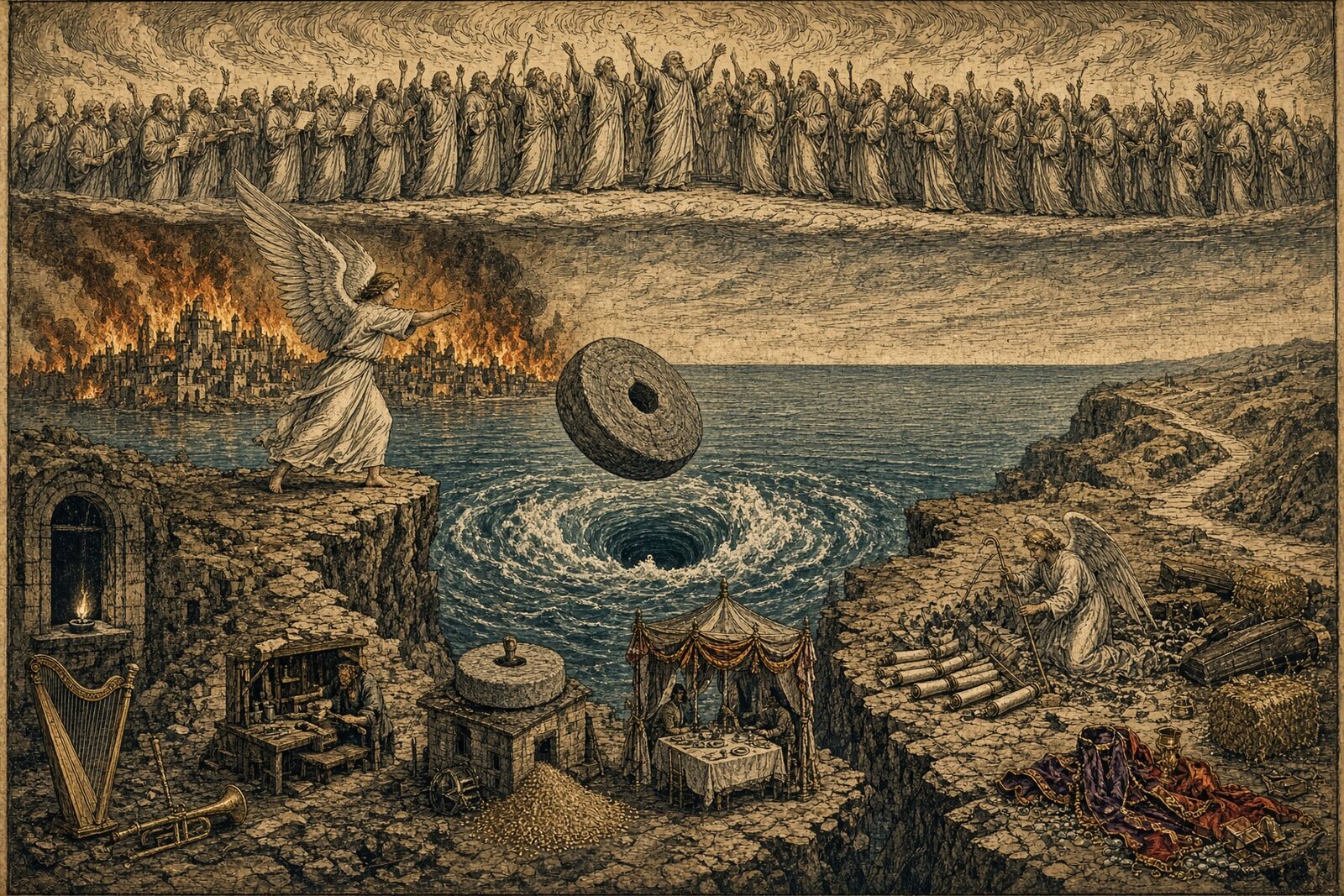
21 And a mighty angel took up a stone like a great millstone, and cast it into the sea, saying, Thus with violence shall that great city Babylon be thrown down, and shall be found no more at all.

22 And the voice of harpers, and musicians, and of pipers, and trumpeters, shall be heard no more at all in thee; and no craftsman, of whatsoever craft he be, shall be found any more in thee; and the sound of a millstone shall be heard no more at all in thee;

23 And the light of a candle shall shine no more at all in thee; and the voice of the bridegroom and of the bride shall be heard no more at all in thee: for thy merchants were the great men of the earth; for by thy sorceries were all nations deceived.

24 And in her was found the blood of prophets, and of saints, and of all that were slain upon the earth.

← Revelation Illuminated Bible

Explanations

Fallen, Fallen Is Babylon

Fallen, Fallen Is Babylon

Revelation 18:1–24 — Fallen, Fallen Is Babylon the Great

Session 42 | A prophetic announcement of Babylon’s destruction with a call to “come out of her” — followed by laments from kings, merchants, and seafarers who profited from her. Source: A2K Online Church Archive — Revelation 18:1-10


Overview

Chapter 18 is a prophetic denunciation of Babylon/Rome, structured as a funeral dirge. It is the companion to chapter 17 — where chapter 17 unveiled Babylon’s evil, chapter 18 announces her certain and complete destruction.

The teacher uses a picture of fire and destruction in the distance with a person stepping back — illustrating the right response: knowing destruction is coming and distancing yourself from it.


The Angel’s Announcement (vv. 1–3)

*“Fallen, fallen is Babylon the great! She has become a dwelling place of demons, a haunt of every foul spirit.””

An angel with great authority descends, and the earth is lit with his splendor. His announcement echoes Isaiah 21:9 (the fall of the original Babylon) and the second angel’s message in 14:8.

Babylon has become:

  • A dwelling place of demons — what was once glorious is now haunted
  • A haunt of every foul spirit — spiritually desolate
  • The source of fornication for all nations — leading the world into idolatry

“Come Out of Her, My People” (vv. 4–8)

*“I heard another voice from heaven saying, ‘Come out of her, my people, so that you will not participate in her sins and receive of her plagues.’””

This is the practical call of the chapter. God’s people are in Babylon — they live within the Roman Empire, participate in its economy, and are tempted to adopt its values. The command is to separate:

  • Come out — disassociate, distance yourself
  • Do not take part in her sins — refuse to participate in idolatry and immorality
  • Do not share in her plagues — judgment is coming

God Remembers Her Iniquities

“Her sins have piled up as high as heaven, and God has remembered her iniquities.”

Babylon’s sins are not forgotten. God’s justice may seem delayed, but He remembers.

“Pay Her Back Double”

The call for double recompense is poetic justice — Babylon treated others brutally; now she receives the same measure. This is not personal vengeance but divine retribution that matches the crime.


The Laments (vv. 9–20)

Three groups mourn Babylon’s destruction:

The Kings of the Earth (vv. 9–10)

“Woe, woe, the great city, Babylon, the strong city! For in one hour your judgment has come.”

The kings who committed immorality with Babylon stand at a distance and weep. They enjoyed her benefits but will not share her destruction.

The Merchants of the Earth (vv. 11–17a)

*“Woe, woe, the great city, she who was clothed in fine linen and purple and scarlet.””

The merchants lament because no one buys their cargo anymore. A detailed list of goods follows — the full inventory of Rome’s luxury trade:

  • Gold, silver, precious stones, pearls
  • Fine linen, purple, silk, scarlet
  • Fragrant wood, ivory, bronze, iron, marble
  • Cinnamon, spice, incense, perfume, frankincense
  • Wine, oil, fine flour, wheat
  • Cattle, sheep, horses, chariots
  • Slaves and human lives (the climax of the list)

The last item — “slaves and human lives” — reveals the moral horror beneath Rome’s glittering economy. The empire’s wealth was built on human trafficking and exploitation.

The Shipmasters and Seafarers (vv. 17b–20)

*“Woe, woe, the great city, where all who had ships at sea became rich by her wealth.””

Those who transported Babylon’s goods also mourn. But heaven is called to rejoice — because God has judged Babylon and avenged the blood of his servants.


The Finality of Babylon’s Fall (vv. 21–24)

*“A strong angel took up a stone like a great millstone and threw it into the sea, saying, ‘So will Babylon, the great city, be thrown down with violence, and will not be found any longer.’””

The millstone imagery echoes Jesus’s warning about causing little ones to stumble (Matthew 18:6). Babylon’s destruction is:

  • Sudden — like a millstone thrown into the sea
  • Complete — “will not be found any longer”
  • Irreversible — music, crafts, grinding, light, and the voice of the bridegroom all cease

The Final Charge

“In her was found the blood of prophets and of saints and of all who have been slain on the earth.”

Babylon’s ultimate crime: murdering God’s people. The charge is universal — she is guilty of the blood of “all who have been slain on the earth.”


Summary

Element Meaning
“Fallen, fallen” Prophetic announcement — already certain from God’s perspective
“Come out of her” Call to separate from the world system
God remembers Justice delayed is not justice denied
Kings’ lament Those who profited politically mourn
Merchants’ lament Those who profited economically mourn
List of goods Rome’s luxury trade — climaxing in “slaves and human lives”
Millstone thrown Complete and irreversible destruction
Blood of saints Babylon’s ultimate guilt

“There were some people who knew destruction was coming and took a step back so they wouldn’t suffer those consequences. That’s what ‘Come out of her, my people’ means.”
Lament Over Babylon

Lament Over Babylon

Revelation 18:11–24 — The Lament Over Babylon

Session 43 | The second half of chapter 18, focusing on the merchants’ lament and the full list of Babylon’s luxury goods — exposing the economic exploitation and human trafficking at the heart of the Roman Empire. Source: A2K Online Church Archive — Revelation 18:11-24


Context

This session covers the same passage as Video 42 (Revelation 18:11–24) but delivered to a different group. The teacher emphasizes that this is the wrong place to start if you’re new — it assumes familiarity with the preceding chapters’ framework about Babylon/Rome.


The Merchants’ Lament (vv. 11–17a)

The merchants weep because no one buys their cargo anymore. The detailed list of Babylon’s imports is a catalog of luxury and exploitation:

The Categories of Trade

Category Items
Precious materials Gold, silver, precious stones, pearls
Fine fabrics Fine linen, purple, silk, scarlet
Luxury goods Fragrant wood, ivory, fine wood, bronze, iron, marble
Spices and perfumes Cinnamon, spice, incense, perfume, frankincense
Food and drink Wine, oil, fine flour, wheat
Livestock Cattle, sheep, horses, chariots
Human beings Slaves and human lives

“Slaves and Human Lives”

The Greek phrase sōmatōn kai psychas anthrōpōn is striking: literally “bodies and souls of people” — the complete reduction of human beings to commodities. This exposes the moral rot beneath Rome’s economic prosperity.

Rome’s economy — like all oppressive empires — was built on:

  • Conquest and plunder
  • Slavery and human trafficking
  • Exploitation of conquered peoples

Revelation condemns this economic system as inherently evil. The merchants’ grief is not moral — they grieve the loss of profit, not the loss of human life.


The Seafarers’ Lament (vv. 17b–20)

“Every shipmaster and every passenger and sailor, and as many as make their living by the sea, stood at a distance.”

The maritime industry — which transported Babylon’s goods — also collapses. Transport, commerce, and travel all depend on Babylon’s system. When she falls, the entire network falls with her.


Heaven’s Call to Rejoice (v. 20)

“Rejoice over her, O heaven, and you saints and apostles and prophets, because God has pronounced judgment for you against her.”

While the world mourns, heaven celebrates. God has finally vindicated his people. This is not glee at suffering but joy at justice — the end of a murderous system.


The Millstone of Judgment (vv. 21–24)

*“A strong angel took up a stone like a great millstone and threw it into the sea, saying, ‘So will Babylon, the great city, be thrown down with violence, and will not be found any longer.’””

What Will Cease in Babylon

Lost Significance
Sound of harpists and musicians No more celebration
Craftsman of any craft No more production
Sound of the millstone No more daily bread
Light of a lamp No more life or guidance
Voice of bridegroom and bride No more joy or new beginnings

The Blood of All the Slain

*“In her was found the blood of prophets and of saints and of all who have been slain on the earth.””

This final charge makes Babylon universally guilty — not just of persecuting Christians but of “all who have been slain on the earth.” Babylon represents every oppressive system that sheds innocent blood.


Summary

Element Meaning
Merchants mourn The empire’s economy collapses
List of goods Exposes Rome’s luxury and exploitation
Slaves and human lives The moral horror — humans as commodities
Seafarers mourn The entire trade network falls
Heaven rejoices God’s justice is vindicated
Millstone thrown Complete and irreversible destruction
All sounds cease Total desolation
Blood of all the slain Babylon’s universal guilt

“This is the wrong teaching to start on. This is like starting in calculus when you’ve never taken basic math.”

The Tale of Two Cities

The Tale of Two Cities

Revelation 17–22 Introduction — The Tale of Two Cities

Session 40 | An introduction to the contrasting visions of Babylon (the harlot) and New Jerusalem (the bride). Revelation presents two cities and two women — each demanding the reader’s allegiance. Source: A2K Online Church Archive — Babylon & New Jerusalem - An Introduction to Revelation’s Two Cities


The Structure of Revelation’s Final Section

From chapter 17 through chapter 22, Revelation presents two contrasting cities personified as women:

Babylon (Chs. 17–19) New Jerusalem (Chs. 21–22)
A harlot / prostitute The bride of Christ
Drunk on the blood of saints Pure, prepared for her husband
Clothed in purple and scarlet Clothed with the glory of God
Holds a golden cup of abominations Holds the water of life
Rides a scarlet beast Descends from heaven
Destined for destruction Eternal and enduring

These are not merely literal cities — they represent two realities, two value systems, two ways of life:

  1. Fallen Babylon = the world system organized in opposition to God; the culture of empire, self-glorification, and violence
  2. New Jerusalem = the people of God living under his reign; the community of the faithful, pure and prepared for Christ

Why This Introduction Is Necessary

The teacher devotes this session to orienting readers to the “two cities” framework because the details of both visions are dense and easily misunderstood. Before diving into the specifics:

  • Babylon = Rome for the first readers, but Babylon is a recurring reality in every age
  • New Jerusalem = the church as the bride of Christ, already descending from heaven as a present spiritual reality
  • The reader must choose which city to be a citizen of

How the Two Cities Function

Revelation does not present these two cities as mere information. They are rhetorical — designed to persuade and motivate:

Babylon

  • Unmasks evil — shows Rome for what it truly is rather than its propaganda
  • Discourages compromise — associating with Babylon brings judgment
  • Shows the end of evil — Babylon’s destruction is certain

New Jerusalem

  • Gives hope — God’s people have a glorious future
  • Encourages faithfulness — the reward is worth the suffering
  • Defines identity — believers are citizens of heaven, not of earthly empires

The Practical Application

“This really challenged me into how I view the church today.”

The two cities call the reader to:

  • Discern which “city” they are building their life in
  • Reject the values of Babylon (greed, violence, self-glorification, idolatry)
  • Embrace the values of New Jerusalem (faithfulness, purity, worship, love)
  • Recognize that every generation has its own “Babylon” — and its own call to “come out of her”

Summary

Babylon New Jerusalem
Harlot Bride
Drunk on blood Clothed in righteousness
Worldly wealth Divine glory
Destined for destruction Eternal
Demands allegiance to Caesar Calls for allegiance to the Lamb
Built by human empire Built by God

“Revelation puts two cities in front of you and says: choose. You can be a citizen of Babylon or a citizen of New Jerusalem — but you cannot be both.”

Lenses