the marriage of the Lamb is come, and his wife hath made herself ready

Rev 19:6-9

Rev 19:6-9

6 And I heard as it were the voice of a great multitude, and as the voice of many waters, and as the voice of mighty thunderings, saying, Alleluia: for the Lord God omnipotent reigneth.

7 Let us be glad and rejoice, and give honour to him: for the marriage of the Lamb is come, and his wife hath made herself ready.

8 And to her was granted that she should be arrayed in fine linen, clean and white: for the fine linen is the righteousness of saints.

9 And he saith unto me, Write, Blessed are they which are called unto the marriage supper of the Lamb. And he saith unto me, These are the true sayings of God.

← Revelation Illuminated Bible

Explanations

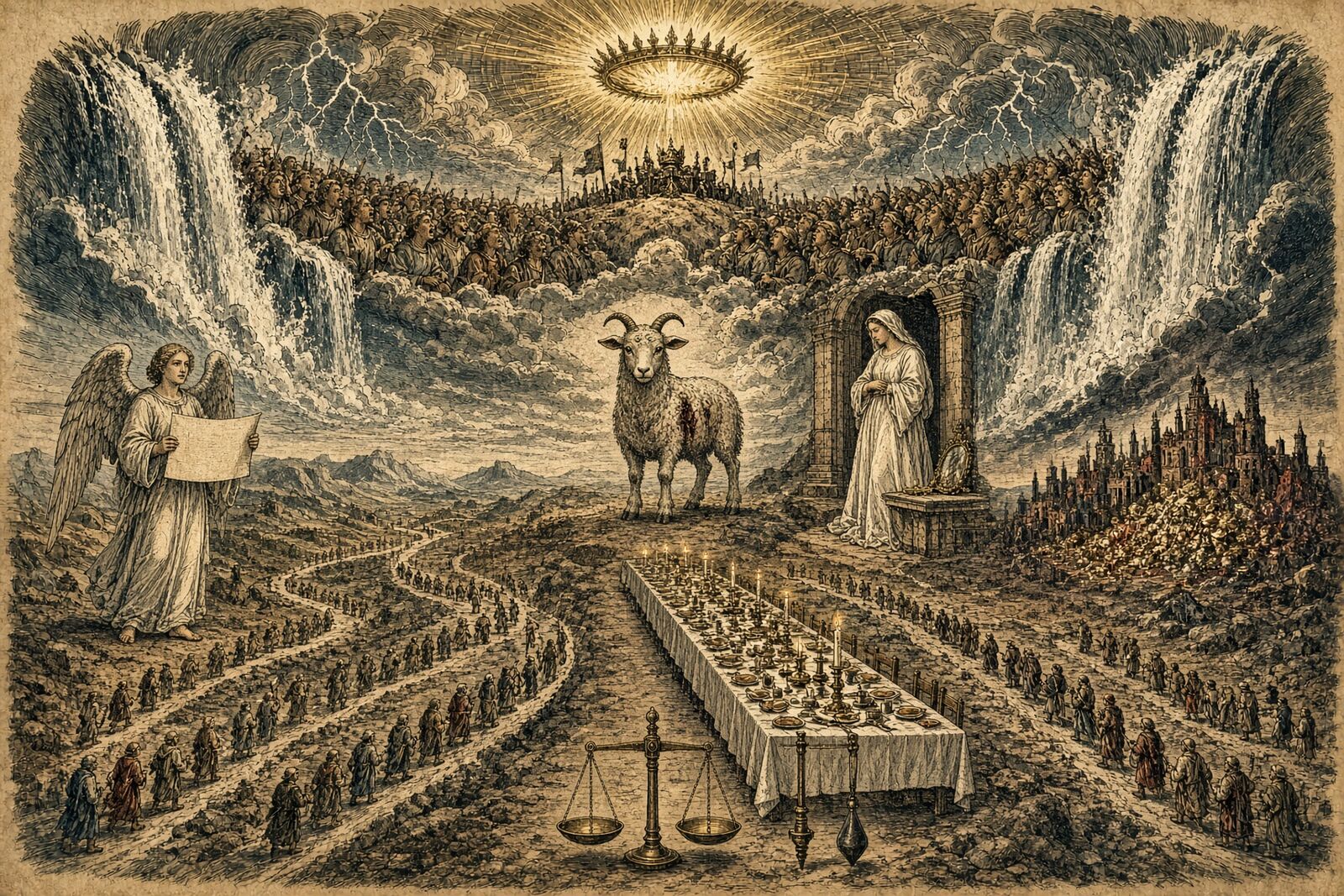
Hallelujah! The Marriage Supper of the Lamb

Hallelujah! The Marriage Supper of the Lamb

Revelation 19:1–10 — Hallelujah! The Marriage Supper of the Lamb

Session 44 | Heaven erupts in worship after Babylon’s fall. Four “Hallelujahs,” the marriage of the Lamb, and a warning not to worship angels. Source: A2K Online Church Archive — Revelation 19:1-10


Overview

After the destruction of Babylon in chapters 17–18, heaven responds with praise. This short passage is one of the most worship-focused sections in Revelation. The teacher notes that Revelation contains many hymns that have influenced modern Christian worship music.


The Four “Hallelujahs” (vv. 1–6)

The Greek word Hallelujah means “Praise Yah” (praise the LORD). This is the only place in the New Testament where the word appears, though it is common in the Psalms.

First Hallelujah (vv. 1–2)

*“Salvation and glory and power belong to our God; because His judgments are true and righteous.””

The great multitude in heaven praises God for:

  • Salvation — deliverance from sin and oppression
  • Glory — God’s inherent worth and majesty
  • Power — God’s ability to act

The reason for praise: God has judged the great harlot and avenged the blood of his bond-servants. Justice has finally come.

Second Hallelujah (v. 3)

*“Her smoke rises up forever and ever.””

This echoes the judgment on Edom (Isaiah 34:10) and Babylon (Rev. 14:11). The destruction is permanent and complete.

Third Hallelujah (v. 4)

The twenty-four elders and four living creatures fall down and worship God, saying “Amen. Hallelujah!” — the heavenly council affirms God’s judgment.

Fourth Hallelujah (vv. 5–6)

*“Give praise to our God, all you His bond-servants, you who fear Him, the small and the great.””

A voice from the throne calls for universal praise. The great multitude responds:

*“Hallelujah! For the Lord our God, the Almighty, reigns.””

This is the climax: God reigns. Not Caesar, not the beast — God.


The Marriage of the Lamb (vv. 7–8)

*“Let us rejoice and be glad and give the glory to Him, for the marriage of the Lamb has come and His bride has made herself ready.””

The Bride

The bride of the Lamb is the people of God — the church. She has made herself ready, which involves:

  • Preparation — a process of growth and sanctification
  • Purity — “it was given to her to clothe herself in fine linen, bright and clean”
  • Righteous acts — “the fine linen is the righteous acts of the saints”

This last point is crucial: righteous acts are part of salvation’s story in Revelation. The bride is not saved by works, but her works are the evidence of her preparation. Faith and faithfulness go together.


The Marriage Supper of the Lamb (v. 9)

*“Blessed are those who are invited to the marriage supper of the Lamb.””

This is the fourth beatitude in Revelation (1:3; 14:13; 16:15; 19:9; 22:7, 14). Those invited to the supper are blessed.

The angel tells John: “These are true words of God” — emphasizing the certainty of this promise.


John Tries to Worship the Angel (v. 10)

*“I fell at his feet to worship him. But he said to me, ‘Do not do that; I am a fellow servant of yours and your brethren who hold the testimony of Jesus; worship God.’”

John is so overwhelmed that he attempts to worship the angel. The angel refuses — making clear that only God is worthy of worship.

This is an important point: angels are fellow servants, not objects of worship. The same applies to any being (Mary, saints, etc.) that some traditions have elevated to recipients of worship.

“The Testimony of Jesus Is the Spirit of Prophecy”

This phrase summarizes the purpose of prophecy: the spirit that inspires prophecy is the same spirit that testifies about Jesus. All true prophecy points to Jesus.


Summary

Element Meaning
Four Hallelujahs Heaven praises God for just judgment
God reigns The central declaration — not Caesar, not the beast
Marriage of the Lamb The church united with Christ
Bride’s fine linen Righteous acts of the saints
Marriage supper Blessed are those invited
Angel refuses worship Only God is worthy
Testimony of Jesus The heart of all prophecy

“This is not a passage about doom and gloom — it is a passage about worship. Heaven celebrates because God has finally set things right.”
The Tale of Two Cities

The Tale of Two Cities

Revelation 17–22 Introduction — The Tale of Two Cities

Session 40 | An introduction to the contrasting visions of Babylon (the harlot) and New Jerusalem (the bride). Revelation presents two cities and two women — each demanding the reader’s allegiance. Source: A2K Online Church Archive — Babylon & New Jerusalem - An Introduction to Revelation’s Two Cities


The Structure of Revelation’s Final Section

From chapter 17 through chapter 22, Revelation presents two contrasting cities personified as women:

Babylon (Chs. 17–19) New Jerusalem (Chs. 21–22)
A harlot / prostitute The bride of Christ
Drunk on the blood of saints Pure, prepared for her husband
Clothed in purple and scarlet Clothed with the glory of God
Holds a golden cup of abominations Holds the water of life
Rides a scarlet beast Descends from heaven
Destined for destruction Eternal and enduring

These are not merely literal cities — they represent two realities, two value systems, two ways of life:

  1. Fallen Babylon = the world system organized in opposition to God; the culture of empire, self-glorification, and violence
  2. New Jerusalem = the people of God living under his reign; the community of the faithful, pure and prepared for Christ

Why This Introduction Is Necessary

The teacher devotes this session to orienting readers to the “two cities” framework because the details of both visions are dense and easily misunderstood. Before diving into the specifics:

  • Babylon = Rome for the first readers, but Babylon is a recurring reality in every age
  • New Jerusalem = the church as the bride of Christ, already descending from heaven as a present spiritual reality
  • The reader must choose which city to be a citizen of

How the Two Cities Function

Revelation does not present these two cities as mere information. They are rhetorical — designed to persuade and motivate:

Babylon

  • Unmasks evil — shows Rome for what it truly is rather than its propaganda
  • Discourages compromise — associating with Babylon brings judgment
  • Shows the end of evil — Babylon’s destruction is certain

New Jerusalem

  • Gives hope — God’s people have a glorious future
  • Encourages faithfulness — the reward is worth the suffering
  • Defines identity — believers are citizens of heaven, not of earthly empires

The Practical Application

“This really challenged me into how I view the church today.”

The two cities call the reader to:

  • Discern which “city” they are building their life in
  • Reject the values of Babylon (greed, violence, self-glorification, idolatry)
  • Embrace the values of New Jerusalem (faithfulness, purity, worship, love)
  • Recognize that every generation has its own “Babylon” — and its own call to “come out of her”

Summary

Babylon New Jerusalem
Harlot Bride
Drunk on blood Clothed in righteousness
Worldly wealth Divine glory
Destined for destruction Eternal
Demands allegiance to Caesar Calls for allegiance to the Lamb
Built by human empire Built by God

“Revelation puts two cities in front of you and says: choose. You can be a citizen of Babylon or a citizen of New Jerusalem — but you cannot be both.”

Lenses

The marriage supper

Four Lenses on Revelation — Preterist

The hallelujah is over a Babylon already fallen — Rome, or Jerusalem on that branch. The supper divides the school: partial preterism keeps it future along with the Rider and the resurrection; full preterism reads it of the new-covenant order begun in AD 70, the Bride being the church.