Revelation 19:11–21 — The Rider on the White Horse
Session 45 | Heaven opens and the Rider called Faithful and True appears — followed by the great supper of God and the final defeat of the beast and false prophet.
Source: A2K Online Church Archive — Revelation 19:11-21
Structure: Three Sections
The teacher breaks the passage into three sections, each beginning with the phrase “And I saw” or “Then I saw”:
- vv. 11–16 — The Rider on the White Horse
- vv. 17–18 — The Angel’s Invitation to the Great Supper of God
- vv. 19–21 — The Defeat of the Beast and False Prophet
Section 1: The Rider on the White Horse (vv. 11–16)
*“I saw heaven opened, and behold, a white horse, and He who sat on it is called Faithful and True.””
The Rider’s Identity
This is Jesus Christ — depicted in his role as conquering King and righteous Judge. He is described with a series of titles:
| Title |
Meaning |
| Faithful and True |
His character — everything he does is reliable and genuine |
| The Word of God |
He is God’s final revelation (John 1:1) |
| King of Kings and Lord of Lords |
His supreme authority over all rulers |
The Rider’s Appearance
- Eyes like a flame of fire — all-seeing judgment
- Many diadems (crowns) — he is the true ruler, not Caesar
- A name no one knows except Himself — divine mystery
- Clothed in a robe dipped in blood — his own sacrificial blood (contrast with the blood-soaked winepress)
- Sharp sword from His mouth — judgment by his word (not a literal weapon)
- Rod of iron to shepherd the nations — kingly authority (Psalm 2:9)
The Armies of Heaven
*“The armies which are in heaven, clothed in fine linen, white and clean, were following Him on white horses.””
These are not armed soldiers — they wear fine linen (priestly garments), not armor. They follow the Rider not to fight but to share in his victory. This is the same fine linen as the bride’s clothing (19:8) — the righteous acts of the saints.
The battle is won by the Rider alone — his sword (his word) defeats the enemy. The army’s role is to witness and participate in the victory, not to fight.
He Treads the Winepress
*“He treads the winepress of the fierce wrath of God the Almighty.””
This recalls the grape harvest of 14:17–20 and Isaiah 63:1–6. Jesus is the one who executes God’s final judgment.
Section 2: The Great Supper of God (vv. 17–18)
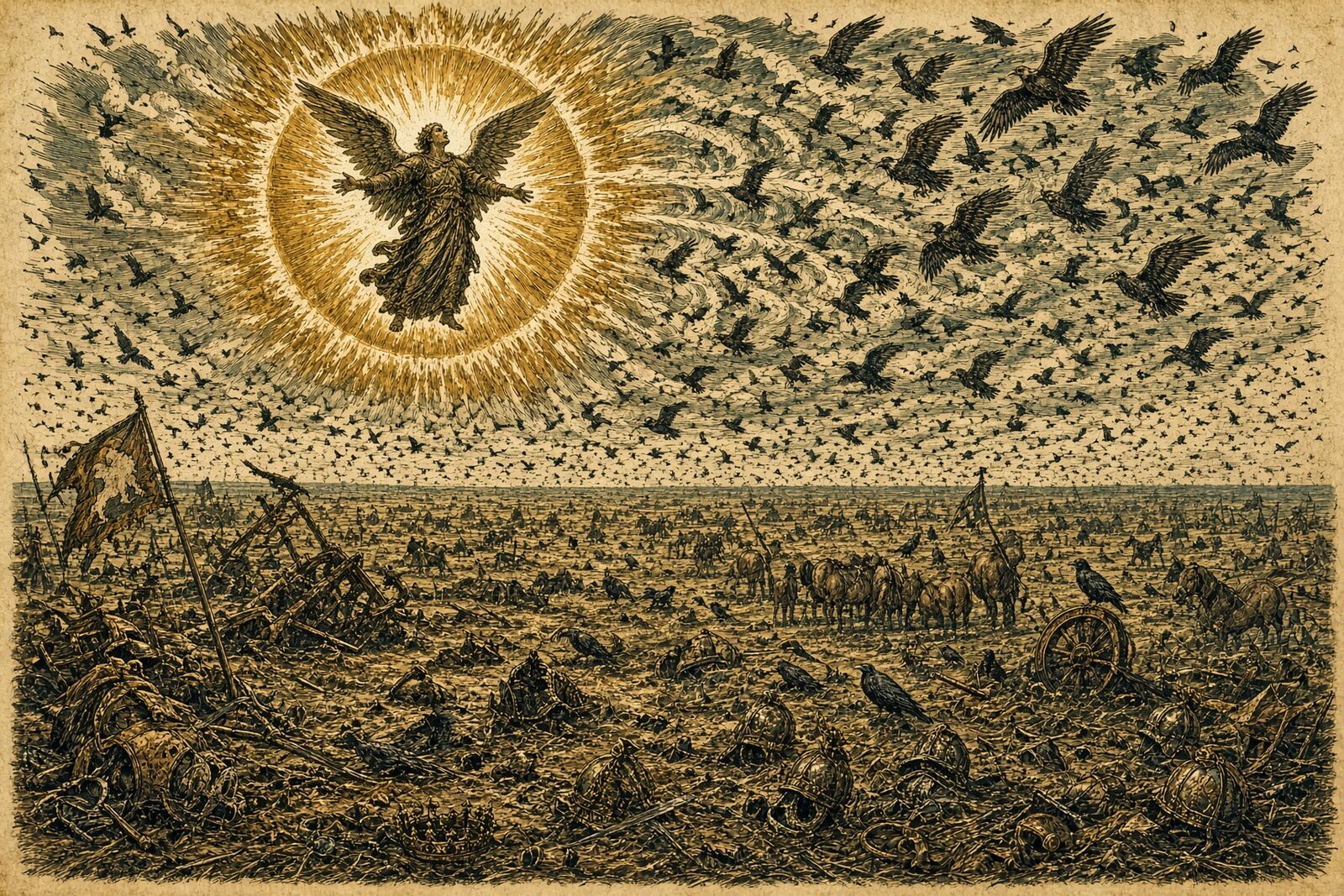
*“Come, assemble for the great supper of God, so that you may eat the flesh of kings and commanders and mighty men.””
An angel calls the birds of the air to a gruesome feast. This is a macabre contrast to the marriage supper of the Lamb (19:9). One is a celebration; the other is judgment.
The “guests” at this supper are the enemies of God — all who opposed the Lamb:
- Kings and commanders
- Mighty men
- Horses and their riders
- All people, free and slave, small and great
This is universal in scope — no one who opposed God escapes.
Section 3: The Defeat of the Beast and False Prophet (vv. 19–21)
*“The beast was seized, and with him the false prophet who performed the signs in his presence.””
The Beast and False Prophet
These are the same two figures from Revelation 13:
- The beast from the sea = the Roman Empire
- The false prophet = the beast from the land (Imperial cult promoters)
They are thrown alive into the lake of fire — the first time this phrase appears in Revelation. Their judgment is immediate and personal.
The Rest Killed
The rest of their armies are killed by the sword from the Rider’s mouth — judgment by the word of Christ. The birds gorge on their flesh.
Key Interpretive Points
The Army Doesn’t Fight
The armies of heaven follow the Rider but do not engage in battle. The victory is accomplished by Jesus alone through his word. This is consistent with Revelation’s message: conquering is done through faithful witness, not violence.
This Is Not a Literal Battle
The teacher emphasizes that this is symbolic language — a sword from the mouth, birds eating flesh, a winepress of wrath. The point is the certainty and totality of God’s judgment, not a prediction of a literal military engagement.
Summary
| Element |
Meaning |
| Rider on white horse |
Jesus as conquering King and Judge |
| Faithful and True |
His character |
| Name written: King of Kings |
His supreme authority |
| Sword from His mouth |
Judgment by His word |
| Armies in fine linen |
The saints sharing in victory, not fighting |
| Great supper of God |
Judgment feast for God’s enemies |
| Beast and false prophet |
Thrown into the lake of fire |
| Rest killed by the sword |
Universal judgment |
“This is probably not a passage you’ve crocheted on a pillow or put on your refrigerator. But it’s Scripture — and if it makes us uncomfortable, maybe we should be uncomfortable.”