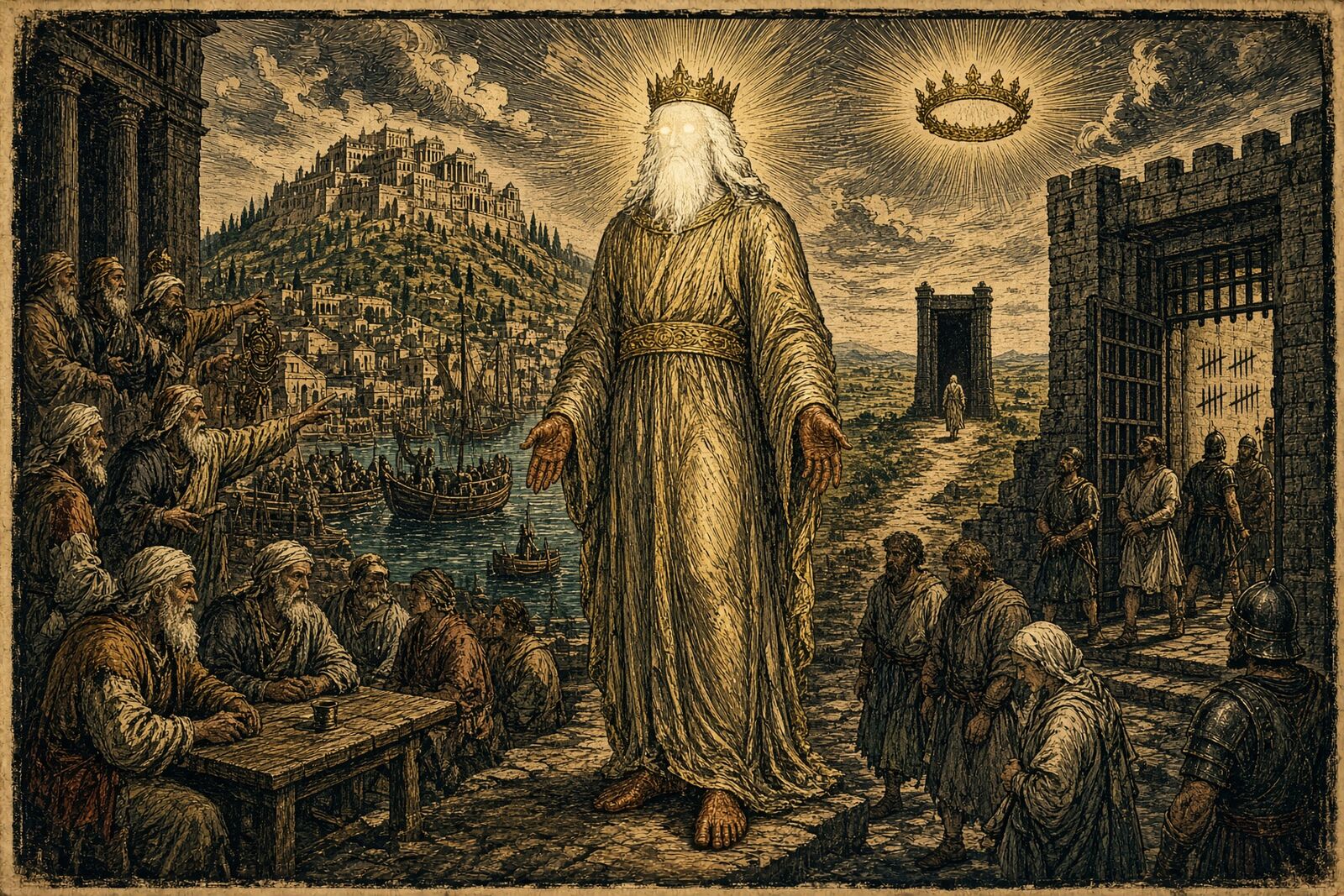
The Letter to Smyrna — Revelation 2:8-11
Session 8 | Four verses of text, but extensive historical context on Smyrna: the Imperial cult, the Jewish tax (Fiscus Judaicus), crowns as a city symbol, and the call to be faithful unto death.
Source: A2K Online Church Archive — Revelation 2:8-11
The City of Smyrna
Key facts:
- About 40 miles north of Ephesus, also a port city on the coast
- Architecturally as large as Ephesus, though perhaps smaller in population
- Claimed to be the birthplace of Homer
- One of the most beautiful cities in Asia Minor
- The first city in all of Asia Minor to hold athletic games (1st century BC)
- The city name (Smyrna) comes from the word myrrh — the fragrance used in burial preparation
The City That Died and Rose Again
Smyrna was captured and destroyed by the Lydians in 600 BC, and its residents were deported. For over 300 years, the city was essentially dead. But the descendants of those residents maintained their Smyrnaean identity through generations and eventually rebuilt and relocated the city around 290 BC.
This history is not incidental — Jesus introduces himself to this church as “the first and the last, who was dead and has come to life.” The city’s own story mirrors the resurrection. The description is chosen specifically for this city.
The Imperial Cult in Smyrna
Smyrna’s loyalty to Rome was among the deepest of any city in Asia Minor:
- Built a temple to the goddess Roma in 195 BC — over 300 years before Revelation was written
- Citizens petitioned Emperor Tiberius for permission to build a provincial imperial temple in 26 AD, which was granted — making Smyrna the second such temple in Asia Minor
- This honor brought significant civic privileges
- Festivals honoring the Emperor included sacrifices, banquets, and public celebrations
- Inscriptions throughout the city dedicated temples and buildings to various Caesars, including calling Domitian “son of God” and “high priest”
The point: for Christians in Smyrna, refusing to honor the Emperor was a public act of defiance with serious social and legal consequences.
Smyrna and the Crown
The crown was a defining metaphor for Smyrna’s identity:
- Citizens called Smyrna “the crown of Asia” because of its unmatched architectural beauty
- The city’s buildings were literally arranged in a crown shape encircling the central hill
- Smyrna was the first Asian city to award victor’s wreaths (crowns) at athletic games
- Crowns were given for athletic victory, public service, and to honor royal visitors
- Surviving coins from Smyrna feature crowns and wreaths on nearly every design
The payoff: Jesus promises the faithful in Smyrna “the crown of life” — not the laurel wreath of the goddess Nike, not the architectural crown of the city’s beauty, but the crown that comes from faithful witness even unto death. The language is chosen specifically for this city’s culture.
The Jewish Tax (Fiscus Judaicus)
This is crucial context that explains much of the conflict in Smyrna.
Background: After the Jews revolted against Rome in 66 AD and the temple was destroyed in 70 AD, Emperor Vespasian imposed the Fiscus Judaicus — a Jewish tax on all Jews throughout the empire. The money that had previously gone to maintaining the Jerusalem Temple was now redirected to building a pagan temple to Jupiter in Rome.
Scope of the original temple tax: Adult Jewish males aged 20–50 paid it.
Scope of the new Jewish tax: After 70 AD, all Jews — male and female, young and old, slave and free — were required to pay. Receipts from as far away as Egypt confirm it was widely enforced.
Domitian’s enforcement: The Emperor during Revelation’s writing went further, applying the tax to anyone who lived like Jews — those who were circumcised, rested on Saturday, or observed kosher food laws. He also went hard on Jews who tried to hide their identity. A contemporary historian (Suetonius) describes witnessing a 90-year-old Jewish man examined in a public court to determine if he was circumcised.
The effect on Jewish Christians in Smyrna:
Jewish believers who had converted to Christianity faced an impossible situation:
- If they tried to distance themselves from Judaism to avoid the tax, the Jews in the synagogue could expose them as crypto-Jews
- If they were exposed, they remained taxable — and if they refused to pay the tax (which funded a pagan temple), they faced prison
- This cycle of slander, exposure, and poverty is exactly what Jesus describes in this letter
Jesus’s Introduction (Rev 2:8)
“The first and the last, who was dead and has come to life.”
Why this particular description for Smyrna?
- “First and last” — all-encompassing authority; Jesus is the beginning and end of all things
- “Was dead and has come to life” — directly mirrors the history of Smyrna as a city that died and was reborn after 300 years
This is not a random selection. Jesus deliberately chooses a self-description that resonates with the city’s identity. Every letter does this.
What Jesus Knows (Rev 2:9)
Jesus says: “I know your tribulation and your poverty — but you are rich.”
The contrast is between:
- Financial poverty (real, caused by the Fiscus Judaicus, persecution, property confiscation) — a literal description
- Spiritual richness (rich in faith, in eternal life, in God’s promises) — a figurative commendation
Why Were They Poor?
Possible causes:
- Jewish Christians still paying the Fiscus Judaicus they couldn’t escape
- Property confiscated because of refusal to worship the Emperor (see Hebrews 10:34: “you accepted joyfully the seizure of your property”)
- Heads of households imprisoned, leaving families unable to provide for themselves
The Synagogue of Satan
Jesus says there are those “who say they are Jews and are not, but are a synagogue of Satan.”
This is strong language. Why?
In the Book of Acts, Jews repeatedly collaborated with pagan civic authorities to have Christians arrested (Acts 14, 16, 17, 18). They had no legal power themselves — only the Roman magistrates could imprison people. But Jews would inform on Christians to those authorities, effectively throwing Christians under the bus.
In Smyrna, the Jewish synagogue — which had immunity from Emperor worship as a recognized ancient religion — was apparently reporting Jewish Christians to the authorities, arguing they were no longer Jews and therefore no longer exempt from Imperial cult participation. This caused imprisonment and poverty.
Jesus says: if you are conspiring with Rome’s satanic system to persecute God’s true people, you are no longer a synagogue of the Lord — you are a synagogue of Satan. Revelation reveals that Rome is not merely a political empire — there is a mastermind behind it, and his name is Satan. Those who align with Rome align with him.
The Prison Test (Rev 2:10)
“The devil is about to cast some of you into prison, that you may be tested, and you will have tribulation for ten days.”
Prison in their culture: Unlike today, prison was not the ultimate punishment. It was a holding cell until trial. At trial, you might be exiled, sent to the mines, executed, or released. Being thrown in prison meant you were about to face a formal test of your faithfulness.
The testing: Roman officials would often use physical means (flogging, torture) to extract information or coerce compliance. “Testing” here involves real suffering.
Ten days: Drawing on Daniel 1:11-14, where Daniel and his friends were tested for exactly ten days to see if they would compromise their Jewish identity. They were faithful; God blessed them. In Revelation, “ten days” symbolizes a limited, complete period of testing — it will run its course, but it will end.
“Be faithful unto death” — Some in Smyrna will die. Jesus is not promising them escape from martyrdom. He is calling them to faithfulness through it.
The Crown of Life and the Second Death (Rev 2:10-11)
“Be faithful unto death and I will give you the crown of life.”
The true crown in Smyrna is not:
- The goddess Nike’s laurel wreath on the city’s coins
- The architectural crown of the city encircling its central hill
- The crowns given to athletes and gladiators
The true crown is given by Jesus to those who are faithful unto death — a crown of life that only comes through the resurrection.
Historical fulfillment: Polycarp, bishop of Smyrna in the mid-2nd century, was martyred around 150 AD at about age 80. If he was 20 when this letter circulated, he read it. When offered a chance to deny Christ, he famously said he had served Christ for 80 years and would not renounce him now.
The second death (v. 11):
“The one who conquers will not be hurt by the second death.”
This is the first occurrence of the phrase “second death” in the Bible. Revelation will explain later (20:14): it is the lake of fire — the final judgment, annihilation, the death that comes after resurrection for those who are not part of God’s people.
The conqueror who is faithful even to physical death (first death) will be immune to the second death. Martyrdom does not end you — it is the path to resurrection.
Summary
| Element |
Meaning |
| City died and rose again |
Mirrors Jesus’s self-description — chosen deliberately |
| Crown of Asia |
Smyrna’s pride; Jesus offers the real crown — the crown of life |
| Fiscus Judaicus |
Explains why Jewish Christians in Smyrna were poor |
| Synagogue of Satan |
Jews conspiring with Rome to persecute Christians |
| Prison test |
Real persecution; “ten days” = limited, complete period (echoing Daniel) |
| Faithful unto death |
The specific call to this church — some will be martyred |
| Crown of life |
The true Victor’s crown — given to those faithful unto death |
| Second death |
Final judgment; the conqueror who is faithful through the first death need not fear it |
“Be faithful unto death and I will give you the crown of life.” — This is so powerful and so applicable. All we can do is be faithful to him to the end of our life, whether by natural causes or as a martyr.