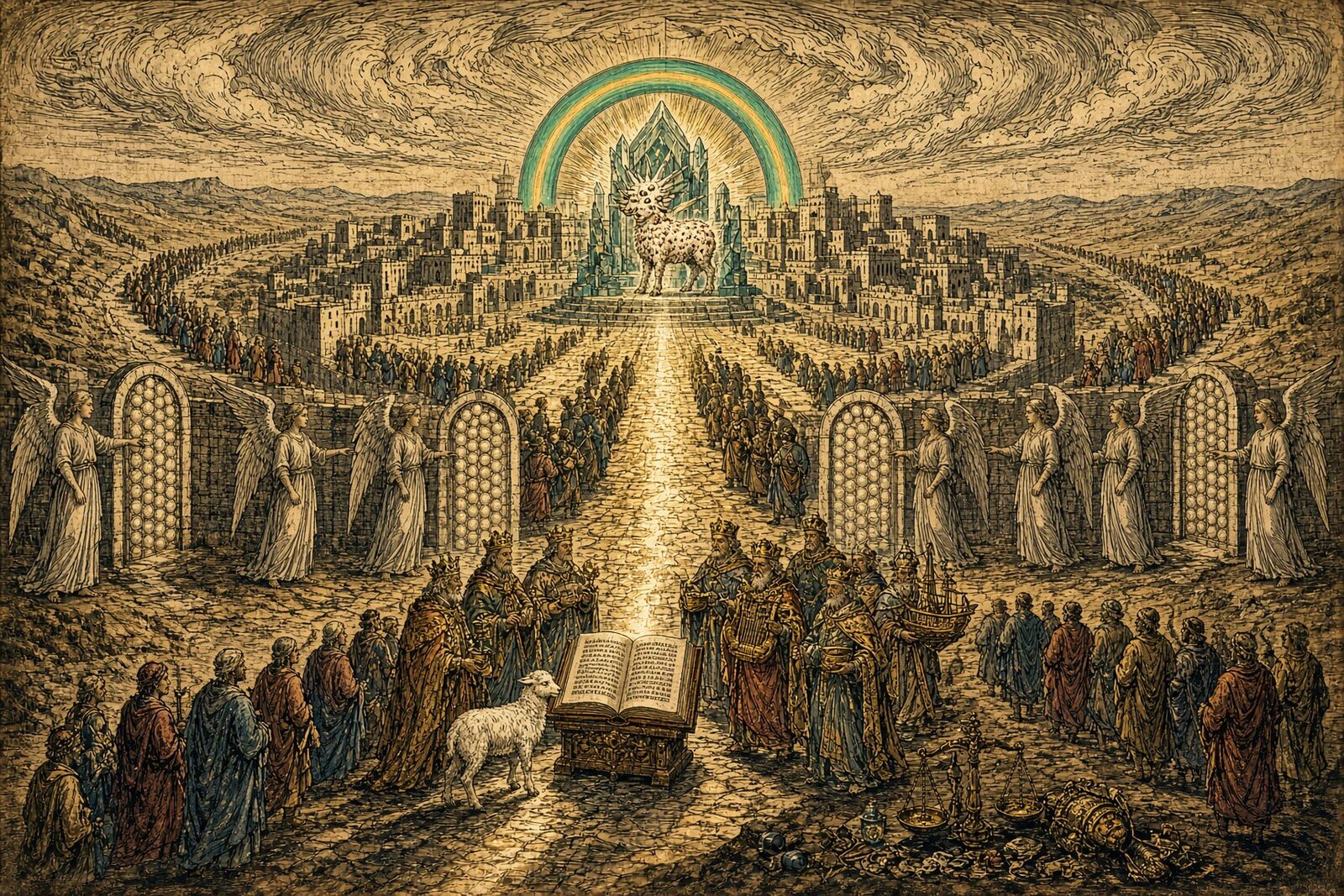
Revelation 21:9–27 — The Bride of Christ as a Poetic City (Part 1)
| Session 49 |
John is shown the bride, the wife of the Lamb — and sees a city. New Jerusalem is a symbolic, poetic description of the church as God’s redeemed people. |
| Source: A2K Online Church Archive — *The Bride of Christ is a Poetic City |
Revelation 21:9-27* |
The Key Insight: The Bride Is the City
*“Come here, I will show you the bride, the wife of the Lamb.” And he carried me away in the Spirit to a great and high mountain, and showed me the holy city, Jerusalem, coming down out of heaven from God.””
John hears “bride” but sees “city.” This is the interpretive key to the entire passage. The bride of Christ (the church) is being described as a city — just as Babylon (Rome) was described as a harlot city in chapters 17–18.
The teacher notes he was formerly taught that New Jerusalem was a literal architectural city that would physically descend. He no longer holds this view for several reasons:
- If it’s a literal city, the passage has no practical application for how to live today
- The text itself says John is being shown the bride — the church
- The description is highly poetic and symbolic — gates of pearl, streets of gold, a perfect cube — the language of symbol, not architecture
The City’s Dimensions (vv. 10–21)
The Great and High Mountain
John is taken to a mountain — echoing Ezekiel 40:2 where Ezekiel is shown the visionary temple. From this vantage, he sees the city descending.
The Glory of God
*“Having the glory of God. Her brilliance was like a very costly stone, like a stone of crystal-clear jasper.””
The city’s light is not its own — it reflects God’s glory. This is what the church is supposed to be: a reflection of God’s character.
The Wall and Gates
- A great and high wall — security, separation from evil
- Twelve gates — with twelve angels at the gates
- Names of the twelve tribes of Israel written on the gates
- Twelve foundation stones — with names of the twelve apostles
The twelve tribes + twelve apostles = the unity of Old and New Testament people of God. The church is built on both.
The Measuring
An angel measures the city with a golden measuring rod — a symbolic act (like Ezekiel 40–48) indicating that the city belongs to God and meets his standards.
The Cube
*“The length and the width and the height are equal.””
The city is a perfect cube — 12,000 stadia on each side (about 1,500 miles). The cube recalls the Holy of Holies in Solomon’s temple (1 Kings 6:20), which was also a perfect cube. The entire city is the Holy of Holies — the place where God dwells.
The number 12,000 = 12 × 1,000, symbolizing the complete fullness of God’s people.
The Building Materials
| Material |
Symbolic Meaning |
| Jasper |
God’s glory (4:3) |
| Gold like clear glass |
Pure, transparent — nothing hidden |
| Twelve foundation stones |
The apostles |
| Pearl gates |
Precious, beautiful — each gate a single pearl |
| Streets of transparent gold |
Purity, value, radiance |
The extravagance of the materials is not about literal wealth — it is poetic language to express the incomparable value and beauty of God’s people.
No Temple (v. 22)
*“I saw no temple in it, for the Lord God the Almighty and the Lamb are its temple.””
In the Old Testament, the temple was where God dwelled. In the new creation, God and the Lamb are present everywhere — no building is needed. The church has direct, unmediated access to God.
The City’s Light (vv. 23–24)
*“The city has no need of the sun or of the moon to shine on it, for the glory of God has illumined it, and its lamp is the Lamb.””
- No sun or moon — God’s glory is the light
- The Lamb is the lamp — Jesus is the means by which God’s light reaches the city
- The nations walk by its light — the city is a beacon to all peoples
The City’s Inhabitants (vv. 25–27)
*“Its gates shall never be closed; and they shall bring the glory and honor of the nations into it.””
- Gates never closed — perpetual safety and access
- Nothing unclean — only those written in the Lamb’s book of life
- The glory of the nations — not military conquest but redeemed cultures bringing their best to God
Summary
| Element |
Symbolic Meaning |
| Bride = city |
The church described as a glorious city |
| Cube |
The entire city is the Holy of Holies |
| 12,000 stadia |
Complete fullness of God’s people |
| No temple |
God and the Lamb are directly present |
| No sun needed |
God’s glory provides light |
| Pearls, gold, jewels |
Incomparable value and beauty of the redeemed |
| Gates never closed |
Eternal security and welcome |
“If I were to teach you about the architecture of a city 1,000 years in the future, there’s no application for your life. But if this is a description of what the church is supposed to be — that changes everything.”