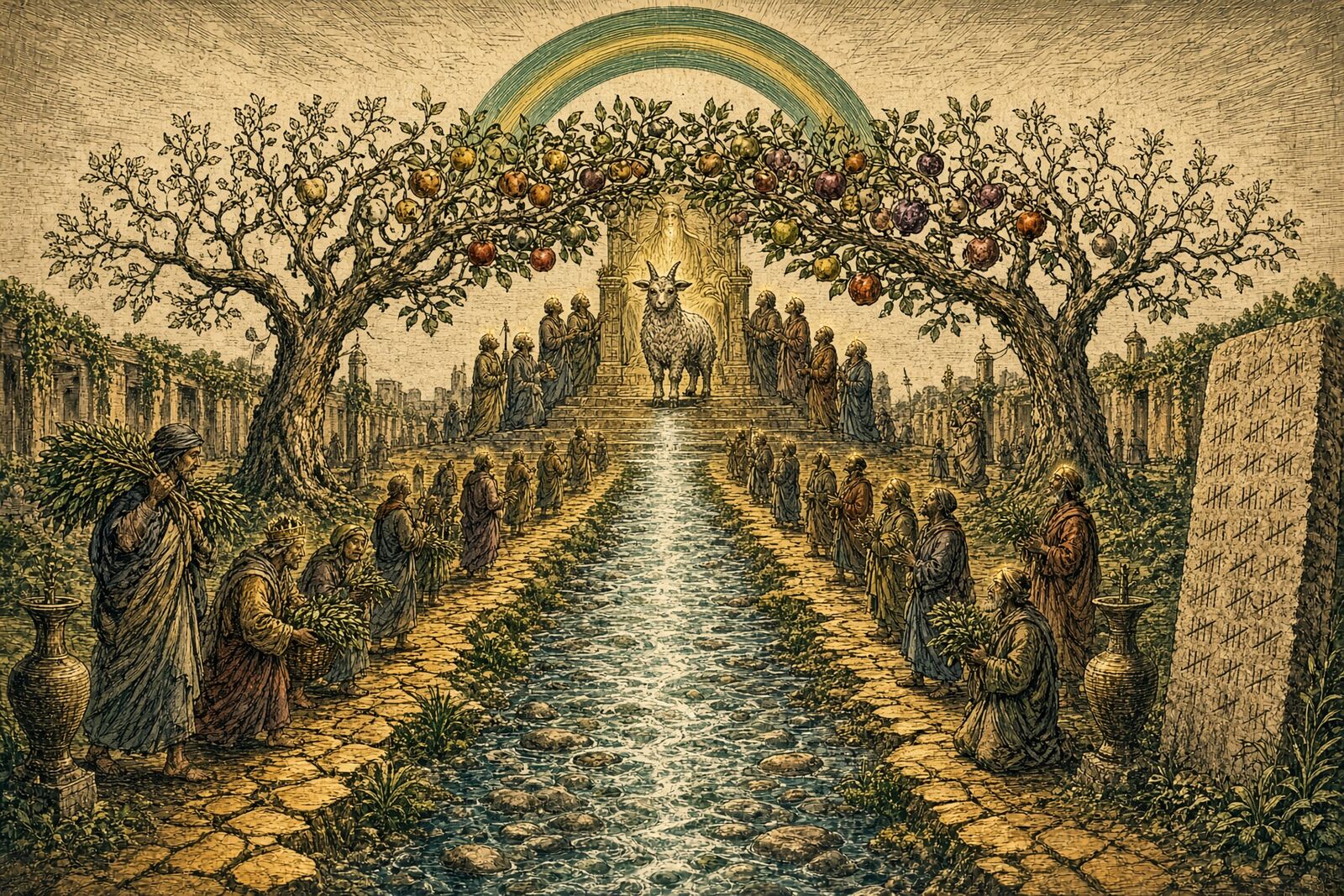
Revelation 22:1–9 — The Bride of Christ as a Poetic City (Part 2)
| Session 50 |
The river of the water of life, the tree of life, the removal of the curse — and John again attempts to worship an angel. |
| Source: A2K Online Church Archive — *The Bride of Christ is a Poetic City |
Revelation 22:1-9* |
Context
This is the second half of the New Jerusalem vision (22:1–9). The teacher continues the same interpretive framework: New Jerusalem is the bride of Christ described as a city — a present spiritual reality descending from heaven that believers can become part of through faithfulness.
The River of the Water of Life (v. 1)
*“He showed me a river of the water of life, clear as crystal, coming from the throne of God and of the Lamb.””
From the Throne
The river originates from God’s throne — the source of all life. It flows from both God and the Lamb together, emphasizing their unity.
The Water of Life
Echoes:
- Eden — a river flowed from Eden (Genesis 2:10)
- Ezekiel 47 — a river from the temple bringing life
- John 4 — Jesus offers living water
- John 7:37–39 — rivers of living water = the Spirit
The water is clear as crystal — pure, undefiled, life-giving.
The Tree of Life (v. 2)
*“In the middle of its street, on either side of the river, was the tree of life, bearing twelve kinds of fruit, yielding its fruit every month; and the leaves of the tree were for the healing of the nations.””
The Tree of Life Restored
The tree that was lost in Eden (Genesis 3:22–24) is now restored — access to eternal life is open again.
Twelve Kinds of Fruit
Continuous abundance — fruit every month, year-round provision. No more scarcity.
Healing of the Nations
The leaves bring healing — not physical healing (there is no more death or pain), but the healing of relationships and divisions between peoples. The nations that were once hostile to God and each other are now at peace.
No More Curse (v. 3)
*“There will no longer be any curse.””
The curse of Genesis 3 — the consequence of human sin — is finally removed. Everything broken by the fall is restored.
The Throne of God and the Lamb
God and the Lamb share one throne, ruling in perfect unity. His bond-servants:
- Serve Him — joyful, willing service
- See His face — the ultimate blessing; direct, unmediated relationship
- Have His name on their foreheads — they belong to Him
No More Night (vv. 4–5)
*“There will no longer be any night; and they will not have need of the light of a lamp nor the light of the sun, because the Lord God will illumine them; and they will reign forever and ever.””
- No night — no darkness, evil, or uncertainty
- No created light needed — God’s presence is sufficient
- They reign — the conquerors share Christ’s reign
- Forever and ever — eternal, not temporary
“These Words Are Faithful and True” (vv. 6–7)
“The Lord, the God of the spirits of the prophets, sent His angel to show His bond-servants the things which must soon take place. And behold, I am coming quickly. Blessed is he who heeds the words of the prophecy of this book.”
God confirms the reliability of the vision. Jesus himself speaks: “I am coming quickly” — the imminence of his return, not in a calendar sense, but as a constant motivation for faithful living.
John Worships the Angel Again (vv. 8–9)
*“I fell down to worship at the feet of the angel who showed me these things. But he said to me, ‘Do not do that; I am a fellow servant of yours and of your brethren the prophets and of those who heed the words of this book. Worship God.’””
For the second time (cf. 19:10), John tries to worship the angel and is firmly corrected. The angel insists:
- He is a fellow servant — not worthy of worship
- John’s brethren are also fellow servants — no hierarchy of access to God
- Worship God alone — the consistent message of Revelation
This repeated correction reinforces that only God and the Lamb are to be worshiped — not angels, not Mary, not any created being.
Summary
| Element |
Meaning |
| River of water of life |
Eternal life flowing from God’s throne |
| Tree of life restored |
Access to eternal life regained |
| Healing of the nations |
Peace between peoples |
| No more curse |
The fall completely undone |
| See His face |
Direct relationship with God |
| No more night |
No darkness, evil, or uncertainty |
| Reign forever |
The conquerors share Christ’s reign |
| Worship God alone |
Even angels refuse worship |
“The bride of Christ is presently descending out of heaven — it is a reality that is within our grasp. We can take hold of it through faithfulness and obedience.”