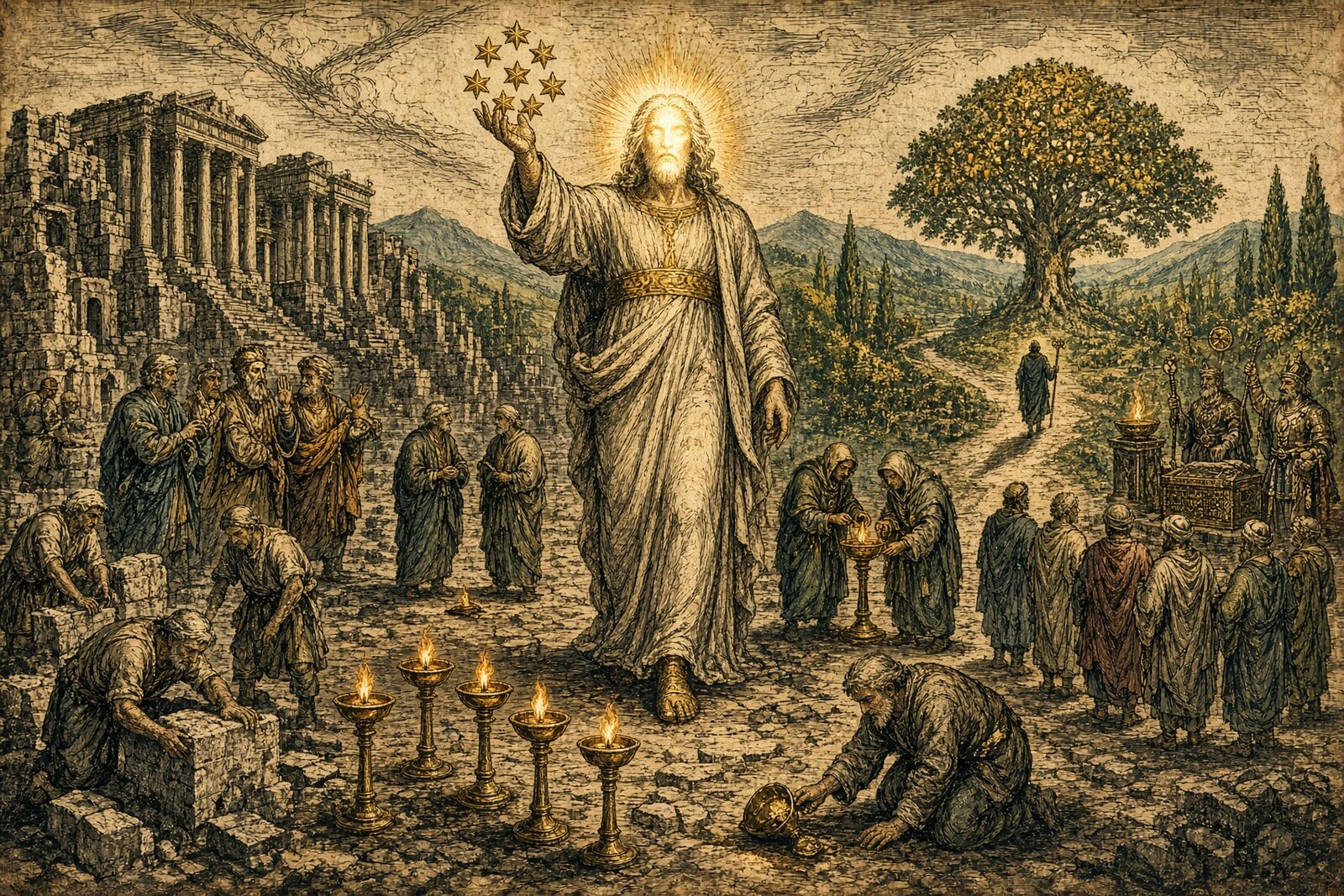
The Letter to Ephesus — Revelation 2:1-7
Session 7 | The first of the seven letters, with extensive historical background on the city of Ephesus before examining the text.
Source: A2K Online Church Archive — Revelation 2:1-7
Why Historical Context Matters
These letters were written to actual Christian communities in actual first-century cities — not to symbolic future churches or abstract types. Reading them without understanding the cities is like reading Paul’s letter to Corinth without knowing anything about Corinthian culture. The more we know about the city, the more the letter’s specific details come alive.

The City of Ephesus
Key facts:
- Largest city in Asia Minor; third largest in the Roman Empire (after Rome and Alexandria)
- Population over 250,000 — a major urban, industrial, and commercial center
- The only port city among the seven churches — the natural first stop for a letter sent from Patmos
- Seat of Roman provincial government for all of Asia Minor
- Designated a “free city” — allowed to self-govern, but public business required scheduling with Rome
Religious Landscape
Four major religious forces shaped Ephesian life:
- A Jewish community — well established, significant
- The Imperial cult — worship of the Roman Emperor and his family (the fastest-growing religion in the first century)
- The goddess Artemis — patron deity of Ephesus, whose temple was one of the Seven Wonders of the Ancient World
- Christian communities — including those shaped by Paul, Timothy, and John’s Gospel
The Imperial Cult in Ephesus
Rome did not force these cities to worship the Emperor. The citizens chose this on their own:
- Rome authorized Ephesus’s request to build a temple to Julius Caesar and the goddess Roma — at Ephesus’s initiative
- Another temple was built in honor of Domitian (the Emperor when Revelation was written)
- 13 inscriptions dedicated to Domitian were found in the temple
- An 18-foot statue of Domitian stood outside
- Emperor’s birthdays were celebrated as annual public festivals
- Sacrifices to the Emperor were held publicly
- Statues and busts of imperial family members filled streets and buildings
- Coins bore the Emperor’s image alongside the goddess Nike (goddess of conquering/victory)
![[IMG_1164.jpeg]]
![[IMG_1165.jpeg]]
The key takeaway: if you lived in Ephesus, you could not avoid this. Emperor worship was on the coins in your pocket, the streets you walked, and every public building.
The Goddess Artemis
Artemis was potentially more important to Ephesus than even the Emperor:
- Her temple was 425 feet long, 230 feet wide, 60 feet tall — the largest Greek temple in the world
- A fertility goddess who attracted many female worshippers
- Protected the city’s welfare; vast wealth was stored in her temple like a bank
- Her temple was a “grove” associated with trees, growth, fertility, and life
- An entire month of the calendar (spring) was devoted to her worship by the second century
- A carved ivory plaque of a tree of life was excavated from the original temple foundation
The tree of life connection is not accidental — the reward promised to conquerors in Ephesus (Rev. 2:7) is “the right to eat of the Tree of Life in the paradise of God.” Jesus counters Ephesus’s Artemis-paradise with his paradise.
The Riot in Acts 19
Acts 19 records one of the most dramatic episodes of early Christianity in Ephesus. Paul and the church were so effective at preaching the gospel that:
- Silversmiths who made small silver shrines to Artemis began going out of business
- Demetrius the silversmith rallied the craftsmen: “This Paul has convinced a considerable number of people that gods made with hands are not gods”
- A riot filled the 24,000-seat amphitheater with Roman citizens shouting “Great is Artemis of the Ephesians!” for two hours
- The city clerk finally dispersed the crowd by noting they had no legal permission from Rome for this public assembly
Point: In the first-century heyday, the Church of Ephesus was so effective at evangelism that it economically threatened pagan idol worship across the entire city of 250,000 people.
The Letter: Revelation 2:1-7
Jesus’s Introduction (v. 1)
Jesus introduces himself as “the one who walks among the seven golden lampstands” — emphasizing his present, active presence in the churches. He is not distant. He knows exactly what is happening.
What Jesus Praises (vv. 2-3, 6)
Jesus commends the Ephesian church for:
- Toil and perseverance — they have suffered but responded without violence and without giving up
- Testing false apostles — they carefully examine the credentials and teachings of visiting teachers, and have identified liars
- Enduring for Jesus’s name without growing weary
- Hating the deeds of the Nicolaitans — a group whose teachings Jesus also hates (more below)
The Rebuke: Leaving Your First Love (v. 4)
“I have this against you: you have left your first love.”
This is almost universally interpreted in popular teaching as forgetting to love one another or God in a general sense. The teacher argues this is wrong, and the context supports a different reading:
“Your first love” = their initial love for gospel proclamation
The evidence:
- In Acts 19, their defining characteristic was evangelistic passion so powerful it upended the economy of a 250,000-person city
- The phrasing is not “you have forgotten to love” but “you have left your first love” — the original, initial love
- Their zeal to preach the gospel had cooled, likely because persecution, harassment, and pressure had made it too costly
Jesus is not rebuking lovelessness in general — he is rebuking the abandonment of their evangelistic mission.
The Call to Repentance (v. 5)
“Remember from where you have fallen and repent and do the deeds you did at first.”
Repentance (metanoeo) means to change your mind, which then changes your behavior. This word appears more in Revelation than in any other New Testament book — and it is almost always addressed to Christians, not to pagans.
The threat: if they don’t repent, Jesus will remove their lampstand. Since lampstand = church, this means he will remove the church from the city. History confirms it: there is no Christian community in Ephesus today. Jesus made this threat and followed through.
The Nicolaitans (v. 6)
The Nicolaitans appear in two of the seven letters (Ephesus and Pergamum). From context:
- In Pergamum (2:15), they are linked to “eating things sacrificed to idols and committing acts of immorality”
- The Nicolaitans appear to have taught that Christians could participate in pagan worship practices and temple feasting without it affecting their faith
- Jesus hates their deeds — this is one of the few things Jesus explicitly says he hates
The Promise to the Conqueror (v. 7)
“To the one who is conquering, I will grant to eat of the Tree of Life which is in the paradise of God.”
“Is conquering” — present participle, an ongoing lifestyle, not a past achievement
What does conquering mean for Ephesus specifically? Based on what Jesus praised and what he rebuked:
- Continue demonstrating perseverance (non-violent endurance in persecution)
- Return to faithful gospel proclamation — the “first love” they left
- Continue rejecting the Nicolaitans’ compromising teachings
The Tree of Life promise: This directly counters Artemis worship — the goddess associated with trees, groves, and a paradise. Jesus says: if you want the real tree of life in the real paradise, get it from me, not from Artemis. The conqueror’s reward is specifically calibrated to the temptations of this particular city.
Key Themes
| Theme |
Detail |
| First love = evangelism |
Their zeal had cooled under pressure; Jesus calls them back to the mission |
| Repentance for Christians |
More frequent in Revelation than in any Gospel; Christians must keep repenting |
| Lampstand removed |
The church in Ephesus no longer exists — Jesus’s threat was carried out |
| Conquering = persevering + preaching |
Two interlocking responsibilities for this church |
| Tree of Life |
Counter to Artemis’s tree/paradise — the true reward from the true God |
| Nicolaitans |
False teachers saying it’s okay to participate in pagan worship and immorality |
Application
The letter to Ephesus is a warning to any church that has:
- Sound doctrine ✓
- Tested false teachers ✓
- Endured persecution ✓
- But quietly stopped preaching the gospel to the surrounding world
Jesus says: that is not enough. The mission matters. A church that is theologically precise but evangelistically silent has left its first love and needs to repent.
“He who has an ear, let him hear what the Spirit says to the churches.” — This is not just for Ephesus. It is for every church, including ours.